
Translated material
Why heroin did not become fashionable at rappers
It is customary to associate heroin with rock music, brown and any other genre, but not with rapp. In different years, hip-hop performers read about Crake, grass, MDMA and even Xanax, but not about the heroine, about which consensus seemed to be entrenched in this industry. As part of the study on the influence of heroin on the cultural environment, Bohemia and its representatives, journalist Nikita Smirnov studied, as well as, most importantly, why this drug and his consumers in the eyes of rappers became a forbidden topic.
"Light target"
Heroin has no musical preferences. Starting from the 1950s, he killed without the analysis of the musicians of various genres: the performers of jazz and blues, pop singers and diluted a whole “hall of glory” of rockers. But over forty years of hip-hop history, it is difficult to recall that any of the rappers have problems with this drug.
It would seem that consumption and distribution - the central topic in the rap, and everything is used - from grass and crack to syrups against cough and “angelic dust”. It would seem that in 2018 in the United States, the alarm is due to the heroine epidemic-and African-Americans often become its victims. How did it happen that the heroin bypassed the rap and its performers?
You should ask the elders. Flavor FLAV, a participant in the cult group Public Enemy (the other day it turns sixty years old), in one of the interviews talks about how I met heroin drug addicts in childhood: “I’ll tell you, guys, I am not shy, but did this experience really leave the imprint for life, are noted? I was very, very scary. I realized that I do not want to have anything to do with the needle. ”
The heroine epidemic among the US Black Population was noted in the late 1960s and in the 1970s. In 1969, 44 % of those who went to prison in the district of Colombia passed the heroin test with a positive result. “Although in New York there are undoubtedly rappers using cocaine/CREK, I failed to install a single New York rapper that would be self-predicted as a heroin consumer. This is quite reasonable [...]-among African American men who grew up in New York in the 1980s and 1990s, there was a terrible image around the consumption of heroin. Many of these young people had close experience with various problems, on which, as a result of their dependence on heroin, members of their families and relatives suffered. Given the AIDS epidemic and the “ War with the drugs ”, the youth stayed away from this substance. ”
“I saw heroins, they only do that they peck like a zombie,” said 50 Cent. Jay Z considered those who use heroin as a “light target”: in childhood, he and his comrades “pushed cutting heroins from the benches”. Heroin did not become the subject of a cult among the young population - they did not sang it and did not strive for it. On the contrary, the effect of this drug, coupled with the consumption method, was clearly demonstrated: it is better not to try.
A completely different thing is Crak.
Crack epidemic
In the 1970s, cocaine became the most popular drug in Hollywood, in the recording and any other creative industry. Cocaine was simultaneously the subject of status consumption, a means to find a common language and, of course, a powerful stimulant. But the poor in the population needed a cheaper analogue. In the early 1980s, dealers found a way to offer this audience a more affordable product. It became CREK - a crystalline form of cocaine, which is a mixture of cocaine salts with baking soda or other chemical base and intended for smoking.
The new drug first appeared in Los Angeles, from where the Crack Epidemic, which took place by the mid-1980s, came. Crak was cheaper in production, easily prepared and diverged perfectly. In 1984, the price of the dose started from two and a half dollars - about 400 rubles in today's money. The average dose of cocaine in the same years was four times more expensive.
In the poor black quarters, hands did not reach heroin: Crak began to close the need for buzzing even earlier than the word for him (for the first time the term will appear in the press in The New York Times in November 1985). In 1996, journalist Harry Webb released a scandalous series of Dark Alliance programs, which is assumed that the authorities deliberately “planted” poor black quarters on a new drug. This point of view will be reflected in subsequent songs. In 2000, Ghostface Killah from Wu-Tang Clan reads that “some ... supplied us with Crac and weapons in the early 80s”-in the song “I canon go to sleep”:
SOMEBODY RAPED OUR WOMEN, MURDERED OUR Babies
Hit US with The Cracks and Guns in the Early 80's.
In 2005, Kanye West in the song Crack Music says that “Ronald Reagan has prepared a solution” how to stop the “black panther”:
How Stop The Black Panthers?
Ronald Reagan Cooked Up Answer.
Webb’s assumptions were later refuted, but the version of the target government program continues to have supporters and demonstrates a moral panic around the epidemic.
Already in 1987, Charles Bronson will fight Crac in Death Liba 4. There is no one to sing Crak: unlike heroin or LSD, this is not a romantic, but an urgent drug. It is natural that the youngest and most pragmatic genre will tell you about young and pragmatic drugs.
However, even before the rap became a tribune for a conversation about drugs, black performers touched this topic on the second and fank records- as a rule, trying to appeal to the mind of the “brothers”. In 1971, Marvin Gay was producing the Hat's Going on, which in 2003 will take sixth place in the ranking of the greatest Rolling Stone albums. The title song is devoted to poverty and drug addiction. In 1972, the album of Kertis Maifield Super Fly, the soundtrack for the film of the same name, in which the musician critically talks about drug trafficking is released and heads.
In rap about drugs, it comes to drugs almost immediately, from the beginning of the 1980s. In the song about the “White paths” “White Lines” (Donat Don 'Do It It), the rapper Melle Melli warns of the dangers of cocaine: “Sweeter than sugar, worse than salt, and if you hooked, there is no one to blame.”
For the first time, Toddy Tu describes the fight against Crak in the 1985 composition Batterram. CREK itself is not called in it, but the situation is described when the doors of the houses are carried out by the B100 armored car, which was used by Los Angeles special forces during the aust vehicle on drug trays. Rapper Nipsy Hassl caught this picture: “You could drive around the area and see a house with a nihern hole in the wall, because it was just covered. He was glued with ribbons, threw it, and this happened regularly. ”
One of the first references to Crak is in the song Kool Moe Dee “Monster Crack” of 1986. In it, the rapper says that 1986 is the time of horror, and the main one is not a “fly”, “strangers” or “tooth”, but a drug that Kul Mo di calls “monster Crak”. You can get hooked on it through a "kiss".
IT Only Takes One Kiss and A Deep, Deep Breath
The You're Hooken for Life Cause Its The Kiss of Death
In 1988, the Public Enemy’s acutely social group produces the track “Night of the Living Baseheads”-the word Basehead means “sticking out on the Crack”, Base is one of the slang designations of the drug. The output of the "night of living shopping" is accompanied by a clip, and this is the first musical video dedicated to the problem.
1988 will recall the Raekwon from Wu-Tang Clan. In the cult song Cream (1993), the rapper describes the teenage years when he combined grass and CREK - "from the combination blood came from the eyes."
No question i woold Speed for Cracks and Weed
The Combination Made My Eyes Bleed.
In the same 1988, Ice-Ti, one of the Pioneers of Gangste-Rap, offers a more playful approach. In the track “I'M Your Pusher” (words refer to the Pusherman song Kertis Maifield), Ice-Ti builds an analogy between Crac and a good hip-hop-track and calls himself a “pusher” of good musical dope, urging the plate if you want to “be a high”:
You Donat Need It, Just Throw that Stuff Away
You Wanna Get High? Let the Record Play.
Together with the gangste-rape, a key for the rap is a duality: rappers at the same time want to look like sellers-and describe familiar audiences of consumption horrors. By this time, the content of texts begins to seriously worry responsible parents.
Mother against
The censorship system in American cinema took place in the 1930s, and in the late 1960s it was replaced by the rating system that we knew. But it never occurred to anyone until the beginning of the 1980s in the States. But in 1984, the tipper of the mountains, the wife of the Senator from Tennessee Ela Gora, will find the 11-year-old daughter to listen to the song “Darling Nikki” by Prince. In the text of the song, the following words: "I met her in the lobby of a hotel masturbating with a magazine." A year later, the Tiper of the Mountains and three other “Washington wives” will create a public organization Parents Music Resource Center (PMRC), which will release a list of “fifteen dirty songs” (by the way, a great idea for a retro-player). Under the first number in the list - “Darling Nikki”. In the same 1985, the American Association of Soundwriting Companies (RIAA) will introduce a familiar Parental Advisory sticker, which warns of an indecent contents of the album. This step is preventive, since the mountains and her colleagues tried to achieve the introduction of a full -fledged rating system. Like in a movie.
Among the fifteen compositions that fell into the same “dirty” list, only two were devoted to drugs. These are the songs of Hevi-metal Def Leppard and Black Sabbath. Compare how only ten years later the hip-hop-duet Luniz will release the song “I Got 5 on it”-that the lyrical hero has five bucks and he offers to throw herself on the 10-dollar bag of marijuana. The song will receive a platinum certificate from the same RIAA association.

Of course, rock music since the 1960s was inseparable from drugs, and this affected words. The legendary TV presenter Ed Sullivan asked The Doors in 1967 not to sing the line “Girl WeLDNIT GET MUCH HIGHER”, because Get High meant “high”. They sang, and after the performance of Sullivan, contrary to tradition, did not shook his hand in Morrison. In the same year, BBC prohibits broadcast the song The Beatles “Lucy in the Sky with Diamonds” - there are rumors that her words are referred to the experience of taking LSD; It does not help that the abbreviation of nouns in the name looks like LSD. Ten years later, the BBC refuses to take the singles of Ian Dury “Sex & Drugs & Rock & Roll” as a rotation. In 1985, not only the PMRC Association, but also the Jane's Addiction - “Jane Dependence” arose in the United States.
Nevertheless, it was hip-hop, with his verbalization of social problems, who began to talk about drugs not by metaphors and abbreviations, but directly and a lot. For every “Jane's dependence” there is a “pusher Tie” here. The 2013 Projectknow study states that only cocaine and derivatives are mentioned in rap companies more than 19 thousand times. According to the Genius main encyclopedia, in the songs of 2000, Cocaine, CREC and their slang designations accounted for 0.06 % of the entire usage-the word "father" is found with the same frequency in the national corps of the Russian language.
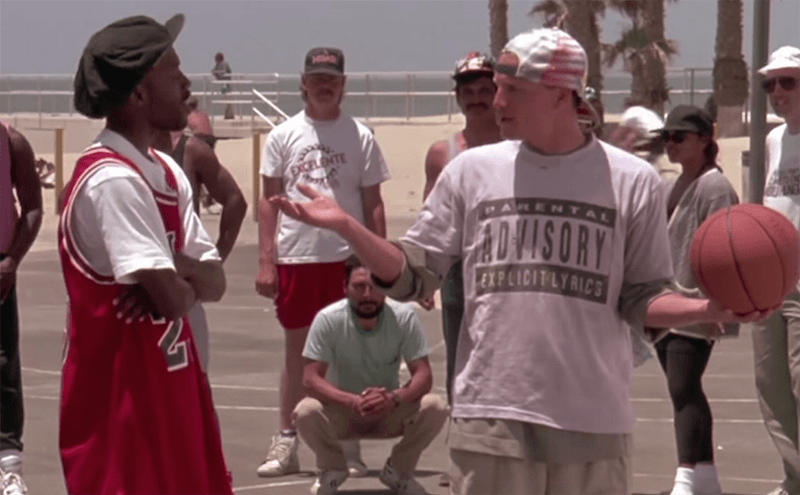
For the young generation, the Parental Advisory sticker becomes a quality sign. Pay attention to the Woody Harrelson T -shirt in the 1992 film “White people do not know how to jump”:
Another conversation
If in 1984 the Tiber of the Mountains was scared of the words “masturbate” in the song of Prince, by the end of the 1980s she had already discovered a gangsta-raep. And I tried to close it - for everyone. So, in 1989, the song “Mind of A Lunatic” by Geto Boys was eager for the charts. It represents an early example of a horror, suck, which is built on an excessive description of acts of violence. In one of the verses, the lyrical hero says that he killed his girlfriend because of her addiction to cocaine. Because of this song, the group turned out to be the object of persecution of the Tiper Mountains and PMRC. The team participant Willy di recalled : “PMRC and the Tipper of the mountains pursued us. They did not like the song, they wrote a lot about this in the press, and as soon as they announced at the concert: “And now from Houston, Texas, The Geto Boys group,“ Buuuuu was heard, get out of the stage! ” And this “boo” lasted for so long, as if we were boasted in shifts. Surely they practiced, drank a lot of water and did not smoke before that for a couple of weeks. ”
But even then it became clear that the Tipper of the mountains is one, and there are a lot of them. Recently, Kendrick Lamar interviewed former members of the NWA group, the pioneers of the Gangste-Rap. Ice Kyub told how the pressure from the mountains, her organization and her husband made the group stronger - as if a loudspeaker had been connected to the voice of the district.
From the late 1980s, to the mid-1990s, the tone in a conversation about drugs undergoes significant changes.
1987
NWA has a song “Dopeman” (a slang designation of a drug dealer). In it, the situation with drugs is described from the reverse angle - on behalf of the seller, not the consumer. And although at the end of the song Crazy Dee (the least famous participant in the group) says that because of Mr. Dopeman, his sister fell ill and not to be a merchant, the rest of the song is not so unambiguous and shows the students a quick and true path to prosperity. Moreover, in his purchase, Ice Kyube gives advice to the dealer - for example, warns to try its own goods.
1993
On the screens of the United States, the film “Threat of Society” about life “in the area” has become a cult film. The protagonist Kane grew up in the family of his grandparents-his father-commercial was killed, and his mother died of heroin. At some point, Kane himself decides to engage in CREK. The soundtrack for the film was headed by the chart R&B albums. Among the key tracks are Pocket Full of Stones UGK duet. In Rap with its district thinking, geography has always been important, and UGK opens a new point: this is a duet from Port Arthur, Texas, a city with a population of 60 thousand people. It turns out that the Crack epidemic got there. The song, enlightening the listener about the life of a clever dealer, sounded quite familiar to a resident of the poor metropolis of the metropolis. But the main thing is that UGK music sounded not only from cars and boomboxes, but also in cinema halls throughout the country.
1995
Tupak Shakur releases the track “Dear Mama”, in which he describes the dependence of the mother on Crak: it turns out that personal misfortune does not prevent the young tupak from shaking with Crack, because he “puts the proceeds in the mailbox” of his mother.
2010
The US Congress Library includes the song “Dear Mama” in the National Register of Audio Ceadwords for its cultural significance.
Braggadocio
As the rap is becoming more commercially attractive, performers are more often concentrated on the topic of wealth and success. In their compositions, getting into the charts becomes a natural continuation of street success-and gangsta rapeers come up with biographies more and more solarly. This special quality of rap music is often indicated by the word Braggadocio (“boasting”, “fanfaronism”). Reddit chart from 2018 shows that the most popular word in rap music is “I”, and followed by “how” (similar data publishes The Pudding). Rap is woven from comparisons belittling the nameless opponent and exaltation of the performer himself.
In the Moment of Clarity, a superpopular Jay Zi talks about the period when “my father traded heroin, and I am with a CREC,” and it seems that without this dynasty he would never have become a successful entrepreneur. Pusha T built a career on the fact that at the age of fifteen he sold drugs; Now the popular rapper is already over forty. The media image of 50 cent is a dealer that has broken nine bullets; For some reason, a small merchant, who had almost died due to an insignificant transaction, becomes a commercially profitable mask. The rapper fat Joe in the song “Crackhouse” claims that he needs a shovel for cocaine, and says about himself: “Fat, because it is so rich; Rich because from the area. " Bravo, fat Joe.
Boar leads rappers to unceasing descriptions of demonstrative consumption. In rap are the brands of cars, clothes, weapons and drinking. The song of Basa Raims “Pass the Courvoisier” of 2001 increases the sales of the cognac of the same name. Jay Z makes a way from describing pistols to a conversation about fashion (“I have white moccasins from Louis [Vuitton]” - in the song “On To the Next One”) and art objects (in “Picasso Baby”). Of course, the mention of drugs, expensive or “street”, will certainly remain part of this conversation.
Politicians are alarming
Now it is hardly possible to establish who attacked before: politicians or rappers, but the first half of the 1990s has become a time of constant mutual attacks-street poets against the best speaker from Washington. (Is it worth it to say who won this battles?)
In 1988, the NWA group, the Pioneers of Gangste-Rap-in their composition, among others, Dr. Dre and Ice Kyub-receive a letter from the FBI agent Milt Alerich that their song “Fuck Tha Police” encourages violence against representatives of the law. Police torn the concerts of the group in the cities of Texas, Miluoi and Michigan - a note in Times associates this with the fact that "outside the school time, police officers are often earned in the security service at concerts."
When the group broke up (the letter has nothing to do with it), Ice Kyub released several superpopular albums with sharp texts. In 1991, the Death Certificate record was released. In the song “A Bird in the Hand”, Ice Kyub describes how social constructions push African -Americans to drug trafficking. “Bird”, it is “kilo”, turns out to be the only way out of a difficult situation. The song ends with the words "A bird in the hand is more than Bush." The rapper’s anger is enough for the famous black activist Jesse Jackson, whose program is the Operation Push, according to the singer, is almost useless.
In the same year, Public Enemy releases the song “By the Time I Get to Arizona”. She becomes a radical response to the situation in Arizona, where, as at the beginning of the song, the activist and rapper Sister Souljah explains, Governor Evan Mekam canceled the celebration of Martin Luther King's day. Первый куплет Чак Ди заканчивает игрой слов в адрес Мекама — «or he's a goner by the time I get to Arizona», которую можно трактовать как «он не жилец к тому времени, как я доберусь до Аризоны».
В 1992 году всё та же рэперша Sister Souljah в интервью Washington Post заявляет: «Если чёрные люди убивают чёрных людей каждый день, почему бы не выделить неделю, чтобы убивать белых?» Месяцем позже кандидат в президенты США Билл Клинтон ответил на эти её слова:
«Если взять слова „чёрные“ и „белые“ и поменять местами, то можно будет подумать, что это [„Великий мудрец“ Ку-клукс-клана] Дэвид Дьюк произнёс ту речь».
Ситуация долго обсуждалась в СМИ, и в словарь политического этикета вошло выражение «Sister Souljah moment».
Вице-президент США при администрации Джорджа Буша-старшего Дэн Куэйл называет дебютный альбом Тупака 2Pacalypse Now позором американской музыки. «Этой записи не место в нашем обществе». Его самым сильным аргументом становится история Билла Дэвидсона. 11 апреля 1992 года 43-летний полицейский остановил автомобиль с разбитой фарой. За рулём был 19-летний афроамериканец Рональд Рэй Ховард; машину он угнал. Ховард достал пистолет и выстрелил Дэвидсону в шею. В этот момент в салоне звучала песня «Soulja's Story» Тупака, в которой лирического героя останавливает полиция — и он стреляет в «паршивцев».
Куэйл получает ответку на втором альбоме рэпера в песне «Last Wordz»: «Дэн Куэйл, тебе следовало бы надрать задницу, где ты был, когда н*** укладывали в гробы?» На той же пластинке есть и композиция «Souljah's Revenge», в которой звучит сэмпл из песни «Soulja's Story» — тот самый фрагмент, когда её герой «расстреливает паршивцев».
В это же время политик и феминистка, дочь священника Си Делорес Такер, некогда маршировавшая с Мартином Лютером Кингом, начинает крестовый поход против гангста-рэпа. Она покупает двадцать акций корпорации Time Warner, чтобы получить право посещать ежегодное собрание акционеров, — и там требует от руководства компании зачитать вслух слова с тех пластинок, которые им почему-то не стыдно выпускать. Топ-менеджеры, белые люди зрелого возраста в дорогих костюмах, дружно отказываются.
Её личным врагом также становится Тупак Шакур. Такер пикетирует Национальную ассоциацию содействия прогрессу цветного населения (NAACP), узнав, что организация номинировала рэпера на Image Award. В тот момент Тупак проходит в качестве обвиняемого по делу о сексуальном насилии (он отсидит девять месяцев в 1995 году). В 1996 году выходит его последний прижизненный альбом All Eyez On Me, на котором есть песня «How Do U Want It?» В ней рэпер незатейливо рифмует Такер с motherfucker и отмечает, что она вместо помощи пытается «уничтожить братьев». Несколько лет спустя Эминем в песне «Rap Game» предложит «этой шлюхе Делорес Такер пососать член»; активистке в тот момент было 75 лет. В 2005 году Такер скончалась, на её похоронах выступал бывший вице-президент США Эл Гор, муж Типпер Гор.
В 1995-м к борьбе Такер присоединился сенатор от штата Канзас Боб Доул, который в том же году объявил о намерении баллотироваться в президенты. Он тоже напал на Time Warner за выпуск непотребной музыки. Правда, в июне оказалось, что компания сделала взнос в штаб Доула на политические цели в размере 21 тысячи долларов, которые сенатор отказался вернуть, мотивировав это парадоксальным образом: «Пусть знают, что этими деньгами они ничего не приобрели». И это — ключевой момент в борьбе хип-хопа с политиками: 71-летний Доул выглядит посмешищем. Вот что о нём пишет пресса:
«Если Боб Доул может критиковать рэп-музыку, то пускай они там выслушают мнение доктора Дре о пропорциональном налогообложении» — Baltimore Sun .
«Такие артисты, как Снуп, Дре и Тупак, важны по нескольким причинам. Прежде всего, они говорят с американской молодёжью. От гетто до голливудских поместий подростковая Америка любит гангста-рэп. Сделало ли это подростков гангстерами? Не думаю» — MTV .
Двадцать лет спустя рэп для политиков станет способом набрать баллы у избирателей. В 2013 году сенатор от штата Флорида республиканец Марко Рубио в вашингтонском баре у Капитолия примется рассказывать о том, чему его научила музыка Тупака Шакура и Бигги (The Notorious BIG). В том же году на инаугурации Барака Обамы чета Джей Зи и Бейонсе — в числе ВИП-гостей. Рэпер ещё в 2009 году рассказывает в «On to the Next One», что «Обама у меня в смс» и «страшно представить, что будет дальше»:
MJ at Summer Jam, Obama on the text
Y'all should be afraid of what I'm gon' do next.
Они требуют перемен
Эпидемия крэка в 1980–1990-е была чистым безумием. В 1991 году за курением крэка застают мэра округа Колумбия Мариона Бэрри:
Кажется, это уже никого не удивляет: четыре года спустя Бэрри, пропустивший перевыборы 1991 года из-за отсидки, снова становится мэром. Крэк был повсюду и с тех пор никуда не ушёл: достаточно вспомнить, как ныне покойный мэр Торонто Роб Форд в 2014-м попался на курении крэка, как и Бэрри за двадцать три года до него.
Тем не менее культура наркопотребления и рэп вслед за ней сильно изменились. По данным ProjectKnow, начиная с 2004 года упоминания кокаина и крэка в песнях идут на убыль. Зато с 2003-го резко возрастает количество упоминаний кодеиновых сиропов от кашля. На 2008-й и 2009-й приходится резкий скачок упоминаний фармацевтических препаратов — ксанакса, викодина, аддерола и других. С 2011 года в моду входит МДМА. Топливо для рэп-лирики всё чаще становится химическим. Кривые от Genius 2015 года показывают, что упоминания синтетических препаратов сегодня, вероятно, уже побили по популярности более традиционные наркотические вещества:
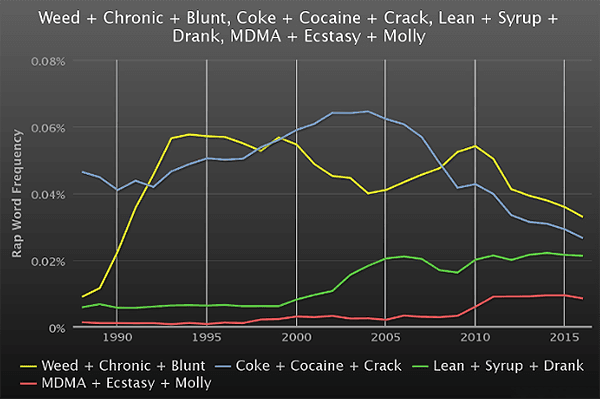
Новые наркотики продвигают новые рэперы. О ксанаксе читает Lil' Pump, МДМА под ласковым прозвищем molly звучит в мемоёмкой песне «All Gold Everything» Тринидада Джеймса, а также в хите «Mask Off» рэпера Future. Старая гвардия в лице Джей Зи возражает: «Я не принимаю molly, я отжигаю в Tom Ford». С новыми наркотиками приходит новое звучание. Старики не понимают, почему молодые рэперы используют triplet flow:
Они не умеют или не хотят читать фристайл, саботируя передачи легендарных диджеев.
В 1995 выходит классический трек «Shook Ones Pt. II», в котором ныне покойный рэпер Prodigy читает:
«Твоя команда — легковесы, мои выстрелы заставят вас левитировать, мне всего девятнадцать, но мой разум старше».
В 2011 году 19-летний Tyler the Creator читает в композиции «Yonkers»:
«Я сыпанул себе немного розовых Xannies [ксанакса] и протанцевал по дому в трусиках с принтом».
Меняется интонация. Употребление выводится из критического поля. Наркотики теперь не проклятие и не кровь, пульсирующая в улицах, — то, что ты либо продаёшь, либо употребляешь (а чаще и то, и другое). Кажется, рэп вступает в ту же эру, которую рок-музыка миновала в 1970-е — время беззаботного наркотического гедонизма. В 2018-м году в топ-10 чартов попадает обыгрывающий в названии «ксанакс» альбом Total Xanarchy рэпера под псевдонимом Lil Xan, то есть «Малой Ксанакс».Xanax is the wave
— Lil pump (@lilpump) 9 июля 2017 г.
15 ноября 2017 года популярный 21-летний рэпер Lil Peep умер от передозировки ксанаксом.
Синтетика убивает
16 сентября 2000 года рэпер Антрон Синглтон, более известный как Big Lurch, ехал в автомобиле. В него врезался пьяный водитель. У рэпера диагностировали перелом шеи. Он восстановился, но усмирял боль PCP — фенциклидином, который также называют «ангельской пылью». 9 апреля 2002 года он принял PCP вместе с соседкой по квартире. На следующий день Синглтон зарезал девушку, вскрыл её грудную клетку и достал лёгкие. Полиция обнаружила его стоящим посреди дороги и смотрящим в небеса. Медицинское обследование выявило в его желудке куски чужой плоти; на шее девушки обнаружили следы укусов. Сегодня Big Lurch продолжает отбывать пожизненный срок без права прошения об УДО. На обложке единственного альбома рэпер держит в руках тарелку с человеческим черепом.
Синтетические наркотики в рэп-музыке появились с начала 2000-х и с тех пор становятся причиной смертей исполнителей, и если мы привыкли к тому, что в рэперов порой стреляют, — пора привыкать и к их передозировкам.
Популярность синтетических веществ можно объяснить рядом факторов: считается, что они менее тяжёлые и не ставят в зависимость; недорого стоят; добываются по рецепту, то есть позволяют формально не нарушать закон; соотносятся с культурой потребления, отличной от «гангстерской». Культура потребления здесь играет важную роль: попивать из двойного стакана purple drank, он же lean, он же sizzurp — кодеиновый сироп от кашля, смешанный с газировкой (как правило, это «спрайт»), — стало признаком хорошей жизни. В коротком фильме сайта Vice об этом явлении «ветераны» кодеинового сиропа жалуются, что рэперы пришли — и всё испортили: когда на purple drank началась мода, он значительно подорожал на улицах.
Именно синтетические вещества — кодеин и ксанакс в первую очередь — с начала 2000-х отправляют на тот свет исполнителей. Причины кроются в обманчивой лёгкости, опасных комбинациях и неумении дозировать потребление.
В ноябре 2000 года от передозировки purple drank умер 29-летний DJ Screw, который в одиночку ввёл моду на этот напиток в Хьюстоне.
В ноябре 2004 года от сочетания кокаина и трамадола погибает Ol' Dirty Bastard из Ву-Танг Клана.
В октябре 2007 года умер пропонент кодеинового сиропа, коллега DJ Screw рэпер Big Moe. Два месяца спустя — Pimp C, половина того самого дуэта UGK, который в 1993 году хвастал продажей крэка в фильме «Угроза обществу».
С 2013 года постоянные припадки происходят с рэпером Lil Wayne, который всюду появляется с кружкой сиропа, — одна из версий связывает ухудшение его здоровья с кодеином.
В январе 2018 года от осложнений, вызванных употреблением ксанакса и purple drank, скончался 27-летний Фредо Сантана.
В сентябре 2018 года от передозировки фентанилом, кокаином и алкоголем умирает 26-летний рэпер Мак Миллер.
На все эти смерти приходится единственный случай героиновой передозировки. В 2013 году отказало сердце у рэпера Криса Келли, соавтора дважды платинового хита «Jump» и участника дуэта Kriss Kross, который в начале 1990-х выступал на разогреве у Майкла Джексона. В теле Келли были обнаружены следы героина и кокаина — подобно рок-звезде, он умер от «спидбола».
PS В начале 2018 года рэперы, потрясённые смертью Lil Peep, обещают «оставить Xanax в прошлом году».
This tweet made me happy !!! pic.twitter.com/BcfWusgG3k
— TRAVIS SCOTT (@trvisXX) 1 января 2018 г.
В январе 2019 года у рэпера Future выходит альбом The WIZRD, в котором он хвастает, что «подсадил весь мир на ксанакс», и говорит, что он «фиолетовый [purp], как единорог».
Альбом занял первую строчку в американских чартах.