
Translated material
Girl-vision | Colta.ru
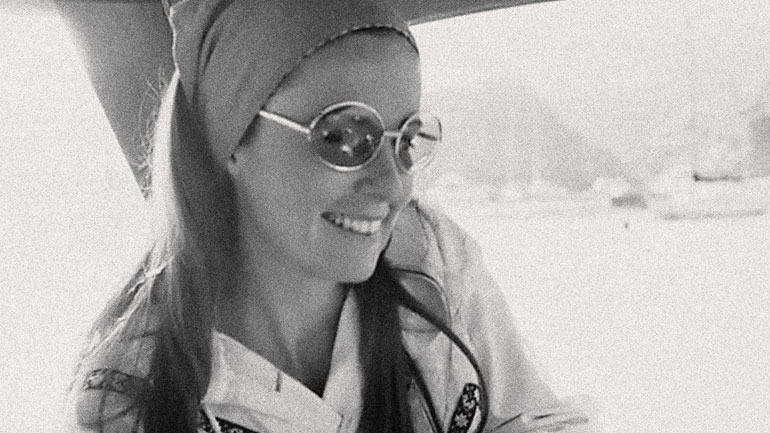
Colta.ru publishes fragments of Alexander Kushnir’s unfinished book “The Generation of Woodstock: Heroes, Marginals, outsiders” about musicians who were unlucky to get to the famous festival and a large rock story, but this does not mean that they did not deserve it. From each you will learn the story of a missed masterpiece belonging to that flame era, and you will feel its spirit. In this chapter - the story of the dentist Linda Perkhaks, who recorded the album, who was ahead of his time for 40 years.
Linda Perhacs - "Parallelograms" (1970)
In the early autumn morning of 1969, the Hollywood composer Leonard Rosenman woke up with an acute toothache. The author of music to numerous films, he was littered with a bunch of orders, so he did not have time for such trifles as restoration of his own health. He instructed the secretary and soon sat in the expensive dental clinic on Beverly Hills. His mouth was carefully examined by a young woman with a charming smile and a dreamy look. When the future laureate of the Oscar woke up from anesthesia, he heard a quiet hallucinatory singing emanating from his pretty savior.
The composer was struck by not so much a melody as a melancholy voice whispering strange phrases over his head: “ Quaadra- Hedral, Tetra- Hedral, Mono- CyCliacynceBercilla.” As Rosenman later admitted, he did not hear anything more beautiful in his life.
Despite the fact that Leonard's mouth was stuffed with instruments, he began to ask questions. From the conversation it turned out that the doctor’s name was Linda Perhaks. Talking about the avant -garde composition with a strange text, she painted blue waves, green circles and pink lines on paper with extraordinary ease. Then she explained to the amazed Leonard that "the sound-stroke, moving in this way in space, ideally should be transformed into parallelograms."
Having come to the next session on the salvation of the teeth, the insightful Rosenman asked Linda to record several of his songs at home. In addition, he tried to understand the logic of creating her compositions - mathematically abstract and emotional at the same time. And, having hastily rinked his mouth, he asked the 27-year-old California, how long she composes.
“In the elementary grades, I wrote several alarming songs, but the teachers reprimanded me for a violation of the educational process,” Linda confessed directly into the patient’s eyes. -I guessed that this was my strength, but they told me: “Girl, let's stop the wider!” After graduating from the university in Los Angeles and received a diploma of a dentist-surgeon, I found a job with a flexible schedule, because I dreamed of exploring life. I was not a hippy and did not eat drugs, but I loved to travel very much. My husband-designer often invited me for walks. We preferred to visit only wild places where a person’s leg did not step. So I started writing songs again. ”
The next day, the master of Hollywood soundtracks called Linde at eight in the morning. He listened to her cassette at home and fell into indescribable delight.
“This must be urgently written! - Leonard said excitedly. - I already booked the studio and invited the musicians. We start working from tomorrow! "
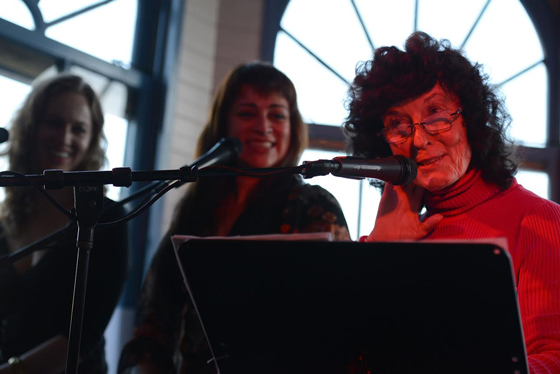 © Getty images Linda Perhaks on Way Over Yonder Festival in Santa Monica, 2014
According to various sources, the album " Parallelograms" was recorded from two months to one year. Linda played the acoustic guitar and sang in an unusual manner. Rosenman helped her with arrangements and led a whole team of drummers, bassists, flutists, pianists and folk musicians who played various folk instruments.
“The harmonic sequences that are adopted in Western music are very predictable,” the singer later said. - Along with conventional tonalities, I used frets (nozzles typical of folk or ancient church music; sounds in them are not correlated in them like in the Major and Minor familiar to us: Lada music is unusual, archaic sound. - Ed. ). When I compose, I follow the command of the spirit, because I always liked to mix sounds from different ends of the Earth. It's all about internal concentration and wavelength, because our whole life is vibration. Everything hesitates - both atoms and the universe. ”
In those days, Linda grew on the music of the heroes of Woodstock - she especially liked the singer Melanie and the Buffalo Springfield albums. At the same time, her original songs, performed by a delicate Mitso-soprano and recorded by the method of imposing vocal parties, were not like neither the rock-gimn, nor the acid folk, nor the intellectual psychedelics. Parallelograms wrote her favorite composition “Parallelograms” at night on a high -speed highway - the melody suddenly surfaced in her falling brain. The song called Dolphin narrated about diving in Lower California, and Paper Mountain Man was autobiographical - she talked about Linda's love for a person who caused her severe pain.
Most of the songs were recorded at night, because during the day Linda Perhaks worked in a dental clinic. She spent a lot of time in the Khlevosol apartment, Rosenman, where she rehearsed with the guitarist Steve Kon, who was periodically joking: “Ah, here is Linda, it's time to play gently!”
Soon, Rosenman managed to agree with one of the Sabellibs Universal , who dreamed of getting his own Joni Mitchell. Its employees moved the sound on the album in such a way that Linda Perhaks, after listening to the result, silently threw the disk out the window. Her indignation knew no bounds. The order of the songs was changed. All the halftones were erased, all sound details were destroyed. The album sounded flat and poor. In addition, the label did not invest a single dollar into advertising and did not provide Lind with the opportunity to give interviews or play promoters. In 1970, not a single review in the press was released at Parallelograms -there was not a single record-shop in California where the album was sold.
The attempts of Linda to convince the bosses of the label to turn the disk were unsuccessful. “They simply ignored me,” she recalls. “And I thought that in such circumstances the idea not to abandon the main work was very reasonable.”
The next 30 years of life, Linda was immersed in science, medical practice and family, trying not to remember the singer’s dubious career. In those moments when she was drawn to music, she secretly listened to her old demos. But, be that as it may, Linda Perhaks did not write more songs.
“Sometimes friends told me that the album had local success in places with the most beautiful nature: in Hawaii, in Canada, Colorado, in Alaska,” says Linda Perhaks. “But not in his native Los Angeles, where loud and assertive sounds always loved.”
Shortly before the Millennium , Brooklyn producer Michael Piper reprinted Parallelograms on his small label The Wild Places , specializing in rare psychedelic music. This compact disc was in a sense of pirate-after all, its publisher did not know what happened to Linda Perhaks and whether it was alive at all. The original edition of the album came out with a rough typo in the name of the performer, so for a long time Michael Piper frantically looked for a singer named Linda Perhaps . It is curious that none of the old -timers of Universal remembered either Linda or her plate “ Parallelograms” . After the grueling searches, the producer who made hundreds of calls still found the author in one of the areas of South California.
This meeting was a turning point in the fate of Linda. Since 2003, its story resembles a Hollywood film with a happy end. After the album was reprinted in a “humanized” version (with an author’s consuming volume vocals and amazing bonuses), the current folk star-Devandra Banghart, Joanna News and Julia Holter enthusiastically spoke about Linda. They were able to convince Linda Perhaks to return to the studio and record two albums of new songs. Her ballad " IF You Were My Man" fell into the eccentric film of the DAFT Punk Electromoma group, and in 2010 the singer gave the first live performance in her career. Exactly forty years have passed since the recording of the Parallelograms album .
To be continued.
Subscribe to the COLTA.RU channel in Yandex.Zen to miss nothing