
Translated material
Tsuckerberg updated Facebook policy. The main thing now is messengers and security
Facebook founder Mark Zuckerberg published on a social network a software article in which he recognized that most of his audience is needed rather not a market area (classic social network), but a room for a private conversation (secure messenger).
Read more. Such a messenger should become the main direction of development of the largest social network of the world for the coming years. After the scandals, like the Cambridge Analytica case , which deprived Facebook $ 80 billion, Tsuckerberg plans to pay special attention to data security: Facebook Messenger and WhatsApp promise to become so well encrypted that personal correspondence will not be able to read the social network itself, and Facebook I am ready to generally refuse to store data forever and sacrifice the presence in countries that require their storage on their territory.
Quotes
- “In the future, all Internet platforms, including social networks and messengers, will have to encrypt users correspondence: people want to be sure that sent messages remain only between them and their addressees, and all the details of the correspondence-including the sent photos and videos-will not be stored somewhere on the Internet for ages. I hope that our company will help to embody these dreams into reality. We will take the first step in this direction with the updates in the work of WhatsApp: first of all, we will pay special attention to the safety of correspondence and encryption of messages, and then we will make the messenger more convenient and expand the capabilities for user communication - we will introduce calls, create video chats and group correspondence, allow you to record stories, pay for goods and services, use the messenger in business, commerce and much more ”.
- “All correspondence will be automatically deleted after a month or year - to choose from. So a person will not be able to fear that his messages will come up somewhere after a long time and will deliver problems to him. We plan to give users the right to manage their correspondence themselves - they will be able to establish a time period through which their messages will be deleted, or even turn off the automatic removal mode. It will also be possible to highlight individual messages directly during the correspondence - they will disappear after a few seconds or minutes. ”
- “To carry out the work of a social network in the country and keep in it the data of users are completely different things. We create an infrastructure around the world, but we deliberately do not build data centers in those countries where human rights are violated-for example, the inviolability of private life or freedom of expression of opinions. The government will easily intercept the personal information of people, if instead of caching the data we build data centers in such countries and store the confidential data of users on their territory. Compliance with this principle can lead to the fact that Facebook will not be able to work on the territory of some countries or expand our presence in new places - we intentionally go to this step. ”
- “I hope that in a few years WhatsApp and Messenger will become the main methods of communication for our users. We are working to make them faster, safer and easier to use. ”
New Facebook principles
- Personal correspondence of users should remain personal. Each person should have a method of communication, in which he is completely sure - he himself controls who can write to him, and no outsider will receive his access to correspondence.
- *Encryption. The user must be convinced that the product he uses is completely safe. In our products we use through encryption - the messages are so well encrypted that personal correspondence cannot read the social network itself. *
- Nothing should be eternal. People want to remain themselves and not worry about the fact that in the future some information found on the Internet will compromise them. We do not store the published story and correspondence of users longer than necessary.
- Safety. People should trust our company and know that we are doing everything possible for the safe work of users with our applications. Within the framework of available technologies, of course.
- Convenience. People should be able to simply and conveniently use any of our applications to communicate with friends.
- Safe data storage. Users want to know that their confidential data will not be able to receive the state - especially in countries where such important human rights as the inviolability of private life or freedom of expression of opinions are violated. In the course of several years we will rebuild the work of all our products, based on these principles. ”
Context
Facebook announces a change in strategy against the background of what loses users in developed countries. Millions of American users left the social network, the newly published data from Edison Research said . Now Facebook uses 15 million less Americans than in 2017. Most of all, leaching of the audience affected the key age group from 12 to 34 years.
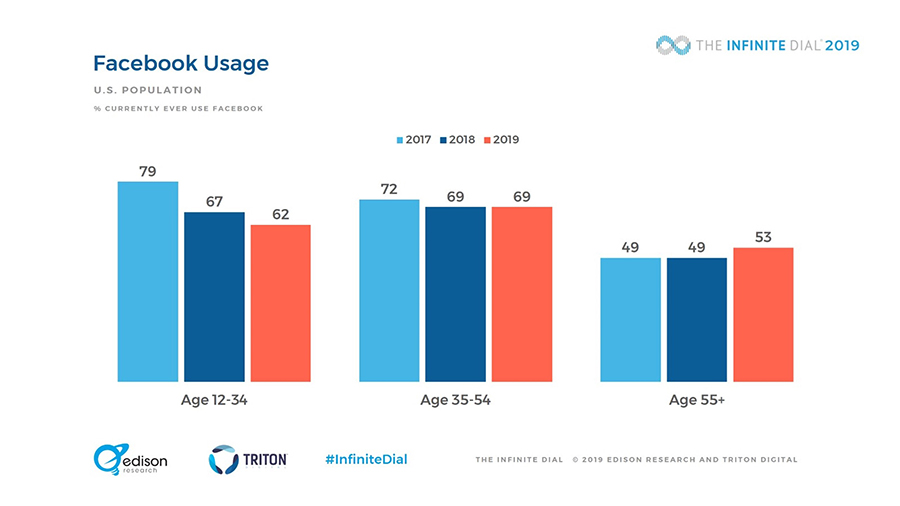
Using Facebook in the USA. Data Edison Research and Triton Digital.
Facebook's right hand does not always know what the left is doing. For example, Facebook promotes the idea of two -factor authentication, offering to use a phone number for this. However, by entering the phone number, you guarantee that anyone can find you by this number. You cannot refuse to be found. In addition, Facebook uses these numbers taken from the user to ensure security, for advertising .
A new theory strategy may mean Facebook departure from Russia. Zuckerberg correctly writes that there is a big difference between the provision of services in the country and storage of user data there. According to the new strategy, in countries where the freedom of statements or human rights is violated, data centers for storing personal data will not be built. Russian legislation requires storing such data in the country.
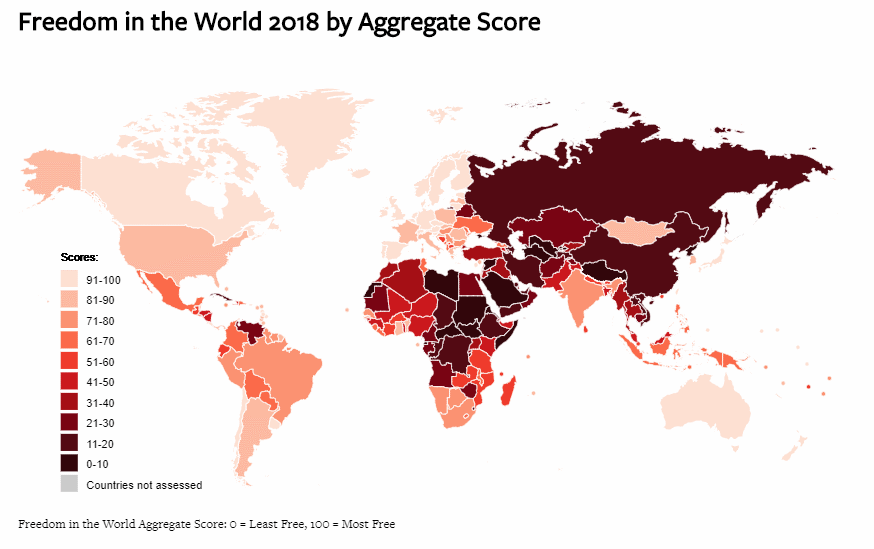
Freedom in the world on Freedom House
If Tsuckerberg speaks seriously, he will have to measure freedom, and most likely he will take existing methods. For example, Freedom in the World 2018 rating, compiled by Freedom House. According to him, Russia is a non-free country, its non-freedom rating is 6.5 out of 7, and the Freedom of Expression, which is guided by Tsuckerberg, is estimated at 3 points out of 16. If the data centers in the country are not placed, Facebook will not be able to work in Russia.
Anna Kovalenko, Alexander Ambzin