
Translated material
Memory. Yakov Zeldovich
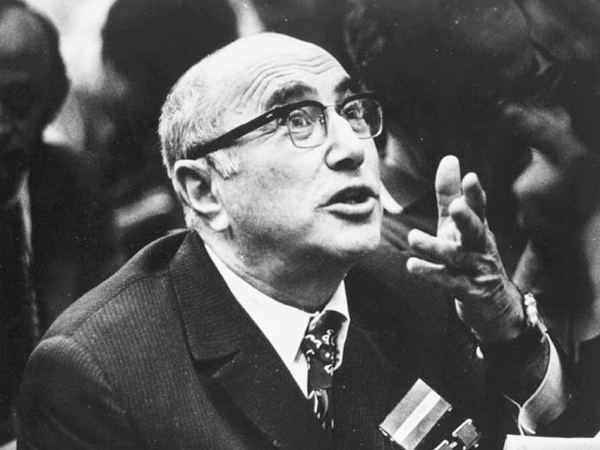
On March 8, 1914, Yakov Zeldovich, physicist, academician of the USSR Academy of Sciences was born.
Personal business
Yakov Borisovich Zeldovich (1914 - 1987) was born in Minsk. His father, Boris Naumovich Zeldovich, was a lawyer, and his mother, Anna Petrovna Zeldovich (Kivevelovich), a translator. In 1924, the family moved to Leningrad, where Yakov entered the third grade of high school, which he graduated in 1930. After that, he got a job as a laboratory assistant to the Institute for Mechanical Processing of Minerals (Mechanobr).
In May 1931, Yakov Zeldovich became a laboratory assistant at the Institute of Chemical Physics of the USSR Academy of Sciences (ICF). In the 1930s, Zeldovich, who formally had only secondary education, was actively engaged in self-training in the field of physics. In 1932-1934 he studied at the correspondence department of the Physics and Mathematics Faculty of Leningrad State University (LSU), but did not finish training. He later attended lectures of the Faculty of Polytechnic Institute.
In 1934, Zeldovich became a graduate student of the NISF and two years later he successfully defended his thesis, and three more later - a doctoral. In 1937, he created and headed the department of high -temperature kinetics of reactions in the explosive processes of the HIS, and then also the combustion physics laboratory. At the end of August 1941, along with the institute, he was evacuated to Kazan. In 1943, together with the laboratory, he was transferred to Moscow. From 1946 to 1948 he headed the theoretical department of the Institute of Chemical Physics of the USSR Academy of Sciences.
Back in 1939-1940, Zeldovich, together with Julius Khariton, published three articles dedicated to the clearance of uranium nuclei and chain reaction. In one of them, scientists wrote: “The kinetics of the development of chain collapse is decisive for judgment on certain paths of practical, energy or explosive use of the breakdown of uranium.” Zeldovich began to prepare such use from the mid-40s, when he worked on a Soviet nuclear project as part of a group of scientists. In 1947, a group of physicists from the Academy of Sciences of the USSR, headed by Zeldovich, was sent to KB-11 (Arzamas-16), where the first Soviet atomic bomb was created. In the future, Yakov Zeldovich also participated in the creation of a Soviet hydrogen bomb. For work on the atomic project, Zeldovich received the title of Hero of Socialist Labor three times (1949, 1954, 1956).
In Arzamas-16, Zeldovich worked until 1963. In 1946 he was elected a corresponding member, and in 1958-academician of the USSR Academy of Sciences.
From 1965 to 1983, Zeldovich headed the department of the Institute of Applied Mathematics of the USSR Academy of Sciences. Also in 1965, he became a professor of the Faculty of Physics of Moscow State University named after Lomonosov, and in 1984-1987 - the head of the department of relativistic astrophysics of Moscow State University.
Since 1983, he headed the Department of the Institute of Physical Problems of the Academy of Sciences of the USSR, was a consultant to the Directorate of the Institute for Space Research of the USSR Academy of Sciences. Since 1977 - Head of the Scientific Council for the combustion of the Academy of Sciences of the USSR.
Yakov Zeldovich died in Moscow on December 2, 1987.
What is famous
The numerous discoveries of Yakov Zeldovich are associated with the theory of combustion, ignition and spread of flame, the theories of ignition of the heated surface, the thermal spread of laminar flame in the gases, the limits of the spread of flame, the combustion of condensed substances. He described the spread of shock and detonation waves, the gas -dynamics of the explosion. Regardless of each other, Ya. B. Zeldovich in the USSR, John von Neumann in the USA and Werner Dering in Germany created a model for the spread of detonation, later called the Zeldovich -Neumann -Dering (ZND) model. They found that when detonation is spread, the substance first heats up when the front wave is passed, and chemical reactions begin in the substance after some time equal to the delay in self -disclaiming. During chemical reactions, heat is released, which leads to an additional expansion of products and an increase in the speed of their movement. Thus, the zone of chemical reactions acts as a kind of piston pushing the leading shock wave and ensuring its stability. From these topics, Zeldovich moved to the study of the conditions of stationary division of Uranus in energy plants and its explosive division.
What you need to know about
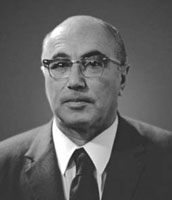 Yakov Zeldovich
Since the 1960s, Yakov Zeldovich has worked a lot in the field of astrophysics and cosmology, where he achieved no less results in comparison with his previous works. His studies covered a number of problems: the theory of formation of black holes and neutron stars, the release of energy and radiation of x -rays in the fall of the substance on black holes; Development of the theory of evolution of the “hot” universe, the properties of relict radiation, the theory of the formation of galaxies and the large -scale structure of the Universe, the inflationary theory of the early Universe. Together with I. D. Novikov, he wrote the monographs “The theory of gravity and the evolution of the stars” and “The structure and evolution of the Universe”. Together with Rashid Syunayev, Zeldovich created the theory of dispersion of relict radiation on electrons ( the effect of Xunyaev - Zeldovich). In 1964, Yakov Zeldovich and independently American physicist Edwin Solpiter put forward an assumption, an accretion discs around massive black holes serve as a source of quasar energy.
Direct speech
From the memoirs of Andrei Sakharov : “The discovery of Uranus division changed Zeldovich’s scientific fate, as well as the fate of many scientists, in the years in advance - in a broader sense, it changed the fate of all of us. His pioneer research together with Yu.B. Khariton on the theory of explosive and controlled chain nuclear reactions of division was simultaneously the latest works published in the open literature before the curtain of secrecy fell in this area. They had a huge impact on everyone who worked in this area. From the very beginning of Soviet work on the atomic (later thermonuclear) problem, Zeldovich was in the epicenter of events. His role here was completely exceptional. <...> Zeldovich extremely did not approve of my social activity, which annoyed and even scared him. Once he said: “Here are people like Hawking, truly devoted to science. Nothing can distract them. " I did not understand why he could not come to my aid, about which, with our friendship, I considered myself the right to ask. I knew that all this tormented Zeldovich. It also hurt me. Today, these events of the past years seem nothing more than foam, carried away by a stream of life. Unfortunately, after my return from Gorky, I met with Zeldovich only once or twice, and even then in public, so that it was hardly possible to talk to him humanly. This is another lesson - do not postpone for tomorrow what you can do today. ”
From the memoirs of Vladislav Mokhov : “The relations of Yakov Borisovich with A.D. were interesting Sakharov. Both knew how to think very quickly, but in all other respects they were completely different people, pronounced sanguine and chorer, “lark” and “owl”; A fan of sharp, often fragrant expressions Yakov Borisovich - and restrained, intelligent Andrei Dmitrievich. ”
From the memoirs of Semyon Gershtein : “After some time, the Yab, having coped with my classes, said:“ Since you will give lessons, I want to ask you to work out with my girls. ” I began to refuse, saying that they do not need it at all, they already study, excellent excellent students, and they will only be shy that they had a tutor (in those days they were ashamed). However, Yab found the following objection: “At school, they do not vaccinate experimental skills. Build devices, and let them do experiments. ” I could only agree (I had some experience: in a rural school I tried to create a kind of physical acticum so that each student could carry out several laboratory work). In the stores of textbooks, it was possible to purchase quite good devices - an optical bench, lenses, galvanometers, etc. There was also a small Wilson camera. And so Olei and Marina began to set various experiments and solve the tasks related to them. It happened that the experiments ended with embarrassment - a couple of times I burned sensitive electrical appliances. Yab made fun of me; Often I myself took part in the experiments, and I, together with my students, listened with interest to his comments about the use of the phenomena under consideration in various technical devices. I was surprised by the experimental skills of Yab and its ability to "work with his hands." “I started as an experimenter,” he told me, “and before that he worked as a laboratory assistant” (I did not know then that Yab had no official higher education). I don’t know if my lessons have benefited the students (invented, as I understood to help me), but they taught me a lot and helped to hold out until May 1955, when Landau managed to implement their plan and take me as a graduate school. ”
From the memoirs of Vladimir Zakharov : “For the first time I saw Yakov Borisovich“ In Person ”in the winter of 1961–62. In Akademgorodok. Winter there is a long and more accurate time to recall. Roald Sagdeev defended his doctoral dissertation, and Yab, for three years a full academician, was his official opponent. Protection as such was erased from memory at all, but I remembered the banquet perfectly thanks to the Yab. He went to the middle of the hall, low, strong, in round glasses of a middle -aged man, peppy and energetic. And the next toast said:
- There were two thiefs, young and old. They arranged a competition: it was necessary to climb a tree and rob the crow's nest, so that the Voronikha, sitting on the eggs, would not notice anything. The young thief climbed as it was - in a jacket and boots. Voronikha noticed him and raised a scream. The old thief said: “Oh you! Look as it should! " He took off his boots, took off his jacket, climbed a tree, stole eggs. He went down - neither a jacket, nor a boot, nor a young thief. So, let's drink for the young generation of scientists! ”
10 facts about Jacob Zeldovich
- Jacob Zeldovich first got to the Institute of Chemical Physics for the first time in the group of excursionists. The questions that he asked showed the possession of thermodynamics, molecular physics and chemistry at a level of at least the third year of the university. Surprised employees invited the tourist to go to work.
- According to legend, the Institute for Mechanical Processing of minerals agreed to the transition of the laboratory assistant Zeldovich to the Institute of Chemical Physics in exchange for a vacuum pump.
- Formally, Yakov Zeldovich never received a higher education.
- During the war, Zeldovich’s work to describe the combustion processes were used to create shells of the Katyusha reactive mortar, and later for the development of solid fuel missiles.
- A sense of humor, distinguishing Yakov Zeldovich, caused the appearance of many stories that enriched scientific folklore. For example, during a discussion with T. Lysenko, who claimed that if the mice are chopped for many generations in a row, the frozen mice should begin to be born, Zeldovich objected: “Many millennia, hundreds of generations in a row, Jewish boys are circumcised. Not a single case has been registered so that the Jewish boy is born already circumcised. ”
- In one of the conversations, Yakov Zeldovich made an interesting remark about Gogol’s “auditor”: “I figured it out,” he said, “that the city’s fathers should be veterans of the Patriotic War of 1812. And risking their lives for their homeland, now it does not seem to be shameful to take a cloth of cloth from a merchant, for which, in essence, they risked their lives. Khlestakov, on his youth, did not participate in the war and, accepting, for granted, the fruits of victory, cannot understand the veterans of things that are elementary for the ruling class. ”
- In 1955, Zeldovich signed a “letter of three hundred”, which contained criticism T. Lysenko.
- In addition to scientific monographs, Yakov Zeldovich wrote several textbooks, including “Higher Mathematics for Beginners” (1960) and “Higher Mathematics for Beginning Physics and Technicians” (1982).
- The son of Zeldovich Boris Yakovlevich also became a famous scientist, a specialist in non-linear optics, a corresponding member of the Russian Academy of Sciences.
- Zeldovich received two personalized awards of the Academy of Sciences. In 1977, he was awarded the Igor Kurchatov’s gold medal “for predicting the properties of ultra -chief neutrons and their discovery and research”, and in 2002 he received the Alexander Friedman award for a series of work: “The effect of reducing the brightness of relict radiation towards the accumulation of galaxies”. Since 2015, the RAS presented the Gold Medal named after Ya. B. Zeldovich for outstanding works in the field of physics and astrophysics.
Materials about Jacob Zeldovich
Article about Jacob Zeldovich in Russian Wikipedia
Kiperman S. Familiar and unfamiliar Zeldovich
Yakov Borisovich Zeldovich (memoirs, letters, documents)