Translated material
Brutal ethics
About the book of the zoo defender Karl Safina and the moral superiority of whales over people
If you like animal programs, you probably met youtube or saw on TV the fiery performances of Karl Safina, the most famous ecologist and zoo defender. Recently, in Russian, his book “beyond the line of words. What animals think and what they feel about. ” Nadezhda Protsenko - about what people, according to Dr. Safine, should learn from whales and elephants. 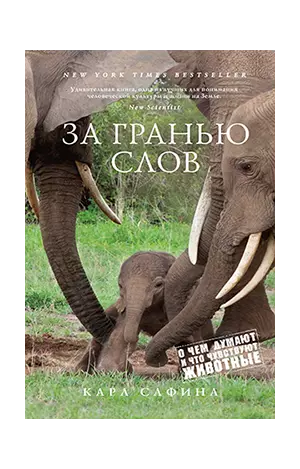 Karl Safina. Behind the line of words. What animals think and what. M.: Hummingbird, ABC-Atticus, 2018. Translation from English Yuri Goldberg and Olga Novitskaya
"Inspiration. Science. Nature. Hope". This is how the life credo of Karl Safina sounds, one of the most noticeable American scientists participating in the protection of wild animals.
He discovered a writer's talent in himself in the late 90s, when he was already very forty and everyone knew him as an authoritative ecologist. The recognition of critics and the press was received by the first book of Safina, Song for the Blue Ocean (1998), dedicated to the behavior of sea birds and fish. At the time of publication, he was already listed as a professor at the University of Ratger of New Jersey. In parallel, already as a public activist, Safina led campaigns on the ban on drift networks in the open sea and amending federal laws on fishing, contributed to the adoption of the UN Global Agreement on Fisheries.
In addition to studying marine animals, Karl Safin is engaged in preserving the elephant population, working in zoos and national parks in Kenya, and wolves of the Yellowstone National Park in the United States. The position of presidential founding of the Safina environmental center and the work of the head of the department "Nature and Humanity" at the University of Group Brook, he successfully combines with literary activity-seven books have already been published under his authorship, each of which was awarded prestigious literary awards in the United States. And in 2011, the 10-episode television series “Salvation of the Ocean with Karl Safina” was released about the problems of marine animals and people who are engaged in them.
In the preface to his last book, Karl Safin reports that it was written simply by observations of animals and their mind:
“For some time I wanted to move away from the issues of wildlife protection that my other works are devoted to, and return to the origins, to remember what I liked more from the very beginning in the world: just watching what animals are doing and trying to understand why they are doing it. My travels led me to the three most protected species: the elephants contained in the Kenyan National Park of Amboseli, the wolves living in the Yellouston National Park, and the wanders, and the inhabitants of the coastal waters of the Pacific North-West of the United States. ”
But in reality, Safin in almost every chapter inevitably moves on to his “direct duties”, namely, to the issues of protecting nature.
The book is divided into four parts, the first of which is dedicated to elephants, the second to the wolves, the third to the mind of animals and the theory of reason, the fourth to the whales. All parts are connected by the general idea that man is not the crown of creation in the animal world, but only equal among equals. Therefore, we should learn to look at the world not from the inside of the human ego, but from the outside, observing ourselves among other animals. Safina assures that with such an perspective of studying the animal world, one can understand: all animals have reason.
“When we are looking for“ mind ”in other animals, we often repeat the mistake of Protagora and believe that“ man is the measure of all things. ” Being people, we tend to study the mind of animals, comparing it with human. Are they reasonable as we are? No, and therefore we won! Are we reasonable as they are? We do not care. We insist that they play according to our rules, but we don’t want to play them, ”Safina argues.
Moreover, he insists that people, with their inherent mystical religiosity, have an irrational mind and demonstrate "a fairly common inability to distinguish reasonable objects from inanimate, as well as evidence from nonsense." In this logic, a “perfect” mind in a person is more likely a pathology: “A often repeated phrase that a person is a rational being, in fact, one of the most common misconceptions. In nature, sobriety prevails, and in man - destructive madness. Of all the animals, we are the most irrational, prone to distorting facts, to delirium and unreasonable anxiety. ” Having come to this conclusion, Safina immediately puts forward the hypothesis that, perhaps, this irrationality is the unique feature of a person: “What, if it is the ability to put forward strange ideas“ makes us people? ”
Safin describes the entertaining stories from the life of Kenyan elephant families from the words of colleagues who have been studying elephants in natural conditions for more than 40 years, since the creation of the Amboseli National Park. Here is a characteristic sample of the author's style:
“Vicki tells about one grown breeder: he tried to cling to his mother again and again, who decided to put an end to this. Whenever the elephant tried to get to the nipple, she just picked up her front leg under the belly and access to her chest was blocked. So she did over and over again. The elephant was beside himself. He pushed her, and shoved, and tusks tried to use it, and in the end-it seems like “ahhhh, I don’t love you, here you, get it!” - poked a trunk into her anus. I put it right inside, a bastard. I hoped, go, at least to draw her attention to himself. And then he turned backwards and clang his mother. ”
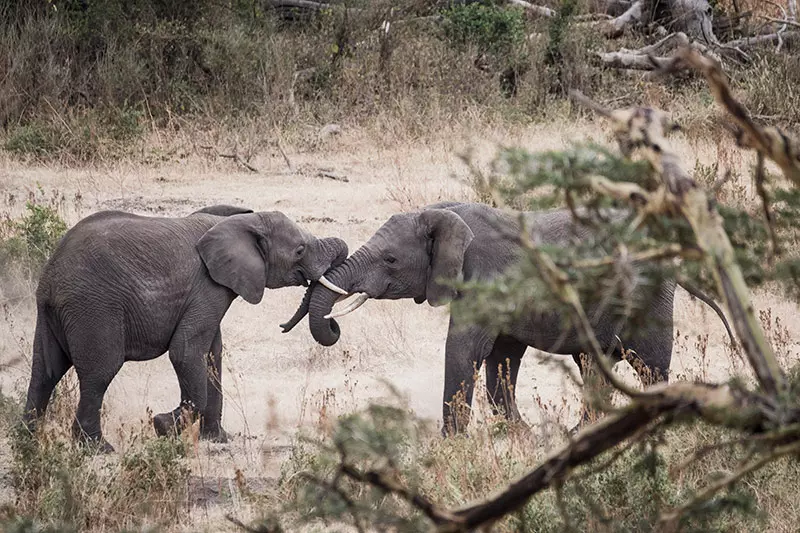 But these funny stories are inexorably replaced by the depressing paintings of elephant extermination due to valuable beans and political motifs even within the protected territories. The statistics given by Safin are truly monstrous: “In Uganda in the National Murk these Park, ten thousand elephants lived, of which twenty-five survived (this is not a typo, twenty-five), because the Ugandian government readily sent 85 % of these animals to the slaughter to sponsor the policy of state terror. Sierra Leone spent her last elephant on his last journey in 2009. In the Democratic Republic of the Congo, 90 % of elephants were killed, 80 % in Gabon, and only in the last ten years. Chad, Camerun, Sudan, Somalia, Mozambique, Senegal - all the number of livestock was shot, units survived. First of all, this, of course, is a blow to the elephants, but people also remain in vault. In Kenya alone for three hundred thousand people, the only source of income is tourism, and tourists come to look at elephants. Therefore, poaching in industrial sizes ultimately leads to massive impoverishment of the population. ”
Safina calls this situation “elephant genocide”, equating animals with the native population of Africa.
In the second part of the book, we move to the Yellouston National Park of the United States, where for several years now they have been recreated by the wolves exterminated in these parts. Rick Mcyntair, a huntsman studying the life of wolves resettled from Canada, tells Safin about the drama of one wolf family, who has deprived by the will of the female leader, paying attention to the personal characteristics of each wolf.
“I always knew that a wolf flock is a family: father, mother and children; That older children help to feed and lift the younger ones to the feet. He knew that the puers grow up, swear and leave their parents to live their own lives, in their own flocks-family, and so from generation to generation. But I had no idea that this debugged process depends on the individual-personal characteristics of the participants, on their ability to store fidelity or betray, weave intrigues, put coalitions, declare Wendetta; That the tragedy in the family can lead to unrest and split. All this looks somehow too ... humanly, ”the author wonders.
Safina draws attention to the fact that wolves are the most social of animals, they never kill simply because they can do this, as a person does. “After the population of the wolves in the National Park was restored in 2006, the Vaiming authorities considered it possible to resolve the wolves in the square subordinate to them. Without licenses. Without restrictions. You see the future trophy - shoot. Hatred of animals-hunters is a product of Western civilization, and there is nothing west in the world than the American West. During the hunting season of 2012, hunters shot seven wolves, carrying collars with expensive radio transmitters worn on the reserve. ”
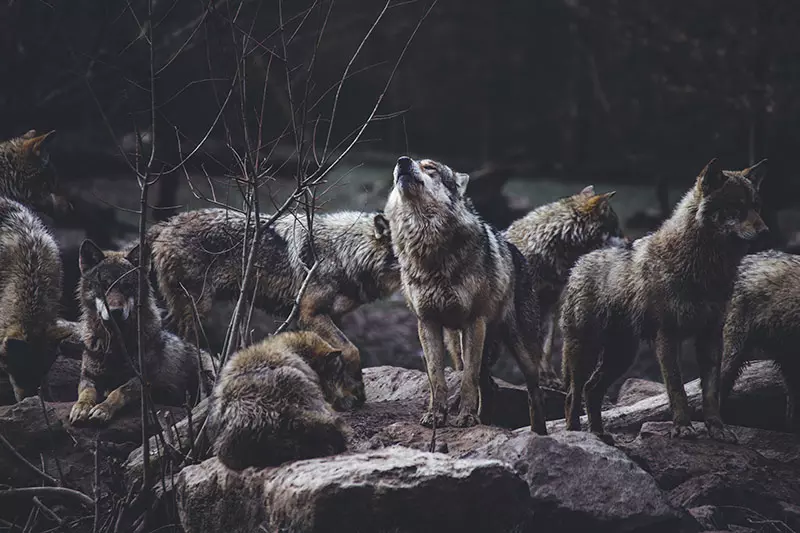 In the last part of the book, which is dedicated to the largest and at the same time the most intelligent mammals - whales, Safina tells the story of his stay in the society of Ken Balkom, who has been studying the killer whales in the southern part of the Georgia Strait in the Pacific Ocean for 40 years. And again, Safina immediately draws attention to the fact that whales have a unique brain, a communicative system and good nature, and, despite all the fears, not a single killer wise has killed a single person.
From a conversation about the incredible frequency ranges of whales, which are simply inaccessible to man, about their “special” language and the structure of the skull, the author proceeds to the intimate details of the life of whales, which are very similar to human ones: “Adult male killer whales can also arrange love games with each other. We saw groups of guys who played ten -meter penis of each other. Like dolphins, they often come into contact with the individuals of the same floor with them, using a fin or snout. Many dolphins who live at large masturbate with the help of different objects, and Ken even watched how excited killer whales rubbed about his boat. Very energetic, but not aggressive. The bottle -haired dolphins are more than all other creatures prone to same -sex love. Dolphins love sex and often deal with it. ”
From the stories of the "life" of animals, the author returns to their problems related to a person. A serious study of the braids began only in the 1970s of the last century, and before that, the imagination of people painted a primitive picture of the killer whale. Until the 1990s, research was carried out exclusively in captivity, which, according to Safina’s colleagues, led to the distortion of data: “Imagine that at the age of four, whales that you admire you. You will cease to develop speech, normal socialization will stop. The world will get cleared up to one room that is surrounded by whales looking at you. Memories of the big world and the family will come over. You will get food after you lower your head into the water to take a treat from the hands of fascinated educators who have never seen people living in families. They will not be able to understand your actions. Your education in all respects will end. You will no longer belong to the big world. ”
It was the misunderstanding of the lifestyle of animals that led to their extermination. Only from 1950 to 1980, he cites a shocking example of Safin, Norway, Japan and the Soviet Union killed about six thousand killer whales, which, without a doubt, caused a sharp reduction in their population. “In 1956, the Icelandic government, frightened that the wars were hunted by herring and tearing fishing networks, accused them of“ bringing the loss of the fishing industry ”in the amount of two hundred and fifty thousand dollars (amazingly small amount, even if you take into account inflation, and, of course, including damage to the herring of mammals, marine birds and marine birds and marine birds and marine birds and marine poultry. fish) ” - continues the author. The ban on the shooting of wars in the United States was released only in 1976, and there is still no prohibition on their capture in Russia.
The heartbreaking stories of catching and murders of Kille Karl Safin finish, hoping for the compassion of readers to the whole animal world:
“Let's see what will happen in the last act: the triumph of human intelligence or catastrophe. Comparing them and ourselves, we become closer. The most important thing is to understand that all living things are one. The world will not save the calculations, but compassion. I want everyone to understand it. And sometimes it seems to me that the killer whales and elephants are one of the few who understand this. ”