
Translated material
Beast as utopia and metaphor
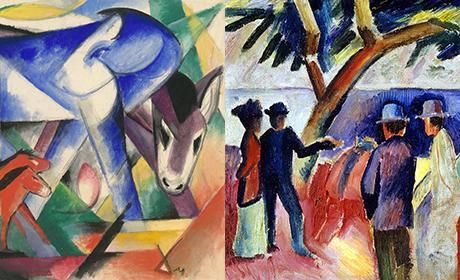
Animalism in art and music. Conversation with Solomon Volkov
Alexander Genis: Today we will talk about an exhibition in one of the Favorite Museums of New York, where masterpieces of German and Austrian modernism are collected. This is Neue Galerie. Located in a luxurious mansion on the fifth Avenue with a cafe, where the most delicious Viennese cakes are served, the museum constantly offers the New Yorkers, which make it possible to plunge into the past, which again became relevant.
The story of the most developed, most educated and most advanced part of Europe, which fell into the abyss of fascism, does not cease to worry us. Especially today, when populism and nationalism everywhere become an important part of a new political spectrum in Europe, in Russia, in America. The art of two collapsed empires-German and Austro-Hungarian often warns about the danger of this path. In the first decades of the twentieth century, the most talented and original masters worked in these parts. But their work was overshadowed by the shadow of the disaster, which was felt by the most sensitive artists. No wonder Vienna was called the "Laboratory of the Apocalypse."
When last year the world celebrated the 100th anniversary of the end of the First World War, the museum arranged an exhibition of two beautiful artists who became its victims. Their fate and creativity cannot but touch us a century later.
(Music)
Alexander Genis: August Mack (1887–1914) and Franz Mark (1880–1916) were close friends and associates, stars of German expressionism, prominent members of the Blaue Reiter group (“Blue Horseman”) and the recruits of 1914. Mack was killed almost immediately, he is buried in a common grave. Mark reached Verden, at the place of his death there is a modest monument.
Unrequited and meaningless death united them in the minds of the audience, and the New York exhibition allows you to trace their parallel evolution. Both began with student realism, both admired Van-Gog's protoexpressionism, both adopted a dense abris from him, unusual impressionists, both fell under the influence of Kandinsky, both went to abstractionism, but it would not be known whether they would have reached him, because the most interesting thing happened halfway. Having parted with an honest portrait of reality, they distorted nature using paints as Matisse (another important influence) - according to picturesque rather than vital logic.
Mack was best succeeded in female figures. Although he often showed them from the back, his wife, whom Mack wrote 200 times, is recognized in all. With its best portrait presented at the exhibition, he did not want to part until he was owned by his uncle, which means he did not go far from the house.

The story of Mark is more complicated and richer. He wanted to draw only animals. An example of this is a double portrait of a dog that opens the exhibition, for which the same dog posed, reminiscent of a familiar artist of a small polar bear. Even on the first quite student canvases, the strangeness of Mark is noticeable: he, as can be seen from the picture with deer, his beloved animals, wrote the forest from the point of view of animals, not people. For us, this is an almost impenetrable thicket, but through it the look of deer easily slips.
The work of the mature brand can also be judged by the poem of his contemporary, the great German poet-symbolist Stefan George, written in the same 1911, which became a turning point for Mark. These verses translated by Sergei Radlov.
Here the animals in the thickets with people weaved
In the Union alien, confused by silk,
And the blue lunes of the sickles, flickering in the height,
Failed in a dance with white stars.
Here are magnificent in the middle of naked lilies spots,
One with the other is so wildly, in thelame.
And nobody is incomprehensible to anyone ...
Suddenly in the evening everything will come to life tenderly.
And dead, rustling, trembling branches,
And people, animals are woven by a pattern -
All of the bizarre
With unraveling clear and affordable eyes.
She is not at every hour desired by us,
Not in a craft in a legacy from the ancestor -
And many never - and not speeches -
And in the images it is rarely given.
(Music)
Alexander Genis: Animalism became for Mark passion, vocation, in the end - religion. Not only did he like the animals more people, this happens with many, Mark believed in a happy world, where animals are perfectly without us.
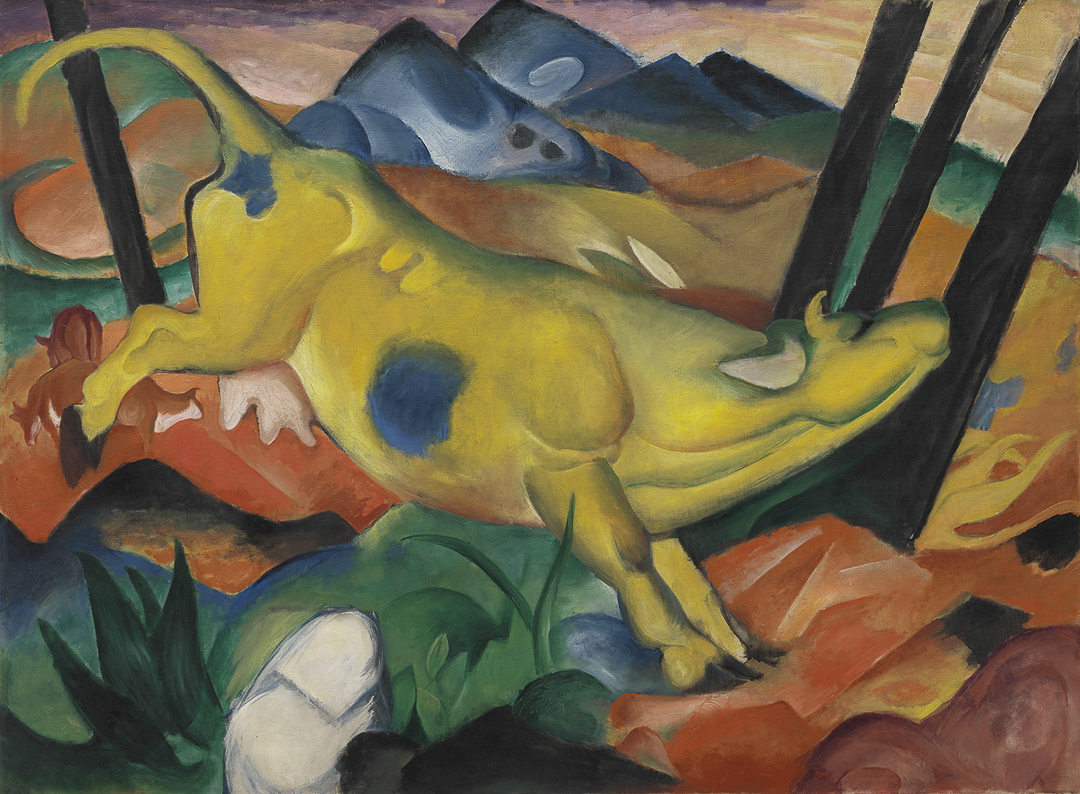
Such is his masterpiece of the same fateful for the Western avant -garde of 1911 “Yellow Cow”, which constantly lives two quarters from the exhibition at the Guggenheim Museum. Along with the “scream” Munka and the gold portrait of Adeli Klimt, this picture became an icon of modernism and in this capacity froze with magnetics on each refrigerator. Including - mine.
For me, this is a joyful finale of the travels of cows along the canvases of my favorite artists. The first of them is Paulus Potter, who in the 17th century created the heroic symbol of the Motherland, depicting it in the form of a bull to the sky. Mighty and homemade, he, together with another beloved allegory of this country - a windmill, represents a Dutch character practical to holiness.
Completely different cows live with Shagal. Innocent victims of the butcher, they humbly carry their cross and sometimes speak in Hebrew.
Another cow hangs at my house. I bought it from the ideologist “Mitkov” by Vladimir Shinkarev. The picture looks anxious: a bewildered cow comes out of poisonous greenery. In her eyes - not fright, but dull hopelessness of nothing confident. She does not wait for help - she just waits, ready in advance to exchange the familiar hardships of life for strangers.
Unlike all of them, the cow Mark came from the bestial paradise, which is spread after her on a huge - in the entire wall - a canvas. As promised to us, she got here in a transformed form, which is why she became yellow. In those years, the artist, like everything in his circle, professed the symbolism of color. Blue was considered male, yellow - female, red - brutal. The yellow cow with a blue spot seemed to exhaust the universal essence of her tribe. Perhaps she was conceived as the heroine of an unwritten fable. In other words, this is a symbolic cow, but the main thing is that it is infinitely happy, as evidenced by a smile in the face, and elegant, as much as possible, with its physique, the bend of the back caught by the artist in the jump. Left without human supervision, she lives in Eden, and not for us, but for herself.
Probably, I thought, standing to the scattering of the picture at the picture, Mark would like to become such a cow in the next life. In any case, he thought about it, for at the end of his short life he began work on illustrations for the Bible. Judging by the sketches, he was captured by the very beginning - the Earth at the dawn of the sixth day of creation, when God had already created animals, but has not yet reached Adam. Verden cut off the life of Mark in the most interesting place.
(Music)
Alexander Genis: We will continue our conversation with a culturalist and musicologist Solomon Volkov.
According to the long-established rules, all our conversations about New York exhibitions are accompanied by a conversation about music, a consonant of the exhibition. The union of two non -verbal types of art is becoming more and more obvious in museum business. Today, exhibitions are often arranged as a theatrical show, which is certainly accompanied by music, consonant exposure. It can be the opuses of the same era, or stylization on the theme of the exhibition, or the plot of close works, finally, musical works inspired by one or another picturesque masterpiece. Whatever music the curators choose, visitors can always take a record with them as the best souvenir from the exhibition.
Volkov and I tried all the strategies of the connection in our programs of the word and music, because it seems to us that this way of talking about fine art allows how to feel the atmosphere of the exhibition and bring the listener to its context, expanding it. Each time we strive to find a special musical rhyme for that central plot of the exhibition, which makes it important and relevant.
(Music)
Alexander Genis: So, Solomon, our today's topic is animalism in art - in your hands.
Solomon Volkov: When I began to think about this topic from your presentation, I was interested in this identification of Mark with a cow. Such a kind of anthropomorphism. You said that Mark saw the cow of the heroine of the fable, and animals appear in the fables, which mean people, and Ivan Andreevich Krylov, with other fabulists.
Alexander Genis: In good fable, they also remain animals too. Saltykov-Shchedrin, for example, has a lot of fairy tales where animals act, but at the same time these animals are similar to animals and people at once. In one fairy tale, it tells that they decided to bribe a faithful dog Trezorko. Trades is depicted as a normal dog. But how are they going to bribe it? They want to slip him in the form of an album in the species of Zamoskvorechye.
Solomon Volkov: In this regard, I thought about how animals transform into people in music, and found two rather revealing and in some way even interconnected examples. The first, many people know about this work, if not everyone who is generally interested in classical music is a play from the Carnival of Animals Saint-Sanse cycle.
Alexander Genis: This music is known not only to those who are interested in classical music, but by everyone who went to school. In the singing lessons, I don’t know how it is now, but in my time, the music began with Saint-Sansa Carnival.
Solomon Volkov: What was shown there?
Alexander Genis: They showed there the essence of music. Saint-Sansu I will never forgive this. Our teachers believed that the best music is onomatopoeic, which means realistic. You remember that the word "realism" was magical in our school. If Saint-Sans depicts how the donkey shouts, then this is the right music, but who is portrayed by Mozart, Beethoven is still unknown. And this for a very long time, up to about forty years, prevented me from understanding classical music.
By the way, Saint-Sans himself “Carnival of Animals” never published, because he did not want him to be associated with frivolous music.
Solomon Volkov: This is the fate of the most popular works. Kamil Saint-Sans was an extremely curious character, one of the most curious in the history of music. Firstly, for starters, he was born in 1835, and died in 1921. I always pay attention to such dates, because it seems to us that we are now living in some incredible revolutionary times, already the earth is trembling under our feet.
Alexander Genis: So it is. We were born in the Soviet Union, and he died before us.
Solomon Volkov: But imagine a biography-Saint-Sansa, who was born in 1835, and died in 1921. These are completely different worlds.
Alexander Genis: From the Paris Commune to the First World War.
Solomon Volkov: And after her. This fascism was already born both Italian and German. Modernism was already a long time ago "Spring Spring" in 1913 Stravinsky. The composer, who carried out his first steps as an archire -revolutionary in music, and finished as a super -conservator.
Saint-Sans was probably the largest child prodigy in the history of all the music, that is, he was a big windoderkind than even Mozart. He began to compose from the age of three, and act as a pianist at five. At the age of five, he analyzed Don Juan in the score. At the age of 7, he learned to read Latin. He had a fantastic memory, he was engaged in professionally astrology, archeology, and occult sciences. The collection of poems published, not to mention the fact that he was a musical critic, organist, anything. By the end of his life, Saint-Sans, as I said, became a conservative and hated Debussy. Moreover, he was small, similar to the parrot, also whispered and said approximately like this: "I will specifically stay to watch Debussy to say what a bastard he is."
The most famous play from the entire "Carnival of Animals" - "Swan". The majestic picture: he portrayed a swan who floats along the bosom of the waters. But in 1907, the young choreographer Mikhail Fokin (this is also an amazing story-a chain of accidents, improvisations, about which I would like to say that a person kissed Apollo or Muse of some kind) Anna Pavlova, already a well-known ballerina, ordered a number for a charity evening, some trifles. Fokin agreed and sparkled in a few minutes the ballet miniature to the music of Saint-Sanse Swan. We now all know this miniature called "Dying Swan." But there was no dying swan-neither both San Sans, nor Fokin. The latter imagined just an anthropomorphic situation in which the swan symbolizes a beautiful girl who blooms and floats through the bosom of water into her future beautiful life. But Pavlova changed the plot. She improvised with him, Fokin himself recalled this: he showed her, she followed him, and then she showed him, and he corrected her - it was a joint creation.
Alexander Genis: There is nothing more beautiful in the world than the resonance of two creative people who breaks bridges and lifts us up. This is a fabulous sensation.
Solomon Volkov: Well, two brilliant personalities are once, and then - a coincidence, happy moments. In fact, even to be present with this kind of creation, probably happiness: to see how this “swan” number was created. Anna Pavlova continued to execute this number and introduced more and more tragic features into it. Fokin himself was not directly related to this, he did not mind, but Pavlova led the image completely away from the original image that Saint-Sansu and Fokin was seen. So the same music with the appropriate interpretation can turn into its opposite.
Alexander Genis: It is interesting that Saint-Sans did not want to print his work. After all, it was written as a joke. Somewhere in Austria, he rested and wrote this opus for a cabbage. In it, he parodied the famous composers of his time, mocked them. All this was not intended for the public, except for the "swan", which he apparently liked more than others, he allowed him to publish, and therefore this dance arose. When he saw that she had arranged Pavlov, he was very surprised that the swan was dying, but he did not protest, he liked it. The entire "animal carnival" first appeared only after his death in 1922.
Solomon Volkov: The transformation in music, which is now in our minds inextricably linked with the appearance of a dying, tragic figure, is amazing in itself. “Swan” is one of the most popular ballet miniatures of all time. There are wonderful creations and wonderful coincidences. Recall how the immortal "swan" of Saint-Sansa sounds.
(Music)
Solomon Volkov: Saint-Sans, as I said, was very popular in the 19th century, in the twentieth century he was already treated as a ridiculous conservator with all his amazing giftedness in various fields of culture and science. But in the XIX it was a European famous figure. However, he had an unknown large adversary-Modest Petrovich Mussorgsky, who, having heard one opus of Saint-Sansa-Dance Macabre, just got on his hind legs.
Mussorgsky wrote incredibly colorful and inventive letters. Moreover, each addressee in its own way. There are such people who write to everyone in the same style, but there are people who, for each addressee of an important one, save their special style. That was Mussorgsky. So all his letters cost considerable work. In 1875, he wrote to Stasov about Saint-Sansa (he knew that he was small in stature, and called him "creative baby"): "I deny him all the brains of my skull. I pushing it with all the power of my heart beat.
Alexander Genis: Biblical curses are straight.
Solomon Volkov: He brought down all his powerful anger on the unfortunate Saint-Sans. But Mussorgsky himself has an amazing example of the same animalism. This is a small fable, and curious, the vocal fable written on its own text. But then he composed his text, he determined his genre with a “secular fairy tale” and called the “goat”. It tells that "the girl was walking to take a walk, suddenly a goat to meet her -" old, dirty, bearded, terrible, evil and all the furry. The last devil. "The girl was frightened and hid. But then, the Mussorgsky continues," the girl was going down the aisle, she got married. "And she goes after the Great Sveta goat, which" is both old, terrible, evil and bearded. The last devil. "But, adds Mussorgsky, unlike the case with the goat," What, the girl was frightened? How, she caressed to him. "She said how she loves that she would be a faithful wife. Here is such a fairy tale.
Alexander Genis: Sarcastic variation for the picture of Vasily Pukirev "Unequal Marriage".
Solomon Volkov: Yes, absolutely. Opus is dedicated to Borodin. You cannot call it a romance. This is a sketch of a song in the style of Mussorgsky. One of the most, in my opinion, its expressive opuses and not very famous at the same time. This song is amazingly performed by one of the great bass. After Chaliapin, bypassing the famous bass of the Bolshoi Theater, I will call Boris Gmyrya, amazing Ukrainian bass, with a very complex biography, a phenomenal vocalist and an artist, unsurpassed, like Chaliapin, the performer of Mussorgsky. He had a special relationship with Shostakovich, which we will ever talk about. Shostakovich was in a knee -reproached way to Gmir, and Gmyr calmly refused him, ignored him, could not respond to letters for a long time. Shostakovich even wrote: you didn’t answer, I understand that you are probably busy. Something incredible, so he appreciated him highly. Indeed, it is impossible to hear Gmir and remain indifferent to his interpretation. Я предлагаю послушать опус Мусоргского "Козел" в исполнении Бориса Гмыри.
(Music)