
Translated material
General civilian boiler
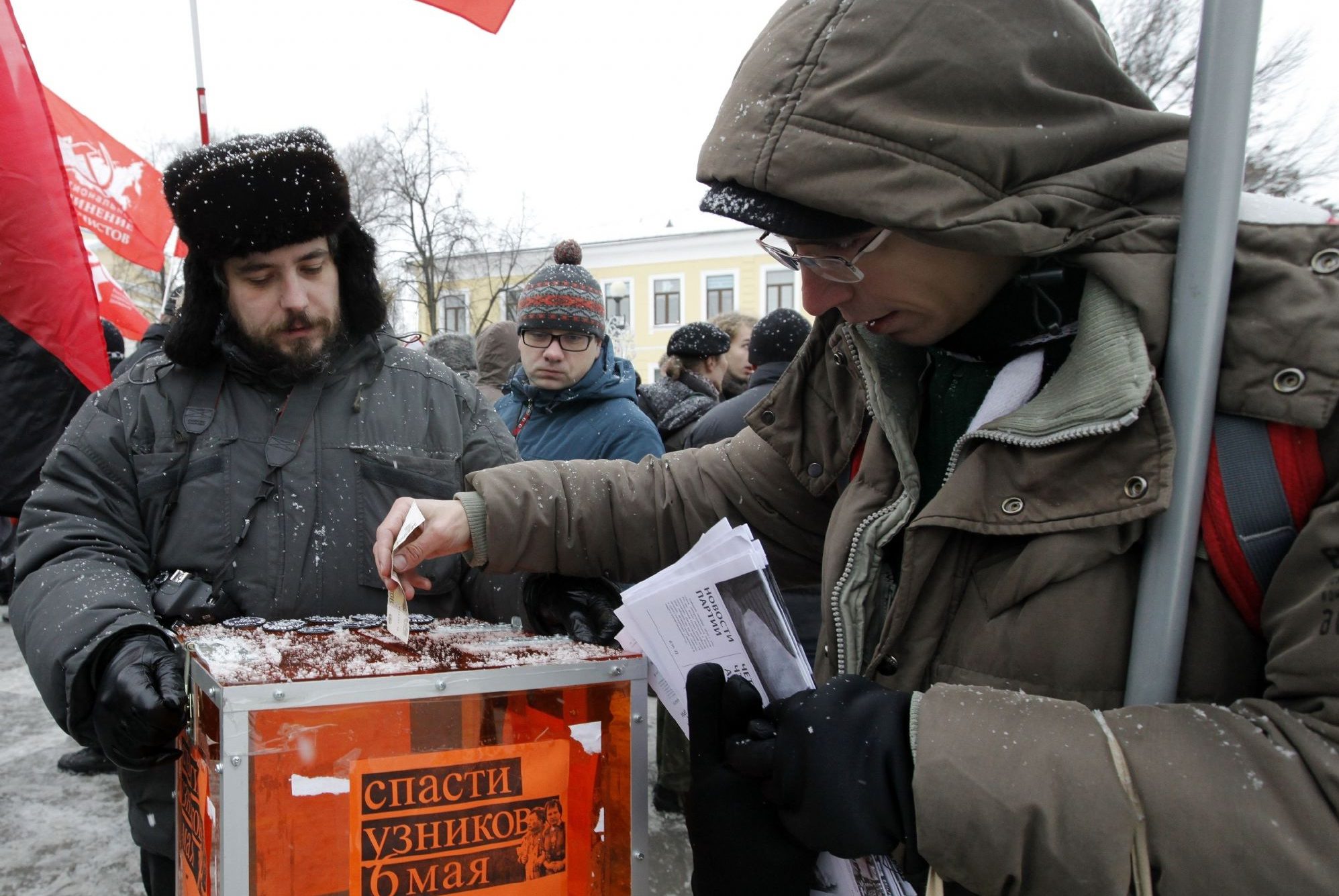
Why are civil activists not looking for large sponsors, preferring unstable private donations to them
St. Petersburg is one of the Russian cities with the most pronounced civil activity. Dozens of public organizations work here, and in 2018 the city became a leader among other regions in terms of the number of protests. As a rule, activists work for symbolic money or for free - according to them, organizations often have neither profit nor a salary fund. But there are large expenses - for example, renting premises and paying projects. Sometimes there is not enough money for either one or the other: even for rent, managers have to collect, accumulating debts and adding from their pockets. At the same time, all these organizations are not looking for stable large sponsors, preferring small private donations to them. And this seemingly unexpected choice is a completely conscious decision.
Money runs
Organizations created by activists differ in the main areas and goals of their work. But some of them are difficult to attribute to one category.
“For example,“ nights ”have two areas of work: direct assistance to our wards and the work of lawyers, aimed at making the state to do their work,” says Vlada Misyurova, head of the department for attracting resources of the “overnight stay”. “They write complaints and appeals for specific people and on systemic problems.”
 Vlada Misyureva photo: from personal archive
The budget “Nighteous and the organization”, according to the organization itself, in 2018 amounted to 61.2 million rubles. Of these, 26.3 million are private donations, 16.8 million - foreign and Russian grants, 10 million - corporate donations, 6.8 million - state support, 1.3 million - income from bank deposits. Organizations also donate products, clothes, services of a total of 35 million rubles. Misyurova says that over the past 8-9 years, the income structure has changed a lot: instead of grants, private and corporate money has come first-and it is on them that the organization is now betting. “So far we are just learning to attract money from business so that this is not at the level of some personal sympathy of leaders,” she says. “We are trying to promote the idea of corporate social responsibility.”
The level at which corporate money attracts now, Misyreva calls the artisanal: such donations are based on personal enthusiasm of any one employee. “Or in the idea: everyone has corporate social responsibility, why will we not have, we are not a serious company?”
Other organizations are even more difficult. “Open space” on Dostoevsky Street appeared in 2012 as a project “Observers of St. Petersburg” - a community of people who monitor the election. Now, in addition to training before the elections and duty during the elections, there are film screenings, lectures on activism, HIV-educational, meetings of human rights activists who help in the courts detained at rallies. The project manager Ilya Ershov recalls that the whole first year the “space” raised money with the help of a fundraising.
“Our colleague went to familiar companies and asked for money, explained how important it was to exist such a place. But a year later she was tired and eventually returned to the business. And we decided to collect money only once every six months, and exactly as much as you need to rent, utilities. We went to Va-Bank and did not choose the amount, but simply indicated the necessary, without which we will not live. ”
The money began to be collected using crowdfunding platforms, then another idea appeared - they began to sell souvenirs. In 2014, the “open space” was required to survive 60-90 thousand rubles a month: 55 thousand for rent, from 5 to 20 for electricity and communal apartment, 2 thousand on the Internet and the phone. Almost every month, the organization finished in the red - from several thousand to tens of thousands of rubles .
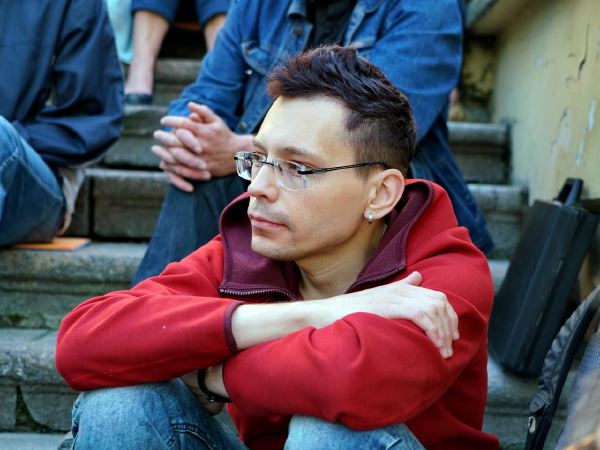 Ilya Ershov Photo: From Personal Archive
“And then activist Varya Mikhailova came to us and organized an auction, at which we collected a third of the amount necessary to repay our debt [for rent and communal apartment],” says Ershov.
At the auction in the Open Space, lots were sold to activists themselves and sympathetic. The authors put and talked about them, the role of Gong was played by a pot of potato and a crowd for potatoes. Among the lots there were posters from rallies, Pussy Hat's personally connected caps, which became a symbol of female protest in the United States, the book of Oleg Sentsov, bread on the sourdough brought from the Maidan. Ershov says that it was not so much in lots as in their perky descriptions and the general atmosphere of the holiday: “Auction is a struggle. Sometimes, having won the lot, you understand that you need to pay 5 thousand rubles for it, and this is all your money at the moment. Honestly, I sat in the hall and pinned myself because I had no money, but I understood that I wanted this hat. ”
Ershov says that since then the horizontal of donations - when the community participants themselves “take off” - has become a fundamental for space. “We realized that a community of activist projects has formed around the“ open space ”,” he explains. - There are no grants, large partners, because it would be addiction. And the one who invested his 5 rubles or 5 thousand rubles feels involved, this forms the community. ”
Neither Ilya nor other organizers receive the salary here. According to him, the “open space” collects about 300 thousand rubles for every six months, the annual turnover of the organization is less than a million.
“We constantly live in debt, and this is normal, we are not a commercial project and do not extract profit. But since we regularly contribute a large amount, in general, our landlords somehow come to terms with this, ”concludes Ershov.
Grants and subvers
"How much did the State Department give out?" -They write in the comments on the page of the new project of St. Petersburg lawyers-law enforcement officers "Team 29". “We do not have a State Department, but immediately the Lord God himself,” the group administrators answer. For its projects, “Team 29” collects money using crowdfunding.
A lot of activists joke about the money of the State Department among activists. But getting them is not so simple. For foreign (and not only) grant programs, activists are often told by colleagues who themselves cannot claim this money due to another topic. Sponsors can be funds that, in turn, receive money from business. It often happens that the fund needs to be implemented in a particular region, then competition is greatly reduced. And sometimes their grants are divided into “subvers”-that is, some organization receives them that gives smaller amounts to others.
The principle of action here is the same as when hiring a subcontractor: the recipient of Grant can decide that some part of the work will be better done by another organization, and share money with it. For example, in the leadership for recipients of grants from the European Commission, they explain that a subversal can be given if the implementation of the project requires this, however, the distribution of subrogants cannot be the main goal of the project. But getting foreign grants is not easy: a lot of effort goes “to the bureaucracy” - and the result is often not worth it.
Read also It is authorized to declare how to write a statement to them, so that they are not accused of false denunciation in response? How does a false denunciation differ from slander?
“Sometimes we do not submit applications simply because we understand that we will spend more resources on paperwork than we get,” says one of the activists. - And you can spend months and not win at all. Larger organizations have “sterile” reports, and it is very difficult to organize it small, there is simply no one to double -check each piece of paper, especially for the sake of small amounts of 10-20 thousand rubles. If there is funding, checks will begin, an accountant will be needed. At some point, you have to choose: to remain a small organization, but without much money either risk and apply for grants. ”
Political activists almost never try to attract serious sponsors in Russia - they explain that it would be a waste of time. Small donations are more reliable than one grant or sponsor: the grant may end, the sponsor will change his mind, and private transfers, especially regular ones, allow the organization to plan the budget.
“Business always has its own interests,” says Ershov. - In addition, it is important for us to want people to participate emotionally and financially in support of the project. If we get money from the very people who come here, then we are sure that they really need it. Do the sponsor need it - you can never be sure. But maybe we have not yet found an ideal sponsor that would share our values and support the community. ”
But small private donations to attract just the most difficult thing, specifies Vlad Misyur, for this it is necessary to interest and involve more than one entrepreneur or granter, but hundreds of people in their activities. Therefore, social networks for the "night" are one of the main tools of fundraising.
“We cannot simply ask for money to help homeless people without telling human stories: who are these people, how they were on the street, why they cannot get out themselves, what difficulties and dangers they fill their every day and why they, in fact, need help. People at the level of instincts have no feeling that the homeless needs to help, you need to immerse in the topic. Although in fact it always works like this: everyone needs to tell about their work so that people want to give money. ”
In the state support, the case plays a decisive role. For example, the deputy of the Legislative Assembly Alexei Tsivilev in July 2018 proposed creating a specialized medical center in St. Petersburg for seriously ill -pounded people, in the winter of 2018 - heating points for tourists near attractions. But the idea did not arise from scratch.
“He is simple -mindedly all said:“ I just walked along the street to the subway, and I walked so far, you know how cold it was? I was very frozen, and then I thought: “What is it, but how do people go?” - He said this publicly, and when after that the media began to ask what was done in the city so that the homeless people were not dying of the cold, he did not think very much from this point of view.
More than six months have passed since then, but during this time only two additional heating points appeared in the city. The deputy, already turning to and. O. Governor Alexander Beglov, again asks to install heating points in the city. Because places in the houses of night stay in the winter of 2019 are enough for only 288 people .
In February 2019, the chairman of the Overnight Grigory Sverdlin met with Beglov, who promised with the participation of the shelter employees to create a city program to help the homeless and allocate money for it, and also took control of the issue of renting for the “overnight” of the site near the area of courage, where they want to open shower and laundry room for stray people. But it is not easy to rent land from the city: documents for a night shelter in the Frunzensky district "Overnight" have been coordinating the city with the city for a year and a half.
Fines on trust
A constant article of the expenses of political activists - administrative fines. Their court appoints after each unauthorized rally several dozens (and sometimes hundreds) of the detainees. According to the group of assistance to detainees in St. Petersburg (GPZ), fines are growing from year to year: in 2014-2015, the detainee paid 500 rubles to the treasury on average, in 2018 - about 10 thousand rubles. For repeated violations - ten times more: for example, after the action on May 5, 2018, the activist of the group for the detainee for Alexei Belozerov appointed the court a fine of 170 thousand. The total amount of fines, according to the United Staff of Assistance to detained in St. Petersburg, then amounted to about 1.2 million rubles. And in 2019, the Frunze District Court of St. Petersburg ordered activists of Bogdan Litvin and Denis Mikhailov to pay a fine of 7.3 million rubles for the fact that they “trampled the lawn” during the campaign on May 5.
The group of assistance to the detainees itself is a volunteer organization, its participants act in the courts as public defenders of activists, provide legal advice and assistance to just detained people in the police department. But the group collects donations irregularly, once every few months, as necessary, to transfer to the detainees and economic costs. The volunteers of the GPZ do not receive fees, and even decided not to accept money for fines, but simply replacing people who themselves for their fine in their social networks. Because the distribution of this money is a separate big job: you need not just to count how much it has arrived, but to understand who to give how much and on whose penalty the money transferred the money this or that sacrifice.
A member of the group Varya Mikhailova, who helped collect money to the “open space”, in 2018 paid the state a fine of 160 thousand rubles. He was appointed by the Kuibyshevsky District Court for the fact that at the Pervomaisky procession, Varya carried the painting “Nine Stations of the Disfision of the Leader” of the Art Group {Homeland}. Varya tried to challenge the decision in the City Court, but it was not possible to achieve the abolition of the fine. Like the rest of the rallies, Varya remained the opportunity to demand the consideration of their case in the ECHR. However, the European court has been making decisions for several years, so the fines still have to be paid without waiting for the decision. Otherwise, the fined will become an ordinary debtor for the state: he will not be able to leave the country, and the amount of the debt will be retained from salaries. To collect money for a fine, Varya and Group {Homeland} printed T -shirts with the same picture and sold it through social networks. The NBC channel shot the plot of this story , and the musicians of the Czech Psychedelic group Plastic People of the Universe took a picture in T -shirts.
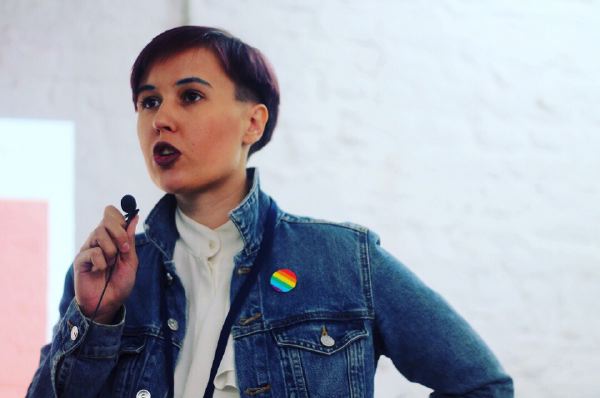 Varya Mikhailova Photo: From Personal Archive
But in most cases, money for fines is collected for personal bank cards, activists themselves note, no one publishes any extracts and reports. The whole system is built on trust: the activist or organization is written in social networks about the start of the collection, and then they also report that the necessary amount was collected. At the same time, the money “for protest” from sympathetic in Russia was collected in the 19th - 20th centuries, says the writer and historian Pavel Gnilorybov, however, not to the specific arrested, but for the revolutionary process in general.
“During the autumn unrest in Moscow in 1905, a cylinder was launched by the Moscow Art Theater with the signature:“ General Dubasov’s bomb, ”Gnilorybov gives an example. - In general, monetary subscription is the most popular way to raise funds in old Russia. And on terror, and on murders, and on monuments. Sometimes, in order not to bother with minor donations, they made robberies, “exes” (expropriation of property). As for the exiles, they were fed by the state itself, and there were enough money transfers from families and sympathizers. ” There was also fundraising: revolutionaries persuaded to help wealthy industrialists. For example, through Maxim Gorky, many gave money underground.
“The main resource of the organization is trust,” concludes Vlad Misyurova. - We have no product that people receive for their money. An employee of the mobile operator may be overwhelmed to me, but I will continue to use the services of the company because I am satisfied with the quality of communication. And we do not have goods and services, only a reputation. There are many people who say that by and large they do not care what we are doing, they are simply sympathetic “overnight”. For example, even when we didn’t even think about going to Moscow, we were transferred about 15% of private donations from there. And one Muscovite told us: “I don’t care at all, I didn’t even understand where you are, I just liked what you are doing and you yourself. You are cool guys.”
The material uses links to publications of social networks Instagram and Facebook, as well as their names are mentioned. These web resources belong to Meta Platforms Inc. - It is recognized in Russia as an extremist organization and is prohibited.
The material uses links to publications of social networks Instagram and Facebook, as well as their names are mentioned. These web resources belong to Meta Platforms Inc. - It is recognized in Russia as an extremist organization and is prohibited.
The struggle for rights Civil activity human rights Russia