
Translated material
Camera, basement, rehabilitation: how they shot videos about the dangers of drugs
Sessions of anti -drug propaganda are held in Russian schools and cultural institutions regularly. Teenagers either draw pictures on the topic of drug addiction, then participate in competitions. Many should remember such a genre as videos that showed and show in the classroom classes. As a rule, they are as naturalistic and rigid as possible, but no one can really say how effective this work is. As part of the study of the place of heroin in the Russian Federation and the world, Samizdat talked with people who shot and shoot videos about the dangers of drugs for Russian schoolchildren and found out how the Kremitorial group, the artist of the Fixikov and the Slavic Church in the United States are connected with them.
Resuscitation of a party
For participants in the Moscow underground club. Jerry Rubin, which has existed since 1992, has long been an absolutely ordinary phenomenon. The author of the cult of zero songs “jump down” Olesya Troyanskaya (died in 1995 at the age of 38), vocalist of the “carcass” and Applecore Alexey “Bitch” (died on December 18, 1999) and others passed through it. “The vocalist of the Chimeras group committed suicide, hesitated at the country of Pankersha Bacillus, left an orphan, a one-year-old daughter of the dancer Kat from the group“ Miracle-Yudo ”,” is transmitted on the website of the anti-drug animated series “Relay”.
The “re-animation” was invented by the director, the founder of the club named after Jerry Rubin Svetlana Elchaninova. The idea was born in the late 90s inside her party, which included rock musicians, photographers, artists and others. These people were far from a healthy lifestyle, the director carefully says in an interview with a samizdat correspondent. Every year the situation became more tragic.
Elchaninova began to meet her friends at concerts in the club less often. “When I began to find out what happened, it turned out that many were rushing, overthrowing or just thumping so that they were degraded and could not crawl to the club. Not a single concert was complete without drugs. Over time, it became impossible to communicate with some - they lost their human appearance. Those who were able to cope with drug addiction have children with physical and mental deviations. Now many sincerely repent of what happened, regret that there were drugs in their lives, ”says Yelchaninova.

The director decided to correct the situation. At first, she gradually changed the club’s ideology towards Straight-Edge Hardcore (the branch of the hardcore-punk-punch, which denies the use of alcohol, tobacco and drugs.-Approx. Author): invited only musicians who lead and promote a healthy lifestyle. Speaking of herself, the director clarified that she always adhered to his healthy lifestyle: “It is not necessary to be inside the process or part of it to evaluate it and figure it out.”
In 2002, 28-year-old Yelchaninova, together with the artist Oleg Pichugin, issued a collection of anti-drug comics. In 2005, after the end of VGIK in the specialty “Director of animated films”, she decided to shoot a series of cartoons about the dangers of drugs.
Elchaninov borrowed the characters for videos from her own comics. Even at the start, the project was supported by musicians from the club. Jerry Rubin agreed to provide their songs for free. According to the director, about a hundred people volunteered to work on the project-multiplier artists, sound engineers, scriptwriters and others. Most of them did it absolutely free, Elchaninov assures. The series were, among other things, the famous Russian animators Pavel “Hihus” Sukhih (“How I lost 21 grams”) and Vladimir Plemiash Ponomarev (“Mr. Freeman”, “Fixiki”). Groups “Purgen”, Distemper, Auktsyon, as well as Nike Borzov, Masha Makarova and others provided their music for different episodes. To collect such a tracklist, Yelchaninov first contacted the groups, and after the musicians came thanks to the "mouth". As a result, the “Re-Animation” videos became full-fledged clips for the songs of rock musicians. So, for example, the video “Little Girl” based on the hit “Crematoria” appeared. According to the plot, the heroine of the cartoon first smokes marijuana, then sniffs cocaine, and after, during hallucinations, the ghost scares her death from injection drugs.
The team shot the first season in a year and a half. It consisted of 26 plots and 15 episodes by timing for three to six minutes. The premiere of the project took place on December 5, 2007 at a rock marathon at the Orange club (in June 2008 it closed.-Approx. Aut.). Then the creators of the “rehabilitation centers for minors were sent from the sale of tickets collected from the sale of tickets, Elchaninov recalls.
The second season of the animated series consisted of twenty episodes. According to Yelchaninova, then the project actively supported the Ministry of Culture (it does not disclose grants). But from the third season, financing from the department was gradually reduced, which is why the creators had to reduce the number of episodes. In total, from 2005 to 2015, the Elchaninova team released five seasons and a total of 62 videos.
Cartoons "Re-Animations" in the framework of anti-drug prevention were shown in schools in Moscow, St. Petersburg, says Yelchaninov. To demonstrate on the air, I bought a 2x2 channel for several episodes, says the director.
The most striking, according to the author of the project, turned out to be the cartoon "Lollipop" published in 2009. According to the plot, the student returns home with an emerald lollipop in his hands. Mom does not pay attention to this, and at this time the boy falls into real dependence on this, at first glance, harmless treats. Love for an emerald lollipop leads to the fact that the boy begins to lose parts of the body (eye, ear, leg, and so on), and in the end scatters into parts.
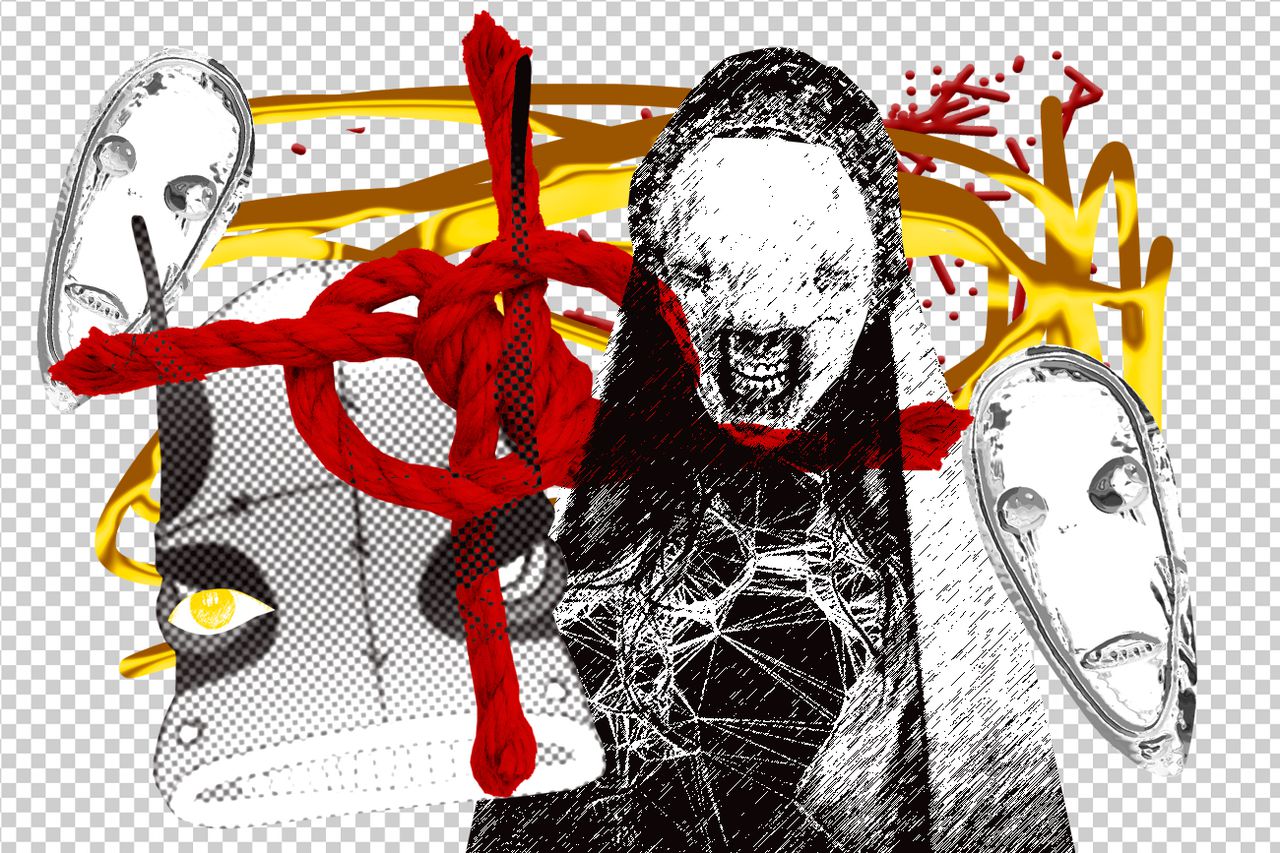
According to Yelchaninova, the "lollipop" differs from the rest of the cartoons of "resuscitation" with a special artistry. “Against the background of all issues, it is less caricature, more atmosphere. Therefore, the “lollipop” acts much stronger than other episodes, ”the director believes. As a result, the cartoon became the flagship issue of the project. The video received about thirty awards of international festivals, says Yelchaninov.
The authors did not seek to turn cartoons into masterpieces of fine art, Yelchaninov explains: it was more important to make everything simple and affordable for adolescents.
“The problem [drug addiction among youth] was on the surface to the middle of the zero - it was felt in every yard, school, club. In the second half of the two thousandths there was a coup, young people began to rethink their values. I think our project certainly helped in this. There was a fashion for healthy lifestyle. Now the problem of drug addiction among adolescents is relevant, but the scale is not so all -consuming. Now drugs are rather attributes of a fun and bright life, and not everyday life and dysfunction, ”the director argues.
According to Yelchaninova, she is still written by novice multipliers and comic book authors with offers of cooperation. The director is ready to help them with advance, but is not going to revive the “re-animation”. “I spent ten years on this project. We just inspired creative people with their example and showed how, with the help of cartoons, you can tell students about the dangers of drugs, ”says Yelchaninova.
According to her, antipaganda using animation is more effective than lectures of narcologists. “Teenagers will not be frank with a specialist. And when the character is fictional, all problems [after watching] can be discussed openly. And based on the experience of the hero of the cartoon, adolescents will be able to discuss their own problems, ”the director believes.
Elchaninova recalls that at the start, many artists and musicians did not believe that the project could affect the audience. But during the work, according to her, they themselves abandoned bad habits. “If now I will see the whole list of project participants, I will see that almost everyone has overcome bad habits,” says Yelchaninov.
Servants from the basements
“We decided not to mount very terrible shots in the film. Although we managed to remove the person who had tape worms in the anus. They just passed the anus. The film and without it turned out to be quite shocking. High school students twice - a boy and a girl - fainted. The teachers did the right thing: they brought them to their senses and forced them to watch. And if we left personnel with worms, it would be even tougher, ”says Samizdat Sergey Matvosyan, author of the Dybenko Celles, and the founder of the New Life rehabilitation center.
In the 90s on Dybenko Street on the outskirts of St. Petersburg it was quite deserted. But people often came there for the sake of the main district "attractions" - the right -bank market, the center of the city drug dealer. Medevosyan recalls that many teenagers were wandering there: under various pretexts, they beg with the passers -by money for a dose. Having received it, the children went to the cellars of nearby houses.
In 1995, Matvosyan decided to shoot the everyday life of drug users on the camera. He stipulates that he never wanted to make a movie: in the early 90s he was engaged in business, then joined the Protestant community in St. Petersburg. Once a familiar parishioner turned to him for help. The girl asked with her to go down to Dybenko’s basements to find her brother. There, Matvosyan saw about a hundred people, "who alive and painfully died in mud, cold and darkness." He decided to return there with the operator.
“I saw drug addicts before, but they did not make such an impression on me as those who were in the basements. Returning, I literally grabbed the acquaintance of the operator (soloist of the Petersburg rock band “The Voice of the Housing” Alexei Chernovolov.-Approx. Author), who shot weddings and dragged there. I could not even explain to myself why I want to remove all this horror, ”says the director. He did not plan to mount shots in a two -hour documentary. Moreover, he did not expect that "he would be translated into foreign languages, and then he would look at half the world."
The first 20 minutes of the tape, the inhabitants of the cellars tell how the first to try heroin, how many years they suffer, what they are sick and how they want to live in the future. At the same time, the camera closely demonstrates ulcers, abscesses on the dystrophic bodies of adults and adolescents. One of the young men whose limbs struck Gangren, removes his pants along with the skin.
The filming and production of the film took about a month. The director recalls that neither the inhabitants nor the police interfered with his work, and the inhabitants of the cellars themselves wanted to get into the frame. “Addicts are quite sociable people. They did not ask to stop the shooting. On the contrary, some even started playing on camera, willingly talked about themselves and their life. After all, all people sometimes want to be stars, and drug addicts are no exception, ”Matvosyan explains.
Simultaneously with the study of the basements, he decided to rehabilitate its inhabitants and created the New Life Center-Community in the Leningrad Region. After that, he came to the basements not just as an observer with a camera. Medevosyan, at first politely, then emotionally, and if necessary - rudely and with the help of manipulations, offered drug addicts directly from Dybenko Street to go to rehabilitation on the commune on the banks of the Gulf of Finland. There they are offered to do labor therapy - agriculture, fishing, and so on. Those who wish in the center of Matevosyan will also help to find the way to the Lord. “On the drum, what a faith, for us there are only sincere and crafty, indifferent and indifferent. With sincere and caring, we cooperate, no matter what religion they confess, ”comments the creator of the New Life.
The project of Matvosyan became widely known in 1998 - after the plot of the "new life" in one of the release of the "view". The telephone of the program “For several months worked in good faith” to the center. “They called and said that it was necessary to make a separate line, because the transfer could not cope with the number of calls - they were trying to contact them who wanted to send to rehabilitation to“ new life ”of relatives and friends,” says Medevosyan.
The work of the "New Life" inspired him to remove the continuation of the chronicle from the cellars of Dybenko, but to show the already healed drug addicts. Medevosyan wanted to prove that everyone has hope for recovery. This was a challenge to doctors who considered drug addicts hopeless people, he explains. In the final of the “Dybenko Celles”, rehabilitants talk about their new, “clean” life: someone found a job and went to his hometown, someone remained a “minister” in the commune. But all unanimous in one thing - "thanks to the Lord who helped to cure."
For almost fifteen years, Matvosyan showed the “Dybenko basements” in different regions of Russia as part of a preventive action for youth. Part of the views took place as part of the Federal Anti -Narcotic Program "Train of the Future". Together with psychologists, artists, musicians, priests and athletes, Matevosyan drove from Moscow to Krasnoyarsk. He talked about the possibility of recovering in a “new life” for free, talked with adolescents. “We needed that after the film and my stories they form a personal position against drugs,” Matvosyan explains. At the end of each action, the audience should have been lazy: "There will be no drugs in my life, in the life of my loved ones, my city, my country."

The author of Dybenko's Celles recommended showing the film to schoolchildren of the sixth and one-eighteenth grades. But, according to him, teachers did not always listen to this advice. “Once, a very small schoolchildren were brought to the teacher’s action - the third and fourth grades. When I asked: “Why are they?” - They answered me: “Let them look to understand as soon as possible what drugs are.” I think that even they understood everything. The film acted as a vaccine, ”recalls Matvosyan. In addition to schools, the “Dybenko cellars” were shown in vocational schools, the houses of culture of St. Petersburg. Several sessions took place in Ukraine and Belarus.
On modern teenagers, the film will not produce such an effect. Now, according to Matvosyan, “adolescents are weaker, so they need something else ... They have greatly blurred the boundaries of good and evil. If earlier the boy could be shamed by the fact that he behaves like a girl, now he will answer: “What is it? This is normal. I am a girl-girl,” Medevosyan argues.
The author of the Dybenko Cellings talked with a correspondent of Samizdat while in the USA. In 2006, the US Slavic Church turned to him with a request to open a branch of New Life in the country. The New Life USA center opened in February 2007.
While Matvosyan developed the center in the States, the FSB became interested in the commune of the "new life" in the Leningrad Region. In November 2012, the security forces came to the rehabilitation center with searches. The organization explained this by the attention of law enforcement officers to the city of “City without drugs” Evgeny Roizman (a few days before that the security forces also conducted searches there) and the raiders' interest to the territories of the Center. Sources of Gazeta.ru in law enforcement agencies said that the audits are related to the complaints of local residents about the illegal activities of the New Life and the treatment of rehabilitants.
According to Matvosyan, at different times the Russian Orthodox Church and United Russia offered the Center cooperation. The “attacks” began after he refused. “No church can achieve the results that the“ new life ”has achieved in the rehabilitation of drug addicts,” Matvosyan explains.
Dear Omsk
The sales voice introduces the viewer to three heroes: a smiling pediatrician-resuscitator Lena, a joyful trainer in Snowboard Pasha and a drug addict Dima with an absent look. “If you think that Pasha and Lena are more like you, and Dima is an alien and has nothing to do with you, then we congratulate you: you took the first step to repeat Dimin’s mistake and his fate,” this begins the “Choice” of the Omsk Association of Rehabilitation Centers “Commonwealth”. Next, experts equate the use of alcohol with drug addiction, call ethyl alcohol a potent drug, and hops - the nearest "relative" of hemp.
For the author of the video - the head of the "Commonwealth" Evgeny Velichev - this is the first experience in the shooting of short films. Before that, he shot only short social videos. But today his short films are more successful.
In 2017, Omich Velichev won the competition of the Ministry of Internal Affairs of Russia "Let's save life together!" For the best social video against drugs. A video called “You know how” became not only the winner of the popular vote (he was supported by 16.5 thousand users), but also the best in the opinion of the jury.Velichev shot this video on the basis of the "Commonwealth". He has been heading the organization since 2016. It was with his arrival that the association began to regularly shoot antipandist drugs about drugs. This is the merit of not only Velichev, but also his operator. According to Eugene, he found his partner among the haters in the comments on the published video on VKontakte. First, Velichev suggested that the interlocutor “make a video himself.” А спустя полгода комментатор решился предложить свои услуги. В итоге тандем снял уже больше тридцати роликов — о вреде наркотиков и о психологии.
«Мы делаем эти ролики по-человечески, качественно и вкладываем в них душу. Хочется, чтобы этими материалами пользовались другие люди. Участие в конкурсах помогает сделать так, чтобы о нашей организации узнали», — говорит Величев в беседе с самиздатом. Ролики Величева также регулярно показывают старшеклассникам местных школ.
Съёмочная группа обычно состоит из трёх человек: оператор, ассистент и сам Величев, который совмещает функции режиссёра, актёра и сценариста. Кроме себя, он задействует в роликах и других людей. Например, для видео «Откажись от наркотиков» он пригласил известных омичей: боксёра Александра Шлеменко, ведущих Нелли Скабелкину из омской ГТРК и Ольгу Юсупову из РБК. Величев пояснил, что «на известные и уважаемые лица люди лучше реагируют».
Среди всех антинаркотических роликов «Содружества» самым дорогостоящим стал семиминутный фильм «Выбор». Только за пост-продакшн с 3D-эффектами пришлось заплатить примерно 100 тысяч рублей.
Величев подчёркивает, что не обращается за финансовой поддержкой в администрацию города. Но при этом он уверен: если такая потребность возникнет, у «Содружества» есть все шансы.