
Translated material
Long wires
British deputies spoke out for a delay in Brexit, now the word for European officials
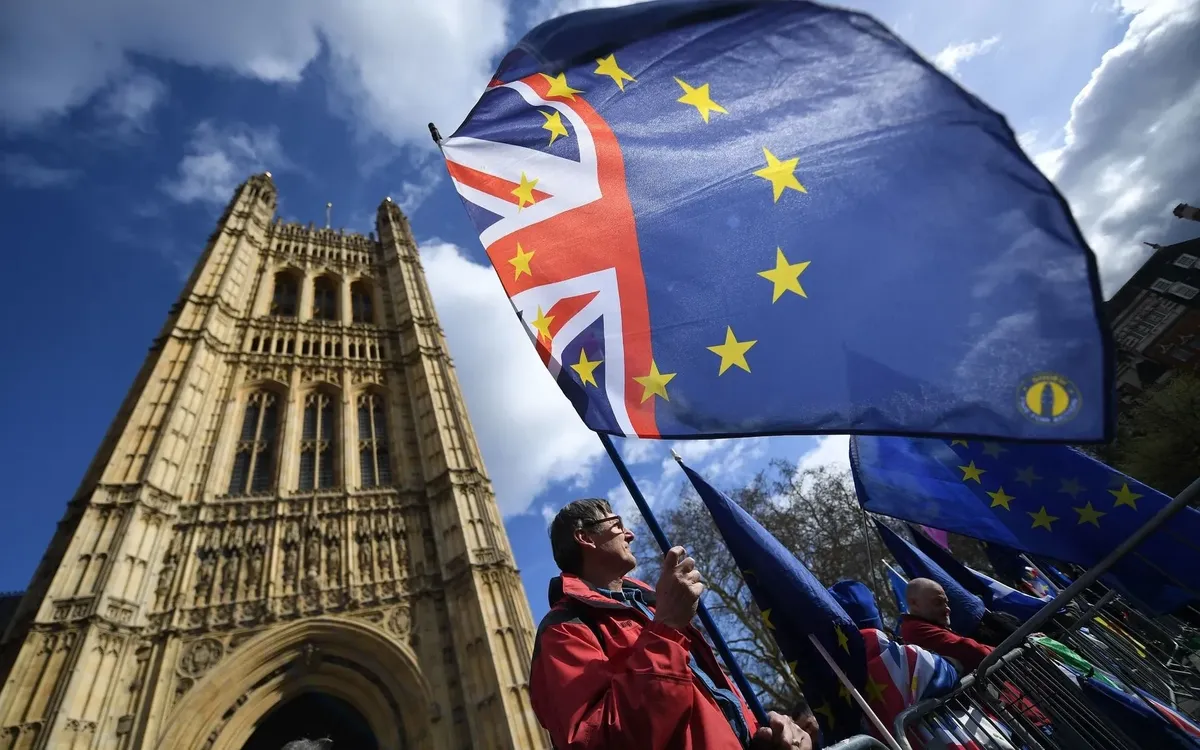
On Thursday evening in the British parliament, voting was held to defer Britain from the European Union. The rules of “divorce” in the case when one of the countries leaves the EU is described in Article 50 of the Treaty of the European Union. In connection with Brexit, it is applied in practice for the first time - and although it assumes that the exit from the EU should take place within two years after the declared decision, on Thursday the deputies asked for time to extend. All alternative options have been exhausted: on Tuesday, deputies once again rejected the draft transaction between Great Britain and the European Union, on Wednesday voted against the "Hard Brexit" - an exit without a deal. The current option is an attempt to win time in order to agree on a scheme that will suit everyone.
Options A and B have not passed
The main problem of Brexit is the border between Northern Ireland, which is part of the United Kingdom, and the Republic of Ireland, which remains a member of the EU. It is assumed that at the end of 2020, Brussels and London will create a joint free trade zone, then the need for the border will disappear. Until that time, the transaction, agreed with the European Union, offers a decision in the form of a temporary Backstop mechanism: all the UK remains in the Customs Union and cannot get out of it at his own free will.
Skeptics believe that in this way the country is in the “customs trap” - it is not a fact that the agreement will really be signed at the end of 2020, and then what is the meaning of Brexit?
On March 12, a decisive vote took place for the second version of the agreement. Compared to the first, it has not changed much: the text did not essentially change at all (the European Union said that this was impossible), but several written statements were added that guaranteeing that Backstop is an exclusively temporary phenomenon and that the free trade zone will be created in the next two years. Despite this, the General Prosecutor of Great Britain Jeffrey Cox on Tuesday noted that “legal risks” have not changed: if the agreement on the free trade zone is not signed on time (and by the example of Brexit, we all became convinced of what European bureaucracy is), then London will not have any reason to leave the Customs Union on his own.
As a result, deputies with a great advantage (391 votes against 242) voted against the transaction. Plan B - “Hard Brexit” or an exit without a transaction, did not pass, which deputies discussed the next day, January 13th. True, a fewer votes were not enough for the approval of the “hard option”: it was supported by 278 deputies, “against” voted 321.
What is bad "hard braces"
The main argument of the opponents of the Hard Brexit is the unpredictability of the consequences of such a scenario, since then the UK leaves the European Union, without regulating any spheres of joint relations with it. So, according to the study of the analytical center New Financial, published on Monday,
As a result of Brexit, 275 financial companies are already withdrawing assets from the UK worth 1.2 trillion dollars.
In conditions of uncertainty, this figure will grow even more. In addition, the economy and the UK and the European Union will suffer from the return of customs duties. Now all the goods imported by the UK from the EU are taxed. According to the forecasts of the British government, published on Wednesday, in the case of a “hard Brexit”, tariffs will be set in relation to 18% of goods.
These arguments forced the majority to vote “against”. However, Teresa May reminded, this option still exists: for example, if the European Union does not allow to extend the terms of Brexit, or if it allows, but for some reason the transaction approved by the majority of the parliament will not appear during this time.
Lengthening Brexit
Teresa May said for a long time that the “will of the people” should be executed on time - that is, March 29, but in January she first suggested that “if a short delay is needed”, then let it be so. On Thursday, the option of “short delay” was supported by a majority vote: 413 versus 202, while it is interesting that most of the MAI-one-party conservatives-187 people-voted against a delay. In particular, many members of the Cabinet of Ministers voted “against”: Liam Fox Minister of Foreign Trade, Minister of Transport Chris Grailing, Minister of Defense Gavin Williamson, Minister of International Development Penny Mordont, as well as a cabinet member, responsible for the connection of the government and the House of Communities (the so -called “leader of the House of Communities”) Andrea Lids.
Now, next week, Teresa May will try to draw her deal for the third time (in which something is unlikely to change during this time) through the parliament.
If the deputies suddenly approve of it by the majority, then the Prime Minister will go to Brussels and ask to extend the terms of Brexit until June 30, in order to carry out all the preparatory procedures in three months. If the transaction fails again, Teresa May will still request an extension of the deadlines-probably longer-but then this will need to be somehow justified.
According to the government’s commentary issued on Thursday, the “great probability” that the European Union will need “good reasons” to approve the extension.
In the European Union, the voting results were already responded, noting that they respected the decision, but reminding: the extension of the Brexit deadlines will require the approval of all EU members. Most likely, this issue will be discussed at the EU summit on March 21–22. However, the head of the European Council Donald Tusk promised his support in this matter. “During my consultations on the eve of the EU summit, I will urge 27 countries to be open to a long extension of the deadlines, if the UK considers it necessary to revise its strategy,” Tusk wrote on Thursday on Twitter.
There will be no re -referendum
In addition to the delay in Brexit, the UK parliament on Thursday considered several more proposals. With a huge advantage (334 against 85 votes), an amendment on a repeated referendum was rejected. By the way, on March 14, Donald Trump spoke on Twitter on Twitter - he wrote that a second vote “would be very unfair to the people who won” during the first referendum.
The proposal of the leader of the Labor Labor Jeremy Corbin, who stated that Teresa May and the Hard Brekit, were no longer “viable options”, so he offers his own option, and “not as a set of political points, but to get out of the dead end”. Korbin proposed “revising Brexit” - to leave the Eurosovyz, but at the same time to maintain a closer relationship with him than the current transaction suggests. However, his idea was also rejected.