
Translated material
From the last empire - to the republic
Russian history in the new coordinate system
If you ask any relatively educated Russian, what state forms existed on the territory of our country over the last, say, 400 years, the answer will be something like the Russian kingdom, the Russian Empire, the Soviet Union and the Russian Federation. Which is generally true, but, in my opinion, it gives an incomplete idea of the progress of domestic history and does not allow you to find its possible ways in the future. In my opinion, there may be an attempt to analyze the history of Russia in the dichotomy of empires and republics, taking into account both world experience and some of the existing similar classifications.
Russia has long been an empire - both in scale and in ways of forming a state, but at the same time its imperial features differed significantly. From the turn of the XV-XVI centuries. The Moscow Principality (which later became called the Russian kingdom) the beginning of a large -scale expansion, which can be called colonial. By the end of the XVII century. The Russians captured the vast spaces of Siberia, and also managed to consolidate control over the former historical centers of Rus' at the same time - primarily Novgorod and Kiev.
In fact, the Moscow princes and kings did the same as Reyes Católicos in Spain, - completed the “reconcist” and gained huge settlement colonies.
Actually, Muscovy was completely not alone in this: the same in the XVII century. All the great powers of the then Europe were engaged. What has become the result of this enterprise - the Russian kingdom of the second half of the 17th century, - in my opinion, can be called the first empire: the state created around Muscovy and consisted of complex expanded metropolis and settlement colonies in the east. The military experiments of Peter I and the formal proclamation of the Russian Empire in 1721 did not change much in the essence of the state: it remained consisting of the Russian-Malorossian Core and the Trans-Ural Periphery-and it was, in fact, until the end of Catherine II, gradually expanding to the west to the old Slavic lands, and southeast of the North-Koronization of the Severzechas steppes.
The end of the XVIII and early XIX centuries. became a turning point for most European empires created simultaneously with the Russian first empire. For the most part, they broke up: thirteen colonies were released, the French sold the United States Louisiana, Spain lost all Latin American possessions, except Mexico, Portugal - Brazil. If you look at the world map of the 1824 model, there are almost no colonial possessions on it (except for Siberia). The Russian Empire has survived, and the European attempt to revenge, heading to Asia, and then to Africa. At this stage, a completely different imperial structure arose: colonization was already impossible, new possessions were seized by force and turned into protectors and Possessions.
Russia took an active part in this competition, having won huge territories-from Finland and Poland in the west to the Caucasus and part of Iran in the southwest, Turkestan in the south and manchuria in the southeast. The empire, which the Russians began to create in the first third of the 19th century, I would call the second empire, since it was a completely new design: the empire created not by one Muscovy, but by all of Russia, and approved not by the resettlement of the Russians, but by military control over the periphery of Par Excellence. The main difference between the Second Empire from European colonial systems was that it combined the original metropolis, new captured possessions and settlement colonies, which were lost by Europeans before.
There was a complex “nesting doll”, surrounded by a common border and imagining itself a single state.
Such a design could not be stable, since it was one of the forms of the complex empire, which was supposed to balance between the mass of interests of the components, each of which was not comparable with most in scale and significance. The First World War, which served as the overstrain of various empires, “collapsed” first of all, all three complex empires-the Russian, Ottoman and Austro-Hungarian (the German Empire was more likely by the name, since there were no serious foreign intransigns within it). The collapse of the empire very often gives rise to the republic - and this is what happened in Russia in February 1917
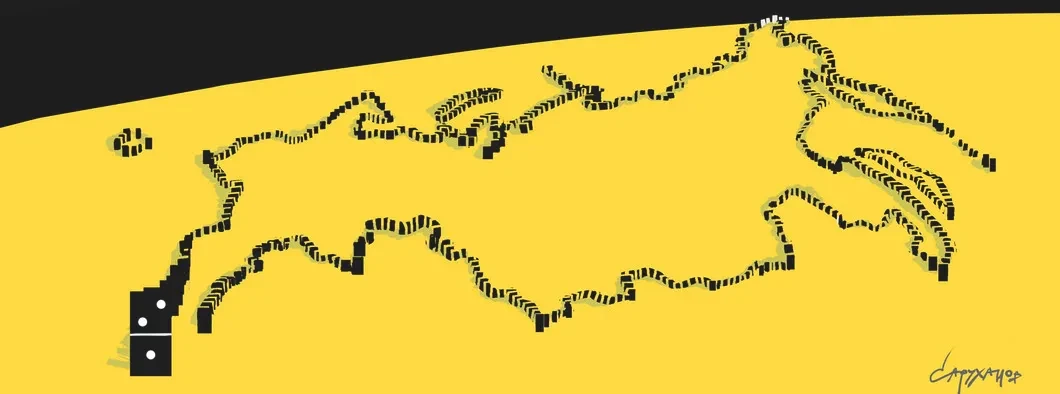
The first republic became a completely European state on its political and legal foundations - but faced an existential challenge, which it could not resist due to its complex "pedigree". The leaders of the First Republic, without even being monarchists, remained imperials, suggesting that the form of government could be replaced within the boundaries of the entire empire - which, in my opinion, was impossible by definition. That is why the republic, instead of dissolving the empire and focusing on changing the state structure of Russia itself, continued to participate in the war, canceled the decisions of the Central Rada and the Finnish Sejm on the autonomy of Ukraine and Finland and continued the strict policy in Central Asia, cleaning the remnants of the rebels after a major uprising of 1916
Realizing the impossibility of preserving the empire in a constant form, the Bolsheviks dared to conduct its “re -nation”: recognizing the independence of Finland, having lost control of Ukraine, Belarus, Transcaucasia and significant units of the settlement colonies in the east, the Communists during the fierce civil war achieved that in each of the former unified state the forces supporting their forces came to power; At the end of 1922, as a result of a sufficiently formal act, the Soviet Union was formed, which we would call the third empire (any similarities with another state that had a similar name, I ask to consider in advance random), since the methods of government did not allow us to talk about republican principles, and the center, settlement colonies and rigidly retained territories with the prevailing non -Russian and non -Slavic population continued to exist Within the framework of a formally single state.
The fundamental difference between the Third Empire and the two preceding were the replacement of the monarchy of the quasi-wise system of power-which, I note, is not so not so that the imperial form of management of the peripheral territories (it is worth recalling that the France was selflessly fought in the 1950s and 1960s for the preservation of their colonies and was completely republic). Another important difference was the formalization of the differences in the status of imperial territories and the division of the empire into the part that, in fact, was the first empire (the borders of the RSFSR almost completely repeated the borders of the Russian kingdom of the times of Tsar Alexei Mikhailovich) and the one that was annexed during the transition from the first to the second and during the heyday of the second empire.
The third empire, no matter how different from the first and second, could not cope with the main imperial curse - the desire for territorial expansion and geopolitical dominance.
The Cold War, multiple conflicts on the world periphery and, finally, a hopeless attempt to occupy Afghanistan led to the collapse of the empire close to the revolution in February 1917. This time, however, the undoubted dignity of the Second Republic was the uncompromising dissolution of the empire (which was inevitably also because the period of colonial rule over the past tenfolds has left over the past tenfields In the past and on a global scale).
In 1991, Russian democrats recognized the sovereignts of the former peripheral republics at a speed that members of the Leninsky Council of Lena would envy, but it should be noted that this time they were adamant in the fact that they concerned the individual territories within Russia, no matter how accidentally they were there (the same Chechnya, for example, in any sense could not be considered part of the first empire, whose historical heiress should claim to be claimed Russian Federation, she is Russia).
The “unconsciousness” of the Second Republic, in my opinion, is generated precisely by ancient imperial reminiscences: how indifferent to its leadership of the fate of the heirs of the Khiva and Kokand khanates, annexed at the end of the Second Empire, the prospects of the same Ukraine, which, in fact, led to the emergence of the first. The “proletarian ideology” and the “internationalism” of the Third Empire are also not worried about anyone, while the fate of the Russian Patriarchate, which sanctified the first wave of imperial expansion with its appearance, is concerned over any decent measure.
Of course, the bustle of the Kremlin inhabitants in no way can be perceived as a real attempt to imperial restoration, which in modern conditions is impossible either almost or theoretically (it was not for nothing that the wisest philofia said that the fourth time, but certain conclusions can be drawn from it.
The conclusions from all that have been said, and from what is happening around it is obvious:
Russian imperial practices are today in the phase of obvious destruction;
The reference point for supporters of imperial ideology is the first empire as the last line of retreat;
Republican principles are entering into an increasing conflict with imperial aspirations, as it happened before, but there is practically no chance of restoring the empire in the narrowed borders (the Winter Palace never paid tribute to the inhabitants of the mountain auls, and the source of wealth and power of the empire has always been a drain population of the metropolis, and not the supply of Siberian fur).
Modern Russia is too hypertrophied in the Coordinates system of the Metropolis-Periferia to be controlled by imperial methods. Therefore, there is only one prospect ahead, in my unenlightened look - the appearance of the Third Republic, completely free from the imperial features and that assumes that radical redeeming of the country that failed (and could not succeed) commit the first to the first. Without such a transformation, Russia will farther down to archaic, and its fate will become more and more unenviable.