
Translated material
When the court is a fiction, but the sentence is real
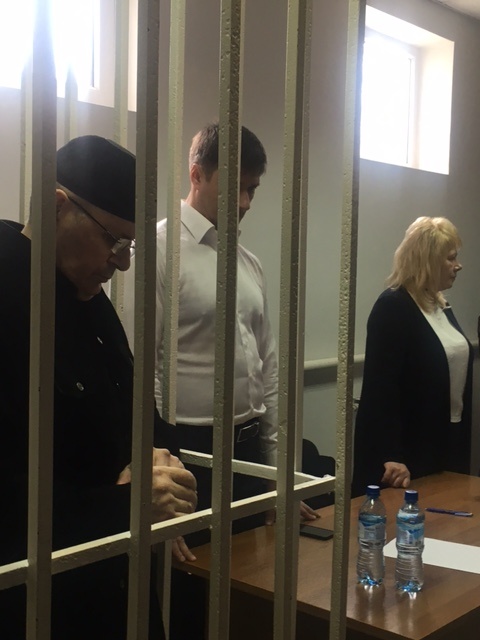
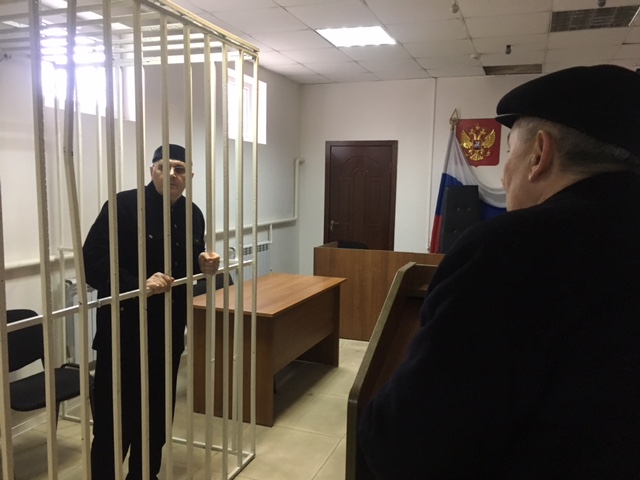
Oyub Titiev received a “four”. As it was - in the report from the court of the court of the correspondent Ntanna Nemtsova
Last summer, the head of the republic, Ramzan Kadyrov, announced the “sanctions” against any human rights groups: “I officially declare to human rights activists - after the Court of Court, Chechnya will become a forbidden zone for them as well as for terrorists, extremists”
“This is the real torture, it should not do this! I would read the entry and plant everyone. Without a toilet, without water for so many hours, ”the human rights activist Alexander Karavaev from Nizhny Novgorod was indignant.
"Torture". It is difficult to calculate how many times we have heard this word in Chechnya over the past 20 years. And here again the story about torture. Karavaev in a whisper says: “Tomorrow, Marina Dubrovina and I will be here in this court in the case of 14 guys, one of them is the nephew of Oyub Titiev. He was given more than 10 years for participating in armed formation. They were tortured. "
Last summer, the head of the republic, Ramzan Kadyrov, announced the “sanctions” against any human rights groups: “I officially declare human rights activists - after the Court of Court, Chechnya will become a forbidden zone for them as well as for terrorists, extremists.” I ask Karavaev if he is worried that from tomorrow, now on Tuesday this week, time will begin “after the trial”. “I worked as I worked, I don’t think about threats,” Karavaev answered. In an appeal from a lawyer Dubrovina, in defense of the rights of the nephew Oyub, Yusup Titiev, familiar methods of knocking out the testimony are listed: “so that the torture is unbearable, for the handcuffs, the detainees' hands are raised on the winch and lowered into a container with water, so that, then attaching the terminals and skipping electric currents and skipping electric currents body, get confessions for sure. "
On the street, before the court and outside the door, people who did not get to the meeting were waiting for a sentence to the hall. Everyone seems to know about the trial against Titiev in the republic. At least those whom I asked in Grozny and in Shali. About how Oyubu “employees threw drugs”, both Yandex-Taxi drivers say, and the guys in a beautiful coffee shop opposite the Grozny City hotel, and hipsters in the square of journalists. They say, and then beg you not to record. “Of course, Oyub is not a drug addict. He is a former teacher, he trained children, he is a true Muslim. I am sure that this is clear to many in Chechnya, ”Madina from Shali told me.
I know Oyub Titiev since 2006. Then, in the Grozny branch of the Memorial, it was not to push through. Many wanted to get an appointment with Natasha Estemirova. People with complaints went for help to human rights activists all day, stood in the corridors, on the street. Someone was gone, “a loved one was abducted” or arrested, someone hoped to find the remains of his dead loved ones, and someone, already desperate to find justice in Chechnya, appealed to the Human Rights Court in Strasbourg. "Memorial" helped people draw up complaints. The sisters of Titiev Zharadat and Hava told how, after the arrest of his brother, in January last year they were supported by a variety of people in the Kurchloevsky, Shalinsky, Argun and Vedensk regions. “No one believes that his brother is a drug addict,” Hava says in a tired voice.
The rural teacher Titiev began to work as a human rights activist in the southeastern regions of Chechnya in 2000, after he witnessed a cruel cleansing, a large number of innocent victims
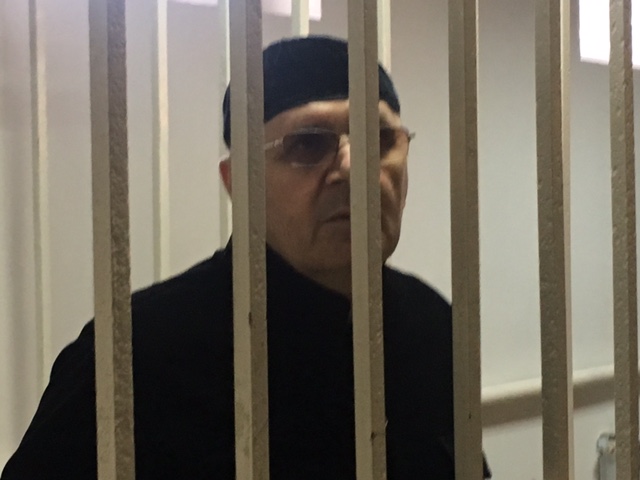
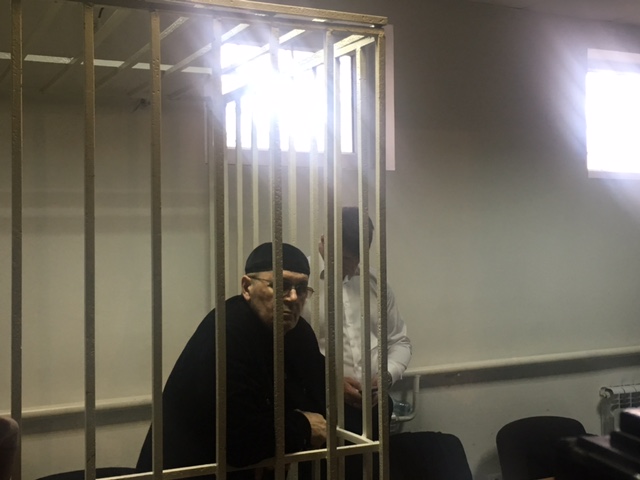
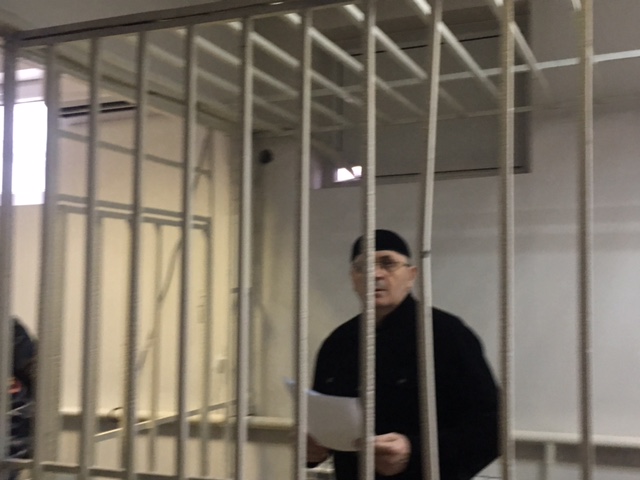
But the judge believed. At ten o'clock hearing, the court said that it considered it possible to “change the category of crime committed by Titiev”, belonging to this crime to the category of moderate severity. Due to the fact that Titiev had not previously serving his sentences, the court sentenced the human rights activist to four years in prison with serving in a colony-settlement. “They fabricated the case against me for nine months, and then for another eight months they fabricated my verdict,” Oyub said loudly in the radio and television microphones and chambers bristling after the sentence.
The rural teacher Titiev began working as a human rights activist in the southeastern regions of Chechnya in 2000, after he witnessed a cruel cleansing, a large number of innocent victims. “Natasha Estemirova brought Oyub to the Memorial. When she was killed in 2009, he was very worried that he was not saved, he felt his personal responsibility for what had happened. And he soon headed the Chechen Memorial, went to the front line, ”says Ekaterina Sokiryanskaya, former colleague of Oyub, the director of the Center for Analysis and Prevention of Conflicts, and there were no others who wanted to do this place.”
After the verdict was issued, the recently emerged from the imprisonment, Ruslan Kutaev said that the colony of settlement is a rather mild punishment, that Titiev will have the opportunity to spend two days a week at home.
“I was the first political prisoner, also convicted under article 228 - heroin was thrown by me. For the fact that I held a closed conference on the eviction of Chechens on February 23, 2014. Oyub still got off easily. I was tortured and beaten. And the bones were broken to me. " Kutaev was not going to flee from Chechnya. “I have one republic. I’m here to support Oyub, like a huge number of Chechens, I worry about it. ”
The Titiyev family did not leave the republic during two Chechen wars, and during the investigation and the trial of the Oyub family, his wife and four children had to be taken to Europe. “This process turned out to be for the Titiyev family“ a real war, ”Oyuba, Yakub, admitted to me. “I told them that I do not need hostages here, people do not need people through whom they will put pressure on my client,” explained lawyer Zaikin. The experienced in Chechen affairs Zaikin is sure that Titiev’s “too rudely clear” case was not fabricated in the leadership of the Chechen Republic, but at the local district level. And that if the court in Chechnya is fair, the case would have long been sent to the prosecutor’s office for a new investigation. To do this, they say, one of a dozen impaired investigation would be enough. “They threw drugs in two packages and in the package, then removed the upper bag with their fingerprints, threw a piece of scotch tape with Oyub’s hair, and forgot to put it in a clean bag. Such a violation would be enough to recognize the investigation not even in Nizhny Novgorod, ”says Zaikin.
After the sentence, Oleg Orlov, chairman of the Council of the Memorial human rights center, admitted that the leadership of the Chechen Republic managed to achieve their goal only partially. “They did it. After threats, attacks, arrests, such vessels we closed our center in Grozny, but this does not mean that we will completely stop working, we will completely leave the republic. We’ll just work differently. ”
The decision of the Shali City Court for NT is commented by a member of the board of the Human Rights Society "Memorial" Alexander Cherkasov and the editor-in-chief of the Internet publication "Caucasian Knot" Grigory Swedov , Alexander Cherkasov, member of the board of the international "Memorial":
In history with accusations against Oyub Titiev, everything is obvious. In December the year before last, the United States finally announced that Kadyrov was included in the Magnitsky List, after which his accounts on Facebook and Instagram were blocked. And at the end of December, the speaker of the local parliament Magomed Daudov made the exposures of the enemies of the Chechen people. He directly stated that the enemies, employees of any funds, committees and centers, made a muck, as a result of which Ramzan Kadyrov was subjected to sanctions. Further, Mr. Daudov explained that if there was no moratorium on the death penalty, the conversation with them would be short-"Salyam Aleikum and that's it." And now they, they say, just need to isolate from a healthy society. Which, in fact, soon happened with Oyub Titev when he was detained on the exit from Kurchaloy.
A few days after his arrest, Ramzan Kadyrov, speaking to the leadership of the Russian Guard and the Ministry of Internal Affairs in Chechnya, spoke out in the sense that we, they say, are not against the protection of human rights. But in relation to our enemies, we are conducting blood feud, and they have no rights. And if someone endures information about human rights violations, and does not report to Kadyrov and his subordinates, then he is an enemy, and this will not pass in Chechnya. And then not only this person will answer, but also his relatives. The leader of Chechnya did not forget to mention human rights activists from neighboring regions. It is important to note that shortly before that the Memorial office was burned in Ingushetia, and soon after the performance of Kadyrov set fire to the “Memorial” car in Dagestan. Then, numerous calls with threats to burn him along with the employees followed the office of the Memorial in Makhachkala.
So there is no special intrigue in the history of reprisal against Oyub Titiev - everything was uttered by direct text. The head of the Chechen "Memorial" has long been personally engaged in affairs very sensitive for local authorities. For example, “a matter of 27”. These are 27 people who disappeared after the detentions in the winter of 2016-2017. After the then attacks of the militants in Grozny, the shawl and curly passed mass arrests, and some of the arrested were not found. They just disappeared. Most likely, the persecution of Oyub Titiev is connected precisely with his participation in this investigation.
Obviously, the work of human rights activists implies the presence of an open reception, where people can come with their problems. And such work after the sentence Oyub Titiev will be actually impossible
Obviously, the work of human rights activists implies the presence of an open reception, where people can come with their problems. And such work after the sentence to Oyub Titiev will be virtually impossible. In fact, it became one when in 2016 it was defeated and burned by the office of a consolidated mobile group of human rights activists. And 10 years ago, after the murder of Natalia Estemirova, the flow of those who were ready to come and report on human rights violations was significantly reduced. The process of counteracting independent human rights work in Chechnya has been going on for a long time. And now we see his continuation, after which it is generally not clear how it will be possible to further conduct legal open activities.
Grigory Shvedov, editor-in-chief of the online publication "Caucasian Knot":
The significant difference between Chechnya and the rest of the republics of the North Caucasus consists in the form of government. Neither in Karachay-Cherkessia, nor in Dagestan, nor in Kabardino-Balkaria, nor even in Ingushetia, North Ossetia and the Stavropol Territory, such a strict authoritarian authority developed. Even now, when the Dagestan is controlled by a person attracted from the outside, there is no feeling that only he makes all decisions there, and no one else is able to influence the republic’s development vector. The role of the federal center is very high in Dagestan. And Karachay-Cherkessia, Kabardino-Balkaria are regions, the situation in which is largely determined by the prevailing elites. There, the term “clan” is in use, although it is not very accurate. But in Chechnya it all depends on the will of one person. He determines what will happen and how. The role of the head of the republic there is incomparably larger than in any other region of the North Caucasus or in general in Russia. For a long time, the Republic of Mari-El was led by the famous Governor Markelov, whose special status was obvious, but even he was not as influential and washed as Ramzan Kadyrov.
And for Kadyrov, many stories related to human rights activists are personal stories. And if he perceives some kind of activity as unacceptable and directly speaks about it, then neither the federal center, nor, the regional elites will argue. In Dagestan, perhaps there would be some kind of confrontation and different points of view. In Chechnya - for nothing.
The question here is much wider than the relationship of the governor and human rights organization. Since the “Committee against torture” is no longer - they took up the “Memorial”. And if another organization remained, she would have gotten
Kadyrov has a personal account here, but not specifically to Oyub Titiev, but in general to the “memorial”. And Oyub Titiev is the person who was not afraid to be the “face” of the “memorial” in a situation where it was clear what this could lead to.
But for Ramzan Kadyrov, not even the Memorial itself is important. You can recall the conflict of Ramzan Kadyrov and the “Committee against torture”. Was the fact then that it was the “committee against torture” that outraged Kadyrov, and therefore he did his work in the republic impossible? No, that’s not the point. The point is not in individuals and organizations, but in a special model of leaks, not implying the very possibility of dissent, opposing its leader, representing a different point of view or the implementation of another discourse. After all, human rights activists were not just talking about something, they carried out a specific work expressed in the publication of information about human rights violations in Chechnya. And this was perceived as an unacceptable activity harmful to the image of the "safest region of Russia."
The question here is much wider than the relationship of the governor and human rights organization. Since the “Committee against torture” is no longer - they took up the “Memorial”. And if another organization remained, she would have got it. This is not the struggle of the two sides, but the desire to destroy in the territory, which is perceived by Kadyrov as “its own”, everything that contradicts official propaganda.
Photo: Anna Nemtsova