
Translated material
In Poland, they found a workshop of Neanderthals
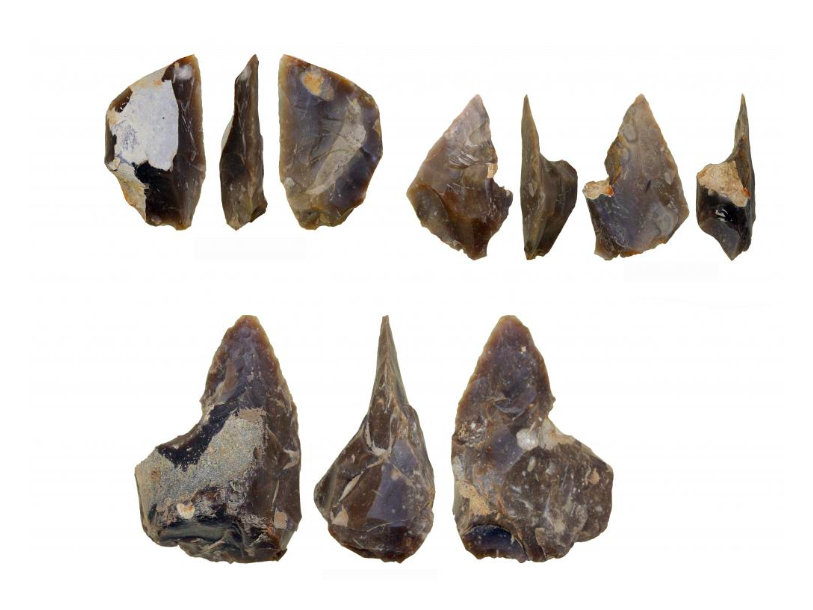
In the south of Poland, archaeologists discovered a large workshop in which Neanderthals made flint guns. In Central Europe, quite a lot of such workshops are known, but this is the first large workshop, located not in the cave. The opening is reported by the site "Science in Poland."
The find was made on the river bank near the village of Petrashin in Silesia, near the border with the Czech Republic. Polish archaeologists, led by Andrzej Wišniewski) from the University of Wroclaw, together with employees of the Leipzig Institute of Evolutionary Anthropology, Max Planck, found 17,000 stone products created 60 thousand years ago there.
Photo: andrzej wišniewski
Until now, scientists believed that Neanderthals during their lifetime did not stop in one place for a fairly long time in the caves. Their guns found in open areas, as a rule, were single finds abandoned after use, for example, where they cut hunting prey. It was assumed that workshops for the manufacture of stone guns outside the caves began to appear a little later, about 40,000 years ago, already among Cro -Magnons. “The finds from Petrashin completely contradict the old vision of the use of open areas Neanderthals. It seems that the community was present in this place for a longer period, as evidenced by a large number of found objects. In addition, the bones of the mammoth, rhino and horses are also preserved, ”says Andrzej Visnevsky.
During the excavations, flint flashes were found that formed in the manufacture of stone tools . The ratio of the number of flakes and finished guns indicates that a significant part of the guns was carried away for use in another place.
It is interesting that for the first time in this part of Europe, scientists managed to reconstruct the entire process of manufacturing the tool from the first blow to the stone block to the finished product. Archaeologists in microsDams on stone were able to determine which tools were used in the work, for example, when cutting animals, and which are not. A detailed analysis of the technique of manufacturing tools also suggested that several different people worked in the workshop, the “handwriting” of which was slightly different.