
Translated material
Why does Putin not leave like Nazarbayev
Answers Tatyana Stanaya: carnegie.ru
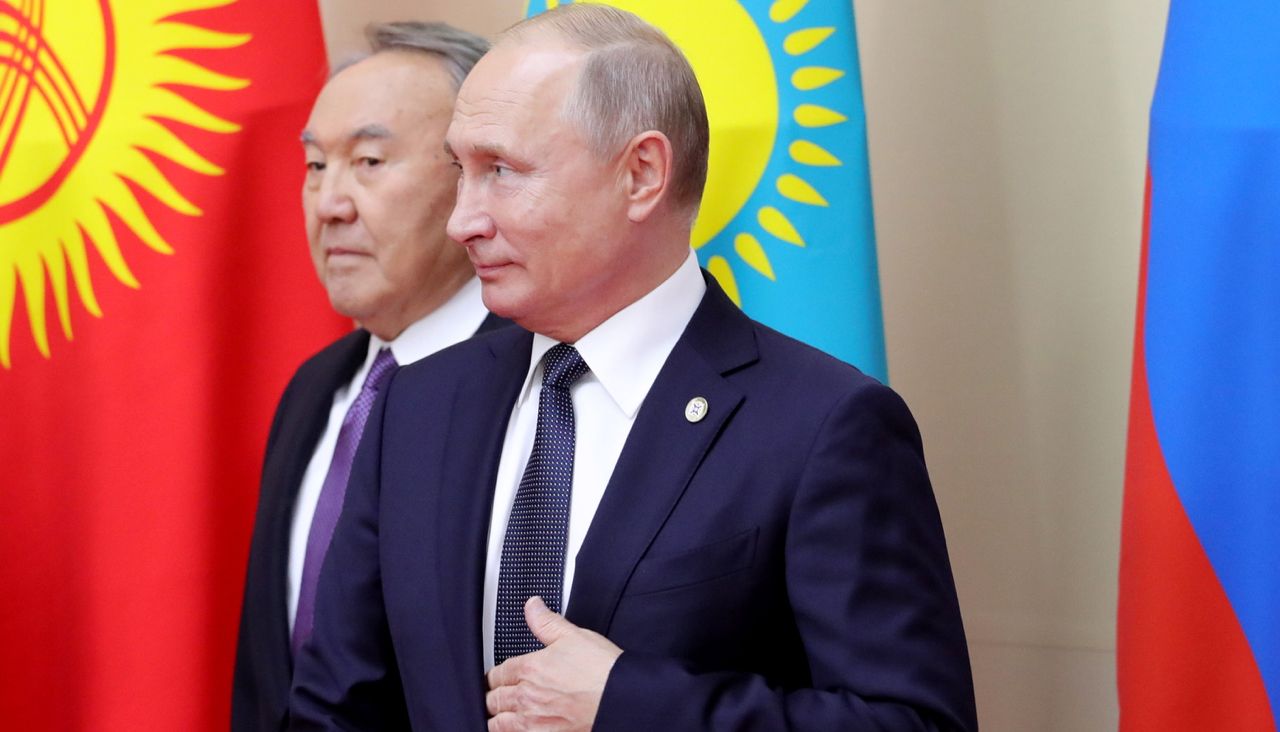
Immediately after the resignation of Nursultan Nazarbayev from the post of President of Kazakhstan, they began to discuss that this could become a model for the departure of Vladimir Putin. But political scientist Tatyana Stanovaya in an article for the Moscow Center of Carnegie explains that although many associate two presidents, Putin himself is unlikely to do this. The Russian leader, according to Stanovaya, has a completely different psychology: he is a manager, geopolitical entrepreneur, adventurer, but not a “father of a nation”. There are many options for Putin's transit, but they are all far from Kazakhstani experience. With the permission of Carnegie.ru "Medusa" publishes the article entirely.
The news of the resignation of Nursultan Nazarbayev forced Russia to discuss not so much the fate of Kazakhstan, the closest geopolitical ally, as the future of Vladimir Putin. Moreover, the option with early care of the post of head of the Security Council has surfaced more than once in Russian discussions about transit. Among other varieties of this scenario is the transition to the post of head of the State Council or some other collegial body that would allow to preserve the functions of strategic and geopolitical management, and would also provide the right to a veto to decide the successor. The Kazakhstani experiment really sets a certain logic to discussions about Putin’s future, but in a completely different context.
Who overtook whom
Of course, there is a certain formal similarity between Kazakhstan and future Russian transit. Nazarbayev left, but remains. He headed the Security Council with the powers that put him above the president and the government, retained leadership in the party in power and formalized the status of Elbasy - the leader of the nation.
In such a situation, you can calmly move away from the routine, slow down the pace of work, while guaranteeing safety to yourself and the family, as well as insure your successor errors. Even if the new President Tokaev does not cope or simply let down, he will be replaced by the daughter of Darig, who became the Senate speaker, the second person in the hierarchy. The safety mechanism, as it was called by observers. Doesn't Putin dream about that?
However, the Kazakhstani experiment has several features that make it not the most attractive for the Russian leader.
Many associate Putin with Nazarbayev, but Putin himself is unlikely to do this. He is 12 years younger than Nazarbayev and, most likely, sees in his Kazakhstani colleague Boris Yeltsin, the first post -Soviet leader of Russia, who also voluntarily resigned and transferred the power of a pre -selected successor. So in this sense, not Kazakhstan overtook Russia in transit, but Russia, and many years ago.
Vladimir Putin for several years has ceased to be the father of the nation. In 2017, there were rumors that the president would re-elect in the image of a “wise grandfather”, an experienced policy that would continue to carefully care about the people. But this did not work, and, most likely, not because the idea is bad, but simply Putin does not do not feel like the “father of the nation”.
The Russian leader has a completely different psychology. You can argue for a long time about Putinization of the system, but he is a manager, a geopolitical entrepreneur, an adventurer, and not the father of the nation - otherwise he would have to work much more to maintain and cherish the proximity to the people. Putin, on the other hand, not only distant and cooled to human problems, but frankly suffers from popular misunderstanding and the difference in the summons.
He came off not only from the people, but even from Russian elites, merging with the state as an unsubstractor machine, whose self -preservation and expansion in his understanding are ensured by the well -being of both the first and the latter. In this regard, the formal similarity with Kazakhstan does not cancel the fact that Putin in the content occupies a completely different place in the political coordinates than Nazarbayev.
Crimea instead of a family
Another important difference between the experience of Kazakhstan is that the Russian leader does not have the necessary attribute of this model - the family. Dariga Nazarbayeva headed the Senate and, in which case, will make up the transit, taking the post of president. Nazarbayev has three daughters, eight grandchildren and five great -grandchildren - a large family that is deeply built into the system of distribution of power and public goods.
Vladimir Putin in Russia - a lone wolf, easily divorced and married in Russia, as Dmitry Peskov tried to convince us several times. Only opposition and Western media write about his daughters, but they are not in Russian political life. Therefore, Putin does not and cannot have such insurance, which is also appropriate more likely in traditional than in modern societies.
The main catch of Putin's transit is that the Russian president will not be able to get one hundred percent guarantees of security and continuity without a radical alteration of the political system for himself in the spirit of eastern traditional societies. Therefore, he is unlikely to strive for this. Going along this path means to bet on the unlimited extension of the Putin regime for yourself, but not the fact that the president wants this.
Therefore, unlike Nazarbayev in Putin, Uzbek experience was unlikely to be strongly influenced when the death of Islam Karimov and further division of power ended poorly for the president's family. How much Putin will leave behind what will require protection? It seems that his first concern is not a family or family business at all, but the problems of a different measurement - what will happen to the Crimea, the presence of Russia in Syria and the country's ability to defend its sovereignty, withstand confrontation with the United States and NATO. It is impossible to underestimate the self -sort of Self -Colelization of his role in history, which inevitably implies the willingness to sacrifice the earthly.
If Putin wants to stay, it will be enough for him to remove the restriction in two terms, and no bulky reforms that make up the system of government (especially given that such reforms do not take into account the limb of the “father of the nation”). If he wants to leave, and very often this is not this informally about this, then in the presence of a loyal environment he will find a place in the system, albeit adapted to a new status. Constitutional reforms are inevitable, but Putin always very carefully approached the editing of the Basic Law. Therefore, even if the redistribution of power is really planned, it is unlikely to be especially radical.
Unnecessary insurance
The Kremlin, of course, will carefully observe the Kazakhstani experiment and study, but not so much in terms of the success of transit for Nazarbayev himself, as when analyzing the behavior of the elites: how the security forces will build relationships with the new president, how the transit will affect the parties of power and what the dynamics of moods in society will fit into a new configuration.
Nazarbayev’s decision can also slow down the implementation of transit in Russia - the discussion of Putin's care was too active and widespread. There is a temptation to repay the wave, so signals may appear in the near future that Putin intends to stay in power for as long as possible and even ready to remove the restriction on the deadlines. Such signals will go not at all because it will become a support script, but simply to bring down the expectation of an approaching transit.
Judging by what Putin said in recent years, there is no doubt that the Russian regime is in his vision, the system works perfectly without his daily intervention. This is the external observers to the “manual control” scheme, the isolation of everything and the whole of the president. But Putin repeatedly made it clear that he sees the situation differently: there is a strong presidential power necessary for such a country as Russia, there is a constructive and mature opposition, a politically responsible elite, and so on. It does not seem that Putin was very afraid that in case of his departure everything would collapse. So, and there is no need for him to reinsure through radical reforms.
The main attention of the Russian president will be focused not so much on the system that, in his understanding and so well, is rebuilt as the successor’s figure is selected. Whether this locomotives will be under the close supervision of Putin or a full-fledged ruler is a separate question, but the president is known for being carefully acting, which means that his departure will pass gradually, measuredly, and the actual transit can really begin after the president’s post, the hands of the successor.
There are many options for Putin's transit, but everything is quite far from Kazakhstani experience, where other political traditions, a different structure of elites and society, fundamentally different geopolitical conditions and logic of management. But the course of transit and its consequences, of course, can affect the choice of the script for solving the problem-2024, as well as the selection of the successor. And if Putin still decides to leave, then the new conditional tandemocracy 2.0 with correction for errors of previous experience appears much more likely.
Read also on Carnegie.ru:
- Access to the cell. That the resignation of Nazarbayev means for Russian domestic policy
- Combining sunset and sunrise. How Nazarbayev’s resignation will change Kazakhstan
- Limited by the place in history. Why did Nazarbayev decide to leave
Tatyana is becoming