
Translated material
Memo for witnesses at the KGB interrogations: what is it and is it applicable now
Thousands of people in the 1960-1980s called for interrogations in the KGB. How not to become a suspect? How not to help plant a person? How to behave during interrogation and what does the law say about this? To answer these questions, dissident Vladimir Albrecht wrote a memo “how to be a witness”, in which he set out his system of the fruit. Historian Aleksey Makarov spoke about its basic principles and asked lawyer Marina Agaltsova if this system was outdated.
Vladimir Albrecht, the son of the executed Polish communist, has repeatedly interrogated the KGB from the mid-1970s. At first, Albrecht told his friends about his experience, then he began to give lectures and advise Jewish-Owls (they were not allowed to emigrate, explaining the refusal to resolve the motives of secrecy-approx. OVD-info) , and then created a memo that was edited and supplemented many times.
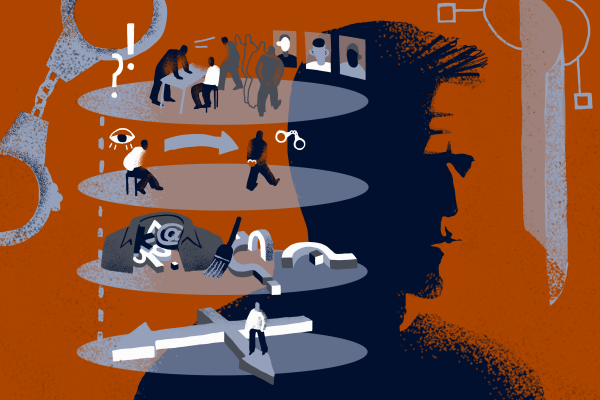
The fetus system is four sieves through which each question of the investigator is sifted: “protocol”, “personal”, “attitude to the case”, “permissible from an ethical point of view”. It is very important to understand that this system is created for witnesses and is not at all suitable with a legal, practical and ethical point of view for the accused. In addition, of course, its use is designed for cases when an interrogation of a witness is not carried out using torture.
Give testimony or not?
Yes:
According to Albrecht , a witness cannot refuse to testify - "because there is no more suitable place to affirm justice." Another argument of Albrecht in favor of giving testimony (which is possible, of course, only when performing the “Protocol” item) is moral support of the accused, who will then read the good words of the witness about themselves. In the end, the witness’s refusal to testify is also a violation of the law, which is unacceptable.
No:
Albrecht gives a very interesting legal argument in favor of situations where you can still abandon testimony. He refers to Articles 13 and 14 of the Criminal Code of the RSFSR, which refers to actions committed in a state of extreme necessity or necessary defense (including the protection of the interests of the Soviet state). According to Albrecht, the investigation of the case under the article “Anti -Soviet agitation and propaganda” is socially dangerous, as it damages the prestige and interest of the USSR (which operates the most democratic constitution in the world and, accordingly, cannot be political affairs). Therefore, it is possible and even necessary not to testify.
Comment of a lawyer
The refusal may lead to criminal prosecution under Article 308 of the Criminal Code (refusal to testify). Therefore, the readings must definitely be given. But what and how - the question is open.
Sieve 1. Protocol of interrogation
Albrecht pays a lot of attention to the legally correct design of the interrogation protocol.
Designation of the case by which interrogation is underway
In the protocol, Albrecht notes, it should be written in what case you are interrogated. Investigators did not always do this so that in a few years a person’s testimony could be used against someone else.
Comment of a lawyer
The investigator must inform what reason they called. The witness may be questioned of “any circumstances related to the criminal case” (Article 79 of the Code of Criminal Procedure). Therefore, if the investigator does not say, in what case the interrogation is going on, you can refuse to testify. The main thing is to motivate the refusal in the interrogation protocol by the fact that the investigator did not announce in what case the interrogation is, and indicate that if he reports, you are ready to come again. The investigator is likely to threaten criminal prosecution for refusing to testify. The likelihood that the case will be initiated is small, since the investigator himself violates the law and understands this.
Responsibility for giving knowingly false testimonies
Before the interrogation, the witness is obliged to sign that he is notified of liability for a dacha of obviously false testimonies.
According to Albrecht, on the one hand, until you subscribe about responsibility - you do not violate the law if you say a lie. Therefore, do not rush and demand that you be allowed to sign it.
On the other hand, if the investigator tries to pull out too much from you during an informal conversation, you can demand that your responsibility record your responsibility in the protocol. Then a formal interrogation will begin and the protocol will appear (or the investigator will be forced to let you go, since informal conversations are not provided for by the CPC).
Comment of a lawyer
In my opinion, the advice is good and applicable in the modern world.
The ban on leading questions
Quote from “How to Witness”: “For example, you can’t ask:“ Did Rabinovich give you to read ‚Archipelago Gulag '”? You should ask: “Did Rabinovich give you any books?” Suppose further that you say that it is not clear to you which Rabinovich is in question and I would like to see his photo. In this case, the investigator does not have the right to show you one photo (this would be a leading question). He must show several photos at once so that you yourself recognize Rabinovich on one of them. Such a request is not so easy to fulfill. Moreover, the whole procedure for identification should be performed in the presence of witnesses and drawn up by the protocol. ”
Comment of a lawyer
In the current Code of Criminal Procedure there is a ban on leading questions (Article 189), so you can refuse to answer them. By the way, this is the only restriction on the freedom of the investigator in choosing the interrogation tactics - except for the ban on torture, of course.
With a request to identify a person from a photograph, you also need to respond with a refusal. According to Article 193 of the Code of Criminal Procedure, identification by photography is permissible only if it is impossible to identify a person “live”. For identification, two photographs of persons, except for the identified, are needed, "if possible, outwardly similar to him." Moreover, you need witnesses. Perhaps the investigator will decide to “confuse” and provide both similar photographs and witnesses. But there is a chance that this question will leave.
Prohibition of pressure and threats
In cases of pressure, Albrecht advises to write something similar in the protocol:
“I would ask the investigator not to walk around, not to scare, not to smoke in the face, not to raise my voice, not to rush with an answer - in a word, not to put pressure on me.”
- Nobody provides pressure on you.
- And I do not say "provides", I just ask "not to provide."
From the point of view of Albrecht, everything that is said to interrogate should be in the protocol. If the investigator does not write down his words in the protocol, then the witness will have to do this.
Comment of a lawyer
Pressure and threats are faithful satellites of almost any interrogation. They must be morally ready for them. The investigator expects through the pressure of "split a person." Remind the threatening investigator about Article 302 of the Criminal Code, which prohibits the one to force testimony through threats or blackmail. This will help reduce his ardor.
Open pressure and threats during interrogation occur, as a rule, when a person does not have a lawyer. Therefore, come with the defender for interrogation.
Accurate reflection in the protocol of questions and answers
The protocol should be recorded absolutely exactly the words of the witness and the questions that the investigator asked him. However, the investigator often distorts the answers that he enters the protocol. In this case, Albrecht advises to react as follows:
“I refuse to answer, because I have reason to believe that my answer will not be written in the protocol correctly, as happened with the answer to the previous (suppose) question.”
“If the investigator edits this answer, then the argument is increasing,” he writes.
Comment of a lawyer
The Russian Code of Criminal Procedure demands that the testimony be recorded “if possible” literally. In practice, this rarely happens. Indications are recorded by the investigator, therefore, changes in answers are very possible.
At the end of the interrogation protocol, it is necessary to indicate all the disagreement with the protocol - for example, if they said “possible” and the investigator missed this. You carry criminal liability for the dacha of false testimony. This and motivate the scrupulousness of recording your answers. The investigator cannot refuse to make comments.
Sito 2. Personal
This is especially relevant when there is a danger that from the category of “witness” you can go to the category of “suspect”.
Example ( interrogation of Albrecht in the case of dissident Anatoly Scheransky):
“Question: You are presented to familiarize yourself with a typewritten copy of the manuscript on 45 pages called“ How to Witness ”. What can you tell about this copy?
Answer: Firstly, I was not presented with a typewritten copy, but a copy, printed on rotaprint. Secondly, I would like to know what this copy has to do with the business of Scharansky?
<...>
Answer: As a witness, I am obliged to answer only in the case of Scharansky. This question is addressed to me, in essence, as a suspect ... "
Comment of a lawyer:
If you get the impression that issues are aimed at clarifying the circumstances of the case, you can refuse to testify. The refusal will immediately alert the investigator. “He has something to hide,” the investigator will think and remind you of a criminal punishment for refusing to testify. The choice of further actions is for a person.
Sito 3. Attitude to the case
The principle of work of this Sita is simple - all issues that are not directly related to the case should be noted, they can and should not be answered.
Albrecht draws attention to the fact that in no case should you rush with an answer to a seemingly simple and “innocent question”. He writes: “An innocent confession that you have borrowed an umbrella from the defendant, can be transmitted in such an original form that a person who sat for almost a year in prison, finally,“ will understand ” -“ They know everything ”.”
That is, possessing frivolous and private information, the investigator can create from the accused who is in a stressful state in a pre -trial detention center, the impression is that even trifles are known to the investigation, so it makes no sense for him to refuse to testify.
Example:
From the response of the human rights activist Valery Chalidze to the investigator’s question, why he refuses to answer the question: “Your question has nothing to do with the present case. He is related to the not yet initiated case of my refusal to answer the previous question. ” As we see, the “personal” sieve works here.
Albrecht emphasizes that it is not necessary to panic if the investigator is aware of your life and the life of the accused. For the investigation, it is important that the evidence is legally fixed. If something is needed by the investigator (and we are talking about politically motivated matters), then you do not need it. Even the most innocent information let him not receive from you.
Comment of a lawyer:
According to Article 190 of the Code of Criminal Procedure, the interrogation protocol indicates the questions that the person refused to answer, and the motives of the refusal. Therefore, purely hypothetically, you can refuse to answer questions that are not related to business.
In practice, this is extremely difficult to implement. Article 189 of the Code of Criminal Procedure says that the investigator is free to choose the interrogation tactics. Naturally, he must interrogate in a specific case, but when appealing the investigator’s actions, it is almost impossible to prove that the issue was not related to the case, because of this investigator, freedom of choice.
Of course, this does not apply to situations where the investigator’s questions are clearly not about that. For example, they called for interrogation in the murder case, and interrogated about the rally. Here you can evade the answer. But one must be prepared that the investigator will threaten a criminal article for refusing to testify.
Sito 4. acceptable from an ethical point of view
Dialogue of Vladimir Albrecht with the investigator:
" - Who authorized you to talk about ethical problems?
<...>
Question: with what specific persons did you have to talk about the ethical problems of interrogation? ”
Example:
Albrecht gives his dialogue with the refuser, who told the investigator who gave him literature. However, he said this is not under the protocol, but now the investigator wants him to repeat under the protocol.
Albrecht advises him not to refuse to testify, because it is illegal. He offers the refuser to say why he now cannot confirm his words (it doesn’t matter if the investigators know or not, who gave literature) - that is, tell the truth. True, from the point of view of Albrecht, it is that "such your act is in the circle of your friends and acquaintances is considered meanness."
Criticism
Of course, Albrecht also had opponents who claimed that the system was too complicated for use, does not give unequivocal instructions and generally calls for testimony.
From the testimony of the witness Nikolaenko in the court in the Albrecht case (quoted by the archive of the international memorial. F.154. Bulletin "" "No. 10. P. 1–2):
“I came, as always, to Lito [Literary Association] and quite by accident found out that Lito would not be, as a person would give legal advice. He spoke too marvelous topics, something like the presumption of innocence, but I still did not understand what it was. It seemed to me that he was fixated on legal issues. ”