
Translated material
What are the people?
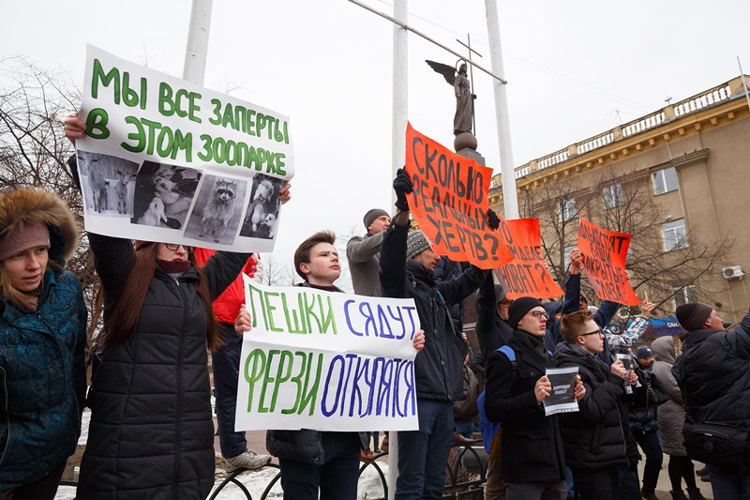
On March 25-26, 2018, in the Siberian city of Kemerovo, the shopping and entertainment center "Winter Cherry" caught fire. The fire covered 1600 square meters, as a result of which the roof of the building and the floors between the floors collapsed. At the time of the start of the fire in the center there were about 1,500 people. Someone managed to run out, someone was taken out by firefighters, someone suffered in a crush, someone tried to escape, jumping from the windows. According to official figures, 60 people were killed in a fire, 41 of them. Most children suffocated or burned alive in cinema No. 2 on the fourth floor, where cartoons were shown: the main and fire exits were blocked. In addition to shops, gaming rooms and cinema halls in the Winter Cherry there was a contact zoo: its employees quickly collected documents, left the room and closed the door behind them, leaving the animals inside. About 200 animals of 25 species burned - foxes, raccoons, snouts, squirrels, rabbits, dwarf goats, hedgehogs ...
The official media did not react to what had happened for almost two days. Entertainment and propaganda programs were going on through central television channels, actively preparing for the next inauguration of Putin. Information about the tragedy spread through social networks and some independent media. A friend from Kemerovo sent me messages in Telegram : his mother lives in the house opposite the “winter cherry”, she saw how people jumped from the fourth floor. Someone wrote that the victims are not dozens, but hundreds, that the media intentionally silence or distort information. The questions were heard: “Why is the president silent?”, “Why don't they declare mourning?”
Putin arrived in Kemerovo only in the morning of March 27. The police dispersed the crowd and cordoned off the square so that he would lay flowers to the spontaneous memorial: the on the eve of the townspeople gathered here, toys, candles, and balloons brought. The governor of the Kemerovo region Aman Tuleyev did not come to the place of the tragedy, and turned to Putin with an apology for “what happened on our territory”. Official mourning in Russia was declared on the 28th, after a wave of civil shares of memory passed throughout the country: without waiting for the reaction from the state, people began to declare mourning themselves. Someone first wrote on the Web: “I declare national mourning”; Others immediately picked up reposts. Everything and everyone - we declared national mourning.
The first action took place on the evening of March 26 in Beslan; On the 27th, Moscow, St. Petersburg, Yekaterinburg, Novosibirsk, Chita, Khabarovsk, Nizhnekamsk, Penza, Voronezh, Krasnoyarsk, Murmansk, Krasnodar, Irkutsk, Kaliningrad, Novorossiysk, Volgograd, Kirov, Nizhny Novgorod, Omsk, Yaroslavl, Perm, Chelyabinsk, Chelyabinsk, Chelyabinsk, Chelyabinsk, Chelyabinsk. Smolensk ... In Kemerovo, the memory of the memory transferred to the mass rally of protest: people demanded the disclosure of information about the dead and the wounded, the explanation of why fire exits and doors of the cinema in which the children were sent to the guilty and authorities for inaction were closed in the shopping center. The slogan “Our country is a“ winter cherry ”, and we are in it - the contact zoo” wandered from the city to the city. I went to the campaign in St. Petersburg: on the Field of Mars, a cordoned by the police field, people silently crowded at the eternal fire, brought toys and flowers. When cops with megaphones began to call the audience to disperse and stop an unauthorized event, the people noted: “Shame! Disgrace!"
Universal spontaneous mobilization has an incredible power of emotional influence. It is as if some kind of dam is breaking through, and we are covered with a giant wave. In grief or anger, we ourselves become this wave, the movement of which the police and riot police are trying to stop, lining up in lines from closed shields. I hurry to the action on the Marse Field from the foundry bridge, along the Neva Embankment, on uneven, dirty ice, past the rifle; A chorus from the song “Civil Defense” of 1989 is spinning in my head: “We are ice under the Major's feet!” In the song, we are that we are the ice on which "the major slides, the major will fall." Who are these "we"? And suddenly I understand both with my mind and my heart that we are the people. Not the Russian people, not a nation, not a class, not a population of a certain territory, not a set of citizens of a particular state, not society, not a public sphere and not many: on the other side of these familiar interpretations, the word “people” has another non-obvious meaning, to the understanding of which the massive transition of compassion into solidarity and sorrow, which occurred in Russia in March 2018.
Until this moment, I had to be a participant or witness to spontaneous folk movements more than once. However, all these movements had a distinct protest character, expressed a negative reaction to the specific actions of the authorities - neoliberal reforms, falsification of elections, political repression, corruption, bureaucratic and police arbitrariness. Here, it was not so much reactive as the active activity of people against the backdrop of inaction of power. One could, of course, limit himself to the assertion that in the case of Kemerovo, compassion and grief grew into mass discontent, which finally exposed an unsolvable conflict between the Russian state and society. However, such an explanation remains superficial and does not allow to fully evaluate the political component of this conflict. Politics is manifested not so much in the fact that people suddenly realize themselves in a situation of confrontation with a state demonstrating an open disrespect for the lives of their citizens, but that in this confrontation from society, from the population, from the totality of citizens, from a diverse set, people are born as a spontaneous force that manifests itself in the constituent ritual gesture - the announcement of national mourning.
This is what the police calling for people to leave an unauthorized rally of memory and go to the authorized, hastily organized by the authorities of the city nearby. The president is scared, defiantly laying flowers on the area cleaned from people. The announcement of national mourning is the prerogative of state power. By decision of the Head of State or Government, flags may be visible, entertainment programs and events can be canceled or limited. This is an extremely powerful ritual: the state officially sets the boundaries of general affect - sorrows that unites the population, that is, all living in this territory, all living, around the dead.
The word "victim", universally used in such cases (victims of the tragedy, victims of the attack, victims of disaster, etc.), not by chance. It refers us to the social function, which from the most ancient times performs a sacred ritual. It is not only about mourning and commemoration, but also about sacrifice, about atoning victims - including such a fundamental to our two thousand -year culture as the crucifixion of Christ on Calvary. The national mourning declared by the state inherits these ancient rituals: behind the gloomy solemnity of sorrow there is a forgotten, replaced history of sacrifice that collected the community around the dead body or bodies that were recognized by this community as the bodies of their members. The victims are innocent, they die for us or instead of us, and we have a feeling of guilt and the desire for atonement: this anthropological mechanism lies at the basis of mourning ceremonies, when individual experiences dissolve in collective affect [1] . The death of children in fire in a locked cinema caused an emotional storm, which through social networks instantly gave rise to many horizontal connections that served as a platform for the self -organization of people from different cities. Cracing the exclusive right to establish a sacred ritual of sorrow in power, the population has turned into a people.
I’ll try to explain what I understand by this word, which not everyone likes, and why I think that, ahead of time, it was given to the right, conservatives, nationalists, reactionaries and dictators, it should still be returned to our actual dictionary. In political philosophy, the concept of “people” becomes significant in the era of education, during the formation of bourgeois societies against the background of the struggle against absolutism. About the good of the people as the highest law of the state is written by Thomas Hobbes [2] ; The people as the only source of political power, which, in case of discontent with the actions of the government, can overthrow the latter, John Locke argues [3] ; The idea of popular sovereignty as the foundations of direct democracy in the republican state is developed by Jean-Jacques Russo [4] . These three quite different concepts are combined within the framework of the so -called theory of a social agreement that directly connects the people and the state. Whether citizens conclude a public agreement in order to end everyone against all against all, like that of Hobbes, or because of the one who needs to streamline natural law, like Locke, or from a common will, like Rousseau, in all cases, people are represented as a single, sustainable, homogeneous political body with their authorities.
The principle of a social contract lies on the basis of most modern national democracies. As Carl Schmitt emphasizes, the uniformity of these democracies, or equal equal, is achieved by the allocation and exclusion of the unequal: someone always remains outside the people [5] . If the criterion of homogeneity is, for example, ethnicity, then representatives of another ethnic group (Jews, migrants, etc.) are excluded. C celebrated in Russia since 2005 and immediately loved by the ultra -right day of popular unity is an exemplary quintessence of the patriotic idea of national homogeneity. It should not be forgotten that it was introduced by the Russian authorities in return to the October Revolution of the anniversary of the October Revolution for the seven decades. This holiday also proclaimed unity, but another is the unity of the Soviet people, behind which there was a story associated with the original understanding of the people in the Marxist way - not as an ethnic group, but as a class. The revolutionary seizure of power by workers involved their establishment of institutions of folk self -government and the dictatorship of the proletariat as an intermediate stage in the construction of socialism. However, the Stalinist ideological doctrine postulates the transition to a non -class society and replaces the class with a multinational Soviet people. The unequal are translated into an extensive group of enemies of the people, against the backdrop of the exclusion of which again the official picture of the unity of the people and the authorities, the people and the party develops.
Thus, with real socialism and under capitalism, the people are attached to the territory with a human resource, the postulation of the unity of which ensures the legitimacy of power in this state. This is a biopolitical unit, controlled and demographically taken into account of the population, which obeys the general laws and is united by national symbols, but also history, language, traditions and morals. History, language, traditions and morals make up a culture - or, as Hegel would say, the spirit is the people. To deny its existence, of course, is pointless. We are always inside our culture, our people - Soviet, Russians, Khanty, Apachi, Germans, Nganasans, Americans, elves or mouse people, like Kafka. Neither socialist internationalism, nor liberal cosmopolitanism, nor capitalist globalization can neutralize the spirit of the people until at least a few of its representatives are alive. But it can be appropriated, rewritten, converted to the support of power or material-demographic resource. The assignment of the people and its transformation from the only source of power into the support of its legitimacy - an almost invisible transition from sovereignty to a subordinate position - in a necessary way follow from the idea of the unity of the people and power. Popular unity is a footboard, on which any power deftly jumps and begins to drive.
That is why some modern philosophers - for example, Antonio Negri and Paolo Virno - propose to abandon the concepts of “people” and instead of him as an actual political force to consider many. In the book “The Grammar of the set”, Virno writes that “people” and “many” are opposite terms. The first goes back to Hobbes, and the second - to Spinosis: “For Spinoza, the term multitudo indicates the multiplicity that exists as such on the public scene, in the collective action, in relation to general affairs, without combining in one and not dissolving in centripetal movement” [6] . For this reason, Hobbes, as Virno notes, “hate” sets. The people, according to Hobbes, are inseparable from the state. The state and the people form a single political body, while many are a natural state preceding its appearance. With the emergence of the state, a lot is inferior to the unity of the people, but during crises can return. Representing a “surge of a natural state in civil society”, many, according to Hobbes, is simultaneously anti -people and anti -state power. In turn, Spinoza considers many not an intermediate, but constant form and "cornerstone of civilian freedoms." Virno and Negri return to this unfairly forgotten concept and successfully use it to describe the immanent state of modern society: a lot is always here, it resists power, it does not allow itself to be collected in a single form and absorb.
Another Italian philosopher, Georgio Agamben, still chooses the “people”, but turns to his other interpretation, which refers to Marxism, populism, the left tradition as a whole, but also to Christianity-to understanding the people as oppressed and disadvantaged: “Any interpretation of the political meaning of the term“ people ”should be repelled from the special fact that in modern European languages he It also means poor, poor, excluded ” [7] . Agamben indicates duality in the concept of “people”: “The same term, therefore, means both a constitutive political subject and a class, which, if not in rights, is actually excluded from politics” [8] . Noting that the people contain a “fundamental biopolitical gap”, Agamben gives an extreme example: “In the sober rage with which the German Volk , best representing the people as a holistic political body, sought to destroy the Jews forever, we must see the extreme expression of that internal struggle, which shares the“ people ”and“ people ”” [9] . The small people who do not allow Nazi unity to take place is not only Jews, but also the people to whom I partly belong to the blood are a gypsy, as well as other “unnecessary integration of the group” [10] . Small peoples in contrast to the big - nomadic, endlessly disappearing or gaining themselves in the outcome.
The story of Andrei Platonov “Jan” (1936) is dedicated to approximately such a wandering people. Her main character, Nazar Chagataev, who was educated in Moscow, on the instructions of the party goes to Central Asia in order to find the lost, poor nomadic people called “Jan”. “It has Turkmens, Karakalpaks, Kazakhs, Persians, Kurds, Beluji and forgetting who they are” [11] - this is how the secretary of the party organization describes this people in the story. “I know this people, I was born there,” Chagataev answers him and adds: “Fugitives and orphans and old, exhausted slaves that were driven away. Then there were women who changed their husbands and got there with fear, the girls who fell in love with those who suddenly died, and they did not want anyone else in their husbands came forever. And there lived people who do not know God, mockery of the world, criminals ” [12] .
Jan is a collective image of the Soviet people as such and an unexpected metaphor for Jewry in search of a promised land, and in general a literary form, which unites under the name of the people of all unfortunate and disadvantaged. Chagataev literally leads this small people in the desert in order to ultimately "teach his socialism." This is a people that exists, and does not exist at the same time, it is always on the verge. Its description is the best suited for the definition given by the tenise of the people, “which is not enough” and which invents, invents literature: “We are not talking about the people called to dominate the world. It's about the small, forever small people, drawn into revolutionary formation. It may turn out that it exists only in the atoms of the writer-the Bastard people, the lower people, oppressed, all the time in formation, all the time far from the end. Bastard no longer means marital status, but the process or drift of whole races. I am the beast beast, forever eternal black race ” [13] .
The people-Bastard Deleoza are a utopian people. He does not exist in unity with the authorities, there is no power over him yet or no, he escaped-or, perhaps, the power itself turned away from him or forgot about him, establishing himself in her monumental unity with a kind of fantaside giant people. How does the utopian people differ from the set? His revolutionary formation, in which he collects and calls himself. Делёз не пишет о таком собирании, конечно, но я полагаю, что его необходимо иметь в виду, если мы хотим понять, как утопический народ становится реальным. Он может назвать себя, как у Платонова, «джан», что означает «душа» или «маленькая жизнь», может назвать себя «лед под ногами майора», может назвать себя «мы» и, таким образом, как бы вмиг собрать себя из рассеянной потенциальности множества. Не власть дает ему имя и учреждает его, а только он сам.
В этом и заключается новый смысл, который я предлагаю вкладывать в слово «народ». Народ, который из революционного становления собирает сам себя, — не большой и не малый, не народ идеологии и не народ утопии (оба — несуществующие на разный манер). Следует, во-первых, отделить в нашем понимании народ от государства, а во-вторых, мыслить его не как статичное образование, а как динамичный процесс, как то, что себя учреждает из множества и существует на самом деле исключительно в момент такого самоучреждения. Тогда только можно будет понять, каким образом народ может объявлять, например, национальный траур и — шире — выступать как активно действующая в истории сила: именно народ, а не власть, осуществляет революции. Не большой народ-гегемон и не малый народ-бастард, а тот, который собирает и именует сам себя. Это именование, или мгновенная актуализация народа, представляет собой, если говорить по-ленински, материалистическое чудо диалектического единства стихийности и организации. За актуализацией народа стоит беспрецедентное моментальное коллективное решение: мы здесь власть. Какое-то мгновение — и его уже нет; мы снова разбредаемся во множество, возвращаемся в обыденную жизнь. Его не зафиксировать, не запротоколировать, не привязать к территории как статистическую единицу, не скрепить никакими скрепами. В определенный момент времени общество просто взрывается народом — до или после того, как кто-нибудь успеет его под себя подмять. Так было много раз — и так еще будет.
[1] См., например: Э. Канетти. Масса и власть (M.: Ad Marginem , 1997, c. 158—161); М. Mocc. Социальные функции священного (СПб.: Евразия, 2000, с. 9—106).
[2] Т. Гоббс. Leviathan.
[3] Дж. Локк. Два трактата о правлении.
[4] Ж.-Ж. Руссо. Об общественном договоре.
[5] Schmitt C. The Crisis of Parliamentary Democracy / Cambridge, MA: MIT Press , 1985, p. 9. См. также: Ш. Муфф. Карл Шмитт и парадокс либеральной демократии / Mouffe Ch . The Democratic Paradox. — London: Verso , 2000, pp. 36—59.
[6] П. Вирно. Грамматика множества. К анализу форм современной жизни .
[7] Дж. Агамбен. Средства без цели. — М.: Гилея, 2015. С. 36.
[8] Там же.
[9] Там же, с. 41.
[10] Там же.
[11] Платонов, 1990: 18—19.
[12] Там же.
[13] Ж. Делёз. Критика и клиника. — СПб.: Machina , 2002. С. 15.
Subscribe to the COLTA.RU channel in Yandex.Zen to miss nothing