
Translated material
Non -income production
The state -owned economy will inevitably make us poor
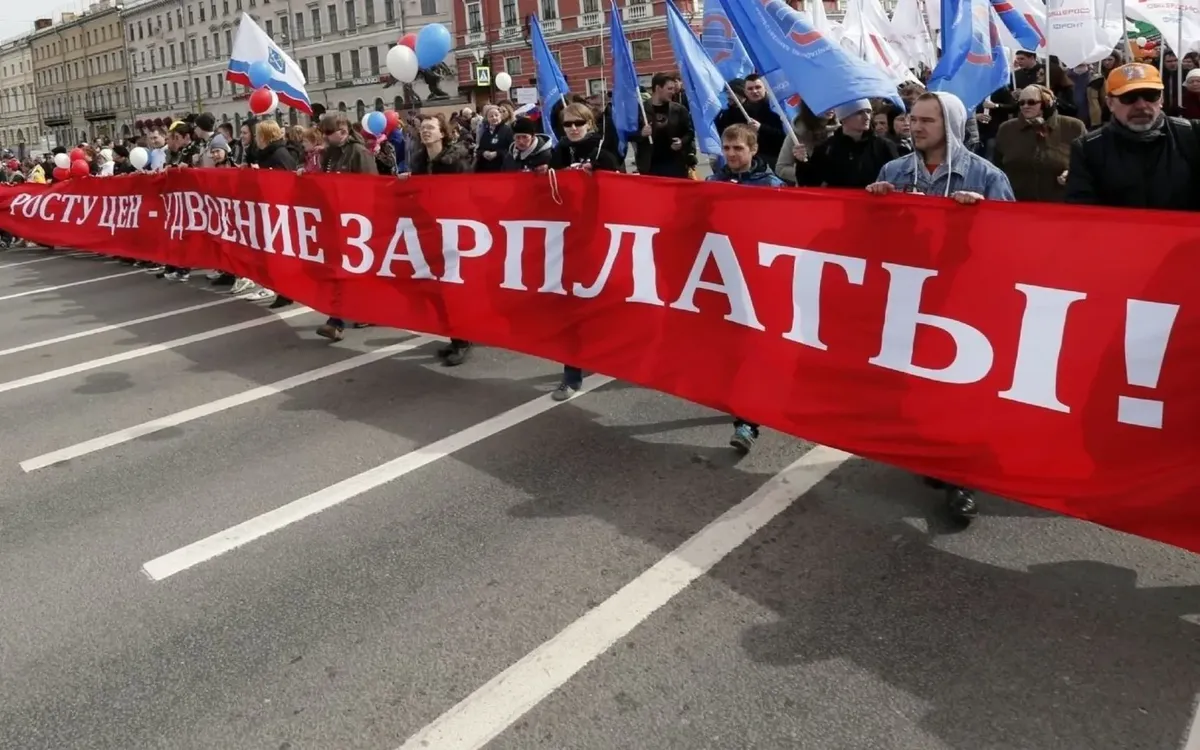
The steady decrease in real incomes of the population, which coincided with the growth of the economy in the reports of government statistics, looks suspicious. But the same statistics admit that since 2013, people have been impoverished by 12% and the total purchasing power of Russian consumers has been reduced by 5 trillion rubles a year. At the same time, it recently became known that the number of residents of Russia, owning a state of more than $ 30 million, increased by 7%per year.
That is, the growth of the economy, apparently, exists, but it is converted into an increase in income of a very special part of the population.
The authorities, in words, are very worried about the poverty of the Russians, promising to come up with something to fight her. Do not calculate - low income, and even with a tendency to decrease - the systemic feature of the model of the economy that Russia now adheres to. GDP growth such a model really provides. But the growth of income is not.
Contrary to Karl Marx
To understand what is happening, you need to answer the question - why should the income of workers grow in terms of economic theory? The answer is not so obvious. After all, Karl Marx himself at one time argued that the proletariat in all cases awaits absolute and relative impoverishment. It is clear that our bosses are Marxists from head to toe, building their current “imperialism” precisely as it was described by the Stalin textbook “Political Save”. But even Engels in the sunset of life admitted that the founder got excited about the “absolute impoverishment”.
The error in the forecast of Marx was caused by the fact that in his theoretical constructions he did not take into account the influence of entrepreneurs and technological progress on the labor market.
Namely, these factors are drivers of wage growth. In a simplified form it looks like this. When opening a business, the entrepreneur needs to hire employees, and for this he needs to offer them a salary not lower than that of a competitor. Naturally, for his money he wants to hire the best masters. And in this case, he has a motivation for an increase in salary. In this case, his competitor also has a motivation either to an increase in salaries in order to save employees, or to the introduction of some innovations that can increase the labor productivity of the remaining ones.
But the introduction of new technology requires more qualified employees who require even more salary. Thus,
In a competitive economy, a system with a positive feedback arises - competition provokes salaries growth, and salaries increase the demand for technology,
Increasing performance, and the introduction of technology requires salary growth.
This, of course, is the most primitive description of the labor market in conditions of development of competition. However, the system works like that. The more people who want to offer you work, the higher the salary of those who are ready to sell their time, skills and work.
"Reverse" motivation
What will happen if you save the entrepreneur from competition and worries about expanding his market share? For example, having provided him with a state order - as is now happening under the motto of “development”, “investment” and “stability”. The motivation of such an entrepreneur unfolds "in the opposite direction."
For the owner of the plant, who knows exactly that its products will be purchased, in any case, all expenses for employees are becoming costs that reduce their own profit of the enterprise.
Such the owner of the plant and motivation to increase labor productivity do not have through the introduction of new technologies. More than buying a budget, he still does not sell, and negotiations on subsidies and benefits with the authorities are easier when two thousand people work at the factory, and not two hundred.
And if the owner of the plant nevertheless increases the salary to his employees, then an unpleasant conversation in the regional administration can wait for him - why are you increasing the “average” salary in the city, provoking unnecessary issues of state employees, doctors and teachers whose salaries are the local authorities are responsible for?
By the way, another paradox of the Russian “average salary” - it is obtained by workers of various qualifications, both minimal and requiring long -term training. For example, the salary is slightly less than the “average in the region” in Russia pay international fast -food restaurant networks. Those work in which the world is paid at the minimum permissible rate. Either the Russian market does not value your diplomas in any way, or the salary is much underestimated to you.
Well, the authorities will object, but the salary of employees depends on the results of the enterprise - the company should not work at a loss? And the labor productivity of employees of Russian enterprises is obvious lower than the same employees at foreign enterprises.
The thought is logical, but why does the low labor productivity at Russian enterprises do not reduce the level of salaries of their top management, which receives remuneration at the world level and even higher? What kind of outstanding results did the heads of Russian state and quasi -state corporations achieve that the payment of their work is calculated by millions of dollars? It turns out that the profit of Russian enterprises is sufficient to pay the remuneration of their directorate, but is insufficient for the remuneration of employees?

How taught in the USSR
But in no case should one think that the system of underestimation of the cost of labor at the state level has something to do with a market economy. This is the specific experience of the USSR, which, from the point of view of the economic structure, was a kind of production holding.
In this holding, any growth in the salaries of workers was perceived by the authorities as an objective evil, since it meant the growth of costs.
Every conversation about taking care of workers in an uncompetitive economic system does not make sense. As one of the characters of the “Gulag Archipelago” accurately noted, in the country where the economy belongs to the state, money becomes “two -story” - the authorities are trying to pay “on the first floor”, and the people should pay “according to the second”. But the laws of demand and proposals worked in the USSR, where a high salary was paid for work, which required some unique qualifications or for which it was not easy for those who wanted to. However, the authorities came up with more sophisticated tricks designed to reduce the cost of labor regarding the value of goods sold by the state.
The most clear example in the USSR was the famous monetary reform of 1961, when 1 “new” began to give 1 “old” rubles for 10 “old” rubles. Outwardly, this looked like ordinary denomination, since public trade prices also decreased ten times. However, prices in food markets decreased by about 4-5 times, depending on the goods. So, in December 1960, in a state store, potatoes were sold along the ruble per kilogram, and in the market, depending on the quality, potatoes could be bought at a price of 0.8 to 1.3 rubles per kg. After the reform, the “state” potato began to cost 10 “new” cents. But on the "collective farm market", 30 "new" cents were already asked for it. In the purchasing value of the "new" money, something that alerted sellers.
One of the explanations of this phenomenon is a sharp decrease in the cost of the ruble in relation to solid currency, primarily to the dollar. The pre -reform exchange rate was 4 rubles per dollar. It is clear that the Soviet person did not see any dollars, but this rate served as a guide for the establishment of state “ruble” prices for products and goods purchased or sold for currency. Theoretically, the dollar exchange rate after the reform should have decreased to 40 kopecks per $ 1, however, it was declared at the level of 90 kopecks per $ 1 - with the corresponding reduction in the official “gold content” of the ruble. That is, in relation to the dollar, the ruble was actually devalued 2.5 times - with the corresponding increase in import prices. Or, in other way, with a decrease in the purchasing power of salary in relation to imports. And to the markets in the market, too.
The Soviet chiefs were so overdone in the struggle for cheap work that in December 1965, the deputy chairman of the State Committee of Prices, Comrade Kuznetsov reported to the Central Committee of the CPSU, which:
“According to special estimates made by the USSR State Planning Committee ..., in 1963, almost 40% of workers and employees (with family members) revenues below the cost of living, about 35% had income from 41 to 65 rubles per soul. According to the calculations of the Research Institute, the cost of living corresponds to income of 40 rubles per soul, and an income of 65 rubles provides a level of wealth. ”
“The elimination of low -income is the central task in the field of increasing the material well -being of workers,” Comrade Kuznetsov emphasized. However, “the ongoing activities to increase wages have little effect on medium -paid groups of workers”, the official was lamented. At the same time, the prices of products in the USSR at the official rate exceeded similar prices in the West.
Devaluation as an economy engine
Why did the Soviet government go to an obvious decrease in the level of working people's income? The answer is simple-oil, the production and export of which began to grow just in the late 1950s. If in 1958 the USSR exported 9 million tons of oil and the same amount of oil products, then in 1962 26 million tons of oil and 19 million tons of oil products went abroad. At the same time, in fact, the volume of oil production in the country grew by only 1.6 times - from 113 to 186 million tons. Why did it happen? Oil at that time was inexpensive - $ 2.88 per barrel, and in rubles at the official rate “before the reform”, each export barrel brought 11.52 rubles to the Soviet oil industry. "Old." And theoretically it was supposed to cost 1.15 rubles. "New." But after the 1961 reform, each barrel cost 2.60 rubles. at a new course.
At the same time, the cost of oil production and transportation has not changed - only the profit of Soviet state businessmen increased.
We observed a very similar picture twenty years ago, during the devaluation of 1998. As soon as the high ruble exchange rate began to threaten the interests of managers of industrial and raw material sectors - this is how the devaluation reduced the income of citizens in relation to the value of imports three times. In addition, the share of wages in the production costs of enterprises has sharply decreased - it was this circumstance that allowed them to demonstrate profitability, and not at all the growth of demand for the products of the “domestic manufacturer” within the country.
According to Comrade Stalin's Testaments
In general, the average salary in the country over the past 20 years has a remarkable feature noted by the Russian economist Maxim Mironov. Our average salary corresponds to the ruble equivalent of the cost of 10 barrels of oil. In 1998, when oil cost $ 10, a salary of $ 100 was considered quite normal. Ten years later, oil rose ten times-and already a thousand-eater salary in large cities ceased to be considered something special. At the same time, the dollar fluctuated in the range from 20 to 30 rubles per $ 1. Ten years later, oil costs about $ 70, and the official average salary in 2018 is at the level of 43.5 thousand rubles, or $ 700. True, the dollar costs about 70 rubles. But the prices for the products of the "domestic producer" in ten years have risen significantly.
And the growing role of the state in the economy does not benefit salaries. The state hires nearly 38% of labor resources in Russia. Both salaries in the budget sector, and especially in the public service, are often higher than in the rest of the economy.
But that is why the growth of salaries in the free labor market annoys the bosses - it forces him to raise his salary and his employees.
But the reduction in the income of citizens is actually a little bothering the bosses, since it is fully consistent with his ideas about how the economy should develop. The fact is that the bosses are really fantasize about "modernization", high -speed highways and industrial complexes. The problem is that modernization requires investment. And if you can lay the road on your own, then where to get robots and generally complex equipment, if it is not? We must buy. And where to get the money?
In the same place where Comrade Stalin took them ninety years ago, from the population. In the early thirties, the All -Union Association for Trade with Foreigners in the USSR (the same Torgsin) bought values sufficient to cover 20% of the costs of importing industrial equipment, technologies and raw materials. In 1933, the values collected through Torgsin was enough to pay for a third of the expenses of the USSR for industrial imports. This whole topic about the closure of the Russian market for foreign goods is an attempt to organize such “Torgsin 2.0” throughout the country, forcing citizens to buy local goods at an increased price, paying them for their savings. And when this money falls into the hands of the authorities, it will dispose of them in its own way.

Head and taxpayers
“The state owes nothing to you” - this is not a reservation of the boss, but his idea of the world order. Only in this phrase it is necessary to replace the word "state" with the word "bosses". The boss has no “taxpayers” in the head. And, as the boss believes, he will do without them.
This happens because the occupancy of the state treasury, according to the chief, does not depend on the activities of citizens. A quarter of revenues of the consolidated budget provide oil and gas. The income from the sale of raw materials is paid for imports, and consumers pay customs duties and VAT. There is no great merit of citizens in this, the boss thinks, there is no oil - there is no import, no import - no taxes. Well, 38% of Russian workers hired by the state cannot be considered taxpayers. Their taxes are simply a return to the treasury of that part of the budget that was spent on paying for their work, and the authorities understand this.
Therefore, the boss argues, the budget situation in general does not deteriorate with the fall in the income of the population. But if you put citizens in the position of medieval artisans paying tax for the right to sell their work in the market, this will be exactly what is required! Hence the enthusiasm of the authorities about the “microbusiness” and “self -employment”. Let me remind you that a large share of the "self -employed" and "microbusiness" in the economy itself is not yet a sign of its quality.
The world leaders in “self -employment” are Uganda, Zimbabwe and several more countries of subequatorial Africa - because there is almost no “employment”, except for “independent”.
Investments without nationality
But the rise in the income of citizens immediately demotivates potential investors in the Russian economy. But cheap work is generally a very unreliable advantage of the country, since new production and high technologies and generally the development of entrepreneurship provoke salaries. And when the salaries in different countries are comparable, the investor chooses the country in which there are real, and not just voiced by the authorities of property guarantees and a really independent court.
In this case, the nationality of the investor does not matter at all. At one time, the Russian authorities have focused on the idea of preserving the “strategic industries” in the hands of the “national entrepreneurial class” controlled by the authorities. We can say that the dream of the authorities came true - such a class of entrepreneurs was created and makes up most of the list of Russian Forbes. But the institutional environment played a cruel joke with the authorities - the state oligarchs acquired foreign passports and at the first opportunity to evacuate their profit beyond the borders of bossy jurisdiction. And when it reaches its return and investment, the conditional “Russian masters” behave in the same way as “non -Russian”. That is, they require real, “final” guarantees. Or compensation for risk, or increased profitability. And the key component of such profitability is a low salary.
Therefore, high salaries are always complete with low risks for business and investment. And if the salaries are low, then with investments and risks for business, something is not much like the authorities.