
Translated material
Lizard is not a comrade to a person
On the 35th anniversary of the first publication of Roman Harry Harrison "Eden"
The whole world
Lay before them, where to choose housing
They had to. The craft of the Creator
The driven, walking hard,
Like wanderers, they are a hand in their hand,
Eden crossing, wandered
His deserted road.
John Milton. Lost paradise
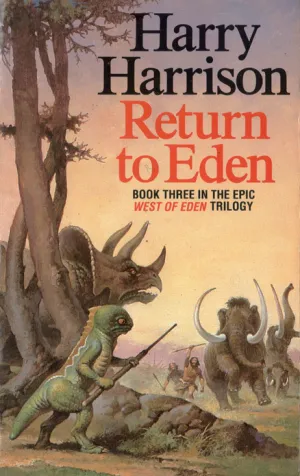 In 2019, it marks the 35th anniversary of the first publication of Harry Harrison’s novel “The West Edem” - the first part of the famous trilogy. Everyone who is familiar with the work of this American science fiction writer celebrates the special position of “Eden” among his works. Of course, the plot here is not so adventurous and dynamic as in most of his works of large shape, but it is amazingly thought out to the smallest detail.
All three books of this “paradise” cycle tell about the alternative history of the development of life on Earth. Harrison offers to fantasize on the topic “What if the mass extraction of reptiles did not happen at the end of the Mesozoic era?” And before us, our planet at the time of the beginning of the ice age, but the dominant life forms for most of it are not mammals. Lizards are still “on horseback” (it sounds a little strange). Among them, even a two -legged reasonable look (Iilane) appeared, which created an amazing civilization based on the use of living creatures (they do not build everything, but grow). The logic here is simple: the reptiles are cold -blooded, they are alien to the fire, it means that the processing of metals, so the development of scalys went along the "cold" path of bioengineering. From blankets to ships - all this is modified by their science of life forms.
It is noteworthy that in almost all the reviews that I read, Iilane are counted for dinosaurs. Such we see them on the cover of the books of the publishing house Eksmo (1999). But, despite the temptation to endow the consciousness of “terrible lizards” (and at the time of writing the novel, the well -known work of the paleontologist Dale Russell about the possibility of the appearance of a reasonable dinosaur ) was already published), this is wrong. The ancestors of Iilan left the ocean, where hatched cubs are sent and where they reach the stage of adolescence - Fargi. In the popular literature of marine mesozoic reptiles - mosaurs, plesiosaurs, ichthyosaurs - is often called “marine dinosaurs”, but in reality they have nothing to do with the ground dinosaurs: there is literally an abyss in kinship between them. It is noteworthy that the relatives of the extinct sea giants of the mosaurs (namely, their Harrison made the ancestors of Jeilane) are Varana, who are recognized as ethologists the most quick -witted of modern reptiles. The designer of the ABC publishing house (2014) was original, drawing them from the Galapagos naval iguan, which is somewhat closer to their biology.
Harrison fans may notice that he has a short story “If” (“if”) of 1969, where reasonable reptiles are also involved, however, from a very distant future - the descendants of the female chameleon released by the boy in America. By the way, they also have matriarchy and iron discipline, like Jilana: the commander will say “die” - and the subordinate will die without blinking ... Although the chameleons do not have mobile eyelids. The story is earlier than Eden, but, apparently, the idea did not leave the writer alone.
So, the era of the reptiles did not end in the Mesozoic, but stepped in Cenoza, people still appear, however, not in Africa, but in America, where Eilena was absent for the time being. To many readers, such a turn of anthropogenesis seemed far -fetched - they say, the author is breeding the “Americanism” from patriotic feelings. But it was there that the wide -skinned monkeys appeared. There was even a version that the homeland of people was the Continent of the named after America Vespucci, where in Oligocene there were already open spaces and forest -steppes and monkeys could well be removed from trees in their needs. That is, the premises for the American path really were. Now some Chinese anthropologists are trying to repeat the path of their Western colleagues and to secure already beyond the territory of the Middle Kingdom of the ancient ancestral home of the first Homo of the modern type.
So, on the planet it becomes too close for two reasonable races. The collision is inevitable. The text of the trilogy is saturated with conflicts open and veiled: reptiles and animals, hunters and farmers, males and females, the views of academic Jeilane and supporters of faith in the whole spirit of life and the soul of reasonable creatures - the sisters of life (Harrison raises the complex themology of theology - only a person is endowed with the soul, as the spirit of animals and the soul of a bicentral Primata?). Finally, the most powerful conflict is the moral torment of the protagonist (the author himself determined him by such, calling the trilogy the true story of Kerrick).
We will not dwell in detail on the ups and downs of the plot. It is much more interesting to find hidden allusions and subtexts in the text - and there are more than enough of them here, for every taste. The most obvious is the image of the strong -willed females of reptiles that subjugated the males and use the latter only to continue the genus; At the same time, representatives of the former stronger sex also bear eggs. The legendary Amazons fade against their background. By the way, judging by the description, one of the groups of Jeilane masters the new city on the banks of the world's largest river ...
The night attack of a huge lizard on the camp of hunters echoes a similar scene from the “lost world” Arthur Conan Doyle. It is difficult to imagine that in a novel with the participation of dinosaurs, at least for a moment the “father” of Sherlock Holmes will not appear. By the irony of fate, criticism from science makes both writers the same claim: how could dinosaurs be unchanged for tens of millions of years, even in isolated conditions? Sir Arthur was silent (either education did not allow to answer, or pride), and Harrison added notes that directly indicate that the whole reason is the genius of reasonable reptiles that have preserved majestic giants. Another reference to the “lost world” is a valley fenced off from the surrounding world, but not relict lizers live in it, but progressive people -lands.
The “Adventures of the prehistoric boy” by Ernest d'Arvilles send us hello through Kerrika, who was instructed by adult hunters to maintain fire, and the “struggle for fire” by Joseph Roni Sr.-through the Mastodonts, tamed by man (I was always surprised by the friendship of mammoths and cave hunters-this was something from “ mare ").
A reference to the first communities of Christians is a religious unification of the sisters of life involved in fishing - a symbol of Christianity. Their persecution of the Roman authorities - the persecution of sisters by ruler of cities. About the Old Testament resembles their salvation from the slavery of the scientist, who goes by the sea to look for the new land of the promised.
The development of reptiles - immigrants from the Old World - North America and the extermination of its indigenous population - these are pioneers of the Wild West and American Indians. And the murder of the mastodons is not for the sake of meat, but out of blind hatred - a reference to the mass extermination of the unfortunate bison, forming the most numerous herds of animals on the planet before the arrival of the White.
The boy held in captivity is constantly deprived of the hairline, and the only clothing for him is a loincloth made of another person's skin. Does not resemble a Nazi concentration camp? Yes, and the leader of the reptiles arranges a massive extermination of people in order to liberate living space, assuring others that people are dirty animals that are deprived of all intelligence, which deserve only death. She is even awarded the title of the Supreme Commander -in -Chief, entrusting unlimited power in order to finally solve the “human issue”. The portrait is more than familiar - the Fuhrer in scales.
The most striking moment of the first book is also guessed - a fire in the city of reptiles, resolving a conflict for a while, but generates all the main ups and downs of further narrative. It is difficult not to recall the famous scene of a fire in Rome from Kamo Matyshiy, Henrik Senkevich. And the theme of the city, as in the novel about the eternal city, goes through a red thread through the entire trilogy. This is not a New York sample “move! Move! ”, Surrounding in impurity and dying of a lack of pure water. The cities of Iilan, which are individual states by the type of ancient Greek policy, are living beings. Everything in them is interconnected and harmonious; The center of ecocentrism is put in the center, to which fighters for protecting nature in our real world are appealed, contrasting it with anthropocentrism.
The described world itself is not paradise. It is full of difficulties and dangers that are unsuitable for the life of deserts and ice -covered with ice and snow, is inhabited by dangerous predators. Only the cities of Iilan are separately located on the Continents of Eden. Kerrick comes to this thought in the first part, and the subsequent narrative only reinforces this conclusion. As befits such a type of work, it is based on a journey-revolution (by the type of Homeric “Odyssey”), the return to the cities of Jelan, a return to paradise. In turn, this is preceded by exile from Eden, or rather, multiple exile. Initially, people are expelled from the city of Iilan, taking revenge for genocide, that is, for a while they become higher or its conductors, punishing sinners, then Jeilane expel people from the city; The sisters of life are expelled from the city for beliefs; Weinte is expelled from her city for disobedience to the elder in a hierarchical staircase.
Since there is Eden (a city that is a living tree; in it, young reptiles know good and evil, becoming full-fledged members of society), then there must be a excessor snake. It would seem that herpet is not expected to have problems with his search in the world, but here is a paradox: Eden, or rather, Eden-Gorod is only inhabited by reptiles. And here Harrison makes a brilliant move: a man involuntarily becomes a snake. Archetypes change roles. Kerrick introduces Weinte to the existence of such a simple concept for him as a lie. Taking advantage of this gift, she kills her fellow, or rather, sister-Iilana. Kerrick changes Weint, but she also changes the captive boy forever, endowing him with knowledge and, most importantly, the language of the lizards. For Harrison, polyglot and propagandist Esperanto, the language becomes one of the factors that determine the plot. Kerrick teaches the enemy’s tongue and thus tastes the forbidden fruit. In the eyes of fellow tribesmen and even his wife, he is poisoned by him. So figure out who, after all, is a tempter here!
Cruelty gives rise to cruelty: at the very beginning of the first book, the bloody massacre of males and cubs, Jeilane, arranged by people leads to the destruction of the main character's family. The death of a small child becomes an apotheosis - the scene is largely sketched from the famous engraving of Gustav Dore “Beating Babies”. But, unlike the New Testament, the following one after another, reprisals against the innocent from both one and the other, at first, repel the reader from both warring parties. In the course of reading, you involuntarily come to the idea that the author nevertheless inclines the cup of his sympathy in favor of reptiles. By the way, the most vivid, expressive characters, for whose actions and thoughts I want to follow who worries the reader - are not people who always complain about the bad weather and dream of freshwriter (at the end of the third book it was impossible to read the description of the next scene of the cutting of carcass, frying and absorption of meat). No, this is an irreconcilable, anger, Iilne Weinte, the main antagonist of the cycle, the leader of the sisters of life - the wise Engin - and my beloved character is the brilliant scientist of Ambalasey (apparently, you involuntarily distinguish a fellow for labor). The last character is almost the only humor of humor in Eden, however, going to the irony and sarcasm, and humor was always important for Harrison.
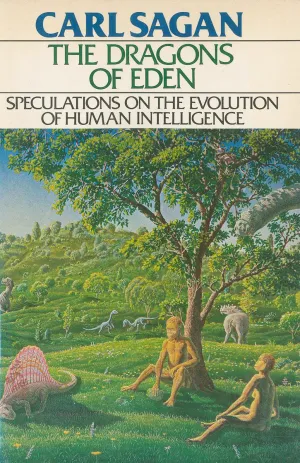 Now it’s worth talking about the title of the cycle. It is highly likely to assume that the impetus for the writing of “Edem” was the book of the famous popularizer of science, astronomer Karl Sagan “Dragon Edem. Reasoning about the evolution of the human brain ”, published seven years before Harrison's novel in 1977. There is evidence of this in its content, where the Sagan describes the oppression with the ancient lizards of the unfortunate animals, and on the cover of the first edition with the image of a tree sitting under a tree (knowledge of good and evil?) Pales (Adam and Eve?) Monkey -like creatures against the background of dinosaurs.
In the light of the latest discoveries of paleontologists, ethologists, physiologists, the book of Sagan is significantly outdated, and many theories of the author were not confirmed, but it must be read by everyone who is interested in biology, its text, which has been leading readers to the thought that has become the motto of Sagan: "Knowledge is our fate."
Reading about mutual hatred of the warring parties, it is easy to notice their similarity. Kerrick, who absorbed the culture of both reptiles and people, is confirmation of this. This duality becomes a source of salvation for warm -blooded and at the same time a heavy burden for its carrier. Why can't the main character part with the cold -blooded world, forget Iilan’s language, stop thinking how they are? To do this, you need to contact the sagan again: his book repeatedly says that in each of the warm -blooded, an ancient lizard sits, whose brain has become the basis for the emergence of the brain of mammals. Reading about the mental torment of Kerrick, who feels half Tanu (man), and half the Murga (reptile), I expected that he would turn to bioenginery and change his body in order to achieve bodily and spiritual harmony.
Several thoughts that the author wanted to throw so immodest when reading: the transition of females to parthenogenesis, that is, a complete abandonment of “worthless and despicable” males. Actually, some real American and Asian lizards did this. The Strugatsky brothers in the "Snail on the slope" came to this idea. By the way, their virgins of parthenogenesis, like Jeain, used biotechnologies. In addition, the use of truly frightening biological weapons-deadly viruses and bacteria against people. After all, Europeans have experience in using it to destroy the indigenous peoples of America - English colonists, distributing to the natives infected with smallpox clothes and blankets, they knew about the absence of those immunity to European diseases.
The author cannot be reproached for ignoring the advanced at that time of biology achievements. For example, saving the wounded individual from the tribe of intelligent reptiles that inhabit the new continent, the scaly scientist uses the artificially grown fabric. Others admire a wonderful salvation, but the researcher reveals to them the true meaning of this experience: she applied the method of transplantation immunity to clarify the degree of kinship between the victim and Iilan. This approach was once widely practiced in zoology. So, in 1967, Meislin published work on transplantation of a skin flap in American reptiles. The essence of the experience is more than simple - the closer the kinship of the studied species, the greater the chance that the pieces of fabrics transplanted from one to another will take root on their bodies. The American herpetologist used the rejection test to clarify some issues of the systematics of lizards from Colorado and New Mexico. Probably, Harrison consultant, biologist Jack Cohen, was familiar with these research.
No less vast and knowledge of the author (or his consultants) in anthropology and ethnography used in the description of the life of people. Thus, the method of hunting for the naval animals of the northern variety of hominids - Paramutanov - is clearly borrowed from the peoples of the north: before hunting, they impregnated the tips of harpoons in a decoction of poisonous plants and they opened a whale.
Since I mentioned these whales (it seemed to me that the object of their hunting is more like giant sea cows), I will share my vision of how Harrison came up with their image: everyone remembers the section in the school textbook on general biology, dedicated to atavisms and rudiments (both ours and western textbooks here are very similar)? Pictures of the tail of a boy and a man with an overgrown face with long hair surfaced? Now connect them in one character - and before you is Paramutan from Eden.
In one of the Russian -language reviews on Eden, Harrison was called a lazy author. Having carefully read the text of the novel, you can answer: “Eden” is not for lazy readers.
Igor Doronin,
Zoological Institute of the Russian Academy of Sciences (St. Petersburg)