
Translated material
The female face of mathematics
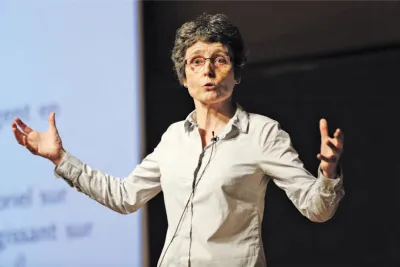 On March 14, 2019, the XXI International Ceremony L'Oréal-INESCO for Women in Science was held in Paris. This year’s innovation was the award of prizes to researchers working in mathematics and computer sciences. Earlier, international awards were awarded only for successes in the field of physics, chemistry, medicine and biology. The monetary component of the award is 100 thousand euros.
The laureate of the Prize for success in the field of mathematics was the representative of Europe, 57-year-old Claire Voisin , professor of college de France and a former researcher at the French National Center for Scientific Research (CNRS). She was awarded the L'Oréal-Inesco award for outstanding works in the field of algebraic geometry. It is noted that its innovative discoveries made it possible to solve the fundamental issues of the topology and structures of Khoja in complex algebraic diversity.
About the contribution of Claire Voise to science and how she inspired other women to engage in mathematics, says Catherine America (University of Orsa (Paris-South)).
Claire Vuzen is a kind of role model for many mathematicians of my generation. For the first time, I heard about her from my supervisor almost immediately upon arrival in graduate school (I studied in Leiden, Holland, at the geometer and topologist tone Van de Vienna, he died at the end of 2014). Almost in the first week, he told me that I would need to go to Paris to Claire Vuzen, which he intrigued a lot.
 When I saw her for the first time (the same summer at a school for young scientists in Turin), I realized that he had in mind: Claire turned out to be a fragile girl ten years older, she went out for every lecture as a fight with monsters and hid them every time before our eyes. Not everything turned out to understand, however, because young mathematicians often underestimate the ignorance of the audience; In this sense, today's graduate students were more fortunate, because Claire's lectures have become much more transparent (those who are interested can listen to records on the college de France, where she recently read two courses).
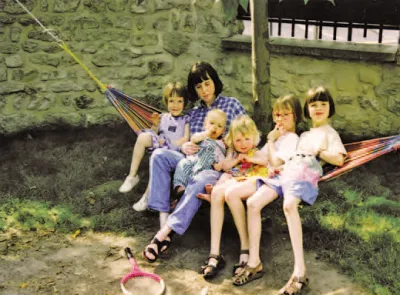
Claire already had three children, she had five of them, four daughters and a son. The legend says that two months after the birth of the senior Claire, she left for Harvard, according to the plan almost to the semester, but soon returned. At one conference, I was settled in the room exactly under the apartment, which was occupied by Claire with four daughters, and at first I was afraid that I would go crazy with noise (I hadn’t had my children then). But throughout the week, no sound came from above. At another conference that took place in Paris, Claire went home to feed children every day at lunchtime (usually the children had dined at school, but in those days it could not work out for some reason).
Of course, I was very intimidated from my youth, that mathematics for a girl and generally somehow not very, and even with a normal family, all the more incompatible; According to legend, this point of view was also shared by remarkable mathematicians like Olga Ladyzhenskaya. The example of Claire in this sense was saving for very, very many, although our achievements are much more modest - such talent, such performance and such severity are rare and separately, and the combination of all this in one person is even more so. And in an external attitude to girls in the French algebro-geometric community, the Claire example also affected very much, many aksacles were afraid, any insinuations in her presence would look funny.
My colleagues and I wrote about the mathematics of Claire last year in the journal Notices of the American Mathematical Society 1 . I can only say that many of the early works were devoted to algebraic cycles and groups of Zhou, at the beginning of the two thousandth Claires solved the famous Kodair problem (is it true that any compact Careerovo is deformed in the projective), having built a counter example with the help of Khoja theory, and in her relatively recent works made a breakthrough in the problems of rationality and stable work rationality of algebraic diversity. We are all sure that she still has many different creative successes ahead.
Catherine America
Photo of the press service
1 Beauville A., America E., Debarre O., Griffiths Ph., Huybrechts D., Charles F. Ad Honorem Claire Voisin // Notices Amer. Math. SOC. 65 (2018), no. 4. P. 390–399.
From the press release of the L'Oréal-Inesco award:
In the field of scientific research, there is still the so-called “glass ceiling”: women make up only 29% of researchers, key positions in academic institutions are occupied by 11% of women and only 3% of the Nobel Prizes in the field of science were awarded to women.
Over the 21 years of existence, the “Women in Science” program helped to support and draw attention to the activities of 107 laureates and more than 3,000 talented young women scientists, both graduate students and doctoral students, providing them with annual scholarships for research in 117 countries. Information about the national scholarship of L'Oréal-INESCO in Russia see Lorealfellowsps-russia.org