
Translated material
The brain loves difficult tasks!
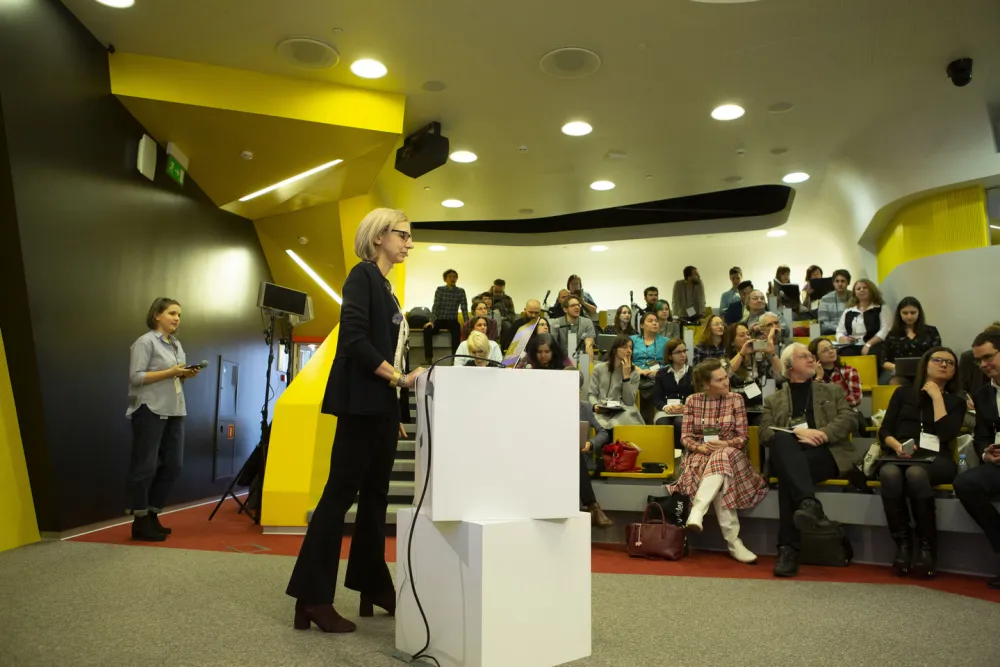
Mathematics is the very school subject to which students have practically no even: either love and understanding, or hatred and a complete stupor. How to help schoolchildren and teachers make this science more affordable and understandable? Will gadgets help this? Or will it be more benefit if you connect the study of the student’s psychology? The answers to these questions were received by participants in the scientific and educational conference “Psychology and technology in mathematical education”, which was held in Moscow on March 18–21, 2019 “Yandex” and the MRE (International Society of Researchers in the Psychology of Mathematical Education).
Will psychologists help mathematicians?
The conference organizers are convinced: it is not enough to know the subject in order to teach mathematics well. It is necessary to study the student well, his features and even errors. “ We conducted a study ,” says Natalia Chebotar , director of the Yandex.Chobnik service, “ and found out that, solving the same problem, students can make a mistake in 24 different ways. It is important to understand the mechanism of error. They now want to see a teacher with a tutor, organizer, and he must first be a diagnostician . ” “ Mistakes are a very important thing ,” agrees the first vice-rector of the Moscow Psychological and Pedagogical University Arkady Margolis . - Without understanding the nature of the mistakes that children make, we are unlikely to be able to provide effective training. Mistakes are different, therefore, it seems to me that they are not of interest themselves, but their typology. It is necessary to understand the features of the thinking of children who lie behind certain mistakes . ”
It is one thing to study physical laws that work equally throughout the Earth. And it’s completely different - to try to comprehend what is happening in the head of a student, who appears here immediately as an object and as a subject of research. And in the fact that in order to increase the effectiveness of teaching, it is necessary to carefully and consistently study the psychology of the student, among scientists, and progressive teachers, there are no doubts. “ The scatter of abilities is so great that teachers are involuntarily focused on those who are well given mathematics, ” Anna Schwartz , chairman of the conference program committee, explains this idea. - Their attention involuntarily appears at the pole of students with great abilities. But there are a huge number of children who, for one reason or another, mathematics is much more difficult. And the further the child is from those who do not experience difficulties with mathematics, the more the versatile interdisciplinary interaction is needed to understand what is happening there, what psychological and neuropsychological reasons are behind this . ” According to the director of the Center for Pedagogical Mastery of Moscow Ivan Yashchenko , the education system changed the paradigm: “ Now not gifted children are in the spotlight. We have a different approach: each child is talented . ”
Thus, we are talking about personality-oriented learning, about the same individual educational trajectory, about which progressive teachers speak more persistently. Now it becomes clear that it is necessary to build it primarily based on the research of psychologists. “ There are convincing results that show that teaching mathematics, starting from preschool age, is effective precisely when developing programs that are based on fundamental psychological research ,” Alexander Veraksa says the head of the Department of Psychology of Moscow State University. “ We are talking about personality-oriented training. And psychology is engaged in a personality study, so we can’t do without psychologists, we learn how to see a child from them. Not just to load it with your mathematical knowledge, but to create a way of self-development of a person in the process of teaching mathematics , ”continues the thought of the scientific director of the Institute of System-Detitive Pedagogy, the author of the Mathematics course“ School 2000 ”, and the methodologist Lyudmila Peterson .
“ The more we take into account the individual characteristics of the child, the more efficiently we can build an educational process ,” summarizes the president of the Russian Academy of Education Yuri Zinchenko . - Conducting diagnostics, learning to measure the state of development in which the child is located, you can build an effective program. Of course, it will be individual. The more features we take into account, the more effective the situation in education will create . ”
The robots are injected ...
Skype lesson, a robot teacher-science fiction writers often draw such a future. Will new technologies be able to replace teachers? This problem was also discussed at the conference. Professor from Helsinki, President of the Marku RMC S. Hannnu believes that it is necessary to implement new technologies in education, however, fundamental psychological research is required to find out, “ how technologies affect the learning process, how people interact with technologies, especially during online work. Researchers of psychology can give an answer to many most important questions, and it depends on how we will approach the educational process. These works, it seems to me, should be carried out jointly by researchers of education and psychology , ”says the scientist.
The education system cannot ignore technological progress: any child knows how to use modern technologies, so they must be used in training. “ The guys are looking for information on the Internet, use electronic devices. And we should not lag behind this, ”said Ivan Yashchenko, director of the Center for Pedagogical Mastery of Moscow. “ However, we cannot bring education to the game.” After all, education, among other things, is a serious work. And one of the most important educational results is the ability to work . ”
Teachers, of course, know how to work. Their work, according to the participants in the conference, is unlikely to once be in the list of unpopular professions. Arkady Margolis claims: “ The teacher’s profession is that profession that will definitely not be replaced by machine learning, algorithms completely. But of course, technology can help the teacher. They can take on the automation of the routine function, which the teacher takes a lot of time, not allowing him to engage in a meaningful part of his profession. If technologies help with verification, evaluating the results, if they can make the lessons of the best teachers more accessible, the teacher will be able to focus on the issues of understanding or misunderstanding by children the complexity of the material being studied . ”
Training is a movement!
In his speech on March 20 at the Conference “Psychology and Technology in Mathematical Education”, Professor of the University of California in Berkeley (USA) , Dor Abrahamson , told how new applications help more effectively teach children mathematics. He believes that training is a movement: “ I mean in the literal sense the movement of the body in space. The more we want to learn and understand, the more we must move. Neuronauk today knows the answer to the question of how children know the world. This confirms the theories of Piaget and Vygotsky. For successful cognitive development, the experience that we receive, and not the concepts that the teachers are of us, are initial. Studies show that experience plays a greater role in the successful development of mathematical concepts than we could assume. The way we move our hands, draw what we hear and what we touch, directly affects how we assimilate mathematical concepts. You can’t learn how to add without knowledge about how the hill or tower of cubes increases, if you add new and new to one cube. And, in fact, technology allows us to return to interactive interaction, which was reduced while we used ordinary computers in training . ” The professor proposes to use applications that would make you move so that mathematical concepts are understood and remembered at the bodily, sensorotor level.
Look in one way
The chairman of the conference program committee, psychologist Anna Schwartz believes that even a correctly built look (not a worldview system, but the eye movement itself) will help the student in learning. Anna Schwartz has been studying the phenomenon of joint attention for many years. “ Modern science has learned to follow exactly where a person looks, with the help of special equipment that monitors the position of the pupil and calculates the direction of the look, ” she says. “ Based on the data obtained by devices, you can create a model of“ correct ”, expert eye movement, which to show the students then .” At the same time, it is not enough just to redirect the student’s gaze, it is necessary to achieve joint attention when two people look together at the same object, knowing that they specially do it at the same time. So mom communicates with the baby, teaching the child to call the toys in front of him. When the child looks at the subject, at this moment the adult calls: "This is a giraffe." The baby looks at another item, and mother immediately pronounces his name. This strategy is more effective than just saying: "Look there, there is giraffe."
The simplest example is the Cartesian coordinates. For example, point 5: 9 is given. The student will first look at the point, and then he will be taught to perform an action: to find it on the axes, first on x, then by y. At the same time, the analysis of the eye movement of the child shows that he does not follow the actions of the teacher, but predicts where he will be at the next moment in order to have time to synchronize with him. The same is true for babies: it cannot be said that the adult redirects the attention of the baby, rather they pick up each other's focus, focusing on the movement of the eyes, then on objects in their hands.
In mathematics lessons, the moment of synchronization is important, which is possible only if the gap between the level of the lesson and his own knowledge allows the student to keep up with and even a little ahead of the teacher’s thoughts. If this is not so, there is an alternative. “ First, give practical tasks, and at the moment when the child is already busy with their solution - that is, we will put him in conditions, where he himself thinks over the material and analyzes possible moves, give a hint in the line of his thinking. Then really joint attention will be achieved, and not just following the instructions of the teacher. The idea is not to configure the student’s gaze, but to adjust the material to his current focus , ”Anna Schwartz sums up.
Mathematics through emotions
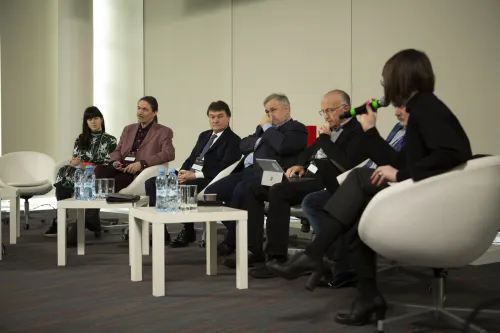 Associate Professor of the Department of Psychology of the Higher School, the head of the laboratory of neurobiological foundations of the cognitive development of Neuropsylab, Marie Arsalida is studying the connection of brain activity with human behavior. She found out that the zones that are responsible for motivation and emotional experiences also work in solving the mathematical problems of some types. In particular, the islet share is part of the cerebral cortex, a long thin body, which is present in both hemispheres and is associated with a frontal share. “ We used to know, ” says Marie Arsalida, “ that she is responsible for the basic things necessary for survival: let the body understand that he is experiencing hunger or thirst - and must find food or water; Pass sensations in various parts of the body. Now it turned out that its middle parts are responsible for this, and the one that is located closer to the prefrontal bark is activated with various types of cognitive activity: when we need motivation, attention, focusing efforts, reaction to the promised reward, when we need to make a decision or make a judgment. The internal parts of this zone also work when performing mathematical tasks - both adults and children. ” The data was obtained using MRI and are a scientific justification of how motivation can help in studying mathematics.
“ Instead of scolding children and indicating errors, you should always choose a constructive tone, praise for achievements, and in unresolved tasks to see areas of potential development ,” says Marie Arsalida. - Then the children will learn to look at it the same. Faced with difficulties, they will say to themselves: “I still don’t know how, but I will definitely succeed if I try .”
Which part of the brain is responsible for the talent for mathematics has not yet been found. However, it is already known that about 60% of children have average mathematical abilities, and 7% are outstanding. “ We want to study these children in order to understand why their brain works better in this direction, ” says the scientist. -Does this mean that some areas are better developed in their areas than that of peers, or do they work differently? "
Is it possible to train the brain to solve problems? As it turned out, yes! “ Children need to know: even if it is difficult for them to solve the problem or understand the topic, the brain works on it . If they continue to engage, neurons are trained in this type of activity, and everything will turn out! Our brain loves to study, and therefore, achieving the result in studying for it is a reward in itself, without external stimuli. The main thing is to provide maximum support, inspire children, try to interest them. Our brain loves interesting tasks, not obligatory . ”
And as a completion, another statement, complete optimism, from the director of the Center for Pedagogical Mastery of Moscow Ivan Yashchenko: “ The percentage of people who are really not capable of mathematics just as they are really unable to physical education, due to some physical features, is minimal. With everyone else, you just need to work correctly, motivate. And the guys will succeed. They will be happy to study with pleasure! "
Svetlana Mikhailova