
Translated material
New properties of old material

The first material that began to be used by humanity was, of course, a tree. The tools and hunting equipment-sticks, spears, bows and arrows-were made of wood, and far from always our ancestors managed to modernize these “devices” with stone tips. It would be more fair to call the Stone Age “wooden age”, but time did not spare the wooden products of our ancestors, leaving only stones in memory of us.
It would seem that in decades of thousands of years, humanity had to fully establish all the properties of wood and not expect something unusual from it. However, the old material can be forced to open from the previously unknown side: the group of Lianbin Ku from Maryland University managed to turn wood first into a “bulletproof”, and then into “fireproof” material. Both of them were achieved using various types of chemical processing.
Firstly, in February 2018, researchers reported that they managed to create a compacted wood, which is ten times stronger than usual [ 1 ].
Super -resistant sealing wood was obtained using a two -stage process. At the first stage, cooking was carried out - boiling wood in a solution containing hydroxide and sodium sulfite. At this stage, there was a partial destruction of two structural components of wood - lignin and hemicellulose. Usually, with the help of such cooking from wood sawdust or other plant materials, pure cellulose is removed, but HU and colleagues did not grind their wood. After cooking, in the second stage, the boiled wood was subjected to pressing at a temperature of 100 ° C - this allowed to compact the material and achieve regular orientation of the nano -rockered cellulose connected to each other with hydrogen bonds. As a result of processing, wood lost 80% of its thickness, but the resulting compressed material was ten times stronger than wood. According to Hu, compacted wood is not only durable like steel, but easier to seven to eight times. The specific strength of new material is higher than almost all known metals and alloys, including light titanium alloys.
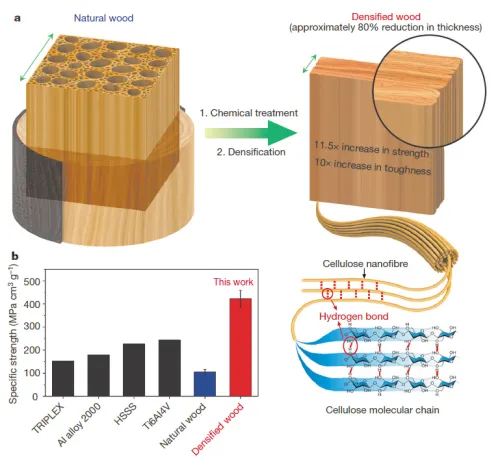
After checking the new material at the ballistic testing stand, the researchers showed that five layers of compacted wood (the thickness of each layer is 3 mm) cannot be broken through a steel bullet, the kinetic energy of which is equivalent to the energy of a pistol bullet. According to the researchers, the strength of new material, determined by the strength of the new material, does not indicate the prospect of creating wooden armor, but such properties will allow the use of compacted wood to create light and strong corps of cars, environmentally friendly buildings and wear -resistant furniture.
Secondly, further studies of compacted wood presented HU OF another pleasant surprise. He found out that the material that left the laboratory can be given without much difficulty and another property valuable for wood - fire resistance, which was reported already in March 2019 [ 2 ]. It turned out that when firing on the surface of superfluous wood, a protective layer of carbon fiber is formed, which makes the material fireproof.
Fire -resistant wood, probably, the dream of all the builders of wooden houses throughout the history of mankind: a huge number of cases are known when the cities in which the main buildings were wooden are quickly burned from random (or not so) sparks. Nowadays, the methods of chemical processing are known that allow you to make a fireproof tree. As a rule, they come down to impregnation of wood with chlorine-containing combustion slowdown, which, firstly, is expensive, and secondly, many of the substances that are used as combustion slowdown can be toxic to a person or dangerous to the environment. In some cases, the impregnation of wood with shallowing devices leads to the fact that the strength of the soaked material is significantly reduced.
The method of giving fire resistance, which discovered HU, not only does not require toxic and expensive reagents. A dense protective layer of charcoal, formed on burned compacted wood, does not affect its mechanical properties.
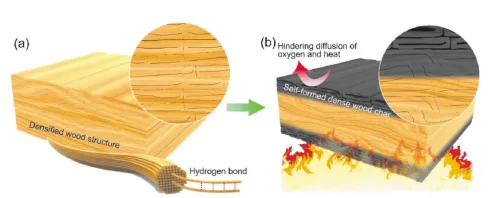
Hu claims that the formation of a fire -retardant surface slows down the time of the fire of the compacted wood three times. Moreover, not only the time of the fire of new material slows down - even when he fires, he loses his strength much more slowly than ordinary wood embarrassed by fire. Thus, when using the material developed by the HU, the buildings will be slower and more slowly collapse, giving people a precious time for safe evacuation.
Experts in wood and other cellulose -containing materials as a whole highly appreciate the work of chemists from Maryland, but at the same time notes that additional studies are necessary before the use of the novelty. Many are surprising that the wood after removal of lignin becomes less fiery - lignin is the least inflammable component of wood, and increasing fire resistance through deligniation can hardly be called a traditional approach to wood processing. Perhaps the reason for increasing fire resistance is a decrease in the number of pores and an increase in density, but, in the opinion of some, the same results can be obtained from wood using more traditional approaches.
Other experts are interested in the issue of the cost of large -scale production of compacted wood - it will not be easier and cheaper to use in practice not compressed wood, but composite materials whose production technologies are well worked out. Hu and his supporters assure that their method is not so expensive, since the developed approach to compaction can be applied to any wood, not necessarily expensive and strong varieties. In any case, looking at the results of the study, we can rightly say that even such familiar material as wood can prepare pleasant surprises for chemists and material scholars.
Arkady Kuramshin,
cand. chem. Sciences, Associate Professor of the Chemical Institute of KFU
1. Hu L. et al. Processing Bulk Natural Wood Into a High-Performance Structural Material // Nature. 2018. V. 554. P. 224–228; DOI: 10.1038/Nature25476
2. Hu L. et al. DENSE, SELF-FORMED Char Layer Enables A Fire-Retardant Wood Structural Material // Adv. Funct. Mater. 2019, 1807444; DOI: 10.1002/ADFM 201807444