
Translated material
Segregation strategy
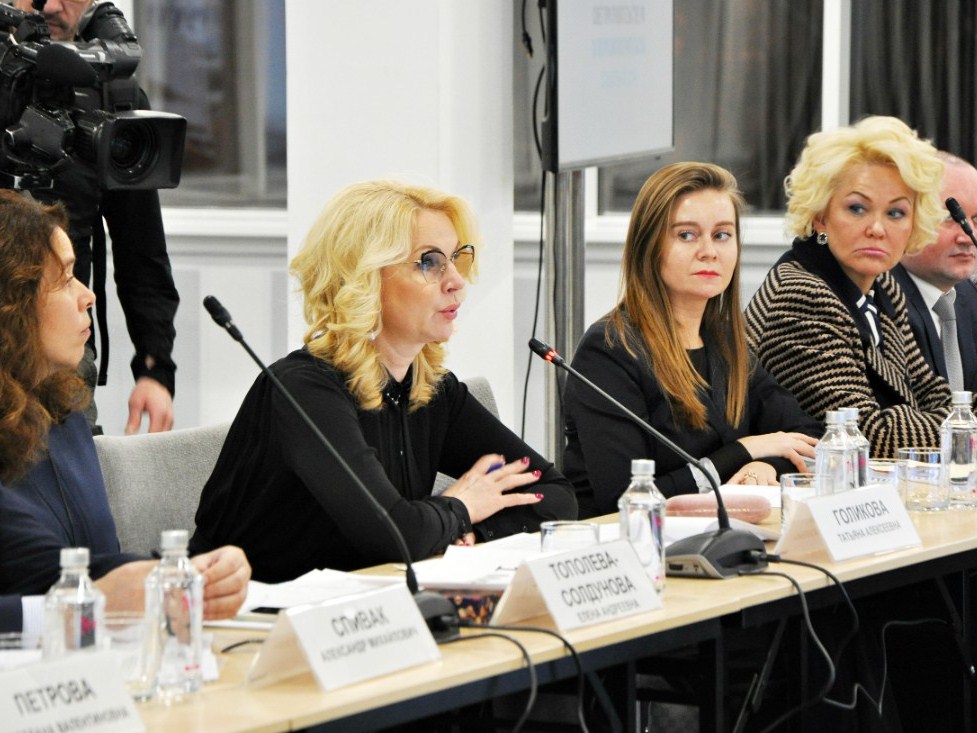
The government continues to work out plans for the reform of the system of neuropsychiatric boarding schools . At the first stage, a re-examination of all PNI guests will be carried out, the number of which exceeds 150 thousand people, reports the Orthodoxy and Peace portal the words of Deputy Prime Minister Tatyana Golikova at a meeting of the Council under the Government of the Russian Federation on the issues of guardianship in the social sphere. According to the head of the Ministry of Labor Maxim Topilin, 40-45% of patients with PNI can potentially be brought to accompanied accommodation.
Recall that in February Golikova instructed the Ministry of Labor and the Ministry of Health to work out ways to improve the PNI system. The authorities also allocated more than 50 billion for the construction and reconstruction of psychoneurological boarding schools in 2019-2024. This step caused the discontent of many non -profit organizations that fear that the money will not be spent on reform, but on the reproduction of the existing system.
The president of the Center for Autism of Autism, Ekaterina Men, shared his opinion on the government’s plans to conduct a reform of PNI with Polit.ru.
 Ekaterina Men
The discussion of this topic once again demonstrated that our society has yet to go a serious way. Proper people who have warm houses who have income, who have a full refrigerator who have the right to move freely and make decisions regarding their life, attribute this exclusively to their merits. If someone ended up in a situation of social insecurity, this is perceived as his fault. It is very convenient to live in such a design, and that is why all of us are facing the most important task: nevertheless, to explain to society that we are all in this sense.
To explain, among other things, that we are all at risk. That we are all aging, that we all get sick, that we are all crossing the streets where some crazy one who will drive us can pass. We live in one common world, and even if you do not take into account moral arguments, there is a completely cynical explanation of the need to make a PNI system more humane. It’s just that none of us is protected from getting into this system. And in this parallel world, crimes, crimes against humanity occur every day. The basic human rights there are violated from the threshold.
We know that this is wrong, that it is criminal. But society as a whole, unfortunately, still lives with the feeling that one or another people can be done, if we are talking about security. And in the mass consciousness, people who fell into the PNI system are simply endowed with the status of “dangerous” ones. After that, violation of their rights is no longer perceived as a serious problem. But actually there is a penitentiary system. There are dangerous people in any country, for this, prisons and criminal codes are created. To limit those who commit socially dangerous acts. Here we are talking about people who have not committed acts prohibited by the Criminal Code. But we, as a society, do not want to associate them with ourselves, and therefore, unfortunately, we believe that they can be isolated.
But this really can actually happen to everyone. I’m not even talking about any difficult cases, but in PNI, for example, they often get due to any property disputes, with a division of inheritance or during a divorce. It is not so rare that people are “healed”. That is, a person, for example, enters a psychiatric hospital with depression, but the drugs that he receives do not improve (and in some cases, on the contrary, worsen) his psychological state. Such a person has a lot of chances to get into PNI. People, unfortunately, do not try on these stories on themselves. They really think that "there are only psychos, people who only crawl and bark."
This logic of the “parallel world, which is more comfortable for us”, unfortunately, is still common. Therefore, we have the most important task: to explain to society that this can affect everyone. Alzheimer is now increasingly happening in fairly young people. Are you sure of the ideality of your children that they will be ready to accompany you with your senile dementia for many, many years? Or are you for some incomprehensible reasons sure that dementia will not overtake you? We are all at risk. And therefore, we are interested in, while we are healthy, while we are capable, to transform this system. So that it is not in the current form, if we suddenly weaken. Protect ourselves from the probability of getting into this hell.
It is also important to note another point that many people do not understand. A psychoneurological boarding school is not a psychiatric hospital. A psychiatric hospital is a medical institution, an institution in which they are engaged in treatment. We will not concern the quality of this treatment, there are also a lot of problems, but in any case it is precisely the institution that is aimed at treatment. PNI is not a medical institution. PNI is a system of organization of life of socially or mentally weakened people.
Should there be a system of organization of life of socially or mentally weakened people? Yes, of course, we do not say that these people do not need support. But a radical breakdown of the strategy is needed. Because PNI is a segregation strategy, the strategy "We should not see these people." As it was with Stalin, who took out of Moscow disabled people. It doesn’t matter who you are, professor or academician, if you do not have a leg, you will be taken out of Moscow. This segregation strategy can seem effective only until you yourself have “lost your leg”. And when you yourself are “losing your leg”, you suddenly find out that it turns out that this parallel world exists.
Support is certainly needed. But the form in which it exists cannot be considered support, it is only issued for support. This support is not for socially or mentally weakened people. And support, firstly, for those who do not want to see them next to them. And, secondly, this is support for a bunch of beneficiaries. This is a huge financial flow, each such guest follows very high per capita financing. This system is a “stream of bodies”, for which a lot of money comes. And someone disposes of this money. The administration that disposes of the pensions of these people. Those who supply food in PNI, and often in reality supplies Baland. Those who should repair them, but in reality do not repair anything. Just look at the statistics of fires, how many boarding schools have simply burned out because of the old wiring and the collapsed infrastructure.
The PNI system in the current form is the country's shame. A shame, which, inter alia, was marked by the UN Disabled Rights Committee. In March last year, they wrote about a terrible situation with the Russian PNI system. Her full reform, of course, will take quite a lot of time. But, firstly, this is still a foreseeable time, and secondly, a long period of time required for the reform is not an occasion not to start it. Until the end of August, namely, this period was declared as the period of the first stage, I think that you can have time to "remove the upper layer." In the PNI system, more than 160 thousand people are at the moment. About thirty percent of them are not even devoid of legal capacity. Even if we only have time to figure out why they are there, in their own will or, for example, as a result of fraudulent deception with housing, it will already be good. In addition, there are a lot of people who got there along the hell of a chain "from an orphanage or an orphanage house-to PNI." Whatever the disability of the pupil of the orphanage has, even if it was enough for him to just buy a wheelchair, it automatically leads it to PNI. Instead of buying him this stroller and providing him with support for socialization and reintegration in society, he is sent there.
But these people can work, can serve themselves, they just need a certain training, certain support. This is the same story as with the homeless. When “mercy” is engaged in their reintegration in society, it very often turns out that, now, he came to work and stole a passport. And under these deposits of new asocial habits that arose in the process of getting used to a person to the station, quite social personalities are found. Having received help, they begin to work, begin to rent a room on their own. But this requires work, work of social workers, psychologists. If we talk about mentally weakened people, they, of course, especially at first, may need outpatient psychiatric assistance. This work is effective, but it requires money.
People with mental illness, even with great mental illness, are incredibly held by work, social activity. That he has colleagues, there are obligations. The very structure of social existence has an incredibly strong therapeutic effect for mentally weakened people, it really reduces the effect of the disease. And that is why, when they tell us that now new “anthills” will be built for 50 billion rubles, that the system will simply be repaired and played for this money, this causes such indignation.
Relatively speaking, we agree that it makes sense to repair the stumps that are in terrible condition and may light up tomorrow. So that they are at least secured for those people who are there. But simple repairs of PNI cannot be called the system reform, our task is to fundamentally change the approach to the problem. At a recent meeting of the Council, they seemed to be announced that by the end of August they would conduct diagnostics of people who are in PNI. This is just the “top layer” that I spoke about.
Questions, of course, still arise. It seems like the Serbian Institute, Kekelidze is taken for this. To which the third sector has claims. There is an even more difficult problem. PNI guests, regardless of expediency, are feeding on psychotropic drugs for years. It is very difficult to determine what is a consequence of the disease, and what is a consequence of prolonged use of psychotropic drugs. If you or you to pump me up with a haloperidol and put it in front of the commission, we are simply identified by the look as patients. Motorika will change, facial expressions will change, saliva will flow. Therefore, the question of how exactly the diagnosis will take place is now very serious for us all. This is not a specific Russian problem, it exists throughout the world. Many scientific articles, for example, analyze what a person has hanged from: from depression or from antidepressants that he accepted against depression. This question is open, and there is no unambiguous scientific answer to it.
How will the guests evaluate the guests? In fact, quite long work of specialists is needed to overcome the consequences of prolonged use of psychotropic drugs and a long absence of full socialization. By the way, medical care is practically inaccessible to the guests of PNI, most often in the institution one doctor, and this doctor is a psychiatrist. People did not get to the gastroenterologist with an ulcer. Hellish absolutely a system. And we must continue to discuss this, in all possible formats, not to assume that if the authorities began to meet us, our task has already been solved.
This system must be deployed. It is necessary to discuss the composition of working groups, discuss who will conduct the mentioned diagnosis. Maybe it is worth attracting foreigners. We now have idiosyncrazia to foreigners, but, for example, when Romania reformed its orphanages, and they had the worst system of orphanages, even worse than the Soviet one, a foreign examination helped it a lot. External forces were attracted.
As far as possible, attracting external power in our case, we do not know, but even if we do not call Americans, we can call specialists from more friendly countries, for example, from Finland. I would like to have an understanding that there should be an external look, that a force that is not tied to this system should participate in the reform. Why are everyone so skeptical of the Serbian Institute? Yes, just because it is part of this system. We do not believe that the non-commissioned officer widow will carve itself.
The fact that Golikov says about it, that high -ranking officials say that it is a shame, that this should not be, of course, causes us hope. Why do I still look at this process positively, even understanding what nonsense will climb during this process? Because finally, from a high position, the position was articulated that it is necessary not only to restore the structure, but it is necessary to change the entire system. The state, probably, is not so much can, it does not really know how to do it at all. I am a realist, I look at the world soberly, but if we now say that it is pointless, because the state still cannot do anything, it will probably not be very right.
If the state will attract NPOs, it will attract a look from the outside, it will already be very useful. Especially if the state says: “OK, we will not spend all the money for restoration and strengthening the existing model, we will spend only half on this. And we will give half to the creation of effective models and the reproduction of those models that already exist and work effectively. ” Why is the stunning model of Lear Armus, who has been working effectively for a long time, does not receive state support?
Samples are created. But they must be reproduced in other corners of our country. This is like a system of inclusive education. No one believed that non -verbal children could study in ordinary schools. NPOs created this model, showed that it is possible. And the state began to support it. The progress is still insufficient, too many still want to throw these children somewhere, remove them from their eyes. But still it moves, in this area development is visible.
If the state has money, but it does not know how to solve existing problems, he just wants to build new institutions according to the model of the old ones, this cannot be called competent social policy. Competent social policy requires compromises. Even if you really want to give all the money to their contractors, so that they get a little on, it makes sense to give part of this money to strengthen those models, those technologies that already effectively work within the non -state sector.
We really hope that the state will show its interest in supporting the current forms of social support for weakened, socially or psychologically, people. Until August, we will not change the system that was built the entire XX century. But if you start now, you can have time to do at least something.