
Translated material
US senators have introduced a bill with the threat of strict sanctions against the Russian Federation
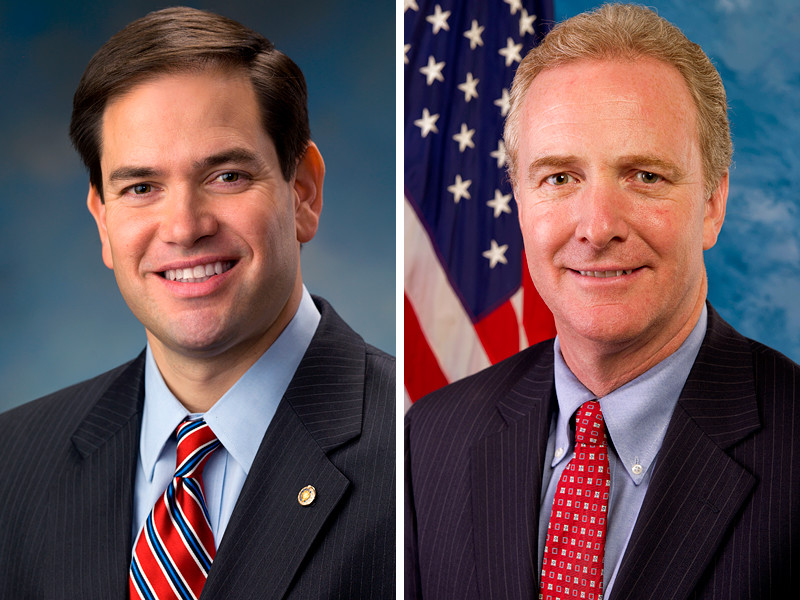
American senators Chris van Hollen (Democrat from Maryland) and Marco Rubio (Republican from Florida) submitted a bill on Wednesday for consideration by the US Congress, which contains a threat of severe sanctions against Russia to prevent intervention in the American elections that can again undertake the Russian Federation. This is stated in a joint statement by two senators published on the official website of Rubio.
The bill provides for the possibility of introducing restrictive measures against banking, energy and defense sectors of the Russian economy, also against Russian sovereign debt, the text of the bill is noted. The Bill, proposed by senators, was called Deter Act (Defending Elections AGAINST Trolls from Enemy Regimes Act - "The Law on Protection of Trolls representing hostile modes", the abbreviation can also be translated as a "prevention law"), TASS reports.
"I urge the Congress to rally and decisively protect our elections and the American people in future years from foreign opponents who are determined to make a split into our ranks and share us to strengthen ourselves," says Marco Rubio.
His colleague also refers to the results of the investigation of the special prosecutor Robert Muller. "A clear conclusion that we can make from the report of [Robert] Muller (investigating the Russian attempt to influence the election campaign on the eve of the US presidential election in 2016. - Approx. Newsru.com ) is that Russia sought to manipulate the American people and undermine the democratic process in 2016," said Senator Van Hollen. We are approaching the electoral cycle of 2020, we must remain vigilant against attacks from the Kremlin or anyone who seeks to follow them (Russians. - Note TASS ) An example. ”
The bill stipulates that the US National Intelligence Director within 60 days after any American federal-scale elections must conclude a conclusion about whether Russia or any other state tried, or persons controlled by these countries to intervene and influence their outcome. If the director decides that such an intervention has really occurred, the draft law prescribes the mandatory introduction of sanctions within 30 days. The head of exploration of the United States will also have to publish a list of Russian politicians and businessmen, whom the American intelligence agencies suspect of involvement in attempts to intervene in the elections and against which sanctions may be imposed.
The measures provided for by Bill include sanctions against Russian banks, including Sberbank, VTB, Gazprombank, Vnesheconombank and Rosselkhozbank. The bill provides for a ban on doing business with these banks in American jurisdiction, as well as for US citizens. The bill also implies a ban or serious restriction of the possibility of opening correspondence accounts that have been sanctioned by banks. These accounts are necessary for conducting transactions in dollars.
There is also a ban on all transactions in American jurisdiction with Russian sovereign debt, bonds of the Government of the Russian Federation and bonds issued by organizations owned and under the control of the Russian state, issued on the day of introduction of sanctions or after it.
The draft law provides for blocking, that is, freezing without confiscating American assets of Russians who may fall under sanctions, including officials and businessmen, as well as a ban for them to enter the United States.
The sanctions provided for by the bill also include a ban for American citizens and companies to carry out new investments in the Russian energy sector. Restrictive measures also provide for freezing all the assets of Russian energy sector companies in the United States, as well as companies from third countries that carry out new investments in the Russian fuel and energy complex.
Bill also includes a demand for the US administration to seek sanctions from the European Union for the Russian Federation. The document mentions China, Iran and DPRK as countries, which, according to the author of the initiative, can organize cyber attacks with the intention to influence the American elections.
The bill, which provided for similar measures, was submitted to the US Congress at the beginning of last year by senators Van Hollen and Rubio, but then it was not adopted by Congress.