
Translated material
Ethiopia against Boeing: the main thing from the report on the investigation of the disaster
The Ethiopian aircraft regulator published a preliminary report on the investigation of the Boeing-737 Max Ethiopean Airlines aircraft. The Bell studied the report. We tell you what led to the disaster, how it developed and what will now be with the new chief liner of Boeing.
The cause of the disaster. The main news of the report is confirmation of the breakdown of the left sensor of the angle of attack. It was she who became the root cause of the whole tragedy.
- The malfunction arose shortly after the separation of the aircraft from the ground. This is a typical picture of the sensor damage to an extraneous object - for example, a bird.
- The sensor jammed on the impossible value of the angle of attack - 74.5 degrees, meaning lifting the nose and dumping the aircraft. Therefore, the entire flight system of MCAS control tried to introduce it into diving, but without the knowledge of pilots.
- On the Boeing-737 Max two sensors of the angle of attack. MCAS receives data from only one sensor, changing it at the beginning of each flight . The fatal flight was 383rd for the entire operation of the broken Boeing. If there were one or less cycles (take-off and landing), disaster could not have occurred.
How the events developed. The problems began almost immediately. On the rise, a warning about icing of the sensor sounded. The crew reacted standardly - turned on heating.
- Then a warning about the loss of speed (vibration of the helm), which lasted the entire flight, was activated.
- A minute after take -off, at the stage of setting heights, the crew turned on the autopilot, but the plane began to behave unusually. The crew turned off the autopilot and reported on problems to the dispatcher.
- In a stressful environment, the pilots did not control the traction of the engines. The compressor revolutions remained close to the take -off of almost the entire flight. This is a critical error, writes Bloomberg.
- In the second minute of the flight, the aircraft control system independently shifted the stabilizer for diving from 4.6 to 2.1 units for the first time . The set of heights ceased, a small decline began. In the cab, a message of the warning system about the proximity of the Earth sounded.
- In the third minute of flight, the pilot is trying to control the stabilizer from the helm. The installation angle of the stabilizer grows to 2.4. But the control system intervenes a second time and more strongly rearranges it to dive - already 0.4.
- The pilot again straightens the stabilizer, the crew turns off the automatic permutation of the stabilizer . The records of the "black box" confirm the shutdown of the system. The crew requests the contrary to the dispatcher.
- Meanwhile, the aircraft speed increases, a warning about its excess sounds in the cab. The crew commander and the second pilot pull the helm on themselves together, but they cannot bring the plane into a horizontal flight.
- The second pilot reports that the manual rearrangement of the stabilizer does not work. The reason, most likely, in a double exceeding speed at low altitude - the trimmer helmets in such conditions are very difficult to shift.
- At the end of the fifth minute, the second pilot recalls the warning of icing the sensor. Both pilots understand what really happened (there was no icing, but the attack sensor was damaged), but the plane could no longer be saved.
- Half a minute before the crash, the Black Box writes out the latest attempts by the crew to rearrange the stabilizer manually, and then the third and last intervention of the automatic system turned on or turned on (from the report). She again rearranges the stabilizer to dive, directing the plane's nose down.
- In the sixth minute of the flight, the plane crashes into the ground at an angle of at least 40 degrees at a speed of more than 900 km/h. At the crash site, a funnel is formed 10 meters deep.
Whose fault? The purpose of the preliminary report is not the search for the perpetrators. But it contains the Boeing recommendation to remake the Boeing-737 Max control system, and the aviation authorities-to control this.
- The Minister of Transport of Ethiopia Dagmavit could the day before said that in the emergency, the pilots followed the Boeing instructions, but this did not help to straighten the plane.
- These reports showed that under stressful conditions, pilots could make a critical error, but at least partially completed the Boeing recommendations to turn off the automatic system.
Boeing reaction. The preliminary report does not mention the MCAS system at all, but it follows from the statement of Boeing that it is it.
The aircraft manufacturers said that “unintentional inclusion of MCAS” will be impossible after updating it software. “The update adds additional protection measures that prevent MCAS from erroneous data. Crews will always be able to overcome the system and pilot the plane manually, ”the statement said.
Boeing President Dennis Mulenberg apologized to the families of Boeing-737 Max who died in both disasters-both in Ethiopia and Indonesia. He confirmed that:
- Both disasters had a common reason - the erroneous operation of MCAS, which received incorrect data from the sensor of the angle of attack;
- The new software for the system is tested and almost ready, it will only have certification and installation on all liners;
- MCAS was only one of the links in the chain of events that led to tragedies;
- Boeing is confident in the complete safety of Boeing-737 Max as a type.
What remains behind the scenes. The disaster could not have occurred if all the Boeing-737 Max aircraft initially had an optional (and paid) system for indicating the angle of attack and warning about the alignment of the attack sensors of the attack. Boeing will begin to install them “in the base” - but the decision was made only after the disaster. Before disasters, these options on their planes ordered only Southwest and American Airlines.
The MCAS system needed this aircraft to facilitate the transition from the previous type, Boeing-737 NG. One of the competitive advantages of the new model is the ability to transplant pilots without retraining to it. This saved millions of dollars, but forced Boeing to “adjust” the pilot qualities using electronic systems.
The regulators have questions to the Boeing-737 Max certification process .
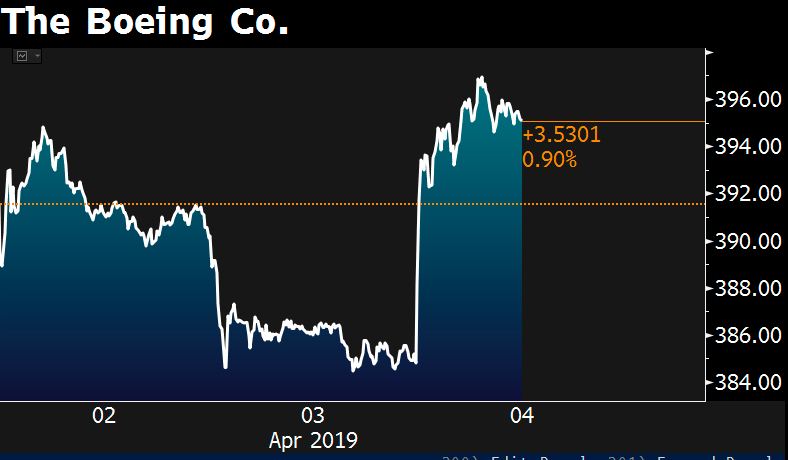
Market reaction. On Thursday, when the first leaks appeared that the root cause of the collapse of the Ethiopian aircraft was a bird , Boeing quotes grew by about 3%. They decreased after the statement of the Ethiopian minister that the pilots were not to blame for the disaster, and grew up again after the text of the report was published.
According to Bloomberg, investors reassured the fact that the report did not have new bad news, as well as the statement of the company itself, which allows us to hope that planes fly again. The shares of the company played almost half of the capitalization, lost since March 10.
What next? The consequences of two disasters for Boeing will be severe, but not catastrophic. According to the Bloomberg analyst, various claims and compensation will amount to about $ 1.9 billion in the amount of approximately $ 3.2 billion. This is less than the company's free liquidity ($ 8.6 billion). Do not be too afraid of future orders too much. The aircraft market is now a high demand and a deficit of the proposal of mediumagistral aircraft, which is a competitor to Boeing - Airbus - will not be able to make up for.