Date
Author
Александр Есипёнок

Preserved copy
Translated material
Full Shies

This is a personal blog. The text could be written in the interests of the author or third parties. The editors of 7x7 are not involved in its creation and may not share the opinion of the author. Blog registration on 7x7 is open to authors of various views.
The other day I went to a landfill under construction in the Arkhangelsk region for the disposal of Moscow garbage (Shies) and decided to share with you my impressions and a few photographs.
First, a short introduction. “If we surrender Shies, we will surrender Russia,” one of the local activists told us (to us - this is a blog tour organized by the magazine “7x7”; I went to Shies as part of it). And these are not just words. If it is built here, such “shies” will begin to appear in an increasing number of regions - there is a lot of garbage in Moscow, enough for everyone. And no reduction in waste generation for you, friends, no recycling or separate collection - why, if you can develop budgets for insanely huge landfills of hundreds of hectares for burial?
Shies concerns everyone who is not indifferent to the issue of waste, the development of SSR (separate waste collection) and recycling in Russia. This is how it applies to all Russians in general, but this is lyricism. And the prose is this: if you are an activist of any RSO movement, organization, group of citizens and ignore the ongoing construction of a huge illegal insane landfill for burying Moscow garbage in the Russian North - this is very strange.
The project is crazy - and it reminds me of similar crazy projects from the past of our country, such as turning the Siberian rivers and laying a gas pipeline along the bottom of Lake Baikal. But, alas, now this project is not in the past, but in the very present - and the construction of the landfill is happening right now. It happens without any project, and therefore without examination and assessment of the environmental impact - because there is nothing to evaluate, there is no project. The only thing that opponents of the construction have on hand is a simple presentation from SeverStroyTrans LLC, which tells about what is planned to be done on the cut down eleven hectares of the northern forest of the Arkhangelsk region.

On Thursday morning we arrived in Syktyvkar (the path from it to the hot spot of the Arkhangelsk region is an order of magnitude shorter than from Arkhangelsk) and then we were faced with a many-hour journey along the roads of the Komi Republic to the border with the Arkhangelsk region. Having checked into a hotel in the evening in the working-class village of Urdoma (closest to Shies), we discussed plans for the next day and went to bed.
Early in the morning (while the roads were frozen and could withstand the flow of cars), we moved in a column to Shies. The drive is about an hour. On the way, we got into a conversation with the driver, a local activist, and began to immerse ourselves in local specifics. Shies is not a case where “one knows better from the outside,” and that’s what we came here for—to feel the meat going on here directly, and not through disturbing videos and photos.
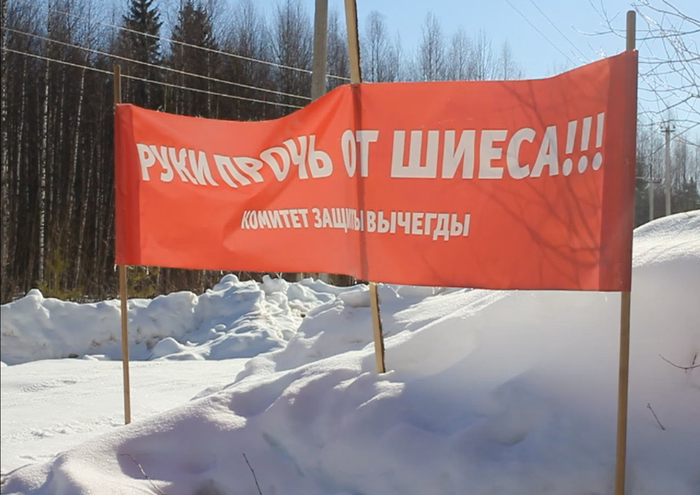
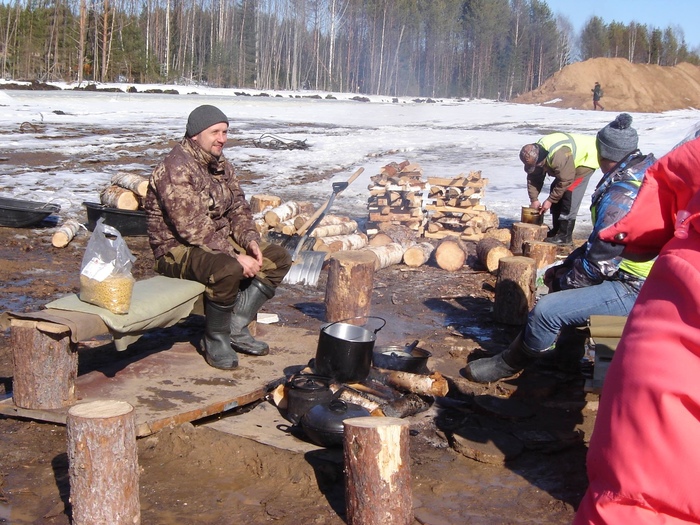
We approach the first watch point - the “bonfire”, blocking the path to the training ground from the north-west side. “Hands off Shies!!!” — inscription on the banner installed at the turn. There are a lot of cars of activists who came to the watch, a lot of calls and slogans on posters that burst out from troubled souls, yellow vests with the signature “People’s Control” and stripes “Pomorie is not a trash heap!” - everything is colorful in the eyes and shimmers in the bright morning sun. The shift workers offer us hot soup and tea - we politely refuse (we had recently had breakfast) and hint that the soup and tea will come in handy later, when we return from the training ground. Despite some distrust of the journalistic fraternity after numerous cases of events taking place on watch being turned upside down - the hubbub of cheerful and not so funny conversations does not subside, several groups immediately formed: journalists and bloggers interview activists and ask them to chop wood for a beautiful shot.
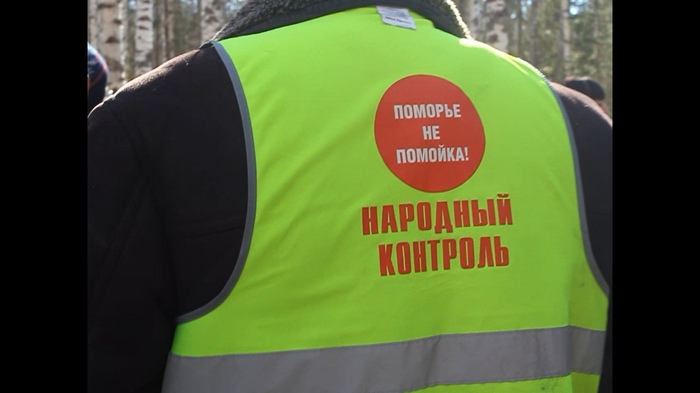
After some time, we move on - there is still more than one post ahead that needs to be bypassed. At the next stop - a watch near the railway - Ivan Ivanov, a lawyer and activist, gives instructions on what to watch out for at the training ground and how to deal with it. We cross the railway tracks only in bright reflective vests - safety rules, violation of which may result in an administrative fine at the request of the landfill workers who are closely monitoring the shift and activists. We approach one of them, offer sandwiches and tea, and ask them to tell us about their assessment of what is happening. The young man refuses sandwiches and leaves the situation without comment.
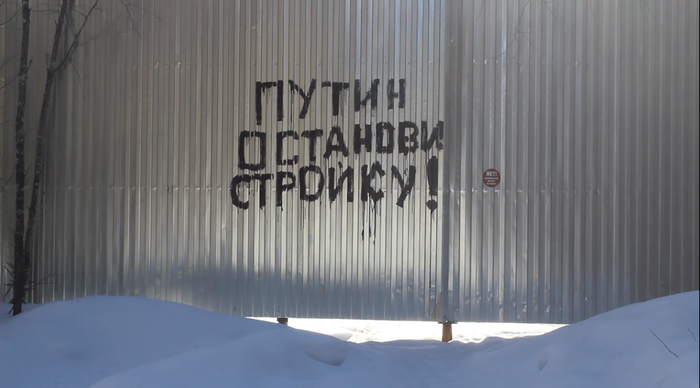
We spend some more time on the road and reach the Shies railway station. Now unloading work is underway on it - heavy equipment is pulling concrete slabs, which will be carefully laid on the lands of the forest fund, which once fed the forest growing on them.
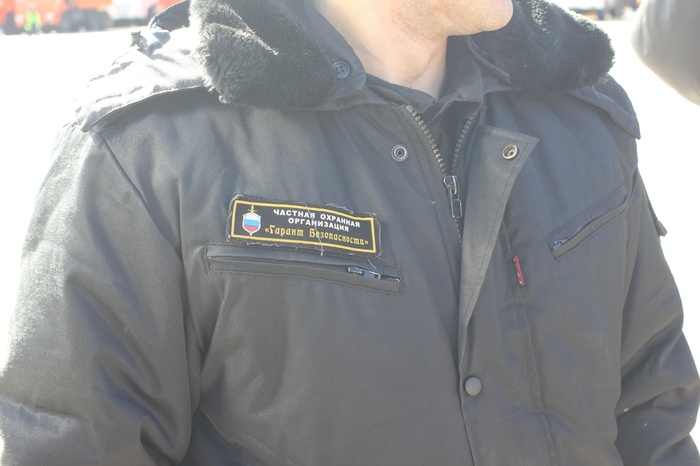
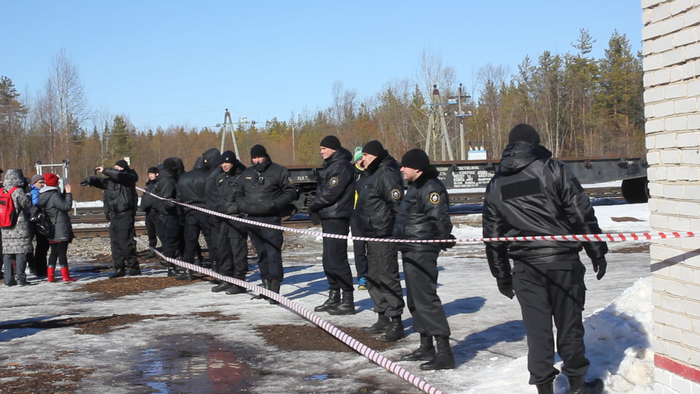
On the occasion of such work, the station is fenced with warning tape and a line of security guards - people in black, without badges, but with stripes “Private security company “Guarantor of Security””. Unfortunately, the text of the patch does not give people who come confidence in their safety, because when they try to get into the territory of the passenger and supposedly public station, they are faced with a wall of private security officers who, although they do not use physical force against the activists, in a rather aggressive manner let them know that they are not welcome here and they will not get to the station. This is strange, because there is a (temporary, I believe) police station very close by, and we are trying to ask the police officers passing by - why are we not allowed into a public place? Silence and indifference were our answer.
Well, let's move on. And then we see latrines for workers and construction guards, from which everything drains into a nearby swamp, a small farm with chickens and sheep (you can guess why they are kept here) and building materials, cables and other rubbish dumped here and there. When our group reached the “helipad” (quotes here because this is not a helipad, but simply a place suitable for landing a helicopter; this helicopter delivers fuel for equipment and other resources necessary to continue construction to the landfill, because all other access roads are blocked by activists, and it is illegal to drain fuel at a passenger station from trains - and activists are closely vigilant to ensure that this does not happen, calling the transport police at any opportunity) - security guards They blocked our path in a dense row, just as it was at the station. There are about 50 of them here in general, but there are much fewer of us. Our presence here and desire to move on are absolutely legal - we are located on forest lands that are publicly accessible to citizens, and one of the conditions of the lease agreement for these lands was precisely the unhindered access of citizens to this territory at any time. As we see, this condition is severely violated. Everything that happens is filmed by a dozen cameras, but attempts to get clear comments from the guards on what is happening are unsuccessful.
After jostling like this for 15–20 minutes, we move to the next watch point - “Leningrad”, after the name of the people on duty there. They offer us tea and cookies again, and it’s hard to resist - after all, we’ve been in the cold for quite a long time, while actively moving. There is another duty station very nearby - “Stalingrad” - and it is installed virtually close to the fenced area of the station.
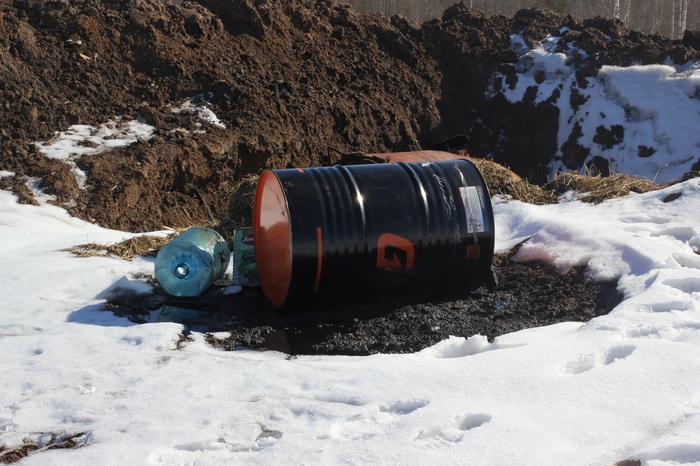
Having rested a little, we continue our walk around the territory of the training ground. From this mountain of clay you can see how excavators are working at the other end of the landfill, here we see a barrel with spilled fuel that is absorbed into the ground and freely flows, presumably, into the groundwater, and here is a large iron barrel in which landfill workers burn their garbage. Locals wrote complaints to Rosprirodnadzor about this incineration barrel, but the landfill workers are constantly moving it, which puts the unfortunate Rosprirodnadzor into a state of frustration, and they regularly helplessly report that no barrel has been found.
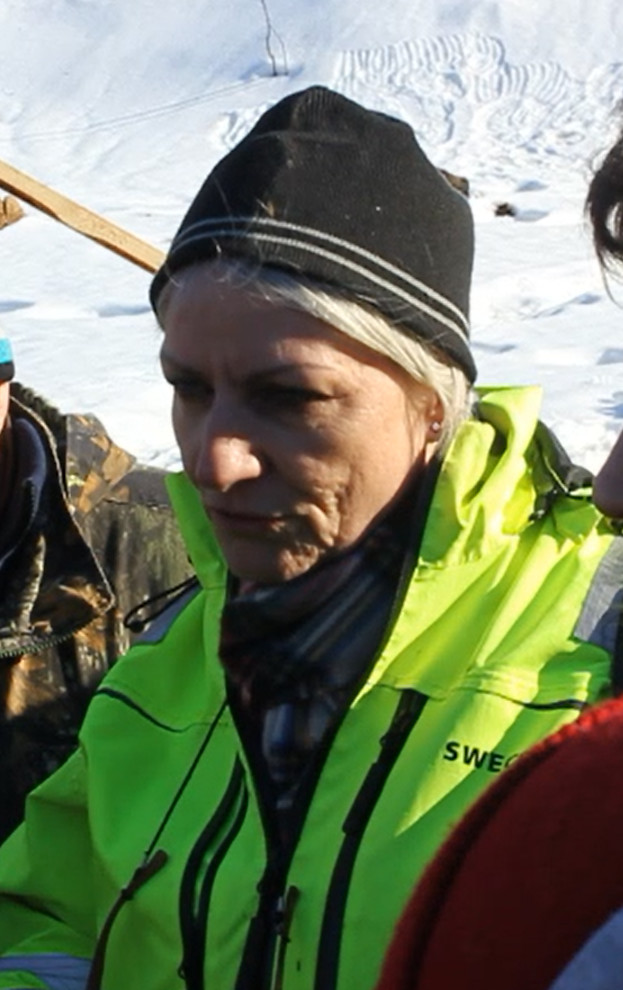
After walking around a bit, we return to Leningrad and wait for the legendary Swedes. The organizers of the tour announced them almost as the highlight of the program, because these Swedes developed and tested (gave an expert assessment) the very technology that they were going to use to bury Moscow garbage at Shies. As a result of conversations with the Swedes, it turns out that this technology was developed for the temporary storage of garbage with its subsequent disassembly and sending for recycling (by the way, according to that very only presentation about Shies, before briquetting, the garbage will be crushed, which reduces all chances of its subsequent disassembly and recycling to zero), and burning garbage with subsequent energy extraction is generally a great idea, and everyone in Sweden does this, and the toxic ash resulting from leaving waste incineration plants (WIPs), they are taken for burial in Norway (great, right?). After attempts by representatives of technology developers to immerse themselves in the Russian specifics of waste disposal and incineration, we receive the comment “well, if everything is done normally, everything will be fine.” Thank you.
A slight misunderstanding did arise, because these Swedes are just representatives of a commercial company engaged in such developments, and have nothing to do with environmental protection or human rights protection. However, local activists were confident that they could try to ask them for protection. As a result, to the question “Aren’t you worried that we will all suffocate here and the entire natural environment surrounding the landfill will be irrevocably damaged?” they received a fair answer: “Why should we care?”, and when asked about a personal assessment of such a project for transporting garbage from Moscow to Shies 1200 kilometers away - “We believe that garbage should be processed where it is generated,” but in this case it is not very clear why they bury the ash from their incineration plants in neighboring Norway.
To sum it up with these Swedes, I want to say that it is quite clear that their task is not to make the best option in general, but the best under given conditions. If we need a landfill, they will build a high-quality landfill; if we need an incinerator, they will construct a good incinerator. Naturally, all this is without regard to Russian (non)compliance with the norms and rules laid down in the original project.
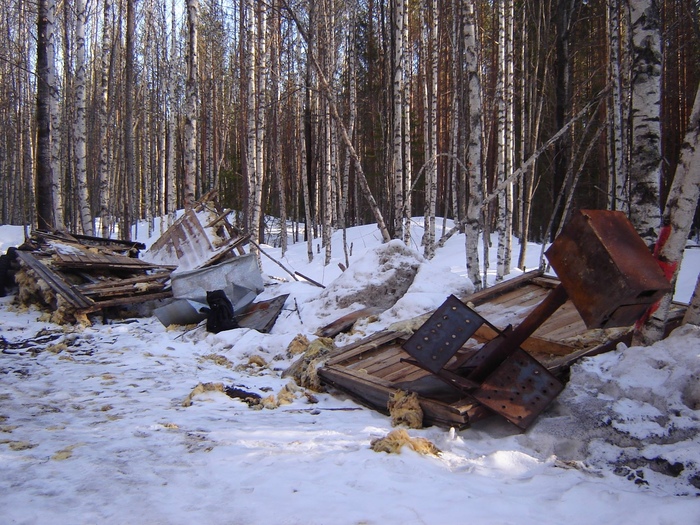
After a visit to the Swedes’ training ground, our blog tour went to inspect the place of the former watch on the road from Shies to Madmas - where the excavator operator (who, as it later turned out, was in fact not an excavator operator, but a simple mechanic who did not even have the right to operate construction equipment) in a deranged state broke the watch trailer with a bucket, in which there was a man, crushed one of the activists with it and, without any regret, moved towards people standing in the way of the mechanism. The wreckage of the trailer has a depressing and discouraging effect on the psyche - it seems that in the same way, with massive construction equipment, the designers and workers of the landfill can ruin the fates of the people living here in no time by building the ill-fated “EcoTechnoPark “Shies””, without looking at any framework of not only morality and ethics, but also the laws of the country (let me remind you that at the moment all work are carried out in the absence of any project documentation, environmental impact assessment, environmental impact assessment and public hearings).
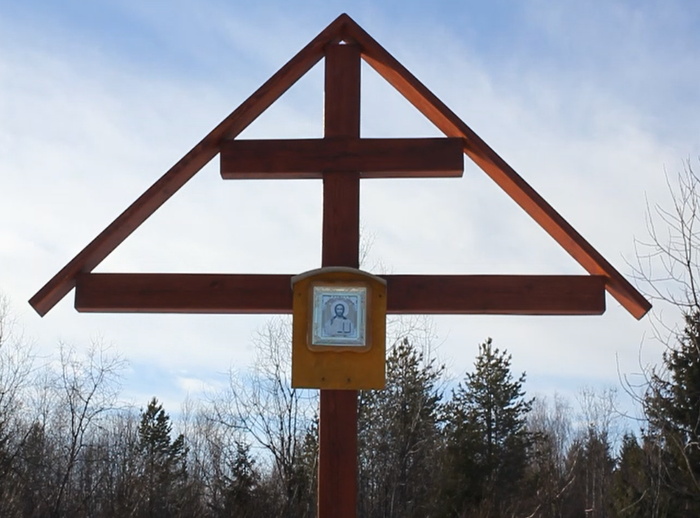
The next point of our journey is the worship cross. This is a massive cross made of strong wood, installed by local residents on the site of the former village of Shies (now this village does not exist, although even among the activists there are those who were born in Shies).
“The worship cross was erected in memory of those who lived in the village of Shies, who built the railway, and harvested timber. We are glad that caring people who care about Shies have gathered here. We erected this cross to show everyone: this is our land, which we will stand for and which we will not give to anyone,” said one of the activists of the movement against the construction of the landfill, Svetlana Babenko.
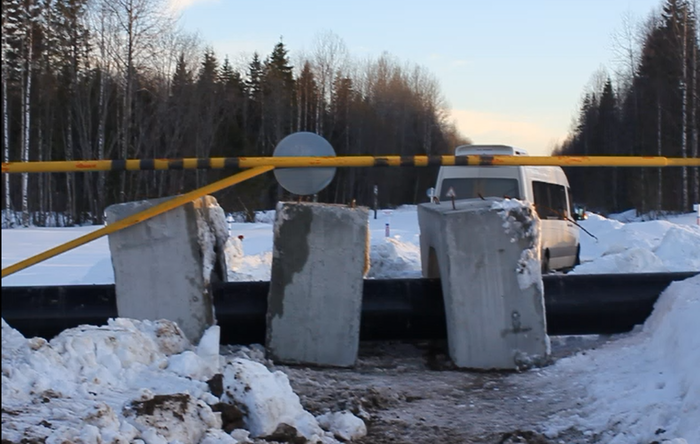
Gradually it’s time to get ready to go home. Participants in the blog tour leave in groups in activist cars. On the way to Urdoma, we discover that the road along which we were driving in the morning is blocked by a huge metal pipe welded to the barrier and littered with concrete “breakwaters”. The only remaining way to Urdoma is through the Gazprom checkpoint (the road along which Urdoma activists travel to Shies belongs to Gazprom). Previously, Gazprom maintained a kind of neutrality in relation to the burning Shies conflict, but now it has clearly made it clear whose side it is on, blocking the activists’ only free path.
We get to Urdoma through the checkpoint without any problems. We have a meeting planned for the evening with the blessed Swedes at the local cultural center - not all journalists and activists had time to ask the questions they were interested in, we need to expand the dialogue. Upon arrival there, the presence of police and FSB representatives in plainclothes is discovered. Questions, requests to show documents. Everything seems to be peaceful: we pass through and begin a dialogue.
The next day an extended meeting was scheduled with local representatives of the movement against the construction of the landfill. Participants in the blog tour ask questions and write down answers. Activists and activists tell how they established separate collection in Urdom and read poems about their native land and opposition to construction. The meeting lasts several hours and at the end of it no one leaves - people somehow spontaneously break into groups and continue communication. It all ends with an alarming message about police arriving at the hotel where we were staying, interested in the document data of the Norwegians who had checked in (representatives of the Norwegian environmental organization “Nature and Youth” and participants in the blog tour). We are urgently organizing the departure of the Norwegians to Syktyvkar - it is better to be on the safe side than the other way around.
In the evening, our group gathers for Shies - again. Tonight, as word of mouth reported, a spontaneous gathering of people from all nearby towns, villages and cities is being organized in order to break the chain of guards illegally blocking the way to certain parts of the training ground.
We've arrived. We got together. We went out in a crowd of about 100 people to the training ground - there a chain of guards of about 70 people was waiting for us. It’s interesting, but it turns out that breaking the chain with this number is much easier than when there are twenty of you (as was the case on the first day of arrival). Now we are already on the “helipad”, so carefully guarded by the security forces. The latter run to their hostel - for some reason they are convinced that this is where we need to go. Some people scatter around the training ground in groups - walking alone here is dangerous. The majority, succumbing to the movement of the security guards, heads towards the hostel. Journalists, presenting documents and press cards, ask to be allowed into the hostel - after all, it is located on forest lands and access should be free for everyone. The guards refuse. Three police officers stand nearby, confused - they answer all questions “without comment”, and when asked to stop the violation of the law - preventing people from entering public territory - they declare that they are incompetent in this matter. The security guards refuse to show their documents, but the policeman, having presented his ID at the request of the press, agrees, at the request of one of the journalists, to ask the security guard to show his documents. He can't refuse. His hands are shaking and his gaze is full of hatred, anger and powerlessness - but he presents the document. The blog tour rushes to record the data of a private security company employee who is breaking the law.

After about 40 minutes, filled with furious demands from opponents of the construction of the landfill for the guards to leave this land and complete inaction of the police, the crowd began to disperse. It is pleasant that in the absence of centralized control of actions, in the absence of a plan and coordination of people, with very hot and harsh passions and emotions, none of the opponents of construction went beyond what was permitted by law and acted exclusively within the legal field. People here, at the limit of feelings and emotions, are still able to control themselves - such is the northern character.
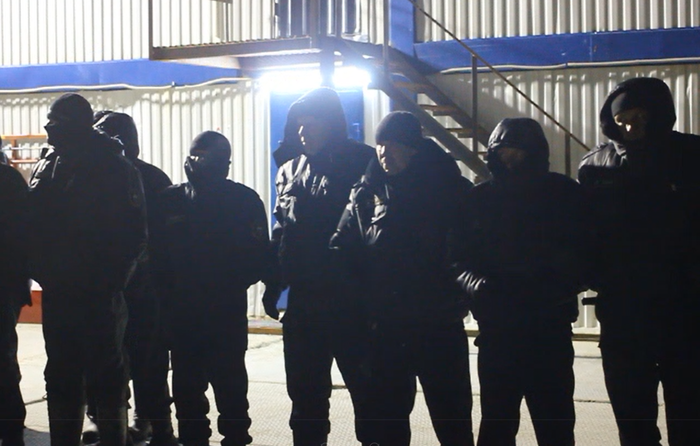
The sad thing is that they take out all their just hatred, all their heat on the mercenaries - on those whom the true culprits of what is happening here simply threw into the embrasures to take the first blow like meat. It is clear that these people could leave here, not serve lawbreakers and not protect their buildings, but they are just following orders. In my opinion, they, of course, are also worthy of public condemnation and censure, but we should not forget who is the true enemy here and who is his mere mercenary.
On the same day, it became known about the detention of Valery Dzyuba, one of the active opponents of the test site. He appears as a suspect in the case of the “beaten excavator operator.” The fact is that certain forces and the media controlled by them distorted the events with the breakdown of the shift trailer and the inadequate mechanic driving the excavator and presented the latter as a “political victim.” According to investigators, he received multiple injuries during this confrontation and had a “broken spine.” It is worth noting here that there is actual evidence of how the “victim” moved around the ward on his own two feet without anyone’s help - which indicates the uniquely rapid regeneration power of his body. Well, or about a false medical certificate. From Urdoma he was taken to the Arkhangelsk hospital by helicopter! Something that hasn’t happened in the history of the village since 1900 or so, even women in labor are taken to the regional center by car, and cases of childbirth in the same cars have happened more than once.
Syktyvkar residents who came to Shies drove me to Syktyvkar in their own car. The dream was restless.
I'm at Syktyvkar airport, waiting to board. On my backpack there is a sticker “No to Moscow garbage in the north!”, on my jacket there is a badge “Pomorie is not a trash heap!”, and in my soul there is confidence in the people remaining on Shies and a slight concern for them.
The next day, it became known that two more activists fighting against the construction of the landfill were detained in the case of a “crippled excavator operator.”