
Translated material
Mikhail Baranov: How to grow a unicorn

Mikhail Baranov 
 Mikhail Baranov
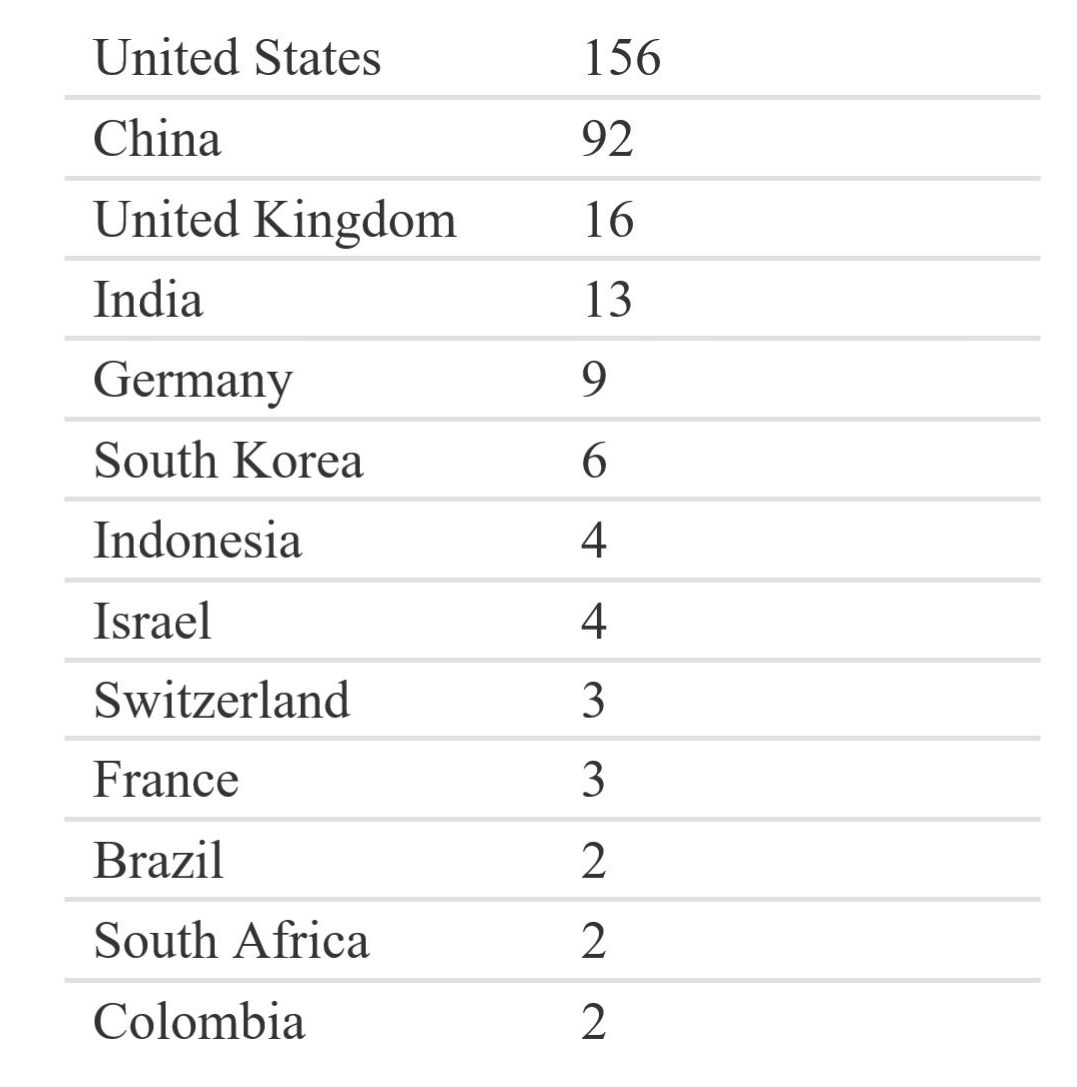 List of countries in which there are more than one unicorn / CB Insights

Polit.ru continues the cycle of conversations with Mikhail Vladimirovich Baranov about global challenges.
Mikhail BaranovToday I want to talk about unicorns. "But what is the relationship of the fairy horses with a horn have global challenges?" - You ask me. The fact is that unicorns were created by the fourth industrial revolution. In 2013, the venture investor Ailen Lee proposed to call private unicorns, who had not yet placed their securities on the startup exchange, the cost of which is estimated at more than one billion dollars. Thus, she wanted to emphasize the rarity of such success stories.
Since the term “unicorn” was invented by venture investors and is used specifically to evaluate companies that have not yet been used by public financing mechanisms by conducting an IPO or being absorbed in a larger public company, startups cease to relate to this category. At the time of our conversation , the database of uninocracy companies, supported by CB Insights, contained 346 companies. Their total cost exceeds one trillion dollars.
If you streamline the CB Insights database by countries, it is easy to see the dominance of the United States (156 companies) and China (92). These two countries have to significantly more than half of the unicorns. And if the almost complete absence in the list of companies from Africa (3) is hardly very surprising, then the small contribution of startups from Europe (37) is much more difficult to explain. Trying to answer this question, we can better understand the conditions necessary to create fast -growing technological companies.
List of countries in which there are more than one unicorn / CB InsightsThe European Union without Britain has 18 unicorns, which is only 1 more than India with Indonesia (17).
At first glance, all objective factors say that there should be much more companies from Europe. The GDP of the European Union is comparable to the US GDP and more than that of China. The population of the EU is less than that of China, but more than that of the United States, it has high solvency. There is no shortage of specialists in Europe: European universities produce both high-class engineers, mathematicians and physicists of old hardening, as well as qualified professionals of a more modern type: programmers, mowing designers, work specialists and machine learning.
Discussing in July 2018 the reasons for such a lag in Europe in unicorns, Quartz magazine as one of the main reasons indicated the features of financing. In Europe, substantially smaller investments are adopted in the early stages of financing. This does not allow startups to accumulate funds for business development. This reason, of course, plays a role. At the same time, London is one of the world capital of capital, and European investors are happy to invest quite large amounts in foreign startups. Therefore, this explanation is not enough.
The authors of the journal Quartz see another reason for the lag of Europe in an undeveloped ecosystem. Technological startups are a rather volatile business, and when a potential European unicorn has problems, the chances that he will stop activities or stop striving for development, much higher than in the case of an American startup. This is due to the fact that in the United States, technological companies are concentrated around Silicon (or, more correct from the point of view of the original, silicon) valley. General focus on success, an example of other companies that have managed to overcome difficulties - all this helps not to give up.
And finally, the third reason for the lag of Europe, according to Quartz magazine, is associated with the non -proliferation of options for employees. The mechanism that allows employees to get a share in the company at a lower price allows you to attract and retain the best specialists, many of whom have been educated in Europe. “This is simply not a part of our culture,” the magazine quotes Jean-Baptist Rudel, chairman of the board of directors Criteo, “candidates in Paris at interviews are asked about free food for workers, and not about options for promotions.”
Another important reason, in my opinion, is the conservatism of Europeans, their desire to first introduce regulation for everything new, and only then to allow to the market. A striking example in the field of IT is antimonopoly legislation, if you remember, it was the EU that fined Microsoft for the fact that the Windows operating system included a pre -installed Media Player, and it is in Europe that they try to prohibit Goggle to preserve their applications on the phones with the Android operating system. In the United States, such claims are also filed, but much less often won.
An even brighter example is associated with biotechnologies. From 1998 to 2004, a moratorium on genetically modified food acted in Europe. Until now, despite the fact that it is actually impossible to distinguish organisms modified using CRISPR technology from organisms that have changed their genes under the influence of natural mutations, any genetically modified organisms undergo an extremely long test of the European food security agency. At the same time, the number of genetically modified organisms allowed to the EU food market remains very low, and Germany, Poland, France, Scotland and some other members of the Union in 2015 refused to grow genetically modified plants on their territory.
The main driver for scientists, of course, is the desire to satisfy his curiosity. But in the absence of the opportunity to bring their product to the market for the development of European scientists will only remain scientific discoveries. Perhaps the scientist will be able to sell his patent to some company from the USA. But to agree with investors not about the sale of a patent, but about the financing of your project, not having the opportunity to bring your product to the market, is almost impossible. So, the unicorn will have to be forgotten.
Russia had its own unicorns, for example, Yandex or Avito. But they either conducted an IPO or were absorbed by a large public company. As a result, at the moment, there are no Russian companies in the CB Insights unicorns database. If we do not start talking about the conditions necessary to create successful technological startups, we risk staying in the backyards of the fourth industrial revolution.
See also: Mikhail Baranov Mikhail Baranov described the foreign policy doctrine of the United States Mikhail Baranov Mikhail Baranov talked with Polit.ru about global challenges