
Translated material
The person who came up with fascism
Filippo Tommaso Marinetti was a real master and a supporter of transformations: at the beginning of the 20th century, he decided to reject all the former art, chanting the superman, steel machines and progress, gathering a whole army of supporters around him. He believed that true beauty was manifested in the war, and went to the front to sing odes with grenades and armored vehicles, and then became a man who created the aesthetic and ideological base for Italian fascism. Samizdat tells his story.
The first half of the 20th century became the forge of new ideologies: the era washed out other heroes, everywhere the echo of bloody wars thundered, the world was rapidly conquered and divided. Contempt for philistinism, comfort, manic desire to give rise to a new person and destroy the foundations of the old world brought out the adventurers from all over the world. Anarchists blew up officials, police officers and created their libertarian communes; The Bolsheviks cut out to know, built the proletarian empire and turned the rivers backwards; The Italian fascists took Rome and expanded their space with new colonies in Africa and Greece.
Artists of art did not sit aside: on September 12, 1919, the Italian poet Gabrielle d'annunzio led the invasion of nationalists into the city of Fiuma, and a year later he proclaimed him an independent republic, as he himself called the “Republic of Beauty”. In his poems, he approved the Constitution, the post of Minister of Culture was occupied by conductor Arturo Tuscanini, and the Anaarchist poet Leon Kokhnitsky was appointed Minister of Foreign Affairs. On the "state" flag of the young unrecognized republic, the phrase "Who is against us?!"
The new time gave artists and poets the opportunity to break the old and build a new one, because even the most crazy poems and canvases could come true into reality. Art has become an integral engine of revolutions and the rebirth of the old world. One of the most noticeable figures in this roaring stream of ideas was Filippo Tommaso Marinette - a man who invented futurism.
"Young and peppy, come to us!"
Filippo Marinetti was born on December 22, 1876 in the vastness of Egyptian Alexandria, in the wealthy family of Italian intellectuals; His father Enriko Marinette was a successful lawyer. Marinette spent his childhood and adolescence in Paris, he was trained at the college of St. Francois Xavier and plunged early into the world of work. At the age of fifteen, he founded his first literary magazine - “Papyrus” and even then faced the rigid rules of the adult world: for the distribution of prohibited literature (Marinette published the scandalous novel by Emil Zola) he was almost excluded from the college. Having received the education of a lawyer, Filippo decided not to follow in the footsteps of his father, but to devote his life to literature. At twenty, he moved to Milan and began to publish the Ponesia magazine, the work in which will subsequently bring him with future associates on the futuristic workshop. But at the beginning of his career, Marinette practiced with new images and symbols in the genre of free verse. The stars and the sea became a source of inspiration for him, the young poet considered them as extraterrestrial symbols. Thus, the poems “La Conquete deses Etoiles” were born (conquest of stars) and “Destruption” (destruction) written in French.
In 1909, in the life of Marinette, an event occurred that turned his consciousness turned over and subsequently shook the swamp in which the art of that time was bogged down. Going around the cyclists in his sports car, Filippo lost control and found himself in a roadside ditch. Enlightenment came to him at the moment when, after a few hours, he was fascinatingly watched the work of a mechanic trying to collect his crippled Bugatti. The same day, finding himself at the desk, he sketched the text of the “Manifesto of Futurism”, immediately sent him to his friend to Paris. Already on February 20, 1909, the manifesto came out on the first lane Le Figaro, and on March 3 of the same year it was read out in front of the three thousandth crowd in the Kyarell Theater in Turin. Hearing the lines of the manifesto, the group of Milan artists suddenly responds to the call of Marinette, releasing a similar manifesto on February 11, 1910. Thus began the coup not only in Italian, but also in world culture.
We are young, strong, live in full strength, are we futurists?
At the time of the publication of the manifesto, Marinette turned thirty -three years old, but in his text he addressed first of all to young people. It was a furious message for young artists: "Young and peppy, come to us!" Thirty -year -old Marinetti released ten years to fulfill all the tasks, after which the new generation should throw them out of the elderly into a garbage basket. In his manifesto, Marinetti called for “spit on the altar of art”, and all the values of the past - ethical, spiritual, cultural and artistic - radically and rigidly deny: “... drag fire to the library shelves! Direct the water of the channels into museum crypts and flood them! And let the current take the ancient canvases! Grab the picks and shovels! Drive the ancient cities! .. ”In Italy, with their“ 1000 museums, one hundred thousand panoramas and ruins for all tastes ”, the futurists intended to deliver the most slimy and decisive blow.
The “museum culture” should replace the cult of technological progress, the new religion should be risk, insolence, courage, rebellion and faith in the utopian future.
“... Why, for the sake of wasting strength at the worthless sighs about the past? This tires, exhausts, devastates ... For frail, cripples and prisoners - this is still wherever it went. Maybe for them the good old days - like a balm for wounds ... And we don’t need it! ”
Trains, airplanes, electricity and pipes of factories delighted the futurists and were an integral part of their work. Technical progress, so rapidly developing, has become the main source of inspiration for them: a work of art that has outlived his eyelid could not compete with racing cars, indestructible locomotives and motorcycles.
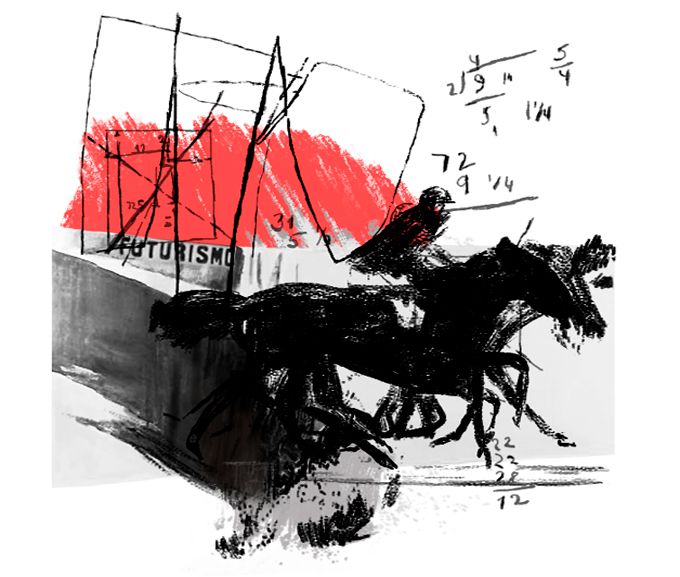
“... we will sing the working noise, the joyful hum and the rebellious roar of the crowd, the motley distinction of the revolutionary vortex in our capitals; Night buzz in the ports and on shipyards under the blinding light of electric moon. Let the factories be tied to the clouds for the strings of the pipe of smoke breaking out of them. Let the bridges throw a gymnastic jump through the surface of the river dazzlingly sparkling under the sun. Let the rogues-pairs sniff the horizon. Let broad -chested steam locomotives, these steel horses in the harness of pipes, dance and puff with impatience on the rails. Let the airplanes slide across the sky, and the roar of the screws merges with the splash of the banner and the applause of the enthusiastic crowd. "
Marinette managed to very subtly reflect in the position of the first manifesto of the feelings and moods of a number of Italian intellectuals. The atmosphere of the brewing world war, which disturbed many, accumulated in the air. In economically undeveloped Italy, the industrialization of the United States and Germany caused a complex of inferiority and admiration, so for Italians the machine became a symbol of the beautiful and great. Having mixed the ideas of anarchism and Nietzscheanism and adding a little eroticism in the spirit of d'annunzio, Marinette, with his manifesto, produces the effect of the exploding bomb. The movement of futurists is gaining momentum, more and more new supporters are gathering around Marinette, with whom he organizes performances, reading poems and is engaged in the popularization of the futuristic movement. Artists also join the artists: Umberto Bochchoni, Dzhakomo Balla, Gino Severini, Carlo Carra and Luigi Rousslie. On the eighth of March 1910, they proclaim their "manifesto of futuristic painting."
"Wings are asleep in the human body." "Futurist Mafarka." The ideology of a new person.
Among other things, the futurists dreamed of creating a new race of people who would move at a speed of three hundred kilometers per hour and had a height of five, ten, twenty thousand meters. A sort of futurist übermensch, in the concept of which, of course, is evidently the influence of Nietzsche and his work "so said Zarathustra." The superman in the view of the futurists is cruel, cynical, evil, omnipotent. He despises romantic love, pity and sentimentality. He glorifies heroism, strength, rebellion and courage, because "the warmth of a piece of iron or wood excites more than the smile and tears of a woman." “... I do not dispute the animal value of a woman, but her sentimental value. I want to fight the greed of my heart, with the helplessness of half -open lips that absorb the longing of twilight, with the fever of the hair that crush and exceed the overly tall stars of the color of the shipwreck ... I want to overcome the tyranny of love, the obsession of the only woman, the great lunar light of romance washing Italy ... Roman "Futurist Mafarka" Marinetti.
The main character is a mechanical superman with replaceable spare parts. He is immortal and capable of flying. In the novel, Marinetti painted his utopian society: in air cities of iron and crystal a new civilization will appear, in which there will be no class separation, hunger and poverty. Dynamo machines will give energy from the tides of the seas and the strength of the wind. Plants will grow faster, and shoes-shoes will begin to process new agricultures. Technical progress will also affect the very appearance of a new person: “First we get acquainted with the technique, then we will make friends with it and prepare the appearance of a mechanical person in a set of spare parts.”
This novel was released in 1910 and immediately found himself in the center of the grandiose scandal. Marinette was attracted to the court for "insulting good customs." A lustful protagonist, ready to rape the prisoners of the black women and adoring prostitutes, ”Marinette successfully handed out the screeches of the bevelers.
Marinetti successfully transformed the lawsuit and indignation of the public into the advertising company of his novel in particular and futurism as a whole.
Steel alcove. The war of Marinette
The war for futurists is the quintessence of courage, heroism and courage. It is in the war that the superman is fully revealed and shows all the above features. Any war, any riot, from the perspective of Marinette, is a sign of health. War is the only “hygiene of the world”, and for these “destructive actions of the liberators” and wonderful ideas are not a pity to die.
For him, as a poet, it was not an empty chatter and boasting: when an Italo-Turkish war broke out in 1911, Marinette was almost immediately in the thick of events. He went to the front to Libya - a correspondent from the French newspaper. So the book “Battle of Tripoli” was born, in which Marinette applied all his practical and empirical experience: military reports from trenches, notes, observations. He sang hymns to the bombs and heroism of the soldier, savor every moment of the rage of battles: “... I envy you, I envy you, dancing crazy grenades! .. Oh, why am I not with you? .. Why am I not one of you? .. Oh, how sweet it should be to jump in this way the countless fragments of his metal body, in the nose, into a terribly open belly of his enemies! Because I am terribly young, young, like you, and full of depressed and closed ferocity and strength. I need, I need me to rudely, sharply and unexpectedly expanding the walls of my body! .. No, no! Much larger! .. Oh! Let my head jump like an blended rocket, to infinity! As you, as you, I want, I must, I hope to explode from the bottom up, right and left, in the compact core of the vile crowds! .. "
In the new book of Marinetti, the instruments of murders and technological progress are animated, which becomes a logical continuation of his utopian ideas and fantasies about mechanical superhumans from the Futurist Mafarka.
In May 1915, Italy entered the war on the side of the Entente countries: Britain, France and Russia. Many futurists leave volunteers to the front, Marinette was no exception. He is appointed captain of the detachment of armored vehicles. This had its own irony: singing the power of equipment and military vehicles, during the war Marinetti receives at his disposal of these combat devils. In one of the Italian offenses, he was one of the first to burst in his armored vehicle at the enemy’s position and captured the whole Austrian corps. During the war, Marinetti also receives a fragmentation wound in the thigh, and he was awarded a medal for the battle of Wittorio-Veneto. In this battle, Italians won a crushing victory, breaking the detachments of the Austrians. Also during this war, Marinette and irreparable losses have been killed, several of his friends were killed: sculptor Umberto Bochchoni and architect Antonio Sant Elia.
However, this did not force Marinette to lose inspiration. A new book is born in the trenches - Steel Alcov. It will be published in 1921, but according to tradition, the exit of the novel will again be accompanied by a scandal. The fact is that on the cover of the book an illustration of Renzo Ventura was placed, which depicted the copulation of a woman with a military machine. Marinetti again inflicted a whipped blow to the cheeks of a chaste public. Censors demanded to destroy this scandalous cover, only after that allowing to release the book.
“Steel Alcov“ turned out to be a work on the verge of autobiography and myth. The main character is Lieutenant Marinetti, the inspirer of the Italian revenge on the line of the Austro-Italian front. “... I was covered by the joy of the discoverer of the new law. Far from Bergsons, sitting down my idiotic university seats, I am experiencing a dangerous moment, being in the very center of the battle, which resolves issues that philosophers could never resolve in their books. ”
In Steel Alcov, Marinetti clearly expresses his motivation, the reason why he picks up a weapon and saddles his armored vehicle, carrying fire and a sword to the position of the Austrians. He extols his moral duty to Italy: “... I have the soul of an Italian soldier. You know what it means to be a 40-year-old, ingenious, performed charm, a powerful generator of the latest healthy ideas given to the world, the creator of powerful poems and, nevertheless, without hesitation, to sacrifice all this for the sake of their land and their people in danger? .. ”
The war ended, but the stormy political events of Italy burst to the life of Marinette. Futurism becomes the "engine" of the fascist revolution.
"To me, black lights!" Black shirt Marinetti
In April 1915, Marinetti is arrested at a demonstration in Rome. Once behind bars, Marinetti meets Benito Mussolini - the future ducal of Italian fascism. But at that time, Mussolini was just the editor of the socialist newspaper Avanti, excluded from the party for categorically expressed against the pacifist position of the socialists. The futurists saw in the future Italian leaders "a man of truly futuristic aspirations."
After the Great War, Marinetti Sorotovyshchi create a political party of futurists - "political futuristic fascia." In 1919, he entered the fascist party and during this period appears with a radical-nationalist position. Two Italian literary geniuses of that time - Marinetti and Gabriela d'annunzio made their efforts to form the ideology of early Italian fascism, its slogans, aesthetics.
But Marinetti was not only an ideologist, but also a practitioner: he played a leading role in the formation of fascist war groups, personally participated in street clashes with the Communists, and also organized the first “Association of Italian Arditi” (Italian Arditi “Brave, daredevils”).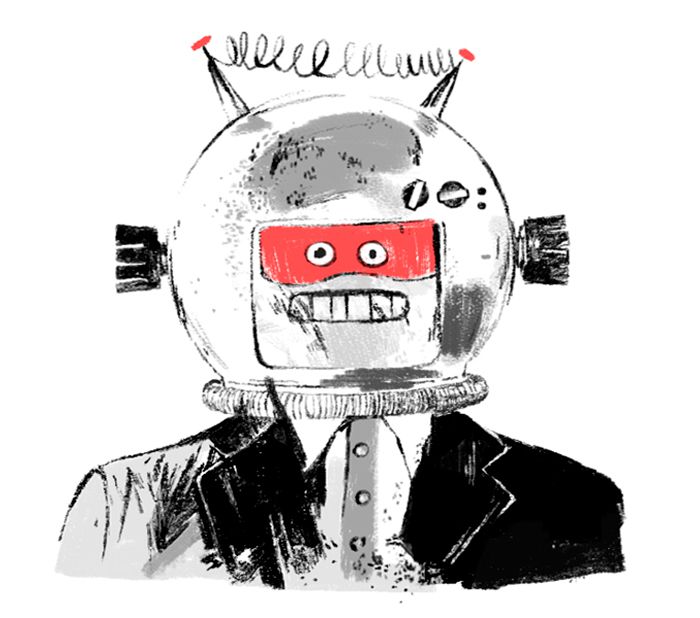
On September 1, 1918, the newspaper “Futurist Rome” was published, and it becomes a printed body of the political party of futurists. The chanting of heroism, social justice and a selfless struggle for new Italy - military units of futurists served as a model for Mussolini. The program of fascism included all the requirements of the futurists, they set the tone and style of the new ideology. The futuristic concept of a person of the future, courage, risk, courage and adventurism organically fit into fascist discourse - black shirts, brave “ardity” with daggers in the teeth, challenging death with the cry of “me ne Frego!” (“I don't give a damn”), a militaristic theme and, of course, the image of the Duche, the “father of the Italian nation”. All this served as inspiration for many futurists, pushing their work to glorify the fascist regime of Mussolini.
But Marinetti would not be Marinette if he simply sailed with the flow: an eternal rebel, he kept loyalty to the principle "from the top of the world to challenge the stars." In 1920, Marinetti left the fascist party with a noise. The reason is Mussolini compromises with clerical and monarchical circles. By the end of the 1930s-beginning of the 1940s, the fascist regime began to poison the futurists, who until then continued to maintain their passionarity. Marinetti is branded as a leader of the “left” art. The Union of Hitler and Mussolini played his role in this. In the Third Reich, such art was considered “degenerative”, so futurism loses its significance for the Italian fascist regime.
In the last years of his life, Marinetti himself is disappointed in fascism, turns to mysticism and Christianity. Nevertheless, the war for the poet does not lose its attractiveness. In 1942, Marinette was in Russia, along with the fascist army. На сохранившихся фотографиях того периода вождь футуризма позирует с русскими крестьянами — видимо, рассматривая эту поездку как очередное авантюрное поэтическое приключение. В 1943 году Маринетти будет ранен под Сталинградом, так и не сможет отойти от последствий, а в 1944 году умирает. Вместе с ним движение футуристов окончательно заканчивает своё существование.