
Translated material
July rain on the planet Pluk

↓ Response Ekaterina Eremenko about Marlene Khutsiev
In the search for ideas and sincere feelings, as well as the times uniting all of us, living “from the Volga to the Yenisei” (and even much further), notebook political technologists have lost their feet. It would seem to be called to the rescue, the win -win, the Great Patriotic War, but this is such a unity that gives rise to not subtle nostalgic feelings, but the only abrupt team: to stand up in a general system without talking, reasoning and prayer. And not a step away. And the “General Faith”, alas, is only quarrels: if you do not want to quarrel, you don’t even speak with a neighbor about religion and politics ...
 Oddly enough, the “good feelings” and quite nostalgic almost everyone gives rise to the soft sixties, the same “useless thaw”, which is often speaks carelessly and without food and which ended, barely starting, leaving only a vague reflection. But it is in the sixties that people of the most opposite beliefs are looking for their roots (and I myself have heard many times). Only then, it seems, everyone began to look around, seriously plunged into non-trivial discussions about themselves and the world around him, to notice something, which used to look at is simply dangerous, dreaming ... The world became more difficult and diverse, it seems that it was really possible to find its own place and live honestly and sincerely. It was finally possible to see something warm, bright, not just a set of verified and excited slogans. And this was also a time of universal universal achievements: all these physicists and lyrics, polytechnic, singing poets, Okudzhava, Vizbor, phizteh, flights into space ...
Perhaps we would quickly forget this short-lived light surge and its weak shades in the series of past years, however, the important image of the sixties in the general consciousness was fixed by the small number of truly intelligent and charming films, the craving for which it seems that it only grows stronger over time. They usually list “a film about scientists” “Nine days of one year” (1962) Mikhail Romm, and then the “Development of the topic” among students and associates - “I walk around Moscow” (1963) George Danelia, “Ilyich’s outpost” (1964) and finally “on the end” of the July Rain (1966) Marlene Khutsiev.
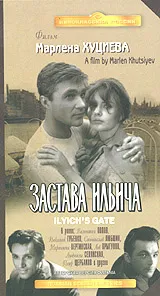 If we try to convey in one word, for which we look back, than that time, then we can say this: in search of something truly human, even “socialism with a human face”. Real friendship, real feelings, exciting your favorite work ... In a sense, now, after a period of “slack”, we are covered by the opposite tendency-“screwing the nuts” accompanied by changes in society: hardening, bite and quarrels with all, new reasons for resentment and “insults”, the requirement of prohibition on the profession, preventing access to “extremist” Information, merciless “optimization” of all social services, only increasing the longing for “lost humanity”.
Formally, all the films mentioned (quite successful and at one time, especially “nine days of one year”) should seem quite harmless and even singing new Soviet reality, updating, youth and aspiration to the future (at least after additional external castration, arranged, in particular, “Ilyich’s outpost”), however, “uninterrupted”, which has passed in a limited reinforced work. July Rain did not deceive the vigilant and not to the best of sensitive critics. It is obvious that such films have a dubious value to prove the “advantages of the Soviet lifestyle” or the pushing of Soviet people to new achievements. And behind the sadness and melancholy of the “monotonous” narrative, it is not at all assurances in the meaninglessness of the surrounding being, but, on the contrary, the distrust of the calm cynicism of the appliances, the “promising scientists”, prudently forgiven the authorities of their work in response to the preferences, a complex riot that matures in a not -out -and -out person.

“ Non -proomulicity! People's inability to communicate! Sweet life! The vanity fusses and languor of the spirit! But in Bergman and Antonioni, the incompleteness of bourgeois intellectuals has deep social causes. Fellini's fuss is exposed from the standpoint of rejection of a bourgeois society. However, I am sure, Marlene Martynovich that you do not consider people immanently closed in yourself, unknowable and non -contact that you do not think that our society paralyzes the attempts of individuals to communicate , ”Khutsiev Rostislav Yurenev 1 wrote in an open letter. The essence of the claims is clear here. Melancholy and dissatisfaction with the surrounding reality can be shown only in films scouring the “rotting West”. Our people cannot experience disappointments and cannot be non -communal.
It is amazing how the fate of the two natives of Tiflis of noble blood, Marlene Khutsiev and George Danelia, who eventually became professional directors who found themselves at the Mosfilm and shot the “system -forming” paintings. They passed away now, almost synchronously, until the last continuing to protect the ideals of youth (without excessiveness, however, without falling out of the “clip”). And if Khutsiev, with his “July rain”, brought the line under a short “thaw”, then George Danelia already in the eighties stigmatized all the squalor of the “color differentiation of pants” and worshiping the next “Mr. PZhi” and his ecilopms, having been into the world, perhaps the most original domestic fiction and anti -utopian - "Kin-dza-dza!" (1986).
 It may seem that this masterpiece grew out of nothing, from scratch, after a number of “lyrical comedies” about “wonderful Georgians”, but back in 1965, Danelia shot the “thirty-three” comedy with the same Evgeny Leonov, which was almost immediately “laid on the regiment” because of the “seal” car, accompanied motorcyclists). The vigilant “comrades” saw in this parody of the meeting of astronauts (and this is only at best). Unfortunately, our wonderful Alexei Leonov, Yuri Gagarin and other astronauts who demanded “take measures” also attached a hand to the ban. So, the hero of Yevgeny Leonov, recognized by the unique because of the “super-complex” tooth, makes a swift career and even goes to the envoy to the international scientific conference to the Martians. It is quite a “Chatlano-Patsak” plot, where a random trifle leads to the top of success-like a simple CC (match). And there was also a completely fantastic (and something like “thirty-three”) 1982 film “Tears dripped” (again with Evgeny Leonov in the title role).
It is very significant that the action of the films of the “sixties” from the bright, morning, singing and inspired by the obscure hope of Moscow in the end transferred to the gloomy planet Pluk ... Now these geniuses have gone and will not be in the continuation of the new “thaw”.
Maxim Borisov
1 "Soviet Culture", August 29, 1967.

↑ Ekaterina Eremenko , who makes an excellent popular science movie, wrote a response about Marlene Khutsiev .
Probably, it would be possible to foresee, but I did not prepare in any way to write about Marlene Martynovich in the past tense.
The gambling, light, mischievous, cunning, impeccably decent, musical, bold ... But we met when Marlene Martynovich was already the eighth dozen.
I still when I watch some episodes, for example, the final “was a month of May”, roar. These personnel went down in the history of world cinema and, of course, influenced a lot, which later starred. I still do not understand how it was done, I have a lump in my throat every time.
Marlene Martynovich was our master. Our workshop was one of the last, which he scored at VGIK. We studied at the very end of the 90s, after the crisis. Then in Russia it was shot and reached a wide screen of films per year about one. VGIK students were taught the installation of cinema then: they gave out film with old Indian cinema and on ancient installation tables with curtains they offered to cut it in a new way and glue it with tape, so that another story was obtained. You will not run away especially - with Indian cinema. Therefore, in the classes of skill, directing Marlene Martynovich and I were mostly engaged in the theater. And so we put some scenes, playing in episodes at each other. I remember that almost always, when we initially watched these productions, everyone had a feeling of awkwardness, as if you were watching amateur amateur performances. And then then he went to the Khutsi site and, not at all criticizing, but on the basis of what he saw, made some proposals, invented something and immediately embodied. It was as if he was pulling and pulling some visible threads to him, like a macram, when something real suddenly appears from nothing. And it was magic. I remember that this magic was born before our eyes, like nothing, a new world arises from the void. We have witnessed this magic many times.
By the way, it is not very well known that Andrei Tarkovsky in the student was practiced by Marlene Khutsiev. In an interview with the Vgikovskaya newspaper in 1966, Tarkovsky said: “ I felt my call only in the fifth year, and until then I had no idea why I came to VGIK. Only after practice, Marlene Khutsiev began to understand that this is a real, great art ... "
I read about this in the book of Nikolai Boldyrev and told Marlene Martynovich; It turned out that he himself did not know before that Tarkovsky wrote about him.
Khutsiev had no arrogance or pathos, which is often characteristic of filmmakers and famous people. Khutsiev had an absolute musical and cinema hearing and an impeccable sense of decency and honesty.
I was terribly lucky what I met in the life of Marlene Martynovich and even had the happiness to learn from him.
Facebook.com/ekaterina.eremenko
(March 20, 2019)
Photo: "Wikipedia"