
Translated material
What color is a rainbow?
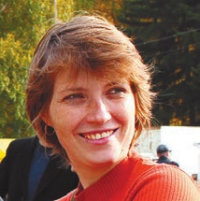
Doctor of Philology, Professor Natalya Koshkareva is known in Russia as the chairman of the Expert Council of the Total Dictation, author of the Russian on Fridays, the developer of the principles of online checks of electronic dictations. She spoke about the other side of her scientific activity - the study of the languages of the indigenous peoples of Siberia - at the March meeting in the scientific cafe Eureka. Recorded by Julia Cherny .

Photo by V. Shamirzaev
Natalya Borisovna - Head of the Department of the General and Russian Linguistics of NSU, member of the spelling commission of the Russian Academy of Sciences, chief researcher at the Siberian Languages sector of the Institute of Philology SB RAS, field linguist. She collects the information necessary for research on expeditions - in places of residence of native speakers of the Ural languages - Khants and Nenets. There is no academic grammar, nor dictionaries, nor a sufficient number of texts in these languages, the only way to get the necessary data is direct work with native speakers in the field, recording sounding speech. “For the Khanty and Nenets languages, an alphabet has been developed. But the rules of spelling and punctuation are actually not formulated ... Imagine that in the Russian alphabet there are two letters - solid and soft signs, but there are no rules for their use. How to write a word under? EZ - with a solid or soft sign? Or, for example, on the cover of the Russian language textbook for the first grade, it would be written “Russian I Zyk”, for the second grade - “Russian and Zyk”, and for the third - “Russian Ecry ”, ”explains Natalya Borisovna.
But they spoke in a scientific cafe not about grammar and not even about writing, but about color ...
The organs of the bee and man are arranged in different ways. All people as representatives of the genus Homo sapiens (if you do not take into account the results of trauma and anomalies), the vision is fundamentally the same. There are approximately 126 million photosensitive cells in the retina. Kimberly Jemeson of the University of California in Irvain claims that the human eye can distinguish from 10 thousand to 100 million color shades. It is natural to expect that we see this world approximately the same. So, we are talking about him.
Reflection of the color scheme in each language is unique. It turned out that even an understanding of what color is does not coincide. If in the Russian language the color is described by adjectives ( white , red , blue , green ) and is perceived as something static, constant characteristic of the object, then in the Nenets color recognition is verbs (such as blushing , blackening ), denoting the process.
Back in the 19th century, William Gladstone and Lazarus Geiger drew attention to the fact that in ancient texts there are practically no words denoting color, and those that are found seem strange to us. In the "Iliad" Homer, the sea is called "wine -color." In our stereotypical picture of the world, the color of wine is associated primarily with red. What really were the waves of the Mediterranean Sea for the ancient Greeks? In the Vedas there is no mention of blue, although thousands of lines are devoted to the events in heaven. In the Rigveda there is no mention of green, in even more ancient literature there is no yellow, and in the most ancient - red.
To compare languages among themselves, linguists use the concept of “basic colors”. With the story about what the basic color is, Natalya Borisovna and began her story. “The basic colors should be, firstly, simple and non-erectional (therefore, bluish or raspberry words do not relate to basic colorfulness), secondly, their meaning should not be more than the designation of the same color (for example, red -a shade of red), thirdly, there should not be restrictions on compatibility (for example, brown ones are brown and finally, this name should be) and, finally, this name should To be widely used, its value in different native speakers should coincide.
In the Russian language, 12 basic colors of flowers, but there are languages in which there are only three such names, or even two! If color is a certain wavelength, and the organs of vision of all people are similar, then why do native speakers call the same physical phenomenon perfect in different ways?
About the fact that two different words blue and blue in Russian correspond to one word Blue in English, many of us know from school. But in many languages, the differences are much more significant! In Australian Aborigines, the same word is used to designate purple, blue and brown. In the Tahiti Aborigines in one word, which can only be translated as red as red, the spectrum is described from orange to purple, while the properties of the surface are also taken into account - it should be brilliant and smooth.
In the 1950s, American scientists Brent Berlin and Paul Kay independently studied the languages of Tahiti and Mexico and found that the color recognition systems in these languages are surprisingly similar. For example, in one word, the entire blue-green section of the spectrum is indicated, and this cannot be explained by the kinship or areal contacts of these languages, but only by the verses of color recognition systems characteristic of all languages of the world.
In 1969, their book was published (Berlin B., Kay P. Basic Color Terms: Their University and Evolution. Berkeley: University of California Press, 1969), in which, on the example of 20 languages, it was shown that the procedure for the emergence of colors in different languages of the world The same: in all languages there is a designation of white and black; If there are three basic colors in the language, then the third becomes red; Following, yellow and green or one word appear to designate yellow, blue and green colors. This sequence is universal. If there is a word in the language to indicate a brown color, then it must have names for all the previous colors in this chain. If there is no separate name for green, then there will be no separate name for blue, since the designation of blue usually appears later than the designation of green.
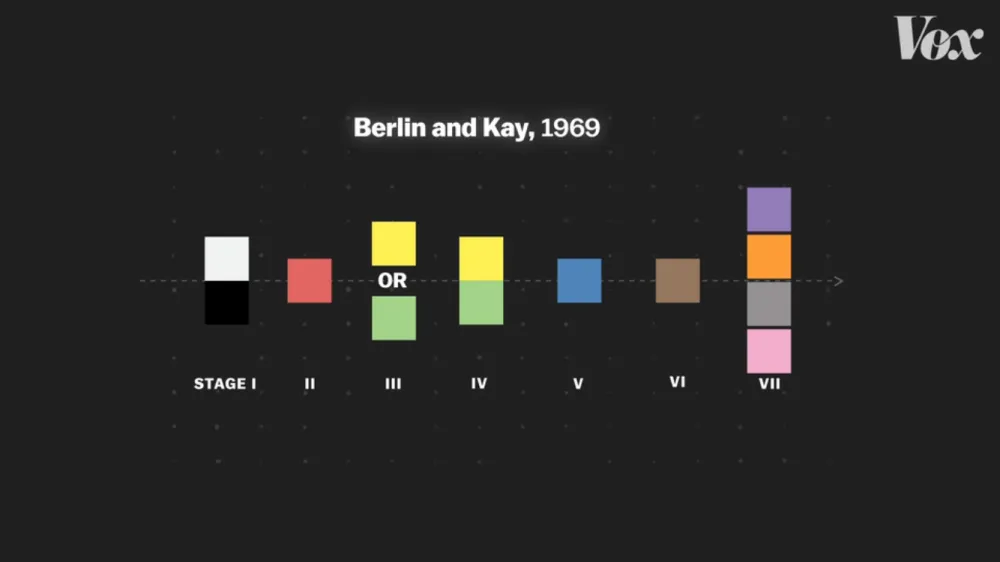
In the late 1970s, a large-scale survey was conducted, in which 2,600 people speaking 110 languages participated, and he confirmed the observations of Berlin and Key: with all the variety of color recognition in the languages of the world, the systems develop in general in the same direction that is due to biologically.
But from each rule there are exceptions. There are exceptions to the rule of Berlin - Keya. One of the Australian languages has a word for blue, but not for green ... “Look at the landscape where the native speakers of this language live,” Natalya Koshkareva suggests to the audience. On the screen the Australian desert with a variety of brown and yellow shades. - In the world surrounding this people there is actually no natural green color, they live in deserted areas with very meager vegetation. Thus, the differences in the system of color recognition are associated with the cultural traditions and conditions of living of the people in a certain environment. ”
The absence of one or two basic colors, of course, is not difficult for us to imagine. But how are languages arranged, where only two basic colors? “In such languages, the color recognition system is based not on chromatic shades, but on other parameters. In the language of Dani (Papua - New Guinea), the word MILI is used to refer to cold and dark colors, and Mola for warm, light, ”explains Natalya Borisovna. - In the Australian language, Burarra is contrasted with bright and dull colors: the word guungaltja denotes white, red, all bright colors; All other shades are called another word - guungundia . ”
On the territory of Siberia and the Far East, more than 60 languages of indigenous peoples are represented, and each of them has its own, unique color palette. Surprisingly, color recognitions in some northern languages resemble color recognition systems in Oceania's languages: they also include the minimum number of basic terms and are based on the principle of brightness, and not on chromatic shades.
It may well be that in the Khanty language there are no color recognitions in the usual sense for us. The same word nŏwi denotes in this language the night luminary-the moon or a month, and only in figurative meanings-the complex of signs “white (light, light gray, gray, gray, pale)”, “brilliant, silver”, “transparent”, “clean”, “new”. This word has another meaning - "beautiful, good." The epithet for describing a beautiful woman in Khanty folklore is white (and not red girl , as in Russian fairy tales). So the word is used in the name of the supreme deity. Thus, the concept of “white” is associated with the radiance of a night luminary in the dark sky, which means that this concept is based on the idea of brightness, and not about chromatic/non -northern signs.
In the European dialects of the Nenets language, the same word sir denotes both ice and white , so we can assume the same basis for combining these concepts as in the Khanty language - brightness, radiance, glow .
The word black in many northern languages denotes spectrum areas, which in other languages are described in separate words - black , blue , purple , that is, “dark in general”, and in Khanty, including dirty, opaque, muddy .
To designate the red color, the word wŭrti is used, in which the root WŭR ( blood ) and the suffix of the participle -ti are clearly released. If you try to reconstruct the literal meaning of the word, then something like “Slirries” should be obtained. But unlike our “blood-red”, native speakers use the word wŭrti to designate “reddish” shades.
In the Russian word, the red -haired, the ancient Indo -European root, associated with the designation of red color, ore , ruddy , rush (characteristic of the Russian language of alternation of d/f and y/s ), English. Red , French. Rouge , German. Rote . Probably, the Russian word red supplanted other names of this color, since it is associated with another section of the spectrum-not with orange-red, reddish, but with bright red. The very word red as a color recognition appeared in Russian quite late - in the 17th century. Prior to this, the words of cherce , worm , wormwood were used - according to the name of the dye made of worms. For the red section of the spectrum, as for any others, in the Russian language there are a large number of words denoting different shades: scarlet, crimson, crimson, purple, raspberry, burgundy, kumachi, cherry, puntes, beetroot, coral, lingonberry, ruby and pl. DR.
Another khanty color recognition, which is also very different from those to which we are used to is the word wŏsti . In manuscript dictionaries of the XIX century, the values of blue, green, yellow are listed for him. Initially, strictly in accordance with the rule of Berlin - Keya, this word correlated with a wide section of the spectrum. But at present, under the influence of the Russian language, the meaning of the word narrows. In modern dictionaries for one of the dialects, the meaning is blue , and for the other - green . It seems that their compilers tried to tie a single -word translation to this word, which would correspond to modern stereotypical ideas about color. But the native speakers themselves are not quite clear from which section of the spectrum this word must be correlated, because drawing borders inside the continuum is a very, very subjective thing.
If you literally follow the definition of basic color recognition, adopted in a linguistic typology, then the word nŏwi ( white ), initially denoting the moon, and the word piti ( black; darkening ), and the word wŏrti ( red , letters. "Closing") can hardly be recognized as basic. Does this mean that in the Khanty language there are no basic color recognition at all? Perhaps the definition of the term “basic color recognition” itself is not very suitable for languages such as Khanty.
What to do if there are not enough words to describe color or the existing word does not allow you to accurately describe the desired shade? You can use images and comparisons. For example, in the Mansi language, the yellow color is described as the color of leaves, seized with the first frost; Brown - like the color of the back of the birch bark or the color of tundra lands, blue - this is the color of the blue Dali, the color of the fog. Under the influence of Russian in modern Khanty, the blue is described through a comparison with the sky, and in Nenetskoy is traditionally compared with smoke. In the Russian language, many adjectives and color recognition are formed from nouns and indicate the standard of color: raspberry (raspberry colors), brown (cinnamon color), lilac (lilac colors), lilac (lilac colors), smoky (smoke colors) and pl. DR.
In the languages of the Altai family, there are quite a lot of color recognition, their system is more like a Russian one. But the system of portable values develops in a completely different way. For example, the color recognition of red in the Altai language is used in stable combinations with the meaning of “naked, beggar”. Black in Tuvin and Altai can be called strong wine or strong tobacco. The expression “black tea grounds” means a large amount of something (with a positive assessment of a large number). A similar expression of darkness in the Russian language is rather negative, so we can say about the enemy’s army. Blue in Tuvan is used in expressions in which someone is attributed to the signs of dirty, uneducated, simple and ... sober .
It would seem, what could the Russian language surprise the audience? But ... we all know about the alternation of the g/f typical of the Russian language, which manifests itself, for example, in the roots of the mountain and the priest (cf. the throat and the pole , necklace ). Such alternation refers us to the connection of the goal of wretched and the bilia of the colors that is maintained at the level of historical Indo -European alternations. In this one can see the echoes of the initially undifferentiated designation of the corresponding section of the spectrum. Linguists even came up with the word GRUE ( Green + Blue, green + blue ) to refer to an undifferentiated blue-green color, often found in different languages.
Blue is one of the original Russian color recognition. But initially he described not a chromatic shade, but rather (as in the Khanty language) is associated with brilliance, glow (historically the same root in the word radiance ).
Why in some cultures there are only two basic colors, and in others - twelve? It can be assumed that the northern peoples do not have to describe bright colors, in the world of snow and polar night it is quite possible to get by with two basic colors. But why are there only two basic color signs in the languages of Papua - New Guinea, in the world of riot of colors? “Why? - answers the question by Natalya Borisovna. -Do I need to describe the color of any object in detail in everyday life? In what situations is it necessary at all? "
To thank a large number of color recognitions in European languages, according to linguists, is not the eloquence of the ancestors and not even their complex cultural traditions, but the emergence of artificial dyes. New bright colors not only adorned our everyday life, but also contributed to the emergence of a huge number of words denoting various shades: monastery white , the color of white nights, alabast , asbestos , blonde , boil-white , lunar , lunar, opal, decay, sugar , ovar , ivory colors -everyone can come up with their color recognition, using their color recognition. Associations with specific items or comparisons.