
Translated material
Yuri Dmitriev: "Remind people of the horrors of unconsciousness"
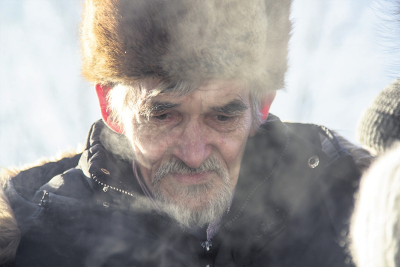
“... In that I see my (and colleagues) mission - to remind people of the horrors of unconsciousness. <...> Today, only the memory of spaces, about wars ... that is, the authorities need "heroes" without a drop of political thinking. A sort of soulless performers of any orders. I remember that humanity has already passed. <...> I'm afraid our boys again want to play the war. Oh, I would not want to! So I’m trying to fight unconsciousness . ”
These lines are from the letter of Yuri Alekseevich Dmitriev - local historian, publicist, chairman of the Karelian branch of the Memorial Society, who has been searching for burials of victims of large terror for many years and turning the places of executions to the places of memory. He is a leading specialist in Russia, the author of many books in memory of victims of political repressions of the 1930-1940s in Karelia. In particular, known as one of the discoverers of Sandarmokh and Red Bor.
Now Yuri Dmitriev, who is already the seventh dozen, is holding under arrest in the investigative insulator No. 1 of the city of Petrozavodsk for far -fetched - how his colleagues, human rights activists, cultural figures and many others are convinced. The formal occasion for them was the pictures of his naked adopted daughter, abducted by unknown from his computer. Against the backdrop of a large -scale international public campaign in support of the researcher, the City Court of Petrozavodsk fully justified Yuri Dmitrieva for accusations against him in the manufacture of children's pornography with the participation of a girl and granted him the right to rehabilitation. However, then the Supreme Court of Karelia canceled this decision and directed the case for a second consideration.
The human rights center "Memorial" recognized Yuri Dmitriev as a political prisoner. Last year, the Moscow Helsinki group - the oldest in Russia and one of the most respected (even our current authorities) human rights organization - certified its awards for historical contribution to the protection of human rights and to human rights movement.
Many independent observers agree that it was “uncomfortable” memory, the restoration and preservation of which Yuri Dmitriev is engaged in, and served as the true reason for his criminal prosecution. Twenty years on August 5, on the day of the beginning of a large terror (according to the order of the NKVD No. 00447 “On the operation to repress former kulaks, criminals and other anti -Soviet elements”), people come to Sandarmokh in order to honor the memory of those who are lying there. And these victims are representatives of many countries and peoples. And obviously, there are forces that do not want the international format for conducting these memorable events. It seems that someone with the help of fabricated charges of extremely unpleasant criminal articles decided to force Yuri Dmitriev to shut up, stop scientific work and discredit his honest name.
The culture of memory, which arose and is actively developing in the West, which is being implemented by Yuri Dmitriev with his colleagues in the Memorial society, is not focused on victories, but on tragedies, not on the winners, but on victims. Of course, in the West, in Europe, the relations of historical trauma and historical victories were also not easy. It is well known that, say, in Germany for forty years after the end of World War II preferred to forget the history of Nazi Germany. But subsequently, a revolution occurred in the public consciousness, and the situation became the opposite: the Germans are trying to comprehend the experienced, to make it an integral part of national historical and cultural memory.
And in Russia, public memory is arranged in a completely different way, it is not customary for us to recall tragedies, disasters, defeats, failures, shameful pages of history, which was the period of Stalinist repression. These trends have intensified in recent years, especially at the official level, and above all, it applies to the tragedies to which state authorities are involved, they bear legal or moral responsibility for them.
In the 1990s, important (but, apparently, insufficient) attempts to restore historical memory, including the memory of the period of repression, were made in post-Soviet Russia. And the contribution to this work on the restoration of the history and names of the executed and repressed were made by the employees of the Memorial, including Yuri Dmitriev. However, now, if we talk not about the work of public non -profit organizations, but about state activities, a completely different approach is observed. The state prefers bashfully silent about this, putting forward the history of only victories, real and invented. Generalized, this applies to the events of the Great Patriotic War. One gets the impression that people stopped being afraid and hate war. Instead of the statement “never again,” the thesis “We can repeat” is promoted.
And Yuri Dmitriev, even being in the investigative insulator, continues to work on preserving memory. He is still engaged in research (as far as possible in the conditions of imprisonment) and conducts educational work among prisoners. The sympathetic, who are written to him by jail, he asks him to send him stories about political prisoners - Soviet times and our contemporaries. Yuri Alekseevich reads these stories to neighbors, thus introducing them to the history of our country.
And it would be nice for everyone who talks about pride in the country to listen to his thesis from the same letter: “ A patriot is a person who loves his homeland. And the homeland and regime are the concepts of oh how ambiguous . ”
Vera Vasilieva,
Journalist host of the Freedom and Memorial project of the Radio Station "Freedom", especially for the TRV-hunger