
Translated material
From non -destruction of sperm to non -destructive composites

Relations on the principle of the famous game “Stone, Scissors, Paper” (when, it would seem, contrary to formal logic, the first beats the second, the second beats the third, but the third beats the first) persistently manifest themselves in various areas of reality. This phenomenon of non -transmission of dominance is devoted to entire monographs [1], not to mention articles. His studies are often conducted in parallel and independently in various scientific disciplines - on their "native" material, but the results can beautifully confirm and complement each other. Below I will introduce several areas where they are close to the study of its mechanisms not in the metaphorical sense (such as “psychological mechanisms of non -transmission of human preferences”), and in the sense close to literally. These are mechanisms of interaction from biochemical to physical level. The areas under consideration: sperm non -destruction, mathematics of a paradoxical attitude “more often to be firmly” and physics of simple mechanisms. These areas seem to be little tied - and, perhaps, they will remain like this forever, but it is possible that their development, as well as the development of neighboring and remote areas, will answer the question: what is the minimum level of the complexity of matter, on which the relations of non -destruction of the dominance “stone, scissors, paper” are already realized?
Relations "stone, scissors, paper" - from ethology to biochemistry
In the last quarter of a century, biology has been actively discussing non -transmission competition - competitive relations on the principle of “stone, scissors, paper”, which are formed between species, representatives of different morphs within the same species, behavioral strategies of individuals, etc. (see, for example, [ 2 , 3 ]). In 2018, the special issue of Journal of Ecology magazine was released with the initiating article “Everything you wanted to know about non -transmission competition, but were afraid to ask” [ 4 ]. Non -conding competition is considered one of the important conditions of biodiversity. The coarsished explanation is as follows: if in the biological world, competitive relations did not form multiple cycles and linear hierarchies would reign there, then all this would have continued very shortly. The superminant (“king of the mountain” that appeared, would be knocked out by everyone else, and then either died of hunger, or would remain to engage in a slow photosynthesis alone, since there is no one else to eat.
Biochemical and physical interactions are interesting, providing mechanisms for non -jealous competition at the micro level, for example, when mating individuals. A striking example is the non -destructiveness of the competitiveness of sperm in Drusophiles and other living creatures, whose stable behavioral strategies are characterized by the fact that females mate with many males for a short period of time. In such species in the body of females, the competition of the sperm of males begins on the principle of “stone, scissors, paper”, and the one whose sperm has high speed wins [ 5 , 6 ]. Studies here are often built like this: females are artificially inseminated with sperm of various males (each female - sperm of several males according to a complex scheme) and then analyze the genotypes of the embryos formed. The fact of non -destruction of sperm is considered established, but its biochemical and physical mechanisms seem to have not yet been clarified. But, let's hope, the case is moving towards that.
Parallel research in mathematics
In an article in the TRV-HOW [ 7 ], I wrote that studies in biology were parallel to the studies of non-utransility in mathematics. Initially, the topic of non -jealous relations of superiority (dominance) was raised by the Polish mathematician Stanislav Trybul [ 8 ]. He considered as a model example what is understandable and well formalized - sets of bars that claim to be the same (standard in strength), but manufactured in three different and not ideal factories. Trybula proved that it could be like this: bars from the factory and more often stronger than the bars from factory B, bars from the factory in more often stronger than bars C, and bars from the factory C are more often stronger than the bars C (and this is not about measurement errors). For those who hear about such an opportunity for the first time, she may seem nonsense - not without reason in books and articles the described phenomenon passes through the category of “mathematical paradoxes”. However, this is a mathematical truth.
Mathematics knew mainly only a few mathematicians about the results of Polish. It went more fun when Martin Gardner in the 1970s began to publish notes on paradoxical mathematical objects in his mathematical columns in Scientific American . Including about non-destructive playing cubes, which since then have become an informal symbol of all non-transit in mathematics (see his books “Crosses-Noliki” and “Time Travel”, from modern popular science texts, it is necessary to mention [9], and from advanced books for high school students [ 10 ]).
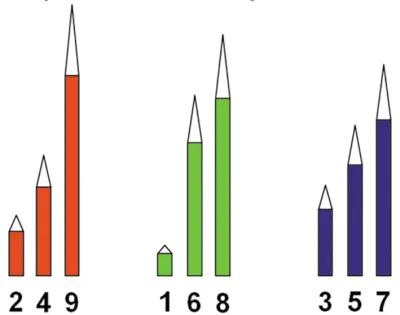
Showing the non -destructiveness of superiority studied in mathematics is easiest at sets of three pencils. There are three sets of three pencils of different lengths (Fig. 1). We compare each pencil from each set with pencils from other sets in length. We get that red pencils are longer than green 5 times out of 9 of their pairing comparisons (“contractions”), green are longer than blue - 5 times out of 9 pairing comparisons, and blue are longer than red 5 times out of 9 pairing comparisons. Based on this, you can build a lot of things about non -destruction. The simplest thing is that now everything is clearer with non -jealous bars. Imagine that the numbers describing the length of the pencils now show the strength of a bar. We get that the bars from the first factory were more often stronger than the bars from the second, those - bars with the third, and bars with the third - more often stronger than bars from the first.
Behind the level of scientific popularization there is serious mathematics - it is enough to say that in 2017, the Field Medaist Timothy Gauers connected to develop an understanding of the theory of probability [11 , 12]. But all this is still a game with cubes. In turn, Alexei Viktorovich Lebedev raised the question of the possibility of non -utranstivity not discrete (as numbers on cubes), but continuous random quantities and showed at what statistical distributions it is impossible, and under which it is possible [ 13 ]. He emphasizes that the “game” wrapper of tasks about non -jealous cubes prompts to perceive the problems of non -destructiveness as frivolous - and in vain. Both in the natural world and in the world of objects created by man, the non -destruction of statistical distributions can be a very significant factor.
Of the most interesting conclusions, justified almost simultaneously in mathematics and in biology, the following conclusion can be called. The more complicated the system, i.e., the more participants are included in interaction (the more playful cubes in the sets, the more biological species in the niche in question) and the large number of parameters these participants are characterized (the growing number of faces of non -destroyers, the growing number of characteristics describing biological species), the more likely in such a system, to find more and more multiple non -state cycles [ 14 , 15 ].
Non -juncting machines based on simple mechanisms
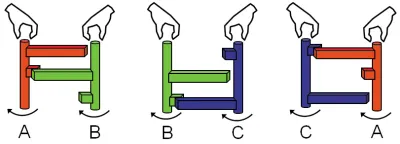
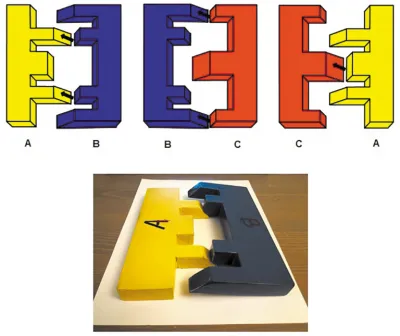
At the recent conference “Psychology and Technology in mathematical education” [ 16 , 17 ], I presented a complex of various non -jealous geometric and mechanical objects based on simple mechanisms (levers, gears, blocks, wedges, etc.). They implement the principle of “stone, scissors, paper” and can be used in teaching physics and mathematics in explaining multifactorial interactions.
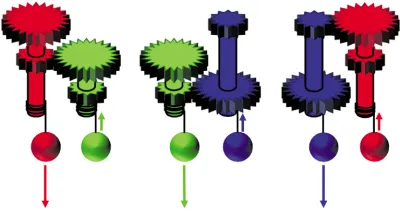
I will first note that after the publication of my article in the TRV-hunger, a certain specialist in gear gears erupted with an angry tirade: they say, non-transit gears and non-jealous blocks are impossible. In the worst case, they violate the laws of conservation and cannot work for this fundamental reason, at best, they will not work, because they will simply jam them. Here, let's say, non -destructive blocks (Fig. 3). There, during pairing connections, the load and outweigh the load in, the cargo into the outlet of C, and with it outweighs A. True, am I trying to drag the model of the eternal engine?
Answer: The laws of conservation are carried out here in the best possible way. The winnings in force in each pair are accompanied by appropriate losses in the distances: the rise of the load in each pair to a certain height is accompanied by lowering the other cargo to a more depth, and the potential energy of the system is reduced. With a multiple repetition of the procedure in sequence in all pairs, all the goods will be at the lower point - say, on the floor (like weights of mechanical watches) [ 18 ]. Such an example can be disassembled in physics lessons.
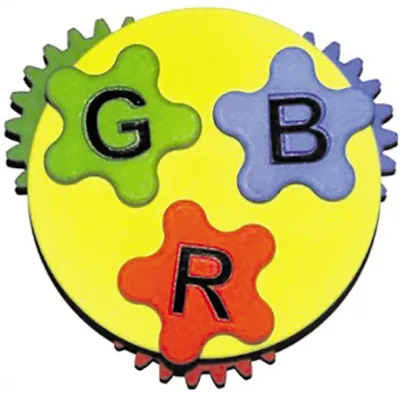
It cannot be said that it is so difficult to understand, and other participants in the discussion were seriously argued with a specialist in gear programs. And also support came from an unexpected side. The Dutch inventor of the puzzle Oscar Van Deventer, referring to my article in a three-hobby, came up with an even more paradoxical thing-a toy with gears, rates and handles (Fig. 4). Whatever element (gear or handle) is chosen by one participant, the second can always choose such an element of the remaining, which will “win” the element selected by the first participant, that is, it will rotate faster than it. There is no absolute winner, but there is a non -jealous cycle. Having experimented with this toy, I discovered another opportunity - the non -jealous game is not together, but the three of them. Namely, if the first two participants in the game are selected by each element, the third participant can always choose such an element of the remaining and such a direction of its rotation (clockwise or against) that this third element will “win” the first two - it will rotate faster than them. Moreover, in 75% of cases, the third player, choosing one or another element and direction of his rotation, can control the distribution of places between the first and second participant - which of them will become the loser (the element he selected will be the slowest), and who will take the second place (the element chosen by him will not be the fastest nor the slowest).
Limits of non -destruction - assessment from below
The non -destruction of dominance is the property of complex, multifactorial systems [ 19 ]. In simple systems, it is not. No need to fear that when measuring just three pencils, their non -destruction in length will be found. But in three sets of three pencils it is already found. The question arises here: what is the minimum complexity of the physical (mechanical) system in which non -utransts is already possible?
Let us return to the strength of physical materials. Question to specialists on materials: are artificial composite continuous blocks or layers, film, non -destructive in abrasion (other resistance, strength) that show this property with pair of direct physical interactions due to the design of the composite structure (and not due to the imperfection of manufacture)? The practical needs of them are now not visible, but the very possibility itself is curious - in terms of determining the boundaries. Palliative amusing solutions are possible - for example, the brush non -destructive in abrasion with “composite bristles” (recall that we sometimes see in films: boys - street shoes cleaners are chicly and many brushes are gathered along the bristles of another). Presumably, the senior non -jealous result could be given by the sets of bristles by abrasion, carefully collected according to the templates of the magic squares of Martin Gardner. (Thus, pencil sets were collected, non -destructive in length - also a thing, if it is obvious, then only retroactively.) And we would have three non -destructive brushes. At a minimum, this is the material for some primary use of a physical or mathematical class.
Alexander Poddyakov,
doct. Psychol. sciences, prof. NIU HSE, ch. scientific. sore. IP RAS