
Translated material
Wasps, Plavet and Plato
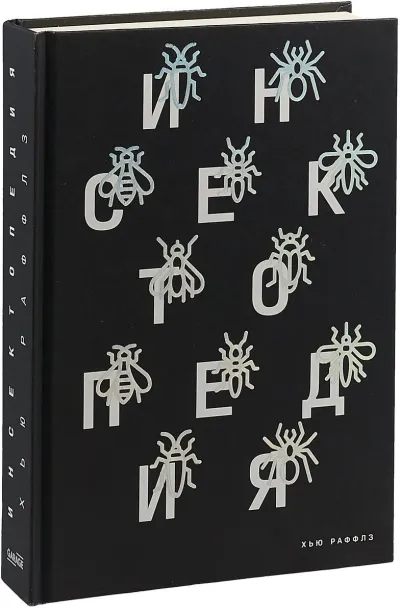
... Osten-Saken's interpreters fluttered not only in a forest clearing,
but also in a narrative vacuum ...
Thousands of books about Plato, Wittgenstein and Heidegger have been written in the world. And thousands of books about beetles-sorogues, cycades and flies. But it is unlikely that these characters are found together somewhere except the book “Insectopedics”-an amazing alloy of philosophy and entomology, which was created by the American anthropologist Hugh Raffles, a professor of the new school of social research in New York.
His anthropology is not at all the way we are used to thanks to Stanislav Drobyshevsky. Raffles primarily a philosopher, and his study of a person involves the search for answers to questions about how a person exists in the world. For him, Batai and Deleuz are more important than Australopitecs and Levi-Strass.
“Insectopedia” is a strange book, this is not even an interdisciplinary study, but a peculiar series of essays, inevitably reminiscent of the “Atlas” of Borges. It is based on the same journey of a smart and attentive person along the globe and world of books. And this, of course, is a full -fledged art work (I do not mean imagination and fiction, but the depth of thought and writing skill).
Insects in “insectopedics” serve as a reason for discussions about the history of civilizations, about the principles and boundaries of cognition, about the past and future of historical science, about the perception of the time and features of the deviant psyche.
Raffles talks about his trips to Africa, where he tried to understand how the locust affects Niger's economy: he enriches some, throws others into the poverty of others and serves as a symbolic cement of the nation. He talks about a visit to Japan, where a boom of hobby with horned beetles has turned into a main sign of time. He writes about a visit to China and about meetings with underground players who lower conditions on the battles of crickets.
Throughout the book, Raffles talks with dozens of people: with an artist who draws insects affected by radiation, with gathers of grasshoppers and sellers of beetles. At the same time, he almost does not communicate with scientists. This is no coincidence. Biology in the book occupies subordinate significance. Raffles are not interested in morphology, ethology or ecology, it is more occupied by the ontological differences of crickets and flies and the evolution of comparison of Jews with lice in Europe.
He interprets the facts from the life of entomologists and insects from the point of view of philosophy.
For example, the Russian aristocrat Baron Robert Romanovich Osten-Saken (1828–1905), who so much admired the soaring of flies that after the resignation from the post of Genaconsul of the Russian Empire in New York, he was studying them for thirty years.
Or the flies themselves, who, apparently, have a completely different perception of time than ours. They live a few days or weeks and, according to the author, a film shot for flies (or flies) so that the picture does not twitch, but go in a continuous stream, should move at a speed of 120 frames per second. Flies " exist in a different plane - in a plane that differs from ours not only in visual acuity, patterns and colors, in a plane where space-time lives in a different mode ."
“Insectopedia” turned out to be a wonderful bewitching book that cannot be classified. It is difficult to say in which scientific journal these essays could appear. They would hardly print “questions of philosophy” and “entomological review”. Rather, they could appear in the collection of avant -garde prose or in abstruse almanacs for intellectuals. It remains only to sympathize with the librarians who will have to squeeze her into the rubricator. By the way, in the bookstore "Insectopedia" is sold not in the section "Natural Sciences" and not on the shelves of "Philosophy", but among other strange books of the publishing house AD Marginem.
It is possible to judge its unusual character by glossary, which looks like an hymn to eclectic. For example:
“Plavet.
Plato.
Pliny.
Plots, Alfred.
Plutarch.
“ The Tale of Genji” (Roman Murasaki).
Border layer.
Pogroms of 1881.
Contences ".
The philosophical approach to insects allows Raffles to completely cover many topics in a new way, and avoiding the deliberate Zaumi and philosophical heavyness. This is the special charm of "insectopedics."
The usual books about insects say that we know about beetles and butterflies. "Insectopedia" says that we do not know and that at all, most likely, we will never know.
In fact, why do we think that we understand insects? For example, flies of-Tulkunchiki. Their males before mating give gifts to females. Some use food - dead spiders and midges as marriage gifts. Others are cunning and handing empty cocoons in exchange for mating, where the corpse could lie, but it is not there. Thirdly, they give female brilliant useless scales. It turns out that males are deceiving females, saving their resources and mating for free, and stupid females succumb to the trick. This is the situation from the point of view of entomology. And from the point of view of philosophy?
“ What if these empty balloons are really gifts, we just don't understand their value? Perhaps females experience ecstasy from feeling these tiny scales. Or captivating relaxation. Perhaps scales awaken memories or some kind of appetite. Perhaps they have a symbolic value - are full of tenderness and deep meaning. Perhaps they just like the tumors ... Is it not obvious that it is extremely difficult to guess what a certain object is and how is it useful from the point of view of creatures, whose way of life is so different from ours? ”
The idea is not new, but Raffles sounds exquisitely and loudly.
In the middle of “insectopedics” there is an important story about the composer David Danne (born 1953), who, during a terrible drought in the United States, began to record sounds in the depths of the pine. It is impossible to hear these sounds, they are outside our perception.
Dann captured low -frequency vibrations and ultrasonic noises using cunning converters for two years, then mounted the most interesting finds together. It turned out the hourly composition "The sound of light in the trees." Barkouts are piercing piercingly, larvae groan bass, creaks like an old door, a pine trunk in the wind, gas bubbles explode in wood, ants drum along the bark. This is a completely different and alien world to us, not at all like a reality familiar to us.
“Insectopedia” turned out to be the same strange work, a collection of amazing stories that the author collected for many years and mounted in the book. Closing her, you understand that sooner or later you will take her to re -read.
Anton Nelikhov