
Translated material
Coffee - rubbish, beloved cat - cattle
"Gorky" in "Labyrinth": Do not miss these books
A novel for teenagers about flights, independent life and repair, a collection of articles of a great anthropologist, a book about choosing and a person’s life without emotions: in today's issue of the “Gorky” section in Labyrinth ”we talk about the books that Svetlana Potapova, Claude Levy-Strauss, Paolo Kindetti and Mikhail Polyuga.Svetlana Potapova. Repair. M.: KOMAPAGID, 2019
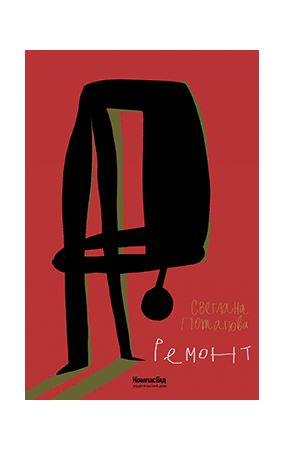 The mother of the 15-year-old main character Lucy once admits that they have another apartment. They live well - rather poorly; The daughter hates her mother, calls her amoea and insignificance. As soon as the opportunity appears, she immediately moves into a separate housing. The new apartment is completely empty, without wallpaper and furniture, but the desire to live separately blocks all the disadvantages. Lucy settles here with an 18-year-old teenager Pasha, in whom he is slowly falling in love (it seems, unrequitedly), and a lop-yuh-class cheburashka, quiet, who has a site about aquariums and two thousand subscribers. It turns out a “absorption”, new residents bring furniture to the apartment and begin to make repairs.
The story of Svetlana Potapova is difficult to call a full -fledged story of growing up - the text is too short. We do not know how the heroine came to the current state and what awaits her ahead (although, judging by the end, there are great hopes for improving relations with the mother). In general, a portrait, perhaps, turned out to be relevant for a particular age and circumstances: after some six months Lucy could already change beyond recognition. In the meantime, she shares her observations about boys, about school, about adults, mentioning a couple of films about schoolchildren, where "everything is wrong."
In addition to the eternal thoughts that school knowledge is not needed in life (“Why is my four in biology, if I don’t know where the collarbone is?”), Lucy well notes the details of someone else's well -being: “King can immediately see that he is from a rich family. Such people are very ... clean. There are never cracks or dirt on their bright sneakers ... ” She reads the Great Gatsby in the original and rejoices when she finds the word Cool in a laudatory meaning.
The most interesting fragments are the heroine's thoughts about love. And they are by no means about how to find a pair. She has a whole theory “On the blindness of a woman’s love for a man”, which brings some to a deplorable end; Or, for example, seeing that everyone is marrying their classmates or classmates, she seriously thinks whether to correctly connect life with a person from a “narrow circle”. How much Lucy’s language is similar to the language of adolescents, let the adolescents decide - however, the thoughts are interesting.
Claude Levy-Strauss. We are all cannibals. M.: Text, 2019. Translation from French E. Morozova and E. Chebucheva
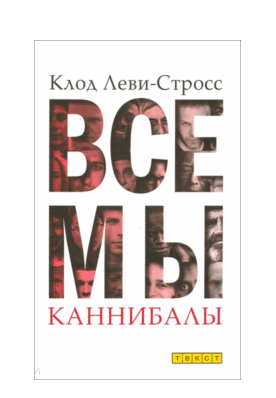 Levi-Strauss (1908–2009) is a great ethnologist, creator of structural anthropology, who studied traditions, rituals and especially myths to find common features among the “civilized” peoples and societies that still live in the tribal system. As you know, he found these common features, thereby often turning our ideas about the “progressive” and “wild”, about highly developed and primitive.
The scientist wrote in the essay collected in the collection from 1989 to 2000 at the request of the Italian newspaper La Repubblica. In them, he again and again shows how the popular and even scientific conclusions are incorrect about ourselves and about ancient people. “Since humanity exists, a constant occupation of a person always and everywhere has become“ the implementation of your idea ”. This lesson brings him satisfaction, he finds genuine interest in him and does not ask him the question of where it can get it. ”
Who said that an increase in labor productivity is a characteristic of our time? The very same decorations of the prehistoric era found in huge quantities and in the vast territories indicate that they were made on an almost industrial scale. Or a question from a completely different area: why are the so -called open crowns of some medieval monarchs amazingly similar to a splash that causes a drop that has fallen into milk? It became possible to observe this pattern only in the 20th century, with slow photography; But how did he come to mind to the then masters? Some articles were even written in the wake of wide public discussions, which is why they fall into the agenda now. For example, one of them refers to female circumcision and its comparison with male circumcision; It is scary to imagine how this text can be read by active women's rights fighters.
"Get" from Levi-Strass and the scientists themselves. Their explanations of some phenomena are increasingly becoming incomprehensible to ordinary people, contradict elementary logic. Levi-Strauss does not say that scientists are mistaken-he only pays attention to how their attempts to comprehend the world are similar to such efforts of cave people. “For a non -specialist <...> The world that physicists are trying to describe for their own use restores a kind of equivalent that our distant ancestors considered the world of supernatural, where everything happened differently than in the ordinary world.” Sometimes it seems that a French academician goes in his assumptions too far; Maybe that's why he is one of the most famous scientists of the last century.
Paolo Kobetti. Eight mountains. M.: AST Publishing House: Corpus, 2019. Translation from Italian A. Yampolskaya
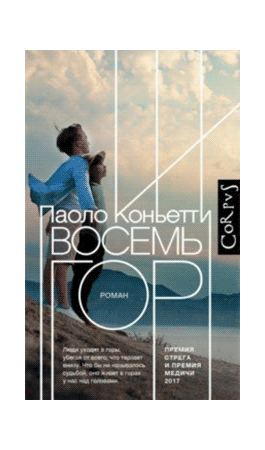 Italy, 1980s. The boy Pietro's boy leaves the city for the summer and takes a house in a mountain village. The father of the family from youth loves mountain ascents and takes his son with him on hikes. However, the boy joins a new hobby rather by inertia. There, Pietro meets the same age as Bruno, who constantly lives in the mountains, looks after uncle cows and, it seems, is not at all interested in adults. They gradually become friends, climb the surrounding peaks; Pietro's parents are even ready to accept Bruno in the family and send him to study in the city so that he can choose another future. But he does not want. Friendship is stretched to the end of the book, and the heroes continue to meet in the mountain valley for the next forty years; And all this time, Bruno remains adamant about his purpose.
Paolo Kobetti writes in Barnsky a short and quiet novel, into which he stuffs the long and versatile story of the relations of two people. Here we are not talking about love, but about friendship; However, there is no doubt that both Pietro and Bruno would call this story of their friendship the main feeling in life. The main intrigue of these relations is the different views of the heroes on life. Pietro, in fact a city man, grows up and continues to educate in the city, Bruno builds a separate hut right on the slope. Pietro in search of inspiration goes on travel, Bruno tries to establish his own business in the mountains. Which is better: “leave and return” or stick out in one place; Go around all the mountains of the world or climb one, but the highest? Where is the line between devotion to your ideals and elementary cowardice before leaving the comfort zone?
A few Kobetti characters can be studied as indicative examples of the notorious situation of “choosing priorities”. Father Pietro remained faithful to himself to the end; His wife delved into the household with age; Bruno girl refused freedom for the sake of constant, albeit very little earnings in hated work; Pietro never limited himself in search. Bruno, on the other hand, chooses almost the lifestyle of the hermit: “Maybe in his youth she will be able to change something. But then we must stop and say: okay, I can do it, but this is not. ” A very controversial thesis, but with surprise you admit to yourself that you are not completely sure, you envy Bruno in the end or only regret it.
Mikhail Polyuga. Regrettable circumstances. M.: Time, 2019
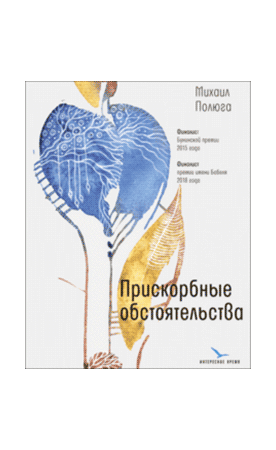 The protagonist, middle -aged man Evgeny Nikolaevich, is lamented about the injustice of the universe: on the one hand, I do not want to die. On the other hand, if you live forever, you will have to constantly endure "work, dry mouth, back pain." “The need to live and communicate” has long been not perceived as a necessity - rather service. Coffee that he is used to drinking every morning - rubbish; Favorite cat - cattle; And he himself is “the finished cynic and the pessimist”.
With such initial data, you expect that the hero is a person without a certain kind of occupation, a writer or, at worst, a teacher. But Evgeny Nikolaevich is a great boss in law enforcement agencies. Maybe a difficult work led him to such a view of life? It seems not: at work he feels more or less confident; And his position is such that you can not deal with different small routine. It seems that the hero just has an age crisis, the very moment when a person is inclined to think that he will leave after himself. And then a colleague reports that Evgeny Nikolaevich is “for study” with internal security officers.
Mikhail Polyuga successfully combined three different layers of reality in which the hero has to exist. The first is the already indicated permanent depression, because of which Evgeny Nikolaevich seems to have lost all sorts of emotions and looks around with cold indifference. Only sometimes saying: “But actually, it’s good to live in this world-in a separate moments of being!” The second is the ordinary of the operational service, where cases should be closed strictly on time, with a pre -known sentence; The interrogated and prisoners arrange a “swing” during interrogations; Employees dig under colleagues and immediately share with each other information obtained; The family is falling apart due to time lost at work; Corruption takes more and more sophisticated species. The most important and sad in all this - you can’t get out of a vicious circle, just quit. Nobody even tries to analyze what is happening, because such a brains will not stand this. Finally, the third is rare contacts with the outside world, which reminds the hero that he is just a person.
A person without emotions, it turns out, also has emotions. But there is nothing to spend on, but you can’t show them. And this happens.