
Translated material
Scientists first showed a picture of the horizon of events of a super -massive black hole. The object watched seven years
The image was received using eight radio telescopes located at different points of the Earth.
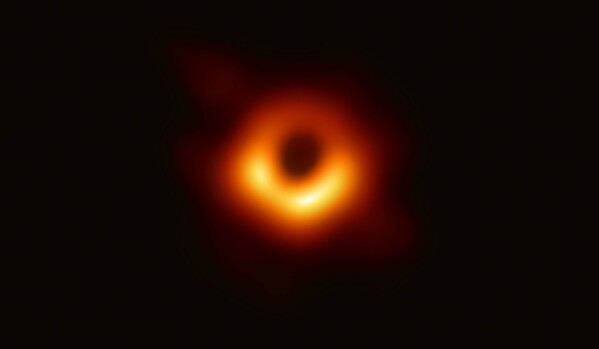
Researchers held six conferences in Washington, Brussels, Santiago, Shanghai, Taibee and Tokyo, where they presented the first image of the horizon of the events of the black hole. The picture was received with the help of the Event Horizon Telescope (“Tescope Horizon of Events”), which launched in 2012 to observe black holes.
Astrophysicists received an image of a black hole in the center of the Messier 87 galaxy, located at a distance of 54 million light years from the ground. Scientists also watched the Black hole Sagittarius A* (sagittarius a*), located in the center of the Milky Way.
Black holes are areas of space with strong attraction, because of which they cannot leave the light. Scientists believe that they exist based on the general theory of relativity. These objects are invisible and absorb electromagnetic radiation, so they cannot be found with the naked eye. Researchers can only observe radiation, electromagnetic waves and distortions of the space around the black hole.
Scientists were able to capture its “shadow” - a ring of radiation and matter on the edge of the horizon of events. Researchers received not just a photograph, but processed images made using radio telescopes.
To observe black holes, a telescope the size of a planet would be required. Therefore, scientists used eight observatories located in Hawaii, in the USA, Spain, Mexico, Chile and at the South Pole. Each telescope measured radiation emanating from black holes. Astrophysicists collected the received information on a supercomputer and created an image that looks like it was made with the help of one huge telescope.
Previously, scientists have already received images of radiation emanating from hot gas around black holes. For example, in 2013, NASA captered the image of the radiation around the black hole of Sagittarius A*.
#News #Cosmos #Blackdyra