
Translated material
For the first time to see a long -standing acquaintance
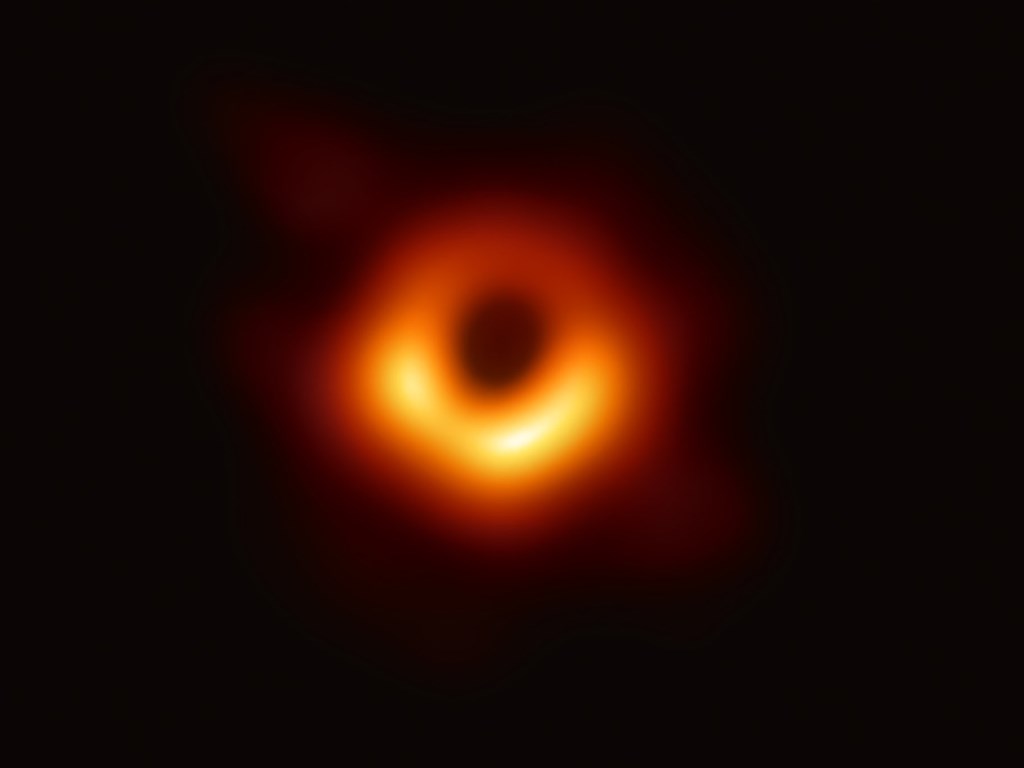
Imagine that you know a person whom you have never seen firsthand, but you know a lot about his actions, personally observed the results of his actions, heard about him from friends and learned him so well that you can even predict what he will do in a particular situation. This situation has been saved for many years, but suddenly the day comes when you are shown a photograph of this, on the one hand, never seen, and on the other, already a well -known person. This is exactly what happened on April 10, when astronomers demonstrated the world in the world the first direct image of a black hole and its shadow in history.
No matter how strange it seemed, formally black holes still remained undisputed, in the rank of hypotheses. I also remember how astronomers said that in the center of one or another galaxy there is a “possible black hole” or “object - candidate for black holes”. But over the years, more and more observations have accumulated that could only be explained by the presence of black holes. The confidence of scientists grew, and gradually reservations were left.
Although not all the details of the physical properties of black holes and their evolution have already been explained by astrophysics, much is already known about the black holes. We know about two types of black holes.
The former are in close double systems and are found by the flow of a substance falling into a black hole from the second component of the system - a star. In this case, the substance forms the so -called accretion disc and heats up to high temperatures, so that astronomers record radiation emitted by this disk. Such black holes are small, their masses usually make up several masses of the sun. More recently, another method of detecting black holes of stellar mass has appeared - registration of gravitational waves that arise when two black holes merge into one.
Other black holes are much larger, in millions and even tens of billions of masses of the Sun. Such black holes are located in the centers of the galaxies (more precisely, in the centers of galaxies with Bald - “bloating” in the middle of the galactic disk). Supermissive black holes also draw into themselves the surrounding substance, forming an accretion disc. Thanks to these discs, the centers of galaxies with ultra -massive black holes have great luminosity, sometimes it can exceed the luminosity of all stars of such a galaxy by tens or even hundreds of times as the Milky Way. It was on this radiation that they were discovered in the late 1950s-early 1960s. Then the scientists have not yet had time to understand what they were dealing with, and called open objects quasars (quasi -star radio sources).
In 1963, the Dutch astronomer Martin Schmidt managed to explain the spectra of the Quasar, finding a red displacement in them, which allowed to determine the distances to them. It turned out that quasars are not only the most striking, but also the most distant objects known to astronomers, located in billions of light years from the solar system. Yakov Zeldovich and Edwin Solpiter were able to explain the enormous energy of the quasarov, suggesting that the accretion discs of ultra -daily black holes serve as its sources.
So a black hole in the center of the giant elliptic galaxy M87 was depicted by an artist (ESO/M. KornMesser)
You can follow the super -massive black holes, observing the behavior of objects (stars, gas clouds) in their environs. Such observations allow you to determine the mass of the black hole with a rather high accuracy. Now quite a lot of such black holes in the centers of different galaxies are already known. Moreover, astronomers suggest that a super -massive black hole is available in the center of any galaxy with a fairly large bond. There is a black hole in the center of the Milky Way, its mass, which is about four million masses of the Sun, is calculated by the movement of the surrounding stars.
Another well -known astronomers of the ultra -massive black hole is located in the center of the Elliptic Galaxy M87 in the constellation Virgo. It is much larger than the “our” black hole (about 6.5 billion masses of the Sun, in this indicator it is second only to black holes in the Galaxy NGC 3842 and NGC 4889 with masses of 9.7 and 27 billion masses), but is much more than 55 million light years. A disk of ionized gas around this black hole rotates at a speed of about 1000 kilometers per second, and its diameter is approximately 0.39 light years.
It was the black hole of the M87 galaxy that was chosen to obtain the first image of a black hole in the history of science. Although the motto of “Pics or it is ' t happen ” does not work in science, the task of seeing the black hole in the earth's telescopes seemed interesting enough to make significant efforts. Of course, there can be no question that an object, albeit colossally bright, but in another galaxy for tens of billions of light years from us, could be seen in an optical telescope. They were going to consider a black hole in the radiodiapas.
But for one radio telescope, such a task was too complicated. The fact is that the angular resolution of the radio telescope is determined by the ratio of the wavelength to the diameter of the antenna. The less this attitude, the more close to each other objects can distinguish between the telescope. Accordingly, by increasing the diameter of the parabolic antenna, you can improve this characteristic of the telescope. But even in telescopes with the largest antennas, it remains small. Their angular resolution rarely exceeds 1 angular minute, which approximately corresponds to the vigilance of the naked eye. And the radio or more radio sources located close to each other perceives the radio or more radio sources as one source.
Radio -Astronomers have long solved this problem. They created radio interferometers - systems of several radio telescopes interconnected and working synchronized. In this case, the angular resolution is determined not by the diameter of the mirror of one telescope, but by the distance between the telescopes (the so -called radio interferometer base).
With the advent of radio interferometers, the radio astronomy sharply overtook optical astronomy in resolving ability. Radio interferometers with a super -long base also appeared (RSDB, Very Long Baseline Interferometry, VLBI). They combine radio telescopes spaced thousands of kilometers and located in different countries, and often on different continents. The radiation adopted on each of them is recorded and processed in a single center.
It was such a radio interferometer that was created to obtain an image of a black hole in the M87 galaxy. It was called the "Terison of the Events" Telescope (Event Horizon Telescope, EHT) and united eight ground radio telescopes: Alma (Chile, European Southern Observatory), APEX (Chile, European Southern Observatory), 30-meter IRAM telescope (Sierra Nevada, Spain), Tyskopa ) James Claireca Maxwell (Mauna-Kaa, Hawaii), a large millimeter telescope Alfonso Serrano (Sierra-Negra, Mexico), a submillimeter grille (Mauna-Kaa, Hawaii), a submillimeter telescope (Arizona, USA) and a telescope on the Southern Pole (Amundsen Station-Scott, Station, Scott, Scott. Antarctica). More than 200 researchers participated in this scientific collaboration.
The map of the telescopes participating in the observations of the M87 as part of the EHT project in 2017. In 2018, EHT included a radio telescope in Greenland. Two more telescopes, located in France and in Arizona, will join the project in 2020.
The interferometer worked at a frequency of 1.3 mm and reached an angular resolution of 20 milliseconds. In order to clearly demonstrate this value, scientists say that in the optical range, such a permit would read the New York newspaper from the Parisian cafe.
When eight radio telescopes in a giant interferometer mode, it is necessary to synchronize the data obtained by each of them with great accuracy. For this, atomic clocks ( hydrogen maser ) were used. During the observation campaign of 2017, each radio telescope received 350 terabytes of data per day. They were recorded on special hard drives and went to the Max Planck Society Institute in Bonn and the Haystek Observatory (Massachusetts Technological Institute), where there are correlators - special supercomputers who processed the signals received and ultimately converted them into the image.
The result was presented in a series of six articles published in the special issue of The Astrophysical Journal Letters, as well as at several press conferences conducted in different countries by scientific institutions participating in the EHT project.
The first image of a black hole
“When a black hole is immersed in a bright disk of luminous gas, a dark area resembles a shadow should form there. This phenomenon, predicted by the general theory of relativity of Einstein, has never been observed before, ”said the head of the scientific council of Eht Heino Falcke from the University of Radbud in the Netherlands. - This "shadow", formed as a result of gravitational curvature of light and its capture by a horizon of events, speaks a lot about the nature of these amazing objects. It was she who allowed us to measure the gigantic mass of the black hole in the M87. ” The border of the black hole - the so -called "event horizon" - is about 2.5 times smaller than the shadow. In the black hole of the M87 galaxy, it has a diameter of a little about 40 billion kilometers.
Due to the huge distance separating observers from the black hole, the visible size of the shadow of the M87 black hole is only 42 angular microseconds (here scientists again resorted to visual comparisons, comparing this with the visible size of the credit card lying on the surface of the moon), and the size of the horizon of events is only seven microseconds.