
Translated material
Everyday life of political repression
On the theory and role of "loud landings" in the management of today's Russia
“Loud landings” purchased a type of television background for citizens. Political scientist Nikolai Petrov was the first to add the definition of “political” to the “repression” presidential elections in 2018. With this, he seemed to twist the wheel of a magnifying device, adjusted the focus, and the picture became not so vague. But the real sharpness is still far away, and the wheel must be twisted every time again - depending on whether we want to see the near or distant plan of this very confusing and, moreover, constantly changing pictures.
- Nikolai Vladimirovich, take the three most recent examples: former Minister Mikhail Abyzov, former governor Viktor Ishaev, international investor Michael Kalvi - in your terms it turns out that they are political prisoners?
- Of course, no: none of them acted as an opponent of power. If we determine the political nature of repression depending on their object, then we can talk about the convicts in the “swamp case”. And we are interested in persecution against the elites, and here it is not the content of accusations, but the very systemic nature of repression.
This is rather not about objects, but about the subject that uses fear as a management weapon - and then, as they say, "there is nothing personal in this."
Focusing attention on individual plots, on the one hand, we see the crime actually or attracted by the ears, and on the other, we try to guess the reason why this case (unlike others) is given a move. But if we change the focus and look at the picture as a whole, then, as if chaotic repressions will appear as serial: not yet massive, but already group - and clearly addressed to one or another group of elites. So the authorities today pursue its policy regarding those who take place next to itself. More or less random victims, as well as addressees who read the “signals”, are the animated elements of the management system themselves: governors, ministers and their deputies, generals from power structures, and large entrepreneurs, since our business does not live separately from power, and power far from material and monetary resources.
If you proceed from such a picture, then the next persons are involved in this flywheel relatively accidentally, but the strengthening of repression - both by frequency and gravity of punishment - is not a surprise. The funnel is spinning in its own logic, and the hopes that after the 2018 presidential elections, the twisting of the nuts will stop did not materialize. Against,
After the Kremlin failures in the past governor’s elections in a number of regions, the authorities only tighten repression against the elites.
“ Sociologist Manuel Castels in the book“ The Power of Communication ”conducts the idea so simple that it looks like a revelation:“ The denser power the discourse, the less violence is required. ” At what point has the ratio of propaganda and repression changed?
- Putin's regime used repression as a method of achieving political goals from the first steps.
Vladimir Gusinsky agreed to sell Mediamost back in June 2000, and the agreement on this was signed in Butyrka. Mikhail Khodorkovsky did not hide the financial support of the parliamentary opposition, and the political background in the Yukos case was undeniable. But until 2011–2012, these techniques were used from case to case, and the system could not be talked about.
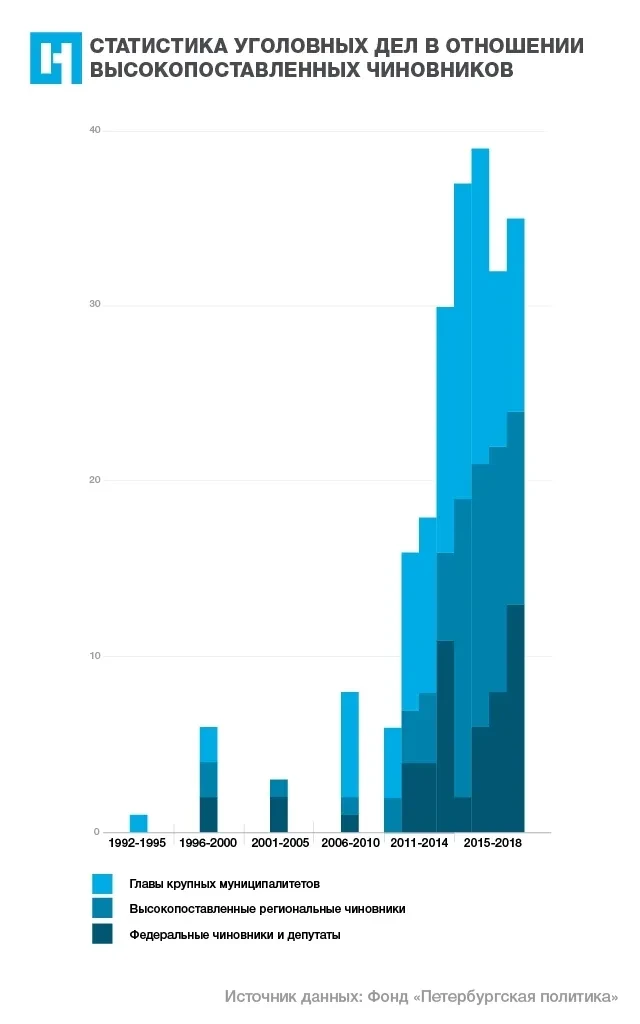
Sergei Guriev and Daniel Traisman in the work of “How Modern Dictators Survive ...” showed that “information authoritarianism” thanks to the seizure of media, which enhance the echo from repressions, can use them more economically. The St. Petersburg Politics Foundation has published an analysis of criminal statistics against senior officials. In 2006-2010, only 8 of these were gained, and 6 of them concerned the level of municipalities. In 2011, there were already 6, over the next year-16, and since 2012 this figure has constantly grew up until it stabilized since 2015 at the level of 30–40 people representing certain elites annually. This is especially noticeable in the regions, and applies to both managers and the leaders of law enforcement and control departments appointed by Moscow. Recently, regional security forces are increasingly falling under fire.
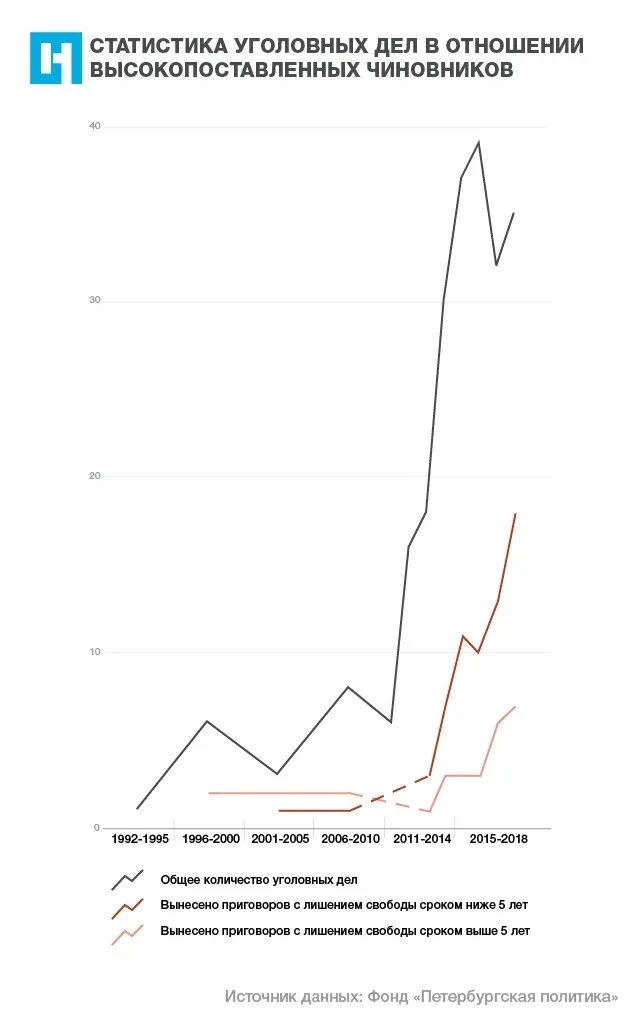
In parallel, the pressure on large business is increased, since any promotions against officials cause plunging all their patronal pyramids. There is also a feedback: affairs of such a scale as against the Magomedov brothers cannot but cause perturbations in the hierarchies of officials, but such changes are most often set aside in time, and we do not immediately see it and we can connect one with the other.
- What reasons have caused such a surge from 2012? After all, it would seem that civil protests required, on the contrary, the consolidation of elites.
- This ultimately happened, but criminal cases began to play the role of a consolidating factor. It all started with the fact that in the parliamentary elections on December 4, 2011, the Party of Power, with all obvious stretches in almost all regions, could not show the planned high result, but on March 4, 2012, Vladimir Putin gathered almost 64% of the vote, allowing, it would seem, a crisis of legitimacy.
The president was less dependent on regional and corporate elites, and they, on the contrary, are more dependent on him. Then, with an eye on the results of the parliamentary elections and protests, Putin first positioned himself as the president of not all Russians, but the majority. The security forces brutally dealt with the protest on May 6, 2012 and made a claim to the role of the main support of the regime. The “swamp business” went against the civil opposition. Your newspaper monitored mainly repression against “ordinary people”, but the authorities acted more visionary: it was frightened not so much by citizens' protests as that they created the possibilities and temptation of regrouping for the elites, and this is already in the understanding of the Kremlin.
Therefore, in parallel with the “swamp business” the security forces was given a mandate for operations against representatives of the upper classes.
Of course, their leaders came with such proposals themselves and the security forces extracted from these cases, who most often took the form of “economic”, the maximum benefit for themselves, but since 2012 they acquired the character of the system. The alternative to this could be the launch of the economy, but the reforms in this area create unacceptable risks in terms of maintaining power.
-In addition to 2012, there was also 2014. Of course, the security forces received an even larger carte blanche, and warlike rhetoric against the background of the annexation of Crimea provoked violence by itself. But, probably, it affected mostly “ordinary people”?
- No, Crimea has become an important factor in the strengthening of repression and against the elites. The situation of "wartime" could affect the severity of sentences - this is clearly visible. But first of all, the economic situation in the country worsened-and if, against the backdrop of a growing economy, the authorities could look through the fingers at pulling off assets, then in the new conditions it became much stricter, especially since the constant updating of the elites began, and new ones also need to be fed with something.
The worse the matter is in the economy, the more the repression and the dispossession function - the repression -
We see this now on the example of the seizure of the property of Alexander Shestun. Reasonable people themselves are fork out: apparently, the head of the Federal Customs Service Andrei Belianov, who, after the search showed on the TV in July 2016, was nevertheless forgotten.
But these are waves, and the explosion occurred in 2012-2014. The Kremlin, increasing pressure on citizens and on elites, began to look for a new model of legitimacy. Against the background of the accession of Crimea, Putin changed the electoral legitimacy to the “water”, and this changed the entire design of the authorities. Prior to this, legitimacy came as if from the bottom up: the president was legitimate insofar as the regional elites provided him with convincing victories in the election. And since then, the model has turned over: now the governors are only legitimized insofar as the president appoints them “acting”, and subsequent elections are already considered as a formality ...
- Last fall, in the elections in Khakassia, the Khabarovsk and Primorsky Territories and in the Vladimir region, this did not work - why?
- Note that in these regions, the indicators of living standards correspond to the average level, and in Vladimir even higher. But after the waves of the repressions that took place in each of these regions, the power there was discredited in the eyes of voters, and the elites, demotivated and demoralized, were eliminated from election campaigns. So, in Khakassia in 2016 he was detained, and two years later convicted of fraud with prices for medicines Vladimir Byzov, head of the governor’s administration. In such conditions, all officials simply stopped working for him.
-Do you think that these criminal cases are somehow sent from a single center?
- A difficult question, he is more about the presence of such a center. The whole system of power was lined up in such a way that there are no infallible in it. But the scheme of election law enforcement also works in the opposite direction - as a selective non -use of the law: in order to initiate a matter against any significant figure in power, it is necessary to obtain the sanction of its cartridge. I think the president gives the go -ahead at the level of governors and ministers (otherwise it turns out that he does not manage anything at all), and at the level below, maybe this is the leadership of his administration. But the system is opaque, and no one knows anything, especially since recently the rules, apparently, are changing.
The proposal, probably, exceeds the demand - “power structures” are already developing according to the laws of a cancer tumor requiring expansion, the system has accumulated inertia, it cannot be stopped without causing discontent inside. Some "organs" constantly accumulate tons of compromising evidence and report to someone about it. “Someone”, probably, in some cases can say “no”, but in others, when “material” lies on the table, it can no longer. But this has nothing to do with the right and generally to public policy. This is a control method, effective at short distances, but dangerous in a more distant horizon.
Here we have this bottleneck, to which generals of the special services lined up with their folders of compromise.
Access there is limited, and if only one person can impose a resolution “I do not mind”, then it must be understood that its ability to keep all this in my head is also limited.
- It seems that the mysterious brain center is located lower, at the level of the power structures themselves.
- There is no center inside the power structures either, it was liquidated in 2008: before giving way to President Medvedev, Putin made radical permutations in the power block. Political weight and authority among his own Nikolai Patrushev, who had previously headed the FSB, received a beautiful position of secretary of the Security Council, retained influence, but lost access to power resource. Alexander Bortnikov was appointed in his place, not having comparable influence. In 2011, before Putin’s returning to the presidential chair, the Investigative Committee was allocated from the General Prosecutor's Office, and since then these two departments have been constantly dog.
Even the FSB controls are fighting between themselves, concluding different levels and inconsistent alliances with the UK, the Prosecutor General and the Ministry of Internal Affairs. As a result, security forces themselves often fall under the distribution. In 2011, the case of the “prosecutor’s casino” thundered throughout the country, and although it seemed to be nothing, the influence in the power block was redistributed. In 2012, the Minister of Defense Serdyukov, who still got off, fell under the anti-corruption case, and in 2015, the ex-head of the Federal Penitentiary Service of the Russian Federation Alexander Reimer.
A striking example was the “Svugrobov case”. In 2011, he was appointed head of one of the key (economic) heads of the Ministry of Internal Affairs - GubipK, and on May 7, 2014 the FSB was detained on charges of provocation of a bribe (as if special services are not constantly engaged in this!). Sugrobov was sentenced to 22 years for the “creation of a criminal community”, which consisted of his own subordinates, and abuse of official position even without a clear mercenary goal - just for the sake of stars and promotion. The Supreme Court, without canceling the verdict, reduced the sentences to all participants in the “community”, and the experts saw a war of special services among this history.
In April 2018, the former head of the Safety Safety Service of the RF IC Mikhail Maksimenko was sentenced, Denis Nikandrov and others were convicted in the same case for the bribe and deputy chief of the Main Directorate of the IC of the Russian Federation for Moscow. The case of Dmitry Mikhalchenko, which first looked like a smuggling of cognac, turned against the deputy minister of Culture Pirumov and hit the FSO director Evgeny Murov.
Behind these specific names, landings and resignations, more general goals are visible-primarily the separation of power and business resources.
If we go down below, we will be amazed at the scale of repressions against the regional security forces who often precede cases against governors ...
- Let's about the governors, otherwise it turns out that shreds fly only from security forces.
“But we tried to answer the question if repressions are controlled.” That's how they can only be controlled - through putting muzzles on the actors themselves. And then Rutin is already: Governor Sakhalin Alexander Khoroshavin (detained in 2015, convicted in February 2018), Governor Komi Vyacheslav Gaiser, along with the predecessor and the whole company Zamov (the main case is still being considered). If we take the federal level, this is, of course, the Minister of Economic Development Alexei Ulyukaev, and then with all the stops: the case of Arashukov, detained for television cameras in the Federation Council, may turn towards the North Caucasus and regional security forces and still untouchable Gazprom. And this is the tip of the iceberg-each person involves pulls a chain of accomplices and witnesses, who, in turn, give evidence for someone “sideways”, folders with compromising evidence are chopped, generals line up ...
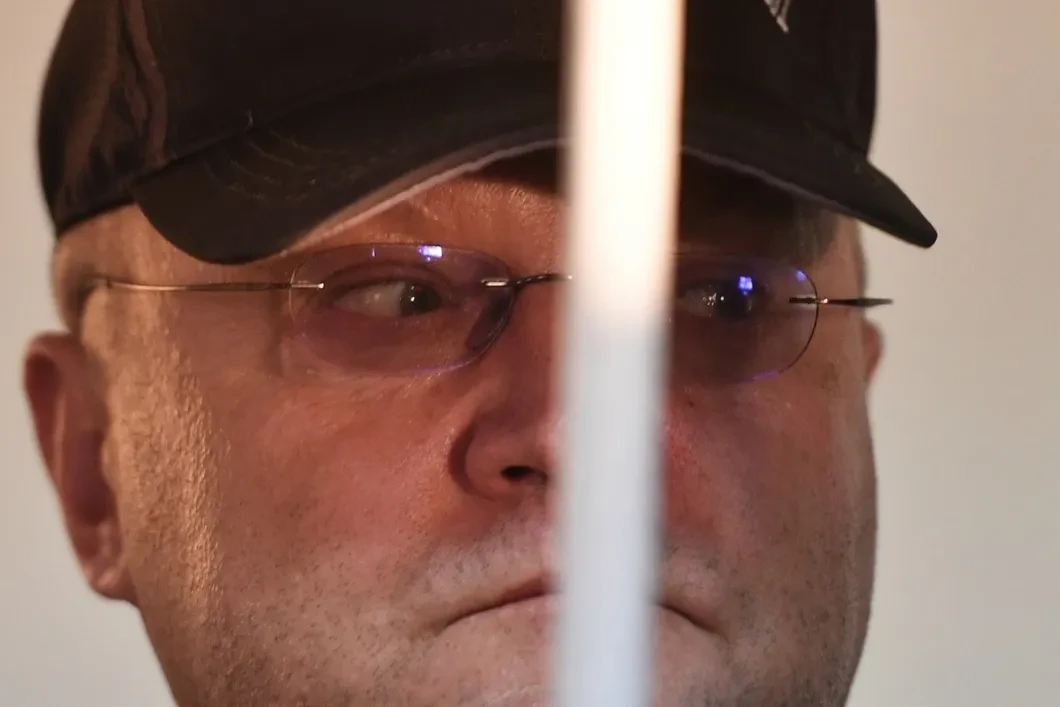
- I read the indictment on the Gaiser - there are more than two thousand pages, and over the course of the first 400 the investigation transfers who was familiar with whom - creates the “criminal community”. But there are very entertaining pages: it is narrated how the Komi leadership bought the press and organized the elections for stolen money ... And what other money could this be done?
- For the same actions, one boss will give a medal, and the other will send him to prison. Due to the confusion of the legislation, any activity in the economic sphere can be interpreted as illegal, not to mention the fact that any position until some point implied elements of “feeding” through participation in corruption schemes. There are funny examples: the Deputy Minister of Energy Vyacheslav Kravchenko was accused of embezzlement of a couple of millions of rubles by fictitious employment of his acquaintance. But what was considered innocent pranks yesterday can today fall under a new double standard of election enforcement, led only by power structures.
- Your colleague Alexander Kynev proposed the periodization of management methods in Russia Putin for the heads of his administration. The “Surkovsky” period was characterized by the creation of a “party in power”, cooptication of supporters into it, which gave them certain advantages and immunities. Under Volodin, party science ceased to play a role - the authorities passed to the resolving of conflicts using complex multilateral agreements. And under Kiriyenko, these agreements also lost their meaning, since no guarantees act: as an example, Kynev gives Pavel Grudinin, who favorably shifted Putin’s victory in the elections, and the Duma mandate was blocked for him, and well (returning to the topic of repressions) if all this does not end for him by criminal proceedings.
- I agree with the periodization of Kynev with the amendment to the fact that the figures of the heads of the AP do not create an era, but only personify them. They themselves are a product not so much the country's political development as the lack of its economic development. I also think that today, largely due to the fact that the funnel of repression is already spinning on its own, we have come to the crisis of normativeness: not only in the sense of written laws (it is already uncomfortable to talk about them), but also in the sense of “concepts”.
- And then what happens on the bench?
-Some kind of rampant flight is not observed. An example of Abyzov shows everyone that you will have to run far and throwing property.
In addition, the spare bench is formed according to the principle of loyalty, not competence. Недостатка в «сменщиках» Кремль пока не испытывает, свидетельством чему стали мартовские отставки глав сразу пяти субъектов Федерации — с их последующей заменой новыми людьми, которые теперь выбираются чаще всего не из коренных жителей соответствующего региона. Все эти отставки, которые, в общем, тоже являются дисциплинарными (но и финансовыми) репрессиями, создают иллюзию управляемости в коротком горизонте, но угрожают ее потерей в более далекой перспективе. Одни и те же «грабли»!..
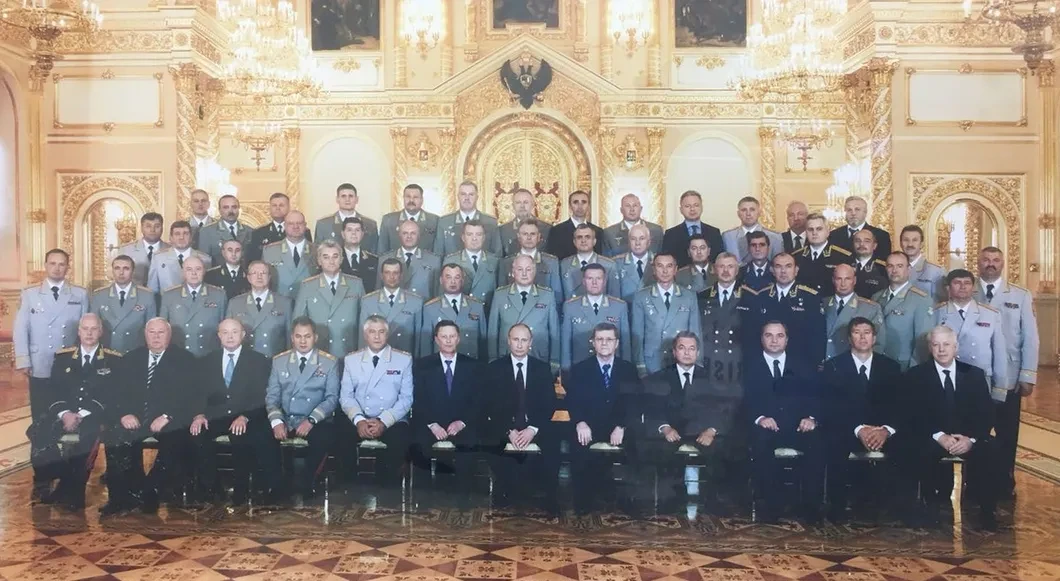
— А как на эту «борьбу с коррупцией» реагируют «народ»?
— Власть, управляющая и крупными медиа, эту тему особенно не педалирует — понимает, что демонстрация исподнего приближенных не поднимает и ее собственный престиж. Опросы общественного мнения показывают, что на федеральном уровне оно более или менее заметило арест Улюкаева с «колбасками» Сечина, массовые чистки в Дагестане и поражающую воображение сумму, изъятую у полковника Захарченко. Все остальное существует как фон, что вполне устраивает власть, тем более что
конкретные адресаты «сигналов» их отслеживают и сразу прижимают уши.
— Существует ли солидарность в элитах, позволяющая им противостоять репрессиям?
— Практика обращений к президенту только усиливает впечатление того, что только он обладает правом миловать, а следовательно, и казнить. Попытка солидаризироваться была предпринята только в отношении Кирилла Серебренникова — но это особая статья, потому что и элита особая, какими-то серьезными ресурсами не обладающая, и на ее фокусы можно смотреть снисходительно. Серьезные игроки деморализованы и не решаются поддерживать друг друга: власть и силовики тут смогли сыграть на опережение, раскрутив маховик до того, как возникла солидарность. Атомизировав элиту, репрессии разрушили базу и для возникновения такой солидарности в будущем.