
Translated material
About the most important thing
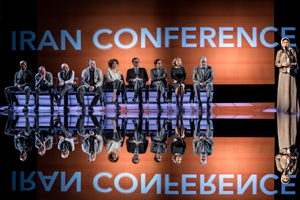
I did not have time to write an article about the Iranian Conference before a fire in Notre Dame. Before the tragic evening of Monday, I had a lot of questions for the play and the performance. It seemed that Ivan Vyrypaev wrote a too didactic play, and Viktor Ryzhakov could not fully translate it into a lively and convincing theater language. “After Notre Dame” I see for the didactics that depth of questioning that turns the play into a passionate and possibly necessary preaching today. The passionate coming and the sermons that we read in the last days on Facebook directly continue those that the talkative characters of the Vyrypaevsky play are conducting. The event also stained with an unthinkable symbolic force and the perception of the performance seen on the eve of the performance - but not everything in it explained.
* * *
Since Vyrypaev and Ryzhakov, in the play “Oxygen”, a new way to talk about the longing and loss of a modern person in the world of post -truths, both have come a long way. Ryzhakov is still fascinated by the God-seeked Vyrypaev and finds in his uneven, contradictory and fulfilled paradoxes of theology some hope for the theater and himself. Trying to get out of the postmodern trap, he, following the Vyrypaev, is looking for a way to "speak with his heart." At the same time, both seem to be well aware of what this linguistic design means after Vladimir Sorokin’s novel “Ice”: today the right to “speak heart” to a certain extent is “redeemed” by manufacturers of a cheap nationalist and quasi -religious product. By the way, Eduard Boyakov, with whom they created the Practice Theater, was captured by a sentimental gaze at the Sorokino novel and was convinced that the formula “speak with your heart!” It does not have an ironic, but pathetic-inviting meaning. However, maybe it was?
The epigraph to the “Iranian Conference” Vyrypaev took words from “Hamlet” about Denmark-Tourm and the polemic statement of the Apostle Paul “So, are we destroying the law by faith? No way; But we affirm the law ”(Rom. 3:31). But the semantic volume of the epigraph seemed insufficient to the playwright, and he added to him an extensive fragment of the poem of one of his characters, the Iranian poetess Shirin Shirazi, about a boat floating along the river without any meaning.
With this intonation, “Conference Participants” at the capital's University of Denmark and begin to talk about the problem of the Middle East, Iran and the modern world, sharply unfolding it towards the search for the “Divine in themselves”. They include the most personal motives, death and existential loss. Shock helps them go beyond the pragmatism of Western civilization to the search for God: they try, each in their own way, to describe how the world in which God is, differs from the world in which He does not have no. The voice of Emma Schmidt-Paulsen, the wife of the Danish Prime Minister, heading the charity fund, is woven into this passionate sermon. She is played by Svetlana Ivanova-Sergeeva (in another composition of the performance-Ingeborg Dapkunaite), carefully withdrawing the Vyaz of the Vyrypaev play infinitely circling around the same words. The seriousness and pathetic with which she expresses envy of the inhabitants of the poor Peruvian village, who knows how to feel happiness, borders on parody.
Reflecting on the purity of the genre, about the forms of a high tragedy or comedy that reveal the relationship of the hero and God, about the need for movement from postmodern to revival, dug, he came to a didactic sermon, whose straightforwardness is as attractive as dangerous.
Counting the last hours of the dying civilization, Ivan Vyrypaev with hidden sarcasm constructs the speech of a liberal lady-selbrity, tearfully and heartbreaking the story of his insight:
“And there, inside me, there was no happiness that I saw in them. And the worst! I don’t know, maybe I’m making some mistake now, that I say this, I hope that my husband will understand me correctly. There, inside me, there was no love that they had. I looked into myself, and I honestly didn’t even understand - why do I live at all? I read all these books about evolutionary development, about unity with space, about the fact that we are all a single whole. But the joy in my heart is no longer becoming. ”
Professor Daniel Kristensen and Theologian Oliver Larsen, everyone in his own way meets with a situation of intolerable loss, finds that “there is something more” than the “consumption structure”, “love”, “joy” and, of course, God are added to this formula.
Drypaev would not have been himself if he had not set towards this spiritual lifting rhetoric tough questions of those who feel differently. Journalist Astrid Petersen (I saw a performance with Marina Drobosekova, in another composition this role is played by Ksenia Rappoport), working in hot spots, or political scientist Magnus Thysen (Alexei Vertkov plays him with Anton Kuznetsov) indignantly reject conversations about the “divine” when the world discussed daily. A person, and the so -called spirituality of small or special peoples (“Russians also love to talk about their spirituality”) becomes just a slogan who covers his swagger and irresponsibility.
* * *
In the Vyrypaevsky play-patron, the party was played between the seekers of spirituality and the critical adherents of humanism and democracy. But the severity of this dispute is reduced in a preceded victory. Having burned and listening to different ideologies and voices, the author tries to recreate the discussion fabric of the modern world. But his endlessly speaking characters are not so much people as principles, views, ideas; All of them are a little fake. Cutting and glued from words, they do not allow to go to the end with them through a paradox, confusion and hope, according to which the playwright seems to want us. In the final, the Iranian poetess Shirin Shirazi, the Laureate of the Nobel Prize in literature, enters into a conversation about love and God. She talks about how she first loved and how her lover began to supplant her herself in her, with every moment - more and more:
“There, inside me, henceforth was only he - my lover, there, inside me, was only love. I felt that tears of happiness flowing on my cheeks. ”
These words refer to the revelations of the mystics of all faiths, to the description of divine love. Losing freedom in the world of the ego, the heroine finds her in God. This is happiness. This is deep knowledge. This is what gives the East a muffled rational West that has lost God. Words turn around, circle over the stage. The beautiful Ravshan Kurkova (in other compositions, the essence of other versions, the performance of the heroine is played by Chulpan Khamatova and Nelly Uvarov) imperiously and bewitchingly speaks of this love ... which she, Iranka, knows - unlike her Western listeners.
But then I have a gap of the template, and something does not fold in my head. Instead of rushing on the waves of this magical and comforting knowledge, I begin to hear my native swagger. After all, when Notre Dame was burning, and I had a vile thought that this is retaliation for leftist populism and godlessness, which covered French society and the Western world as a whole. So the Vyrypaev play is arranged so that the conclusion is quite easily born from it: they are soulless, and we (well, not we - Iranians) are spiritual.
The bell has long been calling for all of us - but not this thought falls into the focus of discussion at the Iranian Conference. However, not in concrete thought, the matter, but in the form of narcotic word production, which resembles affirmations or NLP sessions. Perhaps, possess the characters of the play by some deeper makings of humanity, it would be easier for actors to build a trembling, tender, full of love and understanding with them that it becomes painful and light from the truth of walking.
* * *
The scene of the play is the universal Hamlet Denmark-Türma, and the hall for scientific conferences at the University of Copenhagen-only for the averting of the eyes. That is why the strange constraint of the space invented by Nikolai Simonov: somewhere in the distance-a grate that shove on the screen is a luminous grate on top. Initially lost in the anonymity of the screen, the actors flow one by one onto the stage, so that, having pronounced their monologue, take a place in a long row of seats. The performance was invented by Viktor Ryzhakov and Khudruk of the National Theater Evgeny Mironov as a promotion, where brilliant Russian actors (who were almost three full compositions!) Talk about the crisis of Europe, about the devastation of modern man and the ways of salvation. That is - about the most important thing.
The hero of Igor Gordin Daniel Kristensen, professor and activist of the International Islam movement, for some reason is embarrassed when he is called a Muslim, and we do not understand why. He creates a portrait of a person who is used to “taking”, “get”, “acquire”: Gordin tries to sympathize with his character, but sympathy comes out from him somehow tricked as the secret “Islam” of his hero (and with him the “Islam” of thousands of modern Europeans, who chose Islam as an alternative to their consumer paradise). Before us is a critical statement about a certain type of European intellectual, busy with a delicate and soft intonation of Gordin.
The words of the pastor “we went crazy and, under the guise of freedom, turned our life into an abstraction” describe the technique in which Mironov created his role.
His thought is picked up by a professor of theology Oliver Larsen. In the performance of the avant -garde of Leontyev (Ilya Isaev and Yuri Stoyanov play in line with him) is a certain generalized type of European scientist, a theologian for whom God is his science. Leontiev plays softly and accurately. And, of course, ironically: it is a bell ringes anxiously and demandingly on them. For them, not for us.
Excellent work, an acute clash of different types and discourse, finally, the very theme of the irreconcilable war, which is conducted today by the “principle of God and the principle of Coca-Cola,”-all this sometimes captures strongly. But, reflecting on the purity of the genre, about the forms of a high tragedy or comedy that reveal the relationship of the hero and God, about the need for movement from postmodern to revival, digging came to a didactic preaching, whose straightforwardness is as dangerous as it is dangerous. In the "Iranian Conference", didactics supplants the character so that you can do without it.
The screen broadcasts the speaker’s close plan, whose face is double, flickers, accompanied by unceasing interference. In this flicker, some kind of paradox, volume trembles. But in the play that I saw, only in Evgeny Mironov this volume was filled with living water to the very depths. And it did not care what part of the intellectual and political spectrum is occupied by his hero, the pastor of the Evangelist Church, Father Augustine. A conservative supporter of tradition, implacable in relation to modern art, refusing fans of the Pussy Riot group in a speech in the church, he says words from which it is impossible to dismiss.
But the thing is not in words. Some kind of serious pain stands behind these words-and takes personal responsibility for them. And with his work it proves that psychological realism (or, in other words, a loving, understanding, rescuing an actor) is an indistinguishable and important way to talk about all the errors of man and the world. In front of me was an actor, resolutely merged with his character. Not condemning him, not hidden behind the mask, arrogantly and subtly. Not building a wall of brilliant detachments with him. Accepted completely, with all his unknown, but felt by the volume of fate and pain.
The words of the pastor “we went crazy and, under the guise of freedom, turned our life into an abstraction” describe the technique in which Mironov created his role. Everything that sounded in the play as moralism, rejecting the “Coca-Cola principle” in the name of the “principle of God”, has become a living fabric of human life, only connecting to which one can think of the most important thing.
Subscribe to the COLTA.RU channel in Yandex.Zen to miss nothing