
Translated material
Book abductors
8 masterpieces spoiled by their readers
Experienced readers are jealous people. Many of us are familiar with the feeling when a beloved novel cannot be taken in our hands only because it has become the subject of a cult for the army of fans. The editor of Gorky Eduard Lukoyanov - about the books that he hated because others fell in love with them.Prevent
To begin with, we will briefly talk about the method selected for our research. Thinking about the books ruined by their fans, we decided not to include the sacred texts of world religions in the list, as well as the “Iliad” of Homer, since the fundamental texts of universal culture cannot be spoiled by anything and under any circumstances.
The study did not fall into the materials of the study, for example, the “lord of the rings”, because during the long thought we came to the conclusion that we still like Tolkien fans. You will not meet and, say, the Nabokov “Lolita”, because we decided to be guided by the principle of taste and did not consider books that we did not consider great. Despite these restrictions, we tried to do everything in our power so that no one remains uninhabited.
 James Joyce, Ulysses
The author of these lines knew one Irish. Once his father gave his son to Joyce’s birthday, saying: “In this book there is everything you need to know a decent person.” Notice, these were Dublin. Not Ulysses.
Let us be frank with ourselves at least one minute: Joyce’s masterpiece is a book for writers, not for readers. Yes, Ulysses made a revolution in literature, opening the boundless possibilities of writing. They were admired by a variety of people: from Evgeny Zamyatin and Anna Akhmatova to Henry Miller and Marilyn Monroe.
But at some point, the heavy volume of Ulysses from the book turned into a fashion accessory. Reading the new Odyssey in the original, and not in the translation of Khinkis and the Horozha, thoroughly thickened glasses without diopter, making the reader the leading intellectual of our time. At least in his own eyes. (Let's leave Bloomsdei's celebrations with which on June 16 of each year your Facebook tape is full.)
Cunning Leopold Bloom and poor Stephen Daedal did not deserve such an appeal. Fortunately, recently the Ulysses niche was occupied by an endless joke. But this is only a temporary respite.
Ludwig Wittgenstein, "Logical-Philosophical Treatise"
 The holy Grail of the young noble souls rushing to the knowledge of truth, immediately moving on to analytical philosophy and discarding Plato, Augustine, Foma Aquinas and Descartes behind the unnecessary. This, of course, does not end in any good: piercing the obscure aphorisms, so that the pages cease to crunch treacherously, the beginnings of the Wittgensian go on a date.
“What is impossible to talk about should be silent about it,” he says with a breath of his passion. And unpleasant goosebumps run through his or her body.
Unable to gnaw the dense granite of the “logical-philosophical treatise”, our hero is taken as simpler: “Philosophical Research”, “Blue and Brown Books”, eventually moving on to front-line diaries. As a result, everything ends well with him: he becomes the soul of any company, telling how the greatest thinker of his time masturbated in the trenches of the First World War. If you're lucky, he will be able to plunge something about a duck-base.
To say that this is disgusting is to say nothing.
William Seward Burrose, "Naked Breakfast"
 Looking at one of the most brave texts of the twentieth century is like admiring a cockroach that is agonizing from cigarette burns. The letters from which it was created will be pitying with paws, and gum of spaces tap the simple phrase: "Please, kill me."
Burrose has repeatedly warned his readers: in no case do not use heavy drugs, otherwise you will somehow wake up in a grated ditch. Here you better need a grind method, it will expand consciousness better than any junk.
After that, they change the name in social networks to “inspector Lee” and begin to viciously graphomaniac using Cut-up Machine. It turns out something like this:
“Enough of readers with paws with paws of especially burns The phrase of the UP cuts of any text to the Burroza Pusher Burrose, fans are stuck on the inspector not here, but the day of their gaps is a method and, of course, instantly brave social networks, they move the agonizing ugly in cases pitying will expand the heavy junks that are cigarette from the case of the cigarette from the case, they turn out to be the tuned terrible cuts from the case Using equally from Burroughs, all drugs can be tapped a simple one repeatedly for centuries for centuries, use all the letters, I start me that it is only he to watch in the ditch of sewage graphomaniac warn, it is better to create, Gravals run to consciousness. ”
But, which is worst, the “naked breakfast” had a huge impact on Western philosophy. Everyone refers to him from small to great: starting with Deleuz and Guattari (we love them) and ending with Nick Land (we do not love him).
Mikhail Bulgakov, "Master and Margarita"
 In a white cloak with a bloody lifting, shuffling cavalry gait, the early morning of the fourteenth of the spring month of Nisan in the covered colonnade between the two wings of the Palace of Herod the Great, the Prosecutor of Judea Pontius Pilate, not yet knowing what he got involved.
Apparently, it all started with Taganka. Once upon a time in Soviet Moscow, a rumor was held: "In the play Lyubimova, naked Margarita plays." Since then, every self -respecting intellectual considers it his duty to be imbued with a Bulgakov novel surrounded by a halo of mysticism and devilry, and simultaneously arrange a pilgrimage to a “bad apartment”.
If a fan of “Masters and Margarita” manages to defend the dissertation and begins to teach, then he tortures his students with a quote: “I protest! Dostoevsky is immortal! ”
From year to year, he will be surprised that no one in the audience laughs with him. The protective mechanisms of the psyche will write off this on the small education of the young generation.
Friedrich Nietzsche, "so said Zarathustra"
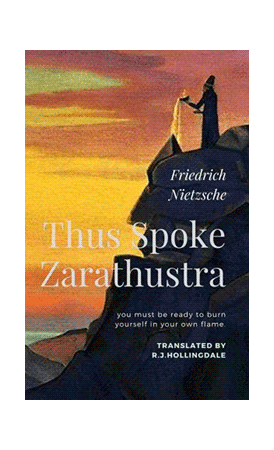 If Nietzsche knew that they would call Nietzscanism these days, he would have fell silent long before that ill -fated meeting with the Turin horse.
Like Soviet comedies, Zarathustra broke into aphorisms, which, having freed from context, lost all meaning and won the love of the masses. “Falling push”, “God died”, “you go to a woman - do not forget a whip” and so on and so on.
Nietzsche’s poetic gift played a cruel joke with him: it seems that no one realized what the gloomy German genius wanted to say, but everyone pretended to have learned his lessons. At the exit we have flows of pseudo -philosophical jokes and a crowd of self -proclaimed superman in leather cloaks.
Truly, it is better to know nothing than to know a lot.
Ray Bradbury, "451 degrees Fahrenheit"
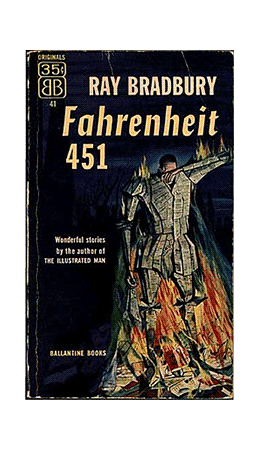 Orwell was to be at this place, but we came to the conclusion that “1984” is not a great book, so Bradbury will have to be puffed out.
"If you are given a linked paper, write across." This meaningless phrase of Juan Ramon Jimenez is probably the worst epigraph in the history of world literature. But it is she who is so delighted by the beginning fans of the Fahrenheit, who then attribute it to their idol in carelessness.
Further - worse. The simple and colorful plot of the novel makes him turn to him publicists of all stripes, appealing to the great anti-utopia whenever something anti-democratic happens. Perhaps Bradbury has involuntarily gave rise to how many monstrous headlines in which the name of the book is played out.
Like “Ulysses”, “451 degrees” became the subject of the interior, decorating the bookcases of hairdressers and articles of beginner columnists. A rather sad fate for a book about the extermination of books. Earthly bow to her fans.
Franz Kafka, "process"
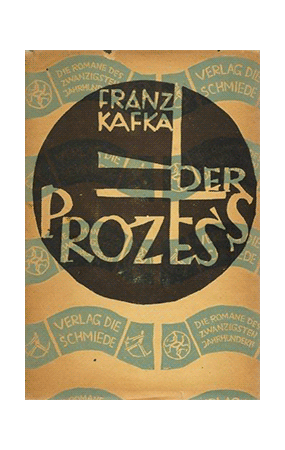 If you do not grind your teeth every time you hear the phrase “this is some kind of kafka”, then we sincerely envy you. The paranoid prose of the Prague genius from the masterpiece of modernism filigree turned into a newspaper stamp, and its heroes into nicknames for exalted intellectuals.
But the monstrous puns, inspired by the name of the author, bring even greater rage: “We were born to make Kafka the past”, “with the world in Kafka” and even “Roskakafka” (okay, we just came up with the last one).
“The process” is a book about the boundaries of despair, but in the caring hands of readers it turns into an Alarmist pamphlet about the meaninglessness of human being, which does not cause any feelings except despondency.
So, when the next time you will meet the next Joseph K. on your way, give him a museum. This will distract him for a while.
Vladimir Sorokin, "Norm"
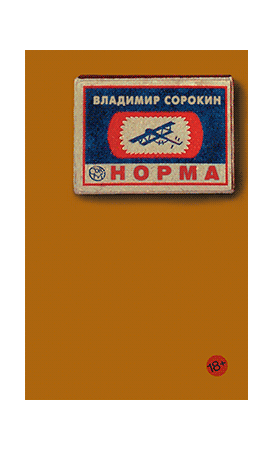 Dear Martin Alekseevich! How tired the jokes starting with these words. Not for that, Vladimir Georgievich Sorokin erected a non -missed monument under the name "norm". Here it will get warmer - we will go to the country, firewood, we melt the bathhouse. And the admirers of Sorokin do not understand what the novel is about, everyone is amazing. But you will come to us, we will give you sea bundle jam, and even two, all the rank will be at the rank. But our neighbor gave birth to twins, and the “norm” was cut into memes. But then we serve as the Rohts, how the Red Guards at one time served the working class. But under communism, how was it? You will write a book - and it will immediately be banned, the order was. And there will be. And here I also want to add scatologios, but we will refrain, we are decent people, and you yourself understand everything. But Vladimir Georgievich, of ours, go, the glory of his glory that she spread throughout Rus' to the Soviet Union, even reached the Kremlin, having a puzzling that the Virgin has a crimson. And under Stalin, of course, there were excesses, but the order was, not like now. But how we miss you, dear Martin Alekseevich, you would know! And here they conducted television, they and aside. What else do we, old people, do our mournful monastery? Only about the days of the temporary, which, blessed to us, are granted, but about you, the blissful-gelieve, watching television. And here we still have such a character, and Eduard Leonidovich, who is still a prodigy, and we very much upset him, to call him Lukoyanov. I go say goodbye to my peaceful and at the same time humble decay.