
Translated material
Memory. Boris Schukin
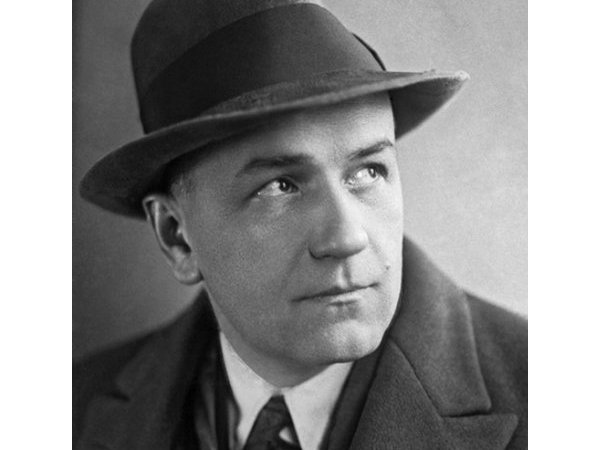
April 17, 1894, actor Boris Schukin was born
Personal business
Boris Vasilievich Schukin (1894-1939) was born in Moscow in a family of an employee. He spent his childhood and youth in Kashira of the Tula province, where his parents moved shortly after the birth of his son.
After graduating from the elementary school, Boris was taken to Moscow, where his father arranged him at the Private Real School of Voskresensky. At the age of 14, the boy was seriously carried away by the theater, tried not to miss a single premiere in the artistic one.
Schukin graduated from the school in 1912, got a job. In the same year, at the Kashira station by the local branch of the Society of Trustees on popular sobriety, an amateur theater was opened, where he played his first roles.
In 1913, Boris entered the mechanical department of the Imperial Moscow Higher Technical School, which at that time was one of the largest higher technical institutions in Russia.
A year later, the First World War began. In the early fall of 1916, the tsarist government drafted into the army of high school students of higher educational institutions. After graduating from four -month -old training courses at the Moscow Alexander Military School, Schukin received the title of ensign, and in December 1916 he was sent to the service regiment, stationed in Saratov, where the soldier taught. Even in the army, he did not leave a love for the theater and in his free time he performed on local theater scenes.
In the fall of 1917, already under the Provisional Government, Schukin was sent to the front in the Kalishi border regiment.
After the conclusion of the Brest Peace in 1918, Schukin was demobilized. He did not go to Moscow, deciding to wait out the Time of Troubles in the quiet Kashira. At first he worked as a locksmith in the railway depot, then he became an assistant to the engineer of the steam locomotive. And in the evenings he played in an amateur theater studio at the depot. In less than two years, he played more than a hundred roles, and in some performances the number of his roles reached 4-5. The game of the young provincial was seen by one of the actors of the Art Theater and spoke about the young promising actor Evgeny Vakhtangov-at that time the head of the Mansurov studio, who in 1921 became the 3rd Moscow Art Theater Studio, and since 1926-the theater named after Evgenia Vakhtangov.
Soon, the local department of universal military training accepted Schukin as a former warrant officer to work for the position of instructor. In August 1919, he returned to the military service in the Red Army, receiving the appointment of senior instructors at the 2nd Artillery Brigade to Moscow to Moscow.
In 1920, Boris Schukin entered the drama studio led by Evgeny Vakhtangov, but in the first months he combined his studies with the military service (Schukin received permission only in 1921). At the end of the studio, he was admitted to the troupe of the theater. Vakhtangov.
Vakhtangov’s aesthetics had a great influence on Schukin's work - its bright theatricality, irony, and the proximity of folk Buffonade. In the early years, he played in the performances that were far from politics - “Miracle of St. Anthony” by M. Meterlin, “Wedding” by A.P. Chekhov, “Princess Turandot” K. Gotszi, “Leo Gurych Sinichkin” D. T. Lensky.
The turning point in the fate of the theater of Vakhtangov was 1925, when the first performances on Soviet plays began to be staged here. They were dedicated mainly to the heroism of the Civil War and the formation of a socialist state. Schukin perfectly succeeded the roles of rustic, but hotly devoted to the new business of people. The actor was noticed by the Minister of Culture by Anatoly Lunacharsky.
Gorky "Egor Bulychov", set in 1932, was not only a star hour in the directorial biography of Vakhtangov, but also a turning point in the life of Boris Schukin, who played the main role in the play. Both the production and the performance of Bulychev Schukin really liked Maxim Gorky, who subsequently insisted that Schukin were entrusted with playing the role of V.I. Lenin in performances and films that were preparing for the 20th anniversary of the Victory of the October Revolution.
In February 1936, a competition was announced to create a film about Lenin for the anniversary of the Great October Revolution. The competition was personally supervised by Stalin, the commission included the leading filmmakers of the country.
Before that, the only films of Lenin on the screen were shown by the dumb films of 1927 “October” by S. Eisenstein and “Moscow in October” by B. Barnet. The role of Lenin was played by the Ural proletarian V. Nikandrov, who outwardly was very similar to the leader of the revolution and even did without any makeup. However, the audience was disappointed with the game of unprofessional artist.
In the era of sound cinema, a new screen embodiment of the leader was required.
The topic was risky, because before that the images of Lenin, Stalin and other leaders of the revolution did not appear in the feature cinema. In addition, there was a terrible 1937 in the yard. It was necessary to create the image of Lenin in such a way that, on the one hand, to show that this is the leader of the world proletariat and at the same time the “most human person”, and on the other, it was impossible to overdo it so that Stalin would not seem too small compared to Lenin.
At the same time, Alexei Kapler and Nikolai Pogodin began to write scripts for the competition.
Pogodin's script “November” (later “man with a gun”) was aimed at a demonstration of the human qualities of Lenin. The playwright carefully worked out the Leninist manner to talk, ask questions, joke and laugh. However, this approach did not find understanding among the organizers of the competition. In the conclusion of the Main Directorate of Cinematography (GUK), it was said that the Leninist episodes did not fully reveal the historical role of the leader and incompletely transmit the breath of the "unforgettable, formidable days of the Great Proletarian Revolution." The task - “show Lenin in all the power” - the author only set, but did not realize, the reviewers considered it. Pogodin had to remake the film script “November” into the play “Man with a gun” and satisfied with its production on the theater stage.
The director of Kapler’s painting with the working name “Uprising”, which was launched at Mosfilm, was appointed young Mikhail Romm, whose films “thirteen” and “pier” have already managed to appeal to Stalin.
Boris Schukin was approved for the role of Lenin. And although at first he refused, this work became the most important in his creative biography.
Simultaneously with the filming in the film, which was released called “Lenin in October”, Schukin played the role of Lenin in the play “A Man with a gun”, which was set by Ruben Simonov. And since Lenin was one, many hours of rehearsals in the theater were replaced by evening hours of Rommel.
At the same time, the actor felt by this time, according to the memoirs of Mikhail Rommy himself, is no longer very good.
Boris Schukin died of heart disease on October 7, 1939 at the age of 45. Death interrupted his work on the roles of Gorodnichi (“Examiner”) and Kutuzov (“Field Marshal Kutuzov”). He was buried in Moscow at the Novodevichy cemetery.
What is famous
Schukin was one of the first Soviet actors who embodied the image of V.I. Lenin. The film "Lenin in October" is the first sound film of Soviet Kinoleninian, one of the most famous Soviet paintings, which was regularly broadcast on Soviet television. Despite the strong politicization, the film was very popular, there were more than one generation of Soviet spectators on it. As a result, Lenin, as Boris Schukin embodied in the paintings “Lenin in October” and “Lenin in 1918”, became a kind of stencil, according to which the artistic images of the leader of the world proletariat were created in the future.
Schukin was remembered by the film and viewers as an “actor of one role”, however, a significant stage in the development of the Soviet theater and the images created by him on stage: Yegor Bulychev (“Yegor Bulychev and others” Gorky), Pavel Suslova (“Virinea” Seyifullina and Truth), Polonia (“Hamlet” Shakespeare).
What you need to know about
Sogdan in 1937 the film "Lenin in October" was shifted several times - in 1956 and in 1963.
After the death of Stalin and the exposure of the “personality cult”, corrections related to the criticism and reassessment of the role of Stalin in the events shown in the film were made in the picture.
Mikhail Romm seized the scenes in which Stalin was one of the main characters (for example, a meeting with Lenin upon arrival in Petrograd, dialogue of Stalin and Vasily), reduced the explanatory credits about the "lasting four hours of the conversation of Lenin and Stalin."
In 1963, when “restoring” the already abbreviated version, corrections were again made to the film: through various technical tricks, Stalin was completely removed from the film - it was blocked either by the characters and a table lamp in front of the screen. Mention of Stalin in those scenes that could not be removed were re -sounded. So, for example, in the initial version, Lenin entrusts Vasily: “Run to Stalin and Sverdlov” - and in the 1963 version he says “Run to Bubnov and Sverdlov”.
It was this version, published in 1964, showed in the USSR on television until the end of the 80s. It was published on video cassettes and DVD.
Direct speech
Mikhail Romm about Boris Schukin: “Maybe the most powerful impressions, I received the largest lesson in human communication from Schukin, from meeting him in work. It’s not that Boris Vasilievich Schukin was my direct teacher, a master of skill, say, although he was huge, he had something to learn. But just humanly he was so unusual, such a kind of piercing, unprecedented person that there was a period when I was just in love with him in a real way. I shone because I saw him, it was amazingly pleased to greet him and look at this unprecedented person. ”
Mikhail Romm on Schukin’s work on the role of Lenin : “Manuilian (a revolutionary who knew Lenin closely, - approx. Redations) said that Lenin had a lot of diverse laughter: sarcastic laughter, good -natured laughter, when he simply flooded, like a child, laughed to tears ... But Schchukin demanded that the Manules show. Manuilsky tried to show. But, you know, a lot of time has passed, and it is not so easy to laugh at another person. It didn’t work out, the Manuilian felt it and said: no I can’t. Then Schukin said: Okay, I'll try. He stepped into the corner of the room, stood his back to us, stood for a minute; Suddenly he turned abruptly, decisively. And you know, I saw a completely different person. Everything has changed in it. And as if the shoulders became wider, the neck seemed to become somewhat shorter. The face has changed, the lips, eyes changed, and mainly the whole spirit of this person. It was completely unexpected. I saw another Schukin. He came up to Manuilian and said:
- You can’t, but I can. - And laughed.
And Manuilsky said:
“I have nothing to teach you.”
Nina Chernova about Boris Schukina in the role of Lenin: “Following the creative plan of Kapler, Romm tried to get from Schukin an almost“ documentary ”approach to the character. Each shooting day of the artist, deprived of even approximate external resemblance to Lenin, began with a long and painful make -up. On the set and abroad, Schukin continued to hone the “leader’s speech”, sitting on listening to gramophone records. Thanks to the artist’s talent and the efforts of the entire film crew, Lenin turned out to be “reliable”, however, not quite similar externally. ”
The critic of “New York Times” Frank Newsphen about the film “Lenin in October”: “First of all, I will note the contribution of the director Mikhail Romm and Boris Schukin, who had handled the task of playing Lenin for the Soviet public (imagine if someone decided that he wrecking this role poorly). Romm preferred to push the revolution to the background, and to the first to imagine the personality of Lenin. Schukin is a genuine miracle of makeup and immersion in the character, his Lenin is interesting, bright and sympathetic to the viewer. ”
7 facts about Boris Schukin
- Boris Schukin professionally owned photography and at one time in his youth even earned a lot of photography.
- Schukin acted not only as an actor, but also tried himself in directing. In this capacity, he took part in the production of the performances: “Temp” by N. A. Pogodin (1930, Council with other directors), “Human Comedy” according to O. Balzaku (1934, Council with Kozlovsky), “Barsuki” by L. M. Leonov (1927, Sovm. With other directors), “Aristocrats” N.F. Pogodin (1935, Com. other directors), and other performances.
- In the movie, Boris Schukin played a little roles. He starred in just four paintings: “Pilot” (1935), “Generation of the winners” (1936), “Lenin in October” (1937) and “Lenin in 1918” (1939).
- For the performance of Lenin, the actor was awarded the Order of Lenin (1938) and the Stalin Prize of the first degree (1941 - posthumous).
- In addition to working in the theater, Boris Schukin also taught at the school at the theater. In 1939, the theater school at the Vakhtangov Theater was awarded his name. So the famous "pike" appeared.
- Since Boris Schur, born in Moscow, spent his childhood and youth in Kashira, where his parents moved some time after the birth of his son, many sources indicate that the actor was born in Kashira. Schukin himself did not remember his early stay in Moscow and considered Kashir to be his homeland.
- In the 1980s, the idea appeared to organize at the Kashira station in a house with a mesonin, built by the actor’s father, the house-museum of Boris Schukin. In 1994, on the 100th anniversary of the actor, by decision of the district council on house No. 25 on Proletarskaya Street, a memorial plaque appeared. But this was limited. The idea of creating a museum remained on paper. In 2013, the house almost settled and in disrepair was burned through the fault of one of the remaining residents.
Materials about Boris Schukin
Mikhail Romm's memoirs about Boris Schukin
Article of Nina Chernova about the evolution of the images of Lenin and Stalin in Soviet cinema.
Boris Schukin on the website of Kino-Theater.ru
Article about Boris Schukin on Wikipedia