Translated material
Seven thousand years of stability

The life of the ancient inhabitants of the modern suburbs in the upper paleolite changed very slowly. Over seven thousand years, ancient mammoth hunters who lived in parking lots in the area of Zarai Kremlin did not change their technologies and everyday life, but the images of large animals that lived in the tundrastep, which covers the lands of the future Moscow Region. How the dwellings of primitive people were arranged and how their sculptures are remarkable, Olga Orlova said in the program “Hamburg account” by the head of the Zaraysk archaeological expedition of the Institute of Archeology of the Russian Academy of Sciences, Sergei Lev .
 Sergey Yuryevich Lev was born in 1975 in Moscow. In 1997 he graduated from the History Faculty of Moscow State University named after Lomonosov. Since 2000, he has been working at the Institute of Archeology of the Russian Academy of Sciences. In 2003, he defended his thesis about the stone inventory of Zaraysk parking. Member of archaeological expeditions in the suburbs, lower Podon, Yemen and Syria. The author of more than 80 scientific publications.
- How did it happen that in the studied and exhausted suburbs, archaeologists were lucky to discover the parking of primitive people?
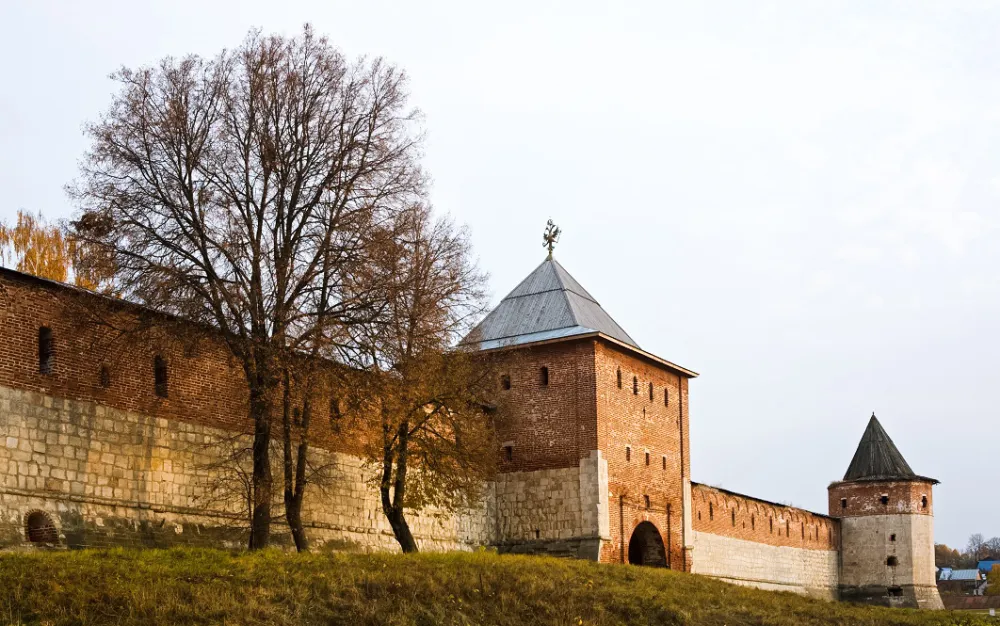
- In fact, the builders of the Zaraysk Kremlin in the 16th century discovered her, but, of course, they could not realize their discovery. Nevertheless, we have evidence that they extracted the bones of mammoths from the ground and threw them back into the Kremlin’s trench.
- They did not understand what they were dealing with?
- Of course, no. They could have their own thoughts, but, unfortunately, this was not recorded in any written sources. Therefore, we have been counting since 1980, when Lidia Ivanovna Maksimova, today the main keeper of the Zaraysky museum, found that the bones of the mammoth are eroded on the slope in front of the Nikolsky tower (this entrance to the Kremlin). She announced the find to the Museum of the History of the City of Moscow, and archaeologist Alexander Vasilievich Trusov arrived. Since 1980, he had excavated at the Zarai parking lot for several seasons. After that, since 1995, the expedition of the Institute of Archeology under the leadership of Professor Hizri Amirkhanovich Amirkhanov took up the case. He attracted many experts who worked at different settlements of the Paleolithic in Gagarino, Avdeevo, Khotylovo, churches - that is, leading Paleolithic expeditions. Hizri Amirkhanovich spent quite a few seasons, a monograph was published in 2000, and in 1997 an international conference was held under the auspices of UNESCO. Thus, Zaraysk has become a rather famous monument.
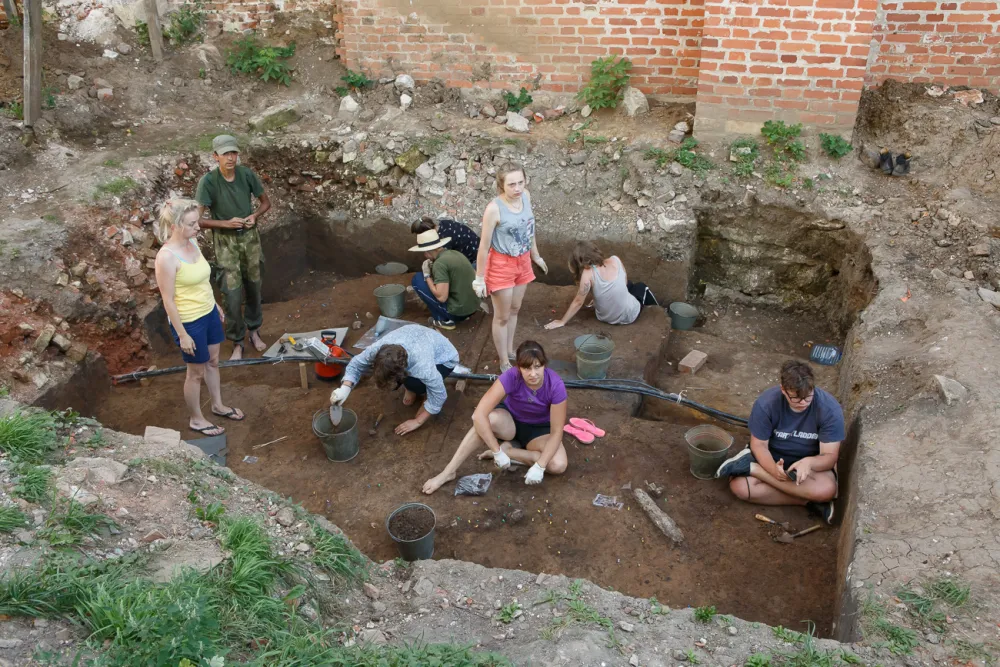
- This is a late paleolitis - that is, from about 23 thousand to 16 thousand years ago. Is it possible to say now how much this parking was, how many people were there?
- A difficult question. Now we understand that Zarai parking is a group of parking lots, settlements. Moreover, as you rightly noticed, we are talking about a large range of time - almost seven thousand years. And spatially, they are also somewhat removed from each other. The parking lots are located on the Kremlin hill, a neighboring hill and further along the River Opestr.
Today we know six settlements. Moreover, some of them are multi -layer. That is, people came and settled in the same place several times for a rather long time. Sometimes they came specifically to the same site, sometimes this site shifted several meters, sometimes several hundred meters. Thus, we know at least six multi-time settlements related to the same archaeological culture, which was called the Kostenkovsko-Avdeevskaya.
- What made them settle in this place again?
- There is no definite answer. However, it is symptomatic that the Kremlin in Zaraysk was built in this place. This is a fairly high hill located above the valley of the Oxeter River. From there, a stunning look opens for many kilometers. It is clear that in the 16th century they watched the Crimean Tatars that attacked the Moscow state, and 20 thousand years ago - at the herds of wild animals: bison, horses, northern deer and, of course, mammoths.
The settlement of the Kostenkovsko-Avdeevsky culture is arranged according to a very specific scheme. In the center of the settlement, at a distance of 2-3 m from each other there is a line of large foci-and, surprisingly, always in the same direction: from the north-west to the southeast. Around them are household pits. And they border this residential platform of the semi -land. There were no dwellings that would be very different from the rest in design or in the nature of the finds, at least we have not yet met.
- Was the fire in the centers constantly?
“We don't know that.” But we know what they drowned. Because coal here is bone. There was quite little wood in the tundrostep. That is, they drowned mainly animal bones. These are large foci-stoves about a meter with a diameter, up to half a meter. They found the so -called focal stones - sandstone and pyroxenitis. It is curious that pyroxenitis is used in modern baths, it holds heat and gives it for a long time. We find foci, covered with bone coal (with a hat).
- It's hard to imagine it now .
- Yes. The glacier was several hundred kilometers. Quite a lot of grass grew into the tundrastep, which served as food to all the ungulates that grazed here.
- It was really easier for hunters to maintain fire to kill the animal and get bones than to cut down a tree?
- On the one hand, yes, because it is precisely the bones of animals that we find in the foci. On the other hand, it was not necessarily killed animals. There were still “cemeteries” of mammoths - mammoths fell into natural traps there. For example, they came for mineral fertilizers - certain salts, clay - and could not get out, because the clay was wet. Another example: in the spring of the carcasses of animals died in winter, it was nailed into the bend of the river, and bones accumulated in these places for millennia in these places. Quite often, people specially settled next to this kind of natural whereabouts. Unfortunately, in Zaraysk we have not found this yet, but we assume that it was, because we calculated the number of individuals by bones and there were several dozen of them - almost 50 mammoths. It is unlikely that all of them were killed by ancient people, because mammoth hunting is a separate complex plot. Thus, we assume that the bones were brought from somewhere and used as fuel.
And here's another curious: we practically do not find the bones of horses, bison, northern deer, which, as we think, were the main source of food. This means that, most likely, the bones were burned. We find literally single remains.
“ Maybe they are burning better?”
“They burn faster.”
- Why did people return? Because of the climate?
- The seasons did not differ from ours, the average annual temperature was a few degrees lower. The summer was very hot, the winter was cold, but low -snow. The climate was sharply continental.
We began to talk about why people returned here. Firstly, they were attracted by a place in itself: an elevated one, with a good review. In addition, we can assume that there was a crossing across the river. At this place on the River Opestot, there is now a dam. And perhaps there were seasonal migrations of animals from north to south. As we know very well in modern Africa, antelopes go north in the spring, south in the fall. Exactly the same situation was in the tundra -steppe on the site of the modern Moscow Region. Perhaps people came here in a certain season to catch animal migration and hunt successfully.
- That is, they, too, went twice a year and came to the parking lot?
“We believe yes.” But clarification of seasonality is an extremely difficult question in archeology. For example, on the teeth of ungulates can be said in which season they died. But we have practically no such bones - literally one bone, the jaw of the horse. Therefore, it is impossible to say for sure. Or here's another sign: in the found foci, quite strongly drowned the walls, firing. That is, the temperature in them was very high, the walls were heated. They have a characteristic saturated-burgundy color. In some cases, there are two or three such burned walls. This may indicate that people returned to this place and cleaned the foci, but did not always reach the original wall. The hearth was pumped a second time, and the second burned wall was obtained. Sometimes between the first and second we see a small crack filled with sand. This means that the season has passed. In winter, a permafrost crack appeared, and in the spring sand washed there. After that, people came and again took advantage of the hearth.
- You said that hunting for a mammoth is a separate complex plot that had to be played every time it was necessary to kill the animal. How did this happen?
- Scientists have long been discussing this problem. You and I can come to the historical museum and see the beautiful panel of Vasnetsov “Hunting for Mammoth”. But, of course, this type of hunt was not used. Because to dig a huge hole in the eternal permafrost, to adjust the mammoth there and make you go down - I think this is somewhat utopian. And in general, our colleagues had doubts that such a hunt existed.
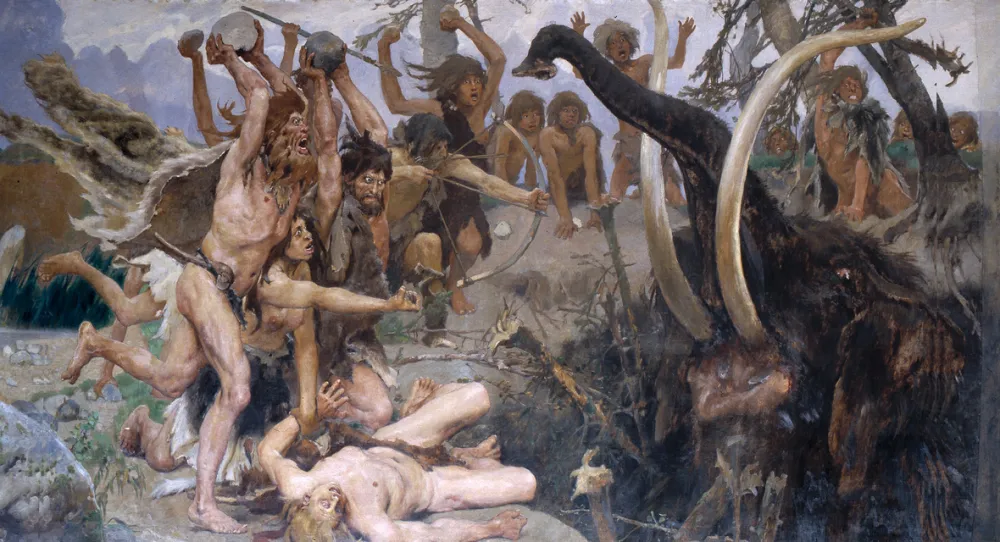
- That is, Vasnetsov invented everything?
- Such ideas about hunting at the end of the 19th century. Today we imagine the situation a little differently. Of course, there was a mammoth hunt, there is material evidence in some settlements: for example, Lugovsky, churches, the Yang parking lot and abroad, in the parking lot of Krakow-Spadzist. There are finds of mammoth bones with traces of tips. In some cases, they even find the remnants of the tips themselves or flint liners in them. Another question is how much the hunt was mass. Because, as our paleontologist says, if the family of mammoths experiences such stress as hunting for it, she simply migrates. And the family of mammoths had a rather large range. Accordingly, people risk not seeing mammoths for a long time. And then, it is physically dangerous. Although we know other examples - modern, ethnographic. The same Bushmen who hunt an elephant amaze with a spear in the abdomen and then pursue a couple of days. But where will this elephant be after it dies? And how much then you need to drag him back to the settlement? Therefore, we assume that nevertheless, the main object of hunting was ungulates, although hunting for those who had fought off the herd, young or wounded mammoths were probably practiced. Tips of copies, darts and arrows made of flint and mammoth tusks quite allowed to inflict serious wounds and kill the animal.
- Was the weapons with which were different for mammoths and for ungulates?
- Unfortunately, we cannot directly judge this. There are arrowheads, copies of copies. Moreover, people of this culture, both began to make them 23 thousand years ago, and continued to do another seven thousand years. That is, there was a stable tradition in the production of material things.
All the guns of ancient people were made of flint (they could then make a bone gun flint). The tips with the side excavation, which were used primarily for hunting, are very typical. The shaft, apparently, was made of wood (since our tree is not preserved, this is only an assumption). We know for sure that there were also spears and darts from the mammoth tusk, and a straightened tusk. At the settlement of Sungir, a little more ancient than Zaraysk parking and relating to another culture, they were found in a burial. These are long, one and a half meter spears, and meter darts. We even now know how to straighten this tusk (initially the mammoth tusks are curved, eight -like). Our colleagues from St. Petersburg Yevgeny Gir and Gennady Klopachev described one experiment. In the eternal permafrost, a well -preserved mammoth tusk was found. It was long soaked in water at almost zero temperature, then the blanks of future copies were cut out of it. They were also soaked for a long time, then straightened, gradually tied more and more tightly to long thick poles (or to a log with a groove), continuing to soak. After the rods from the tusk were straightened and processed with flint tools, they did not lose shape. One such spear is stored in us in the Zaraysk Museum, the other in the Museum “Tsatukes” and the third in the Hermitage.
- It is clear that most of the time people were busy warming up, finding food and surviving. Was they to art?
- I suspect that art in the modern sense of the word was not very relevant for them. Because those things that reach us had a magical, cult significance for them. We can talk about this a little more about this, because at the Zaraysk parking lot in 2001 we found a completely unique thing - a bison statuette made from a mammoth tusk.
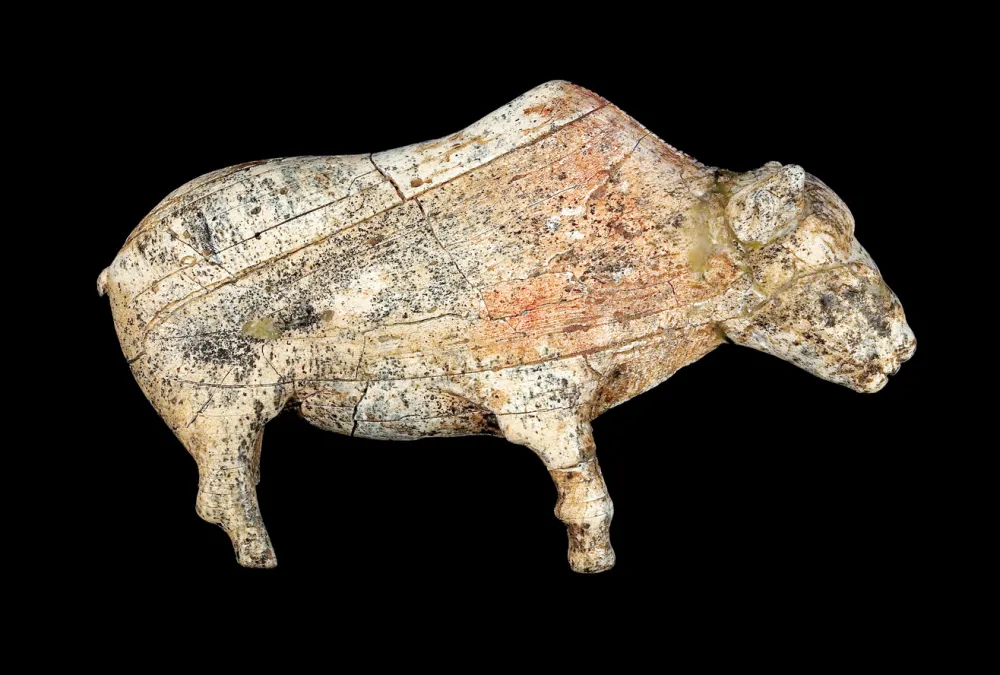
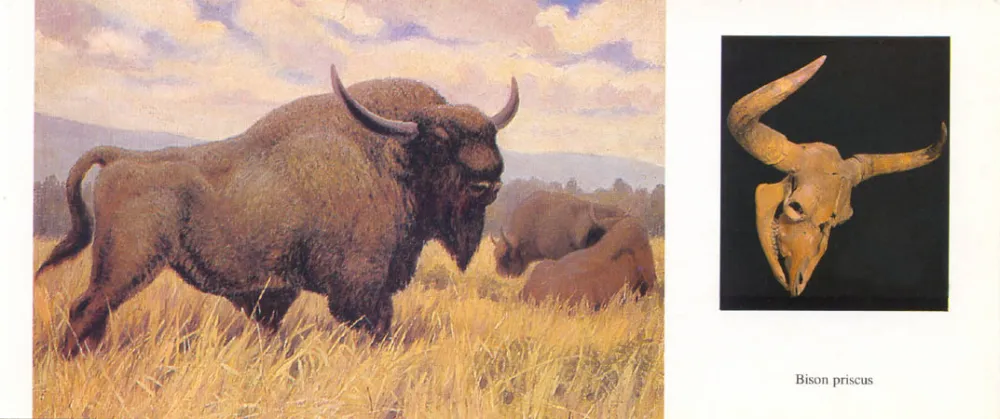
- If this is a bison statuette, then it could be found in the suburbs 1 .
- Moreover, this year we even found the skeletal remains of the bison - the spinal column. And we will continue research next year.
- Incredible beauty.
- You see what naturalism, the realism of the image. How detail the nostrils, mouth, eyes, bangs, horns, ears are worked out in detail. Our paleontologist even confidently speaks of the unbroken female Bison - this is visible by the horns and the general exterior. But at the same time, notice, although four legs were originally made, two are absent. In addition, on the left side there are damage caused by a person.
- That is, he was struck symbolically, so that later he could catch a real beast?
- Yes. Here, of course, a certain hunting ritual is traced. In addition, on the right side, the sculpture was painted with red paint, ocher, possibly symbolizing the flowing blood. A pointed piece of bone is placed in the neck area - perhaps a kind of symbolic spear. And that's not all. The figurine lay in a completely unique context, which is extremely important to us archaeologists. We understand why she was put there. This is a large pit, quite typical for the Kosthenkov culture, 60 cm with diameter, half a meter depth. A special podium was left at the bottom, an elevation of a triangular shape, where there was a figurine.
The pit was covered with red paint, after which a mammoth shoulder was laid on top as a lid. There is what is called in archeology a “closed complex”, a certain hunting ritual is reconstructed.
-First, the parking of Zaraysk-A and Zaraisk-B were discovered, more recently two more - E and F. But these are parking, between which about seven thousand years. How did the life of their inhabitants change? What happened over these millennia? Because for us seven thousand years is a colossal leap in development, change. And how was the ancients?
- The ancients were much more stable. Parking Zaraysk-A is a multi-layer settlement, where the most ancient, lower cultural layer dates from a time 23 thousand years ago. Both he and the following layers contain these classic Kostenkovsky residential structures with foci, dugouts. Then we observe a pause in the settlement. It is associated with the maximum of glaciation, which occurred 19-20 thousand years ago. Then people returned. During their absence, some disasters occurred. For example, permafrost cracks formed, which partly destroyed the layers below.
What we see in the settlement of the third cultural layer (lies above the level of formation of permafrost cracks) is significantly different from the underlying layers. There are no more structures with large foci. Small lens -shaped foci appear. There are no more in -depth dwellings.
After that, about 16 thousand years ago, some warming occurs. We fix it by a change in vegetation (sporo-pyalt analysis). In addition, buried soil is formed, that is, a stable soil horizon at which ancient people settled. This is the final phase of the Kostenkovsko-Avdeevsky culture. And one of the parking lots (Zaraysk-B) is precisely to this period-a single-layer settlement with a completely clear layout.
The material culture has practically no changes. People, as the tips with a side notch made, knives of the Kostenkovsky type (these are very complex guns), and continued to do all seven thousand years. But the structure of settlements has changed. The dugouts with foci disappeared, the dwellings became groundless. Something prevented them from going underground, as before: either permafrost, or a high level of groundwater ...
- So, they did not develop the technology themselves, but at the same time, external circumstances changed so that they forced them to adapt?
- They were not required. Because they were as adapted to the environment as much as possible. They hunted animals, cut them with flint knives, mastered the technology for the attraction of the blades of these knives-and they did not need to develop some special new technologies. However, it was these people who had such skills as grinding, drilling, which received maximum development in a much later era. There are even burned pieces of clay, although they did not have real ceramic dishes.
Sergey Lev
Olga Orlova talked
Video recording of the program:
otr-online.ru/programmy/gamburgskii-schet/anons-sergey-lev-drevnie-ohotniki-na-montov-v-podmoskove-36391.html
1 This refers to the fossil type of Bison Priscus - the ancestor of modern American bison and European bison. Иначе его называют степным зубром. - Ed .