
Translated material
The lords of the rings
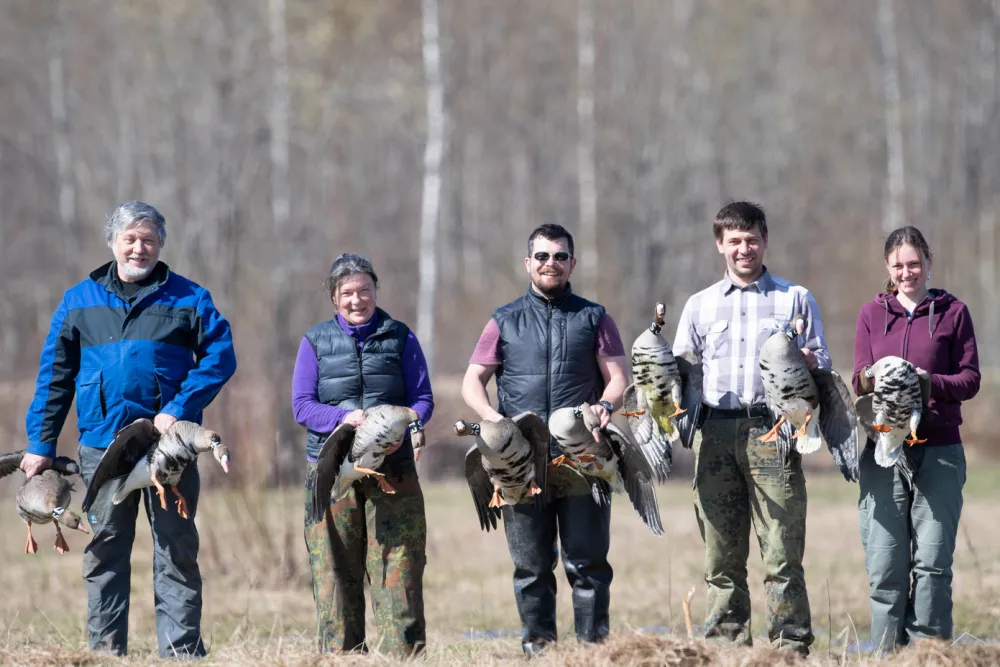


Global networks appeared long before the Internet, and this happened thanks to the birds. For example, kuliki nesting in Taimyr annually perform seasonal migrations on all continents except Antarctica. The study of the routes of migratory birds is extremely important: during migrations they carry invertebrates, seeds and disputes of plants; But in addition, they spread infections that are dangerous to humans - ornithosis, bird flu, salmonellisi, etc., information about the life range of rare species of birds located on the verge of disappearance, as well as on the methods of orientation of birds during migrations, is no less important. Ornithologists from the Institute of Geography of the Russian Academy of Sciences told how they and their colleagues monitor the movement of birds.


Always in touch
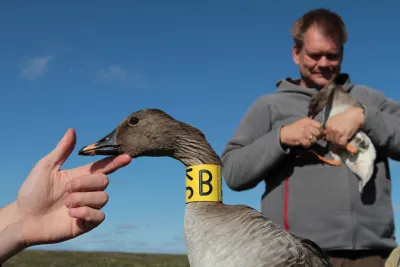
The first scientific method of studying bird migration was announcing. In 1899, the Danes Hans Mortensen began to attach light zinc rings on the paws of starlings. The innovation was that the ring was marked with the serial number, the address was also indicated there. Thus, the bird found (or caught) with a ring knew where to report it, but by number it was possible to identify it. Since then, hundreds of millions of birds have been ringed in the world, in many countries special announcing stations and unified information centers have been created, where return data are received.
Electronic sensors have already been developed that allow us to remotely track the entire flight path of the bird. Location is determined using acceptors. Information about the coordinates of the object is obtained through GPS and GLONASS systems, and transmitted through the GSM network or through satellites. The main restriction in use is the weight of the transmitter: it should not exceed 3% of the weight of the bird.
For more than 10 years, scientists from the Institute of Geography of the Russian Academy of Sciences, together with colleagues from Germany, the Netherlands, Great Britain and other countries, have been conducting research on ways and speeds of migration of various species of birds. This helps to understand how birds react to environmental changes, what role they play in the life of ecosystems, what dangers threaten them during the flight and what threat they can pose for people. Literally online you can see how the rapidly changing climate and economic activity of people affect the birds.
Stop in the clean field
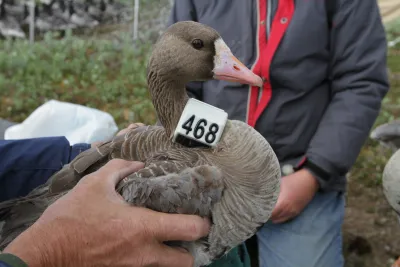
Photo by P. Glazov
During migration, birds may face serious problems. For example, a change in land use can affect the geography of migration tracks and the distribution of places of stops of white geese ( Anser albifrons ). At the same time, a decrease in anthropogenic load is not always beneficial for birds. During migration, geese usually make stops on agricultural lands, next to large reservoirs. In our country, in the early 1990s, the area of crops has been catastrophically reduced in some places. The structure of land use has also changed. As a result, in many areas, places where geese could rest and feed during the spring span. The migratory flock no longer stops in such places, because they overgrown with forest, and birds need a good review to notice the predator in time.
Where to go to Kulik?
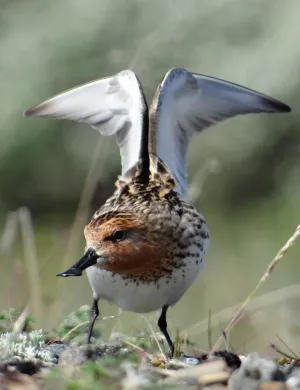
The international working group in Lapatne (SBS TF), which includes Russian ornithologists, with the help of satellite transmitters studies the features of the migrations of Kulik-Lopatny ( Eurynorhynchus Pygmeus ). Kulik-Lopaten-nesting endemic of Russia. It propagates in a narrow strip of seaside tundra from the northern Chukotka to the founding of the Kamchatka Peninsula. These birds are in the first hundred species that threatens disappearance. Few chicks are born, as a result of economic development, bird habitats die, in addition, in the places of wire and in the places of winter (in Southeast Asia and China), illegal hunting is conducted-all this leads to the fall of the number of waders. The view winters off the coast Bangladesh, Myanmar and Thailand, Vietnam and the south of China, and the length of the migration tracks along the coasts of Russia, Japan, North and South Korea, China is about 8 thousand km. Thus, Kulik-Lopaten, like most of the so-called Arctic birds, spends only part of the year in the Arctic, although the most important is the reproduction period, and the rest of the time is outside the Arctic, where the birds are not scattered, as in the tundra, but live in flocks on the coasts.
Over the past 20 years, the distribution of a bastard wrapper in the annual area has been studied much better, but it is still unknown where almost half of the population stops during spans and winter. It is extremely difficult to find a shovel in the vast expanses of the poorly studied coasts of Asia among other waders without satellite telemetry. However, it is necessary to look for to determine the main places of bird stops and establish protection. The possibility for this appeared only in 2016, when the most compact Microwave Telemetry production transmitter weighing 1.6 g. Kuliku-lopature, whose weight is only 30–40 g, this mini-device does not interfere during long-distance flights. Such transmitters in two years marked 12 birds in different parts of the range.
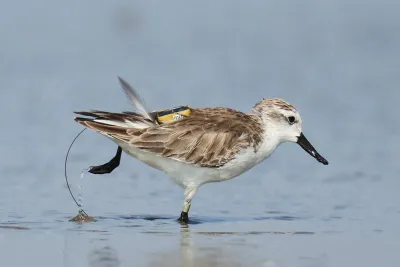
Photo by J. Martines
On average, these transmitters worked for several months. And this is what I managed to find out.
- Lopatnets, considered exclusively coastal birds, can fly long distances over land, “hiding” the path and making small transcontinental flights. Per day they overcome more than 1000 km.
- In some places of stops, Lapatnye has hundreds of poacher's deer networks. It is clear that in these areas you need systematic monitoring.
- The marked birds wintered in different places. Some of these places were previously unknown. So, two birds spent a month in North Korea. One in the fall flew to Indonesia, to Sumatra - this area did not enter the area of the species before.
As can be seen in the example of Lopatnaya waders, with the help of the latest satellite transmitters, you can quickly and successfully study the flights of the flight and the strategy of migration of disappearing bird species, determine their previously unknown stops, places of cluster and molting. All this helps in the protection of birds.
Bird compass
Modern equipment allows you to better study the mechanism of orientation of birds during long -distance travel. It is known that birds are able to correctly navigate in space and return to the flight path, if for some reason they deviate from it.
During migration, a bird must be able to determine your location and direction of movement - that is, to have something like a map and compass. Patuns can determine the cardinal points during the day by the position of the sun, and at night by the stars, they also use the Earth's magnetic field. The situation is more difficult with navigation. Currently, there are two main hypotheses - magnetic and odor (or olphatorial). The use of the “smallest map” by birds has been proven by a number of research. One of them was held by an international group of scientists with the participation of the Institute of Geography of the Russian Academy of Sciences: the mechanism of the orientation of Klushi ( Larus Fuscus Fuscus ), a large seagull, whose nesting area is located in Scandinavia and the north-west of Russia, and the places of wintering at a distance of about 7,000 km in the equatorial latitudes of East Africa. The migration route of birds was monitored using satellite transmitters.
To check which sensory signals are used in navigation, the birds underwent surgery on the olfactory or trigeminal nerve (the latter is responsible for the perception of the magnetic field). As a result, one group of gulls temporarily lost the ability to perceive the magnetic field, the other - smell. The third group was a control. For the experiment, adult birds were selected from southern and central Finland, as well as from the Solovetsky Islands. Finnish birds were moved 1250 km to the island of Helgoland (8O century), and birds from the White Sea-1260 km to the southeast in the vicinity of Kazan (49O century). Part of the club was released in the nesting area.
Birds from all three groups flew south in the fall. That is, damage to the trigeminal and olfactory nerves did not affect the motivation of gulls for migration. They have preserved the ability to determine the cardinal points and achieve the geographical latitude of the winter area. However, only birds with an undeveloped sense of smell were able to adjust their route and return to the boundaries of the migration corridor. The experiment showed that the sense of smell is necessary for the klush to correct the subshirate movement beyond the border of the migration corridor to the unfamiliar landscape. The method by which migratory birds can use navigation odors is unknown - the experimental data allow various explanations. Presumably, birds can remember the smells characteristic of the places of stops during migrations, and “make up the olfactory map” of the flight path.
Grigory Tertitsky, Peter Glazov, Elena Lappo, Julia Loshchagina,
Institute of Geography of the Russian Academy of Sciences