
Translated material
See a black hole
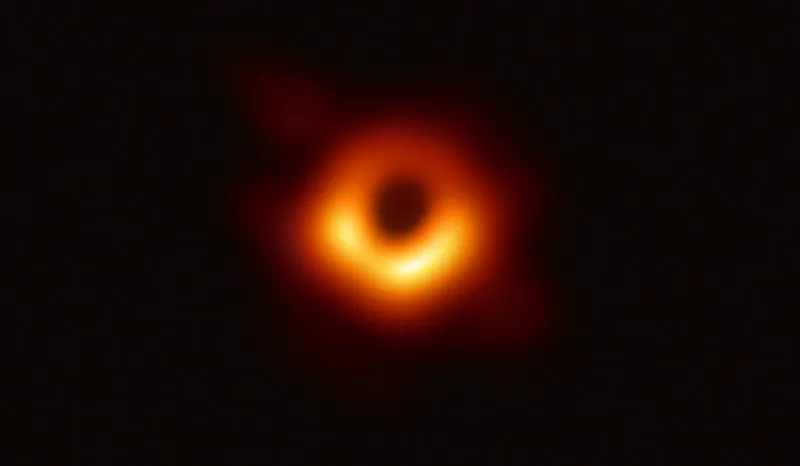
Perhaps the picture that has never been blurred and unintelligible at first glance caused such enthusiasm as April 10, 2019. This image went around all the self -respecting media, filled social networks, became the hero of Photoshop, hit T -shirts and managed to feed. In the picture - the first image of a real black hole in history is a super -minute hole in the center of the galaxy M 87. The image is bad, but the present.
Astrophysical context
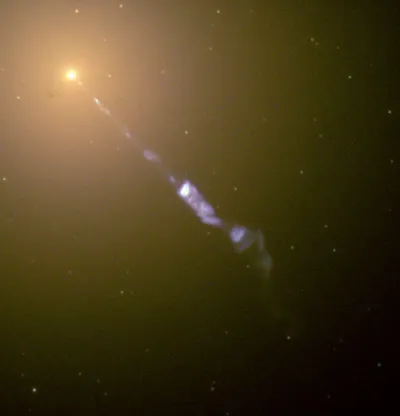
The ultra -massive black hole in M 87 has long been famous for its optical (observed in visible light) jet - a relativistic stream of larger plasma. Typically, jets are visible only in the radiodiapas, sometimes in the X -ray; Optical jets are a rather rare occurrence. Picture in Fig. 1 made by the Hubble space telescope, but Jet is also visible in much less powerful ground telescopes. Jet's length, more precisely, his projection in the sky, is more than a kilo -parcel. Jet is directed towards us, its deviation is only 17 °, that is, its real length is several kilopropers. It is precisely due to the fact that Jet is directed almost at us, we see only one jet, since the second is aimed at 163 ° from us, despite the fact that both of them are relativistic with the strongest relativistic aberration. Based on the effect that Jet has on the interstellar medium, its power is estimated: it is from 1044 to 1045 ERG/s. The first of these meanings coincides with the full luminosity of our galaxy. (Here, the units of the SGS system are used here; for orientation: Sun luminosity - 4x1033 ERG/s.)
But the luminosity of the disk (an accretion disk is a substance tightened in a black hole and warming up to huge temperatures) is relatively small. Among the quasars there are monsters whose disk emits 1047 ERG/s. This one shines no more than 1042 ERG/s, in orders of magnitude yielding jet in power. The fact is that this disc is very ineffectively highlighted: most of its energy is carried straight into a black hole. Such an accretion mode is called Adaf (AdVction Dominated Accretion Flow) is a quasar on a hungry ration. The stream of substance tightened to the hole is not enough for the disk to become dense and come into thermodynamic balance. The accretion disc is optically thin, but geometrically thick due to the large chaotic speeds of protons and nuclei. In ADAF, particles rarely face; Ions fly on their own with Kepleric speeds, electrons themselves, and the temperature of the electrons is ten times lower than that of ions. Electrons shine, we see their synchrotron radiation. And the main energy is carried away by ions into the black hole.
What can be considered at a black hole
Black holes remaining from single stars have a maximum angular size of about 10-15 radian. At such an angle, the smallest earthly bacterium from the moon is visible. Fortunately, the size of the black hole is proportional to the mass (and not the root of the cubic from it, as for ordinary bodies), so giant black holes sitting in the centers of galaxies and absorbing a mass of millions and billion stars are much more promising. Angle -macassive black hole (about 6 billion solar masses) in the Galaxy M 87 (55 million light years) and a black hole in the center of our galaxy - more than a thousand times less (4 million solar masses), but also two thousand times closer. The angular size of these holes is much larger-approximately 10-10: at such an angle, a ping-pong ball on the moon or human hair will be visible to the thickness from a distance of 500 km. In astrophysics, it is customary to measure the angular size in the corner seconds - this is 1/3600 degrees, or 0.5x10⁻⁵ of the radian. In this case, corner microseconds will be more adequate units. Distance to M 87 - 16.4 megaparsk, or 5x1025 cm. Here are the key parameters of the black hole (give the main dimensions in the corner microseconds).
- The gravitational radius of the black hole in M 87 (RG) is approximately 1015 cm (more than three times more than the radius of the orbit of Neptune). It is determined through the mass M, the gravitational constant G and the speed of light as RG = GM/C2. Corner size - 4 microseconds.
- The Schwarzshild radius of a non -converging black hole (a radius of the horizon of events from which no signal does not reach), twice as much: RS = 2RG (8 microseconds).
- The last stable radius orbit: RO = 6RG (24 microseconds).
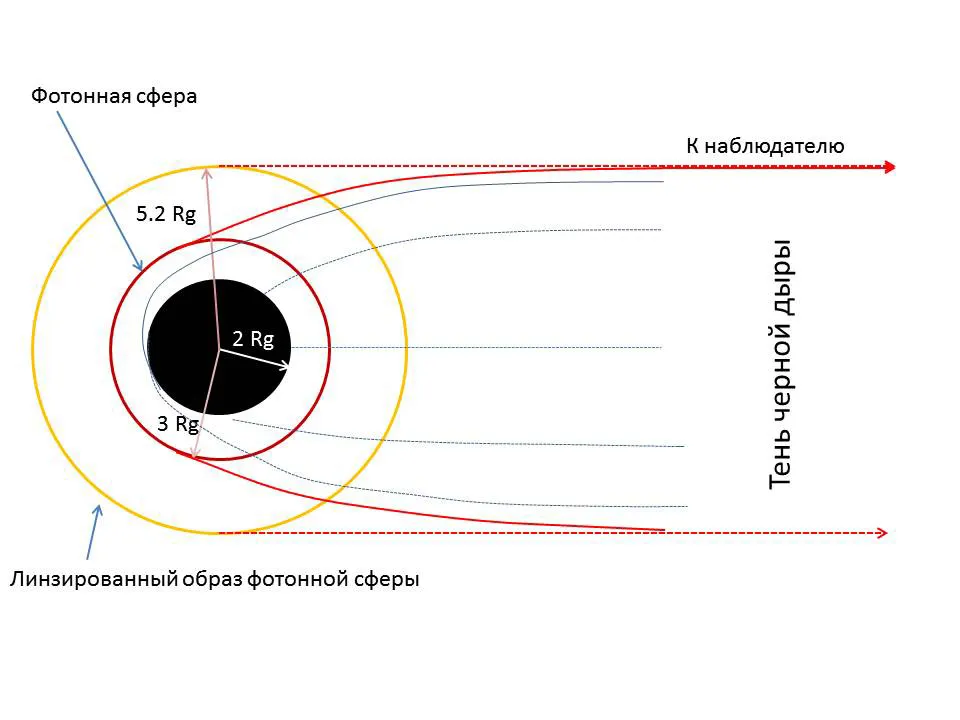
- The radius of the photon sphere: rph = 3rg. A photon flying past a black hole in a tangent is closer than RPH will fall into a black hole; flying on - fly away along the curve to infinity; Flying at RPH - it will circulate around the hole in a circular orbit.
The radius of the shadow of the black hole: Ra = 5.2 RG. Shadow is nothing more than a lensed photon sphere (see Fig. 2). The corner size is 20 microseconds.
What of the above can we see? First of all, we must see an accretion disc. In the case of M 87, we observe this disc is almost flat. But how will the black hole itself appear? She probably rotates. So, her horizon is smaller than Schwarzshildovsky and closer to RG. The size is too small, and, most importantly, the horizon is not indicated by photons that left the vicinity of the black hole. Those who were born near him, with a little exception, swallow a hole. The last stable orbit for a rotating black hole is approaching the horizon and merges with it for the case of the ultimate rotation. In this case, almost all photons emitted from the last stable orbit fall into a black hole, and we do not see them.
But we can see the contour of the shadow of a black hole - a bright ring along its circle. This, of course, is not photons flying around the hole - such orbits are unstable. A bright ring is a kaustic, something like light stripes at the bottom with slight excitement. The trajectories of many photons, including on the back of the accretion disk, from the point of view of a remote observer, are collected in a narrow ring (see Fig. 2). And inside this ring it should be relatively dark. Regardless, because inside the photon sphere we can see photons emitted by the substance away from the black hole, their trajectories are bending and get to the observer. At the same time, the brightness of the radiation emitted inside the photon sphere is greatly suppressed. So, we have a bright ring with a dark area inside and brightly falling out with brightness, since the luminosity of the disk falls when it is removed from the black hole.
Observation technique
There is a so -called diffraction limit of the corner resolution λ/d, where λ is the wavelength, d is the aperture: the diameter of the telescope mirror or the interferometer base. For the largest optical telescopes, the diffraction limit is about 10 milliseconds. For traditional radio interferometers with a super -long base operating on a wavelength of a few centimeters, the diffraction limit is about milliseconds: the restriction gives the diameter of the Earth. The Radio Astro is one of the antennas of which is in space, the resolution is about 30 times better, but the large wavelength does not allow to see what is happening near the black hole: the space around it is filled with electrons of large energies that absorb radio waves (synchrotron self -absorption). With the help of the Radio Astro, they conducted a study of the nucleus M 87 and exactly saw this: an opaque photosphere hiding the black hole and the inside of the accretion disc. But at a wavelength of about a millimeter, synchrotron absorption falls by orders of magnitude - electrons radiate, but almost do not absorb.
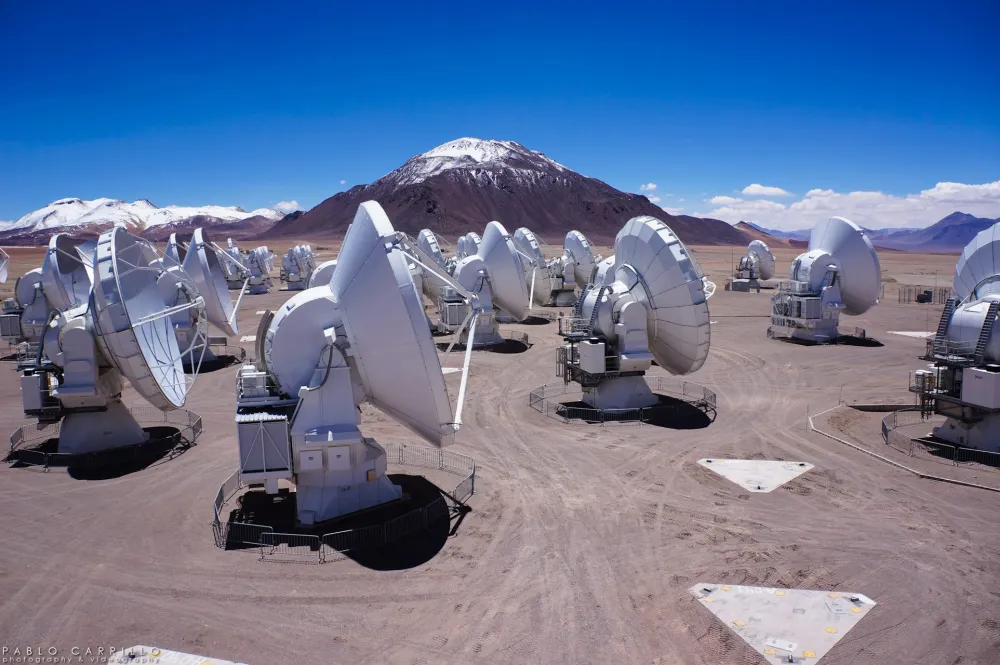
The EHT project (Event Horizon Telescope) is an interferometer of several radio telescopes located in different parts of the globe. They all work in the millimeter range, the study of the nucleus M 87 was carried out at a wavelength of 1.3 mm. The diffraction limit with such a wavelength and a base the size of the diameter of the Earth is about 20 corner microseconds. The same as the radius of the shadow of the black hole in M 87.
With this ratio of resolution and size of the object in the radio interferometry, it is possible to obtain quite intelligible images. In the case of simple geometry of the object - even better: for example, the position of the point object is fixed with an accuracy of 20-30 times higher than the diffraction limit.
The radio interferometry with a super -long base is radically different from the usual interferometry in that it is digital, not analog. Roughly speaking, a temporary signal profile from all antennas with a frequency equal to the double width of the strip of the received signal is recorded. This, of course, is much less than 230 gigaigers, but still a very large frequency, so the primary data is about two petabytes. Then delays are looking for, in which signal profiles from different antennas correlate with each other. According to delays, based on the spatial position of the antennas, the direction of the arrival of the front front is determined. By the aggregate of delays, a map of the facility is built.
In words, it looks simple, but in fact the delays between any pair of antennas are changing all the time: the reason for this is the rotation of the earth, thermal deformation, tides, etc. The most unpleasant is the unpredictable turbulence of the atmosphere, due to which the phase of the received signal “walks”. All predictable factors are included in the delay model, which is easy to take into account, but random factors break the coherent accumulation of the signal in less than 20 seconds, after which you need to look for the correlation by new and “empirically” sew the phase. The procedure, of course, is not easy: the required amount of data is huge, the search for correlations consumes huge computing resources, and the restoration of the card for correlations is also an incorrectly defined task. Nevertheless, in most cases, this problem is correctly solved, in addition, the card with a large attitude of the signal/noise is obtained clearly of the hemisphere of the orientation diagram. All these difficulties increase with a decrease in wavelength. In particular, at a wavelength of 6 cm, the coherent accumulation of the signal is not 20 seconds, but 10 minutes. Accordingly, at a larger wavelength, the lower data accumulation rate is required. That is why interferometry on a millimeter wavelength has become possible only in this century.
By the way, even before the combination of the ehta antennas into the EHT network, the main node of this network - the ALMA interferometer, consisting of dozens of antennas, received amazing pictures of protoplanetary discs (see Fig. 3).
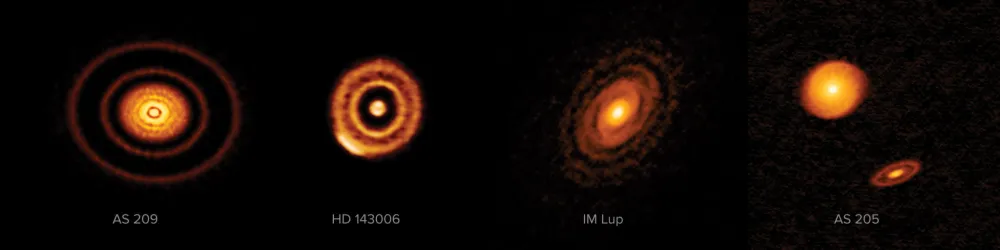
Pictures of protoplanetary discs taken by a separate node of the EHT network - alma interferometer
Results and their interpretation
Four nucleus measurements of EHT were carried out four nights: April 5, 6, 10 and 11, 2017. The results are presented in six voluminous articles published in Astrophysical Journal Letters and collected here . The main picture presented in Fig. 4, for sure everyone has already seen, we give separate pictures by days (Fig. 5).
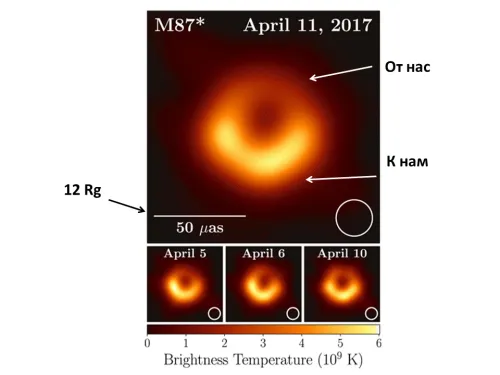
Small changes in the distribution of brightness along the light ring are noticeable. This is natural: the constant time of changes in the radius of the photon ring (near the light days) - days. We see how certain heterogeneouses in the accretion disk are breathing. The different brightness of the upper and lower part of the ring is striking. This is due to the fact that we observe the accretion disc is not exactly flat, but under a slight inclination. The disc is perpendicular to Jet. In the coordinates of the picture, Jet is directed to the right. The disk rotates clockwise, so the lower part of the ring approaches us, and the upper one is removed. This is enough for relativistic aberration to give a noticeable difference in brightness.
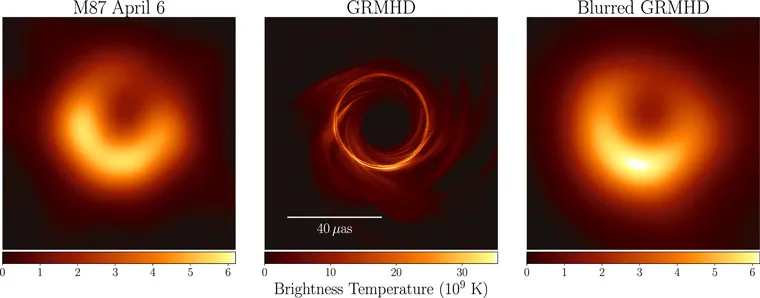
A significant part of the published articles is devoted to modeling the accretion to a black hole with the excretion of a substance and tracing of the emitted photons. This is a rather complicated task, since three -dimensional magnetohydrodynamics are required in relativistic metric. Nevertheless, they decide and look, it looks like an observed picture or not. An example of a comparison of the model with reality is shown in Fig. 6. Of course, not all models give a result similar to the truth. Therefore, it is possible to discard some options for the physics of the accretion disc. For example, an assumption of the same temperature of ions and electrons does not take place. The assumption of a non -conquering black hole does not pass, although it is not possible to measure the rotation parameter: it passes both = 0.94, and the value is a = 0.5. It was possible to exclude ambiguity in assessing the mass of the black hole. There are still two conflicting estimates: 6 billion of the solar masses - according to the spread of stars and 3.5 billion solar masses - according to the movement of gas. From the size of the “bagel” and its comparison with the modeling results, the assessment of 6.5 billion solar masses is obtained, consistent with the first of the above.
The value of the result and prospects
Many consider the main result EHT as a direct confirmation of the existence of black holes. This is so, but this is not the first and not the most powerful confirmation. Gravitational waves from the merger of black holes are stronger. But a picture of the shadow of a black hole is more obvious and clearer for the wide masses. This is very important, since the money for research ultimately gives the wide masses. From my point of view, it is more interesting for the data on the accretion disk. This is a completely fantastic phenomenon, much more complicated than a black hole.
What they did is not the limit. The technique can be licked, gained statistics. There will be clearer images, changes in the accretion disk over time will be visible - there is a lot of interesting astrophysical information.
And another very important prospect is a black hole in the center of our galaxy, the radio source of Sagittarius A. Its corner size is slightly larger; Orientation, apparently, is different, less favorable for observation of the shadow, but more interesting in terms of the effects of lenses and physics of the Accretion disc.
Finally, a more distant prospect is a radical increase in the interferometer base due to the cosmic millimeter telescope. This task is devoted to the Millimetron project, developed in the Fian Astrosmic Center, - the heir to the Radio Astro.
Boris Stern
The author thanks Yuri Kovalev for a number of clarifications