
Translated material
Plus the Internet chariaza
How are political video blogs
Yutube is a platform for video entertainment, the more amazing the appearance of a political context on it looks. What do people who choose such an unpopular format for communicating with the audience do in Utube? Where did these people come from? Why are they wasting talent in areas, obviously unprofitable? These issues were never left indifferent, so I hope the readers will come in handy accumulated observations.
Yetub was originally created as a commercial project. He is about money, which means about entertainment. Because only entertainment can bring serious money in visual format. In Yetube, everything is tied to the number of views, but they pay video bloggers (the so -called vlogers) not for their product directly, but for advertising in it.
Accordingly, the wider the theme, the more willingly advertisers place advertising, the higher the income of the Weger, the more popular its vlog.
It is not surprising that the most massive trends in Yetube are music, humor (primarily “jokes”: the pleasure of contemplating the stupid and clumsy reactions of deceived people was exploited into all the hard -difficult Comedia Dell'Arte), the lubrication of fashion trends, peeping the private life of celebrities. In general, everything is like everywhere and at all times.
For the same reasons, the politician on YouTube is the same marginal genre as in everyday life. This is the general rule, however, there are differences due to linguistic and regional originality.
Inhabitants in prosperous countries are not at all interested in politics. In the United States, the vast majority of inhabitants do not read the federal press and do not look at the federal channels, with the exception of the sitcoms and evening humorous shows.
Political life in the United States begins and ends with local news. Let us give them tribute: in their local life, people are energetic and active, demonstrate interest and engagement, discuss the projects of the authorities of municipalities and counties, domestic shocks, which or another affecting politics (manifestations of racism, migration crisis, police lawlessness, etc.).
The unpopularity of politics in the English -speaking YouTube is explained not only by the indifference of the population, but also by the redundancy of the site itself. Traditional television - from private channels to public and federal - covers all spectra of political opinions, providing the rostrum to anyone who is able to stay within the social contract (does not insult, does not discriminate against, does not show aggression).
As a result, the only political niche in the English -speaking Yetube is the marginals taboo in the mainstream video space, first of all, of course, we are talking about conspiracy -lists like Alex Jones.
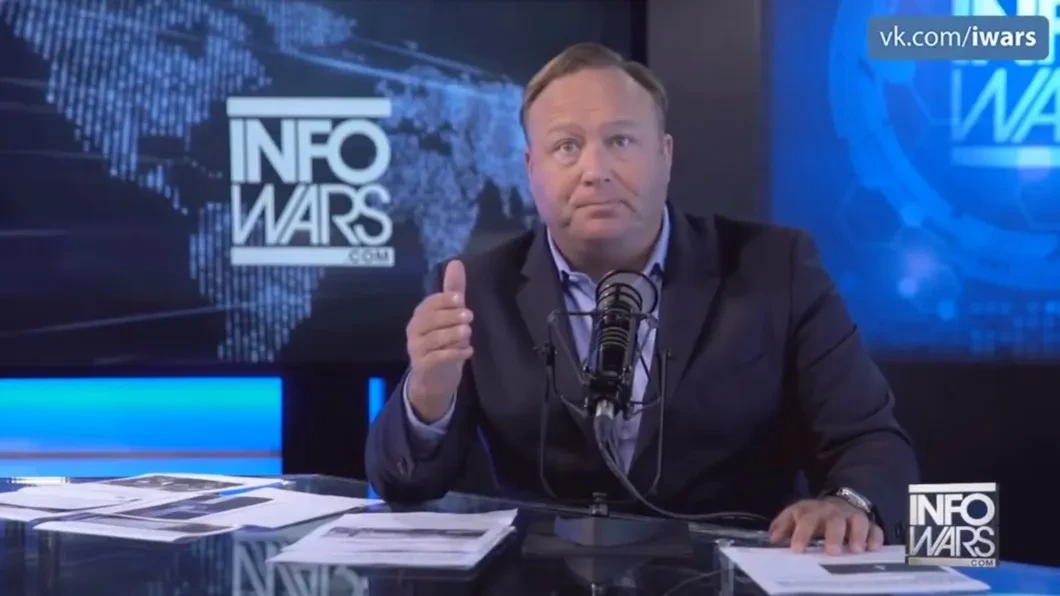
Alex Jones is massive among the neurotized part of the population, but he is constantly banned in Yetube, so he is forced to change accounts daily. Due to these inconvenience, today 553 people have signed on its Infowars Show channel-persistent fans that manage to track the clones of broadcasts. On the personal website of Alex Jones (Infowars.com), a long list of “freshly bombarded videos” flaunts in the hat, on Yetube itself the number of views does not exceed 100-300.
It is possible to illustrate the lack of demand for the political format in English-speaking Utube in two digits: the two most popular corporate channels broadcasting in the political format-Bloomberg Politics and C-SPAN-95 and 300 thousand subscribers, respectively. The number of “hot views” (during the first week after the air) is from one to 20 thousand.
In order for readers it is easier to navigate in numbers: on the Utuub channel of a 23-year-old American cheerful and touching Krivlyak Lisa Koshi almost 17 million subscribers and about 2 million hot views.
The limits of popularity in the English -speaking political yutub are Vlogs of Trevora Noah (4.7 million subscribers, from 500 thousand to 1.5 million views), Stephen Croud (3.7 million/150-600 thousand), groups of homegrown analysts The Daily Wire (1.5 million/50–350 thousand).
All. This is a line that is achieved by erosion of a purely political context with an endless humor and sitcom's tricks.
It is reasonable to assume that the popularity of political topics in video format is concentrated in those language and state zones where there are problems with a full -fledged political discourse in the official television broadcast.
I would like to illustrate this assumption on the example of the territories close to us - the political vilogram of Russia and Ukraine. It will be all the more curious that the situation in the named countries is strikingly different.
I’ll start with the statement that the readers of the “new” paradoxical may seem: in the Russian segment of Utuub today there is practically no political Vlogerta, not because there are no vlogers, but because there are no political discourse itself.
In turn, there is no political discourse because there is no demand for him. The argument “The authorities of the strangle of freedom” does not work, because Yetub is not local television, which is easy to manipulate. Therefore, everything is much more banal: there is no demand - there is no offer.
Today, all Russian political vilograms came together at one point - on the channel of Alexei Navalny (870 thousand subscribers, 25–750 thousand views), and, it seems, these figures reflect the total measure of the interest of Russian society in politics.
Once there was the Vyacheslav Maltsev channel, which even in his best times was amazed at an amazingly dreary format and a conspiracy-nationalist filling. About the ultimate unprofessionalism of the weber (tedious tambourine for one and a half to two hours in each issue!) I do not even say. Today, after the demiurge’s relocation outside the Fatherland, its channel is lifting a completely marginal existence (45 thousand subscribers, 25-50 thousand hot views).
For the sample, you should probably remember the Besogoltv Nikita Mikhalkov (192 thousand subscribers, 400-500 thousand views) and “Vedud” Yuri Dudia (5 million subscribers, 4-10 million views), although neither one nor the other channel are political by definition. The format of Dudia is an interview with Russian celebrities, among whom there are occasionally politicians and employees of the ideological front, and it is these broadcasts that turn out to be the most unsuccessful. Talking with the swearing Parvenu with the difficult fate of the “conqueror (-nits) of the capitals” is clearly better and are incomparably more popular with the audience.
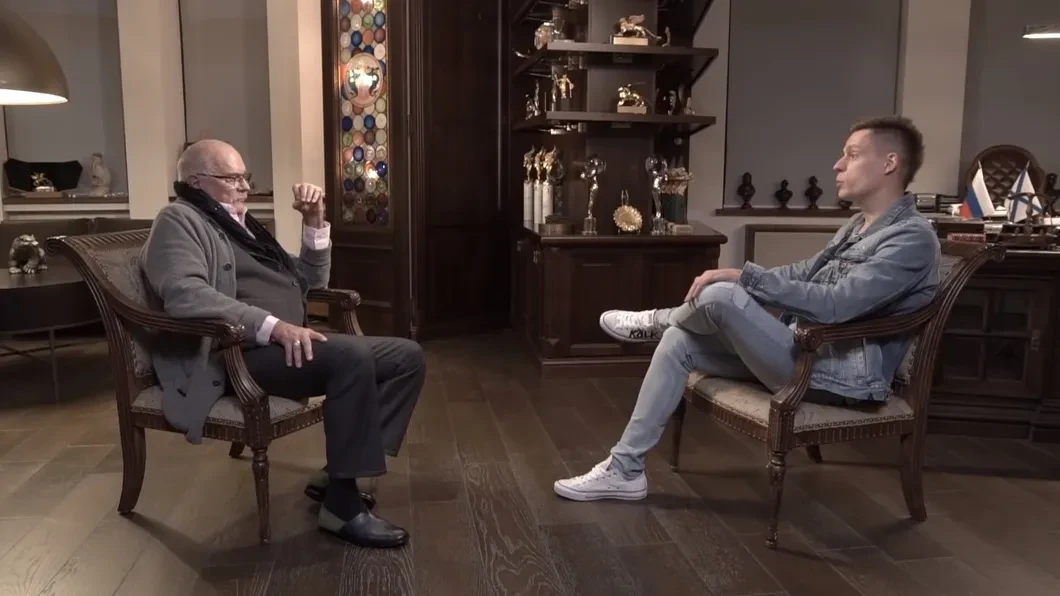
The format of Mikhalkov is a mirror into which the author permanently peers with genuine love and admiration. If something political flashes in the mirror, then brush the swimmer: it was not politics, but the thought of Besogon about such.
Things are completely different in Ukraine. The genre of political vilogram there is extremely popular, and it is in the Russian -speaking segment, which considers itself deprived of the official channels of TV.
This belief is quite justified, since the Ukrainian television -function of the Poroshenko era is: a) low -budget tracing paper from the products of the older brother, on the blue eye of which the opposition political discourse is allowed only as an object of shelter, and b) Russian -language self -language is discriminated at the cave level itself.
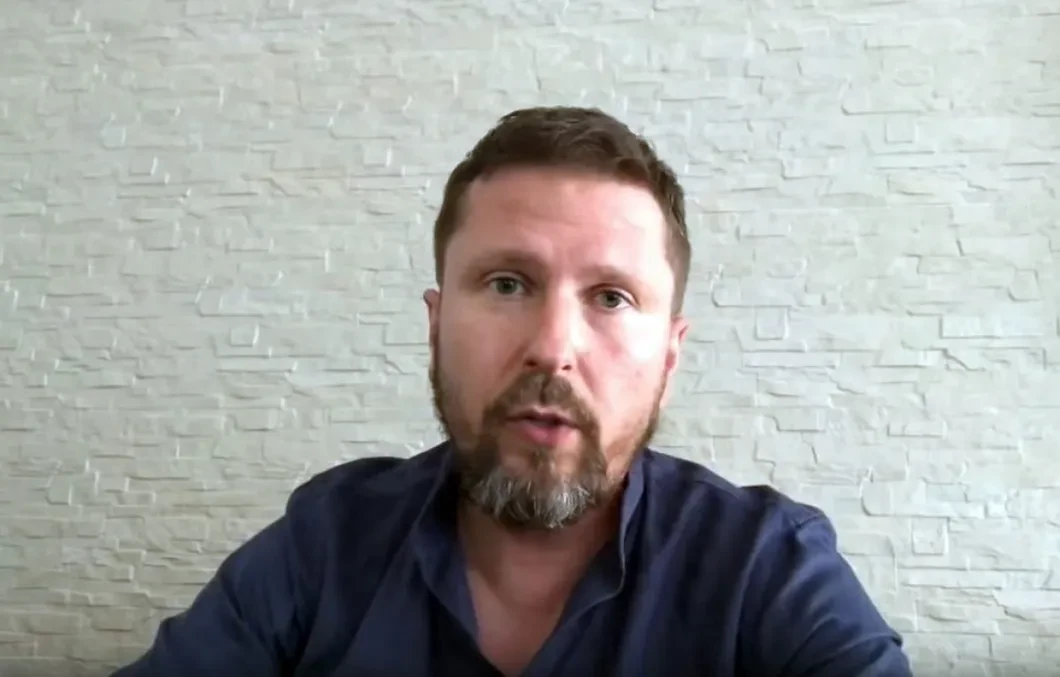
An example of the popular political vogue of even Ukrainian, but world level is undoubtedly the Anatoly Sharia channel (2 million subscribers, 800 thousand - 1 million hot views).
In the political opponents of Sharia, the scale is more modest (for example, Miroslav Oleshko: 126 thousand subscribers, 30-200 thousand views), and at first glance it may seem that the difference in numbers reflects the unsightness of the alternative discourse.
In fact,
Opponents of Sharia work in the genre of animal nationalism and bazaar battle, while the people, contrary to the illusions of the intelligentsia, always prefer to instinctively stay away from marginal excesses.
The problem, however, is that Shary himself does not disdain the arguments of AD Personam, without which not a single broadcast can do.
It remains to conclude that the high popularity of the Sharia lobe is not ensured by the political orientation of the discourse, but by its incomparably higher professional level.
Be that as it may, my replica is not about Sharia as a specific character (about which there may be a variety of opinions), but about political vogue, so I will try to talk about its visual product precisely in the context of the success of the genre itself.
National and cultural originality, undoubtedly, plays the first violin in the role performed by the video blogger, but no one canceled the universal principles of social mythology, so it will not be an exaggeration to say that it is the motivation and phobias of the crowd that determine the success or failure of any leader-nominated leader-whether in a real political struggle or on a popular show.
Success in the eyes of the broad masses consists of a skillful connection of three components. The leadership applicant is obliged:
talk only about what interests the mass, and not it personally;
look exactly the same as the “people” look, and it is to do it both at the external level - the choice of clothes (the notorious “proletarian cap” of Lenin) and gestures, and on the internal - the revolution of speech, vocabulary (“friend”), logical constructions, stereotypes, stencils of beliefs, etc.
To possess a certain highlight that would definitely stand out from the crowd. This highlight can be anything: from Lenin's trunks, the Stalinist accent and barefoot, Gandhi to the captivating diligent of the most popular weber of the planet Swede Puedipai, the Machism of Chavez and the animal cruelty of Pablo Escobar (if anyone had forgotten: the drug Baron also worked as a folk hero).
I hasten to assure the reader that the listed attributes of leadership were not invented by me, but for half a century have been axioms in the social mythology and psychology of the masses, so I propose not to dispute them, but to take on faith and continue our observations.
Let us now return to Anatoly Sharia and see what ensured the phenomenal success of his video blitter on Utube. I believe that the reader had already guessed where I was leaving: Shary talented and skillfully involved all the attributes of leadership, which only ensure popularity in the eyes of a truly mass audience.
Anatoly Shariy appears in front of the camera always in the monstrous in absurdity. I have no doubt that this is being done consciously, because it is difficult to believe that a wealthy person voluntarily flaunted in front of the camera in the sports suit "Adidas", colorful striped polo or shirts with a pulled collar, as if by an accidentally exposing rampant tattoos.
Why does Shary dress like that? Then, that hundreds of thousands of his loyal subscribers will recognize their own everyday life in such an estimate.
Thus, Sharia fulfills an indispensable condition for social leadership - to be like everyone else.
The second condition for popularity is the presence of a highlight. Here, Anatoly Sharia has a rich arsenal: from the Shahid beard to the reputation of a steep and fearless journalist, who brought a dozen shelter pedophiles, thieves, bribe takers and just bandits to the clean water. And all this - under the most severe pressing of the authorities and fabricated affairs, which ended for Sharia with the status of the first Ukrainian political refugee in the European Union.
Sharia's desperate is that ordinary Russians and Ukrainians do not dare to imagine in their own biography, and this desperate (on the verge of recklessness), of course, provides its mythological image with an exclusivity seal.
Finally, the third law of social leadership is discourse, fixated on topics, interesting, accessible and understandable to the wide masses. By the way, this is the most difficult and almost irresistible condition for representatives of the Russian and Ukrainian intelligentsia.
The “brains of the nation” are physiologically unable to talk about anything that goes beyond the framework of personal interests. In the best case, the interests of his class, which, with such despair, broke out of the bells of the philistine being, which now for no rugs does not want to voluntarily return to the non -native swamp.
For this very reason, neither Miroslav Oleshko, nor Nikita Mikhalkov, have the slightest chance to reach the heart and soul of the “large people”, despite their entire populism and pathetics. And it doesn’t matter that the pathos of Oleska is animal-nationalist, and Mikhalkov has an imperial. Neither that nor the other (as well as the vast majority of the rest of the Utyubov Russian, and even more so Ukrainian-speaking vlogers) do not know how, they cannot and do not want to talk about what really excites the masses. Both of them are immersed in personal interests, ambitions and experiences.
Shary with an amazing acting instinct can abstract from his own individuality and get used to externally and internally in the aspirations of the people. He says that every day he speaks in millions of Ukrainian kitchens, and that is why millions are signed on his channel, and Petro Poroshenko could not resist even on stadium debate so as not to remembered Sharia with an unkind word.
In conclusion, I would like to supplement the paradox of all the information mentioned at the beginning. If someone decided that it was worth showing ingenuity, to learn the simple tricks of folk leadership and step on the throat of his intellectual song, as he will immediately become a popular political vloger in Russia, is forced to disappoint: nothing will work out.
It will not work for a reason that outweighs all the image -maker tricks: in Russia today there is no political discourse in principle. As well as there is no audience capable of absorbing similar political discourse.
The counterargument about the "dominance of politics" on Russian television does not work: there is simply a substitution of concepts here. Political discourse is that we observed on April 19 at the stadium in Kyiv. And not on stage, but in the stands.
And the fact that every day is happening on Russian television is called another word - “propaganda”.
From the editorial office
"New Gazeta" is considered by Anatoly Sharia by a propagandist who regularly spreads a lie about our employees. The emergence of this surname in the publication is due exclusively by the author’s intention.