
Translated material
By 2030, Pluto may lose the remnants of the atmosphere
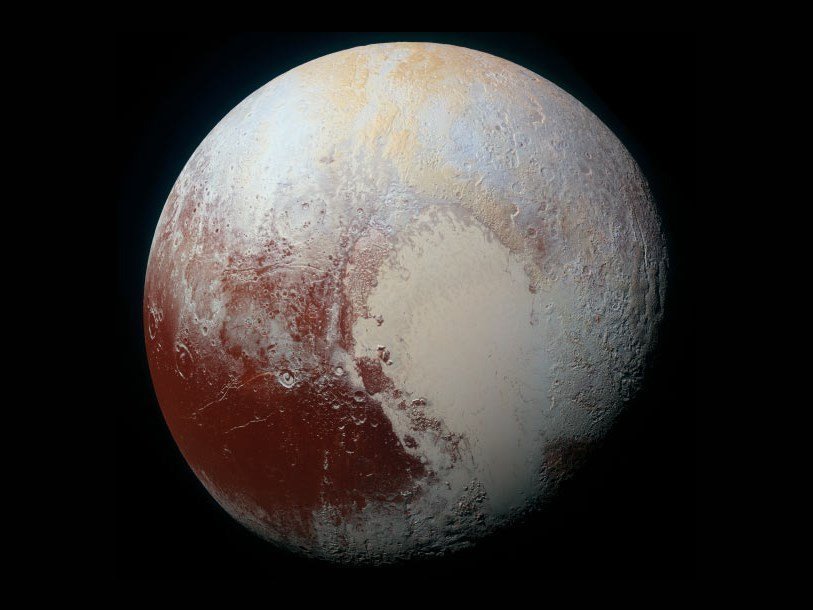
According to the calculations of the astronomer from the University of Tasmania, Andrew Cole) and his colleagues, by 2030, Pluto may lose the small atmosphere that he has. The reason for this will be too strong elongation of the orbit of Pluto.
The atmosphere of Pluto is formed by gases evaporating with its ice -covered surface. It is very urgent, atmospheric pressure at the surface of the planet does not exceed 10-5 atmospheres. The main part of the atmsofer is nitrogen, less than half a percent accounts for the monoxide of carbon and methane. Before the flight of the Spacecraft “New Horizons”, the main method of studying the atmosphere of Pluto was the observation of the moments when it obscures this or that star. Modern technique allows you to determine whether the light of the star disappears at once (as it would be in the absence of the atmosphere in Pluto) or gradually, first scattering into the surrounding plot of the gas haze. It was when Pluto coating one of the stars in 1985 that his atmosphere was opened, further observations of coatings made it possible to clarify data about it. In 2015, the atmosphere of Pluto was investigated by the new horizons.
In the work of Cole and his colleagues, the data obtained during the observations of the coatings by pluton of the stars and from the apparatus "New Horizons" were taken into account. “We were able to build seasonal models of Pluto and determine how he reacts to changes in the amount of sunlight he received,” said Dr. Cole. The fact is that this amount can differ significantly. Pluto makes a turn around the Sun over 248 years, and due to the high eccentricity of his orbit, the distance between the closest to the Sun and the most remote is very great. It approaches the Sun by 4.4 billion kilometers, being closer to it than Neptune, and then moves away from the sun at a distance of 7.4 billion kilometers. During periods of removal to Pluto, less energy of the sun reaches, and the temperature drops on it.
With cooling, atmospheric nitrogen begins to freeze and deposit on the surface of Pluto. Other factors affect the density of its atmosphere. In 1987, the North Pole Pluton for the first time in 124 was on the illuminated side, so nitrogen from polar ice began to evaporate more intensively. Therefore, although Pluto is now moving away from the sun, over the past thirty years, his atmospheric pressure has grown three times. But, as the calculations show, gradual cooling will do its job. Cole and his colleagues believe that by 2030 the entire atmospheric nitrogen of Pluto will freeze and fall on its surface. True, then, when Pluto passes his aphilia, his atmosphere will be restored.
Andrew Cole says that due to the disappearance of the atmosphere, Pluto will become brighter for a while, since its surface will reflect more sunlight. But the beautiful reliefs that people saw in the pictures of “new horizons” can disappear, closed by new layers of nitrogen ice.
The results will be published in the journal Astronomy & Astrophysics.