
Translated material
It is unsafe here: Mozilla diagnosed the Internet
Mozilla, developing open web solutions and Firefox browser, published an annual report on the state of the Internet. The document, the short version of which occupies 82 pages, is based on hundreds of interviews and opinions of more than 200 experts.
The Bell wrote out the key answers of the report without changing the questions asked by the authors, and most importantly, we fit into one card.
.card [Data-Color = " #000000"]: Before {Background-Color: #000000; } .card [Data-Color = " #000000"]: After {Background-Color: #000000; }
The main conclusions of the report
- Most of the inhabitants of the Earth are connected to the Internet.
- The Internet censorship flourishes around the world.
- Biometry is abused by both the authorities and private companies.
- Artificial intelligence multiplies injustice, making mistakes during training.
- A public movement appeared for a more responsible development of AI.
- There are more and more questions for large technological companies.
- Calls to control personal data are the main topic of discussion of the Internet community.
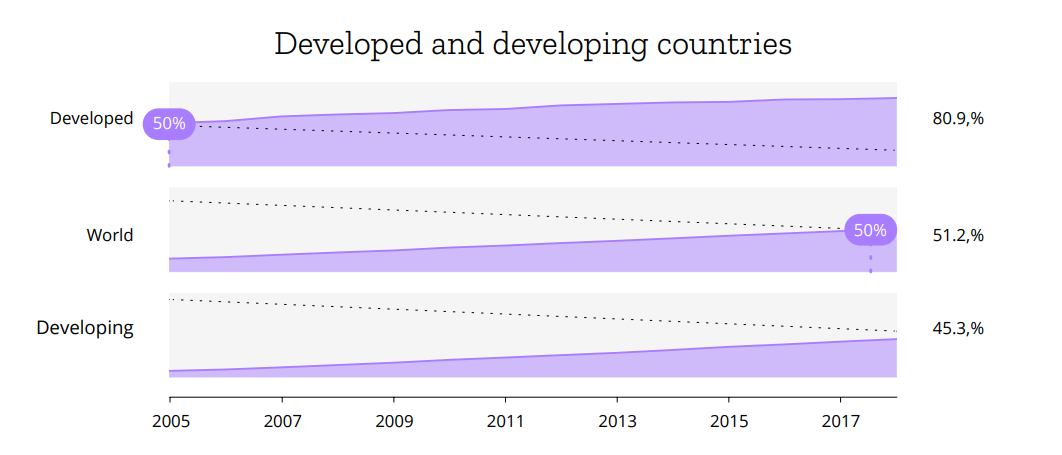
In the picture: the share of residents of developed countries, the world as a whole and developing countries connected to the Internet.
.card [Data-Color = " #000000"]: Before {Background-Color: #000000; } .card [Data-Color = " #000000"]: After {Background-Color: #000000; }
Is the Internet safe?
Correct answer: No.
- The fierce opposition of the collection of information, which began in 2018 due to the scandal with Cambridge Analytica, did not change the main thing: the main business model and currency of the digital world remains the collection and sale of user data.
- Users still do not realize the threats associated with the fact that someone else uses their data. For example: over a billion Indians were threatened due to vulnerability in the government system of biometric identification. Telecommunication companies turned out to be large data on the location of users. Private companies that conduct DNA decryption tests do not always use accumulated information exclusively in the interests of the client.
- The introduction of laws, such as European GDPR norms, affects public opinion, but technologically the influence of the initiative is still small. In addition, endless warnings about the use of personal data are more likely annoying users than inform them ( approx. Author - the authors of the report do not set out this, relatively one -sidedly emphasizing the advantages of the GDPR).
.card [Data-Color = " #000000"]: Before {Background-Color: #000000; } .card [Data-Color = " #000000"]: After {Background-Color: #000000; }
How open is the Internet?
In 2019
- Governments limit the Internet access in a variety of ways - from direct censorship in China and social media taxation in Africa to slowing down or turning off access around the world (slowdown is especially common in India).
- The fight against the language of enmity and extremism almost everywhere turns out to be ineffective or turns into a censorship tool. The German law, designed to smooth out disagreements in social media, was not only subjected to fierce criticism of activists, but also became a model act for Russia, Venezuela and Kenya, who adopted similar documents. Only according to the requirements of German law, over 52 thousand videos are removed every day from YouTube.
- There is a transformation of the attitude to personal data. Groups of activists achieve control over personal information, its protection against the distribution and implementation of practices, when the user himself discloses the necessary data. Several battles were won in this war, but it is still very far from victory. Control is also necessary because the technology for determining our interests leaves much to be desired , and in some cases it may compromise the user.
.card [Data-Color = " #000000"]: Before {Background-Color: #000000; } .card [Data-Color = " #000000"]: After {Background-Color: #000000; }
Who is happy on the Internet?
The inclusiveness of digital space is one of the most important issues of the modern Internet. Here are three main trends.
- Artificial intelligence already determines the fate of people, helping judges, law enforcement agencies and personnel departments. At the same time, the car is too often mistaken or makes judgments based on data, unethical, unjustly and prejudice.
- Some employees of large technological companies protest against cooperation between corporations with military customers, sentences of sentences, migration services. Technical companies themselves are not a model of fair wages, as well as gender and ethnic diversity. In the future, the uneven distribution of the builders of the digital world can create the effect of a crooked mirror in many products affecting real life.
- The composition of the Internet does not reflect the composition of the world's population. The slowest Internet (in Africa) is simultaneously the most expensive for residents. There are still much fewer women among Internetmen than men. And, of course, on the Internet, first of all are residents of developed, rather than developing countries. The greatest penetration is observed in Europe, both Americas and the CIS countries.
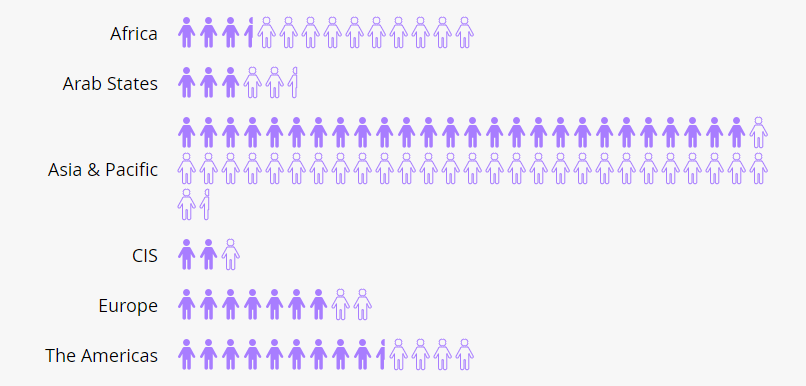
In the picture: if the entire population of the Earth consisted of only 100 people, as if those who are already on the Internet were distributed, and those who are not yet.
.card [Data-Color = " #000000"]: Before {Background-Color: #000000; } .card [Data-Color = " #000000"]: After {Background-Color: #000000; }
Who will succeed on the Internet?
- Since over 50% of the inhabitants of the Earth is already on the Internet, there is a huge request for web-grade. Users do not always understand the consequences of dozens of decisions they made on the Internet. This is poorly explained to them, the skill of conscious use of sites and applications is a rarity.
- Web-graphics go hand in hand with media graphics. Users should understand what the information that they receive on the sites, in the video, in the ribbons of recommendation services.
- The issue of distribution of information from marginal groups (anti -prismaries who believes in flat land, lovers of dietary supplements and homeopathy), influons and people who have learned to operate the digital system (Donald Trump) has not been resolved. The laws to combat Fake News seem to worsen the situation, and do not solve the problem.
.card [Data-Color = " #000000"]: Before {Background-Color: #000000; } .card [Data-Color = " #000000"]: After {Background-Color: #000000; }
Who controls the Internet?
- Only 8 Chinese and American players control most of the Internet. These are Alphabet, Alibaba, Amazon, Apple, Baidu, Facebook, Microsoft and Tencent.
- These companies took control of the network at all levels - from search engines and social media to underwater cables and cloud computing. Antimonopoly fines practically do not affect them.
- These companies earn in one of four ways: Google, Facebook and Baidu are trading; Apple and Microsoft - programs and devices; Alibaba and Amazon - trading intermediaries; Tencent is a multidisciplinary organization that earns both services and advertising.
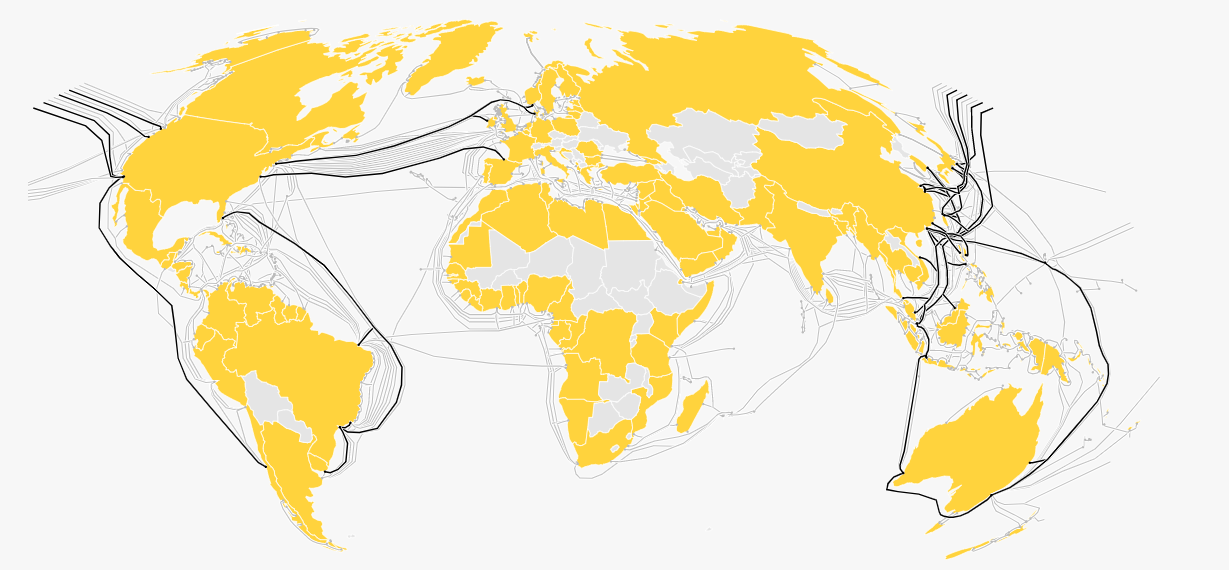
In the picture: Black Cables Google, Microsoft, Amazon and Facebook, gray - other cables. The countries are noted yellow to which cables are brought. 95% traffic passes through underwater cables.
This article was originally written for the Bell Tech technology and building. You can subscribe to it for free here .