Translated material
The British want like in Ukraine
British subjects are tired of professional politicians

Contrary to expectations, a draft agreement on the conditions of Britain's exit from the European Union, agreed by Prime Minister Teresa May and the EU, will not be submitted to the government for the following week for consideration by the House of Commons. “Fainannshl Times”, citing the prime minister advisers, writes that the question “hangs” up to the elections to the European Parliament on May 23.
This means that the hopes that were assigned to the negotiations of conservatives and laborists are not justified. This also means, as the Gardian wrote the other day, that the option of soft “Brexit” suffers defeat, and only extreme possibilities remain: Britain’s exit without a transaction, a review of the output statement or a new referendum.
This spring, the draft agreement of May failed three times in parliament. Then the prime minister resolutely turned away from his support group - Brektyers, and turned for help and votes to the Labor.
For the first time since the coalition government of the Second World War, two parties tried to join forces in finding a solution on significant national issues. Several groups were created in different directions. Even parts of the Eurogili pragmatic compromise of the soft “Brexit” seemed viable. He “could provide a fragile basis for a possible form of reintegration with Europe in the future,” Gardian wrote dreamily.
But there are no results of negotiations yet and, it seems, will be. The time for the search and formation of a strategic partner of the soft “Brexit” is obviously lost for a long time. And tactically, the most inappropriate time: on May 2, municipal elections will be held in Britain, and on May 23–26 elections to the European Parliament, if the May project does not become a law. And what are the concessions and compromises on the eve of the elections, when everyone is against all?
None of the parties is strong or decisive, evaluates the negotiators of the Gardian to offer a major deal: parliamentary support of the soft Brexit in exchange, for example, for a confirming referendum.
The leader of the Labor to Jeremy Corbin is profitable to pull the time and closer to the general elections, but he does not need a deal with May and the approval of her agreement by the parliament. Today, according to polls, the Laborists have a slight advantage, so in the case of universal elections, Korbin can count on the premier chair.
And for Mrs. Prime Minister, good decisions, it seems, is not left at all.
Own party prepares its resignation, collecting signatures to convene an emergency general meeting. Conservatives use this authorized procedure for the first time in history - so great indignation in the field. Intra -party polls evaluate it as the worst Prime Minister Tory in history.
If the agreement with the Laborists does not succeed in reaching an agreement, May promised to provide parliament with the opportunity to vote for alternative options for leaving the crisis. Such votes already took place at the end of March, and then the House of Commons could not make any decision.
Citizens see and give their political class the paralysis of the authorities and the opposition to a crushing assessment. According to a survey of the Yogov monitoring campaign, 57% of the British believe that the lack of a political career for the position of president or prime minister is an advantage, and only 5% evaluate this as a drawback. At the same time, 23% believe that the presence or absence of experience does not matter at all.
All leading British politicians have a negative rating (a positive rating is negative). This is how the first five looks in this light: the leader of the Labor Labor Jeremy Corbin has minus 25 percent, the conservatives of Teresa May and Boris Johnson - minus 22 and minus 6, respectively; The Labor of the mayor of London Sadik Khan and Ed Bolla, respectively, minus 7 and 6 percent.
By the way, the next of the Bracity leader Nigel Faraj, who has just created a new “Brexit”, the negative rating, is 32 percent.
It is difficult to resist, not noting that the record holder for this indicator with the rating minus 43% is the former prime minister, the “golden boy” David Cameron, who held a malicious referendum on Brexit in 2016.
Meanwhile, Britain again, as once in the 60–70s, began to call the "sick person" of Europe. According to Faynenshl Times, the country is experiencing six crises at the same time.
The first and most important is the economic crisis : stagnation and lag in labor productivity and the lack of growth of real incomes of the population. In terms of performance, the UK lags behind most countries of Europe, the USA, Singapore, Australia and Canada.
To this is added an exacerbation of the problem of identity and the Brekit actually, which brought the degree of national discussion to accusations of “betrayal” and “treason”, practically destroying the possibilities of compromises that are so important for the normal functioning of the democratic system.
The political crisis ruins the traditional British political parties and merges with the legal crisis , which is associated with the use of a referendum as a tool for solving basic legal issues, for example, about leaving the EU. There is not the slightest clarity, whether such decisions should be made in a referendum by a simple or absolute majority and what is the role of parliament in the interpretation and implementation of such decisions.
Finally, FT indicates a crisis of leadership . In the general election, the Conservative Party, led by Boris Johnson, will face the Labor Party led by Jeremy Corbin. She considers both the "least qualified potential premieres" of the country - a member of the UN Security Council. “One of them is an avid fig and rat-armed food from Brexit,” the author states, “the other is a tough socialist and an eternal supporter of the left despots.” The newspaper predicts that the mess with such leaders will only aggravate.
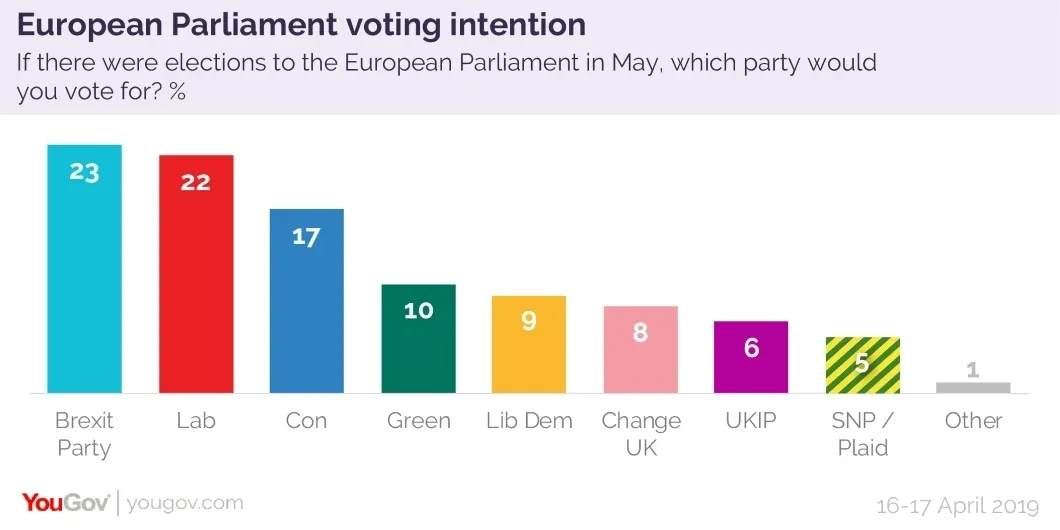
When general elections are held is not quite clear, and the elections to the European Parliament will be held on May 23–26 - they were promised by the European Union Teresa May, when in April she asked the EU second “delay” “Brexit”. These elections will be held on party lists and will actually show citizens' attitude to the main options for political solutions to the Brexit problem.
The Brexit Party and UKIP (the Independence Party of the United Kingdom) require an exit from the EU without any agreement - a tough Brexit. Behind the conservatives, apparently, there will be a draft transaction with the EU Teresa May. The Labor will perform for the Customs Union with the EU, the preservation of elements of a common market and, possibly, for a repeated referendum. Finally, “green”, liberal democrats, Change UK (“Change Britain”) and SNP (Scottish National Party) for preserving the country as part of the European Union.
So the large -scale “survey of the population” will take place, what future the British voter prefers after almost three years of real acquaintance with what Brexit is in practical terms and what is its price. Now he can make a decision with a much greater understanding of its meaning.
Ten days ago, the British gave the following answers: