
Translated material
Apollonovna
Our first Olympic champion Nina Ponomareva on April 27 would have turned 90 years old
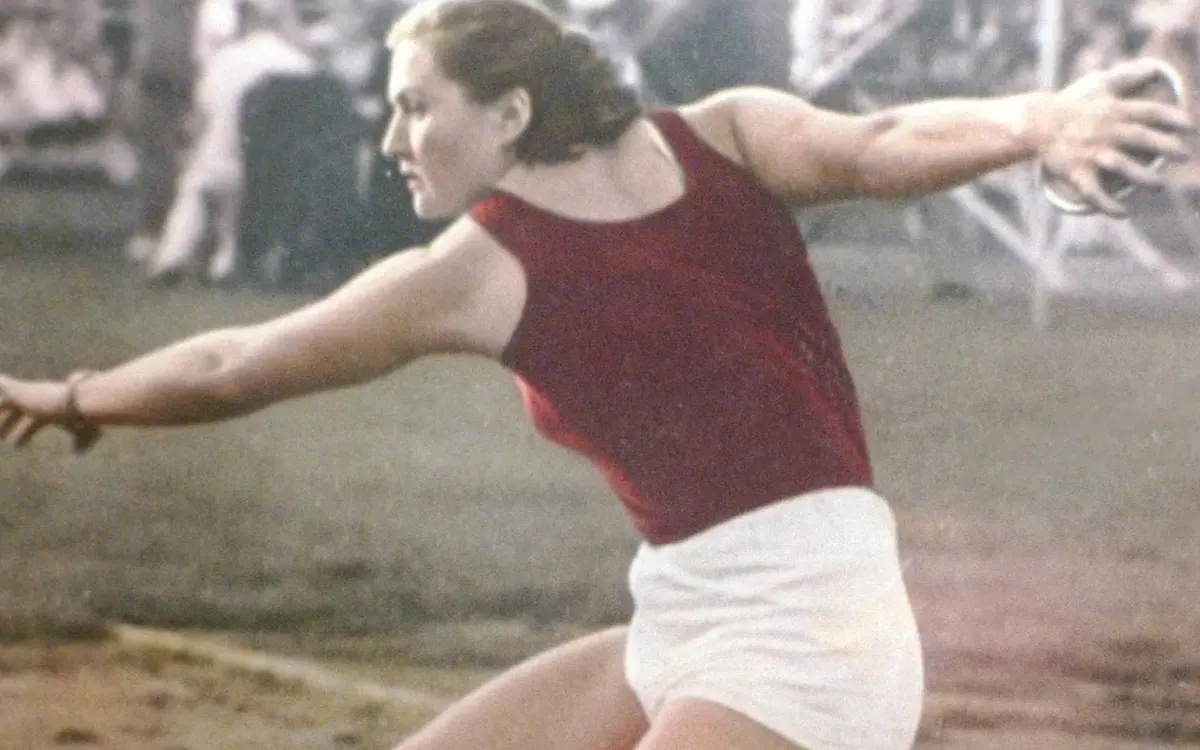
Before her grandiose anniversary, this modest woman with kind, luminous eyes did not live for 2.5 years. I met her several times in Biryulev. In the late 90s, she moved there from Ukraine, where her pensions were not enough even to pay for utilities. With a backpack behind her back and two sticks, she went to the store and always smiled at everyone. Unfortunately, no one recognized the legendary athlete, whom the foreign press invariably called the "Iron Lady."
In 2013, Nina Apollonovna, who was overlapping in Helsinki-52, Olympic Record, who lasted 16 years, was installed on the alley of the glory of CSKA. However, the surname of the drive thrower, which won the first Olympic gold in the history of the USSR at debut games, could not name any of the 30 people interviewed by me today. 22 found it difficult to answer, and eight considered that Larisa Latynina was the “pioneer”. The Great Gymnast, of course, is the owner of one of the largest collections of Olympic awards. But her career will begin in Melbourne, where Ponomareva, by the way, will again ascend to the pedestal. True, there will be the third. “She broke the groin muscles at a warm-up, barely woking into the sector,” the country’s eight-time champion explained later, who, moreover, had to sit in prison in prison in prison in the London apartment of a linden accusation of the theft of a rim with feathers in a prison.
The scandal reached Khrushchev himself after the English newspaper went out with the arshin heading “Ponomarev to Australia does not go to Australia, the Soviet team loses the gold medal!”. It was clear to everyone that this was an ordinary provocation. The “mistake” of the athlete was only in one thing: she forgot to take a check at the box office. “After all the interrogations and ships, it turned out that three shillings puffed me up. But you can’t imagine that I suffered. They arrested me. Under the windows of the crowd of reporters. On the nervous ground began to itch and turn gray. At 27, ”Nina Apollonovna described the“ foggy ”conclusion.
Her life is generally a story of overcoming. Grandfather Ponomareva was a regent of the church choir. Mom is "kulak rash." And the future thrower of the disk was born in 1929 in the Sverdlovsk Gulag. In the hut for a hundred people. For seven years, Little Nina was serving a term with her parents, thinking that they went of goodwill to blame the forest. Then a small peaceful period and - war. The father will go to the front, mom will leave as a nurse to the Far East. Nina will remain in Essentuki, in the Cossack village under the supervision of her grandmother. Those memories are hard to read: “They ate as they could, tried to feed the younger ones primarily. There were no men left, we had to fold the hay and twist the stones in order to ground the torment. But they survived. "
Despite the hungry and cold childhood, a beeing brisk girl with a powerful brush and a huge scale of her hands had a unique one. And it was as if created for ancient fun, which, according to myths, was fond of the radiant Apollo.
Although Ponomarev’s sport plunged by current standards too late. And absolutely by chance. She worked as a saleswoman in a store, and she was asked to run around the city cross. With fright, without any technique and training, in clothes, from which other participants almost got from laughter, 18-year-old Nina finished the third. She was announced to the local Spartakiad, where she devoted everyone in throwing grenades and pushing the nucleus. And the disk almost knocked down the judge. A little later, she was persuaded to start in regional competitions in Stavropol, where she was noticed by the capital's specialists. In 1949, a student of the Pedagogical Institute will reach the bronze of the country's championship and move to Moscow.
She was lucky with the coach: Dmitry Markov, who raised many beautiful athletes, took up Nina's training seriously. After a couple of years, she will turn into a champion of the Union, having overcome the world record holder and the favorite of Lavrenty Beria Dumbadze, with whom there is a version, Wuchetich sculpted the figure of the Motherland-Mother.
However, for games-52 there was a capture from the Urals, as Ponomareva called herself, she rode the third number. The party and the government laid the main hopes on Dumbadze and Bagryantsev. The qualifications of everyone slipped easily, but in the final, two of our leaders did not work out in an unusual environment. The whistle and the scream of the audience interfered, who, with rattles in the hands of a hundred-thousandth stadium, were not at all in advance. Fleeing from the noise, in the breaks between the throws, Nina was wrapped in a blanket. Dumbadze threw 46.29 meters, Bagryantsev - 47.08. Foreign competitors did not flash either. Ponomareva later recalled: “I am in a panic. Experienced friends trembled. What am I? But I release the disk. I look - jerked, but then began to level out. It seemed to fly an eternity. It falls - the stands are roaring. 51.42 - Olympic record. But the realization of what won came only on the pedestal when the heavy golden circle squeezed in her hand. Tears rolled out of the eyes. " And nearby stood Nina Dumbadze and Elizaveta Bagryantseva. We will no longer see such a triple triumph performed by our throws at the Olympiads. By the way, for that victory, the first owner of the highest award did not pay a penny. But in the capital of Finland, Adi Dassler himself was removed from her foot, surprised by her antediluvian rubber slippers in which she performed.

After Helsinki, Nina Ponomareva will beat the planetary record at the tournament in Odessa, win the European Forum, and after bronze in Melbourne will begin to prepare for the Olympics in Rome, where he will not meet serious resistance. She will “throw” the silver medalist by 2.5 meters and will become the author of the new Olympic achievement - 55.10. “It could have twisted it better, but rain confused the cards,” two -time champion will tell reporters. By the way, with this Roman result, in the current championship of Russia, she would have claimed medals.
In 1964, at his fourth (!) Games in Tokyo, the 35-year-old disco-bow will take only 11th place, but with its wise tips will help the eternal rival and teammate Tamara Press to win gold.
After that, the outstanding athlete, whose records many experts still consider real and unsurpassed, as they were mined in the non -steroidal era, when they did not use anything more vigorously than coffee, will be raised by young talents in Kyiv.
Unfortunately, her personal life will not work out. The first marriage with the hammer of Romashkov will last only a couple of weeks. She will also not find mutual understanding with the doctor Vladimir Garin, but she will give birth to the son of Alexander.
And in 1994, at the age of 65, the gray-haired queen will again enter the sector. And the veteran championship of the world will win in Australia, both in disk and in the nucleus. And it will be very sorry that it will not be invited to the anniversary tournament dedicated to the 50th anniversary of the Olympics in Helsinki.

PS
Many athletes from Ponomareva’s generation sold their awards. Nina Apollonovna, despite all the difficulties, did not think about it and always emphasized: "These are medals not only mine, but the whole country."