
Translated material
"I spoke on behalf of Russia"
May 7 - centenary from the birth of Boris Abramovich Slutsky
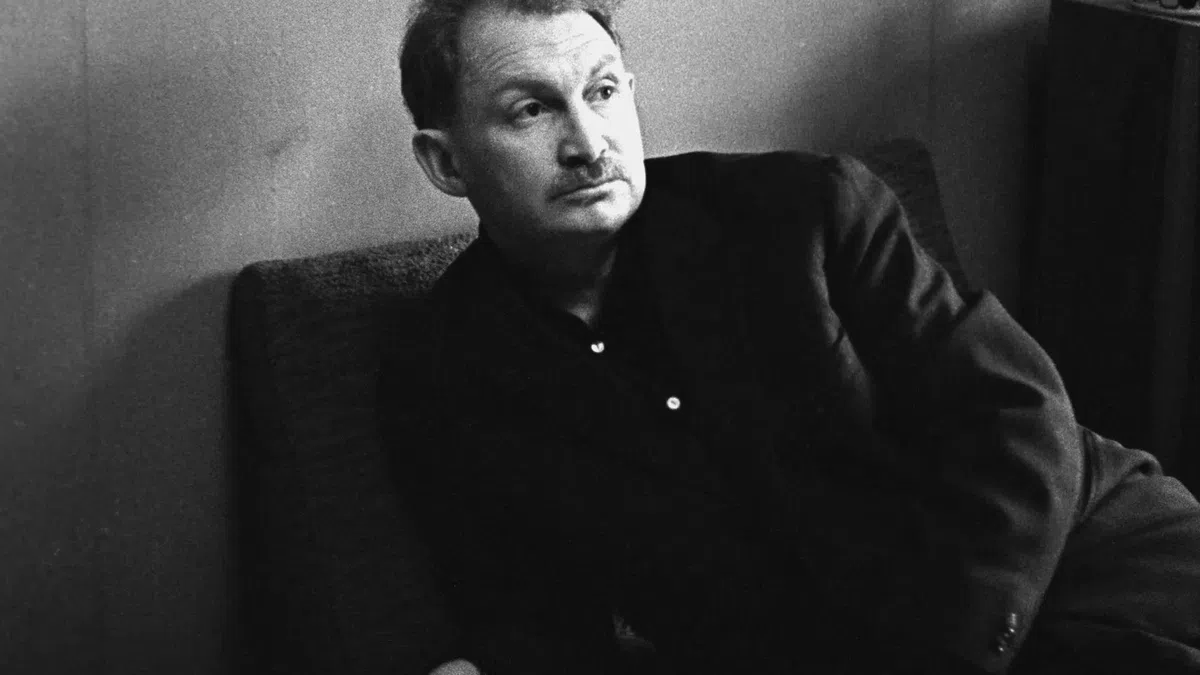
Today is the year of Boris Slutsky, the great poet and a great citizen. He privatized the country, tearing it out of Stalin's hands. I mean not only (and not so much) legendary, textbook poems “God” and “master”, but the entire poetic range: a rare coincidence of the scale of the personality and talent.
For unanimity, not the time has not yet come in the assessment, but is that the point? It is always difficult with great ones. “Our everything” was recognized as such only in the second half of the 19th century, and the monument to him, Pushkin, was open, as you know, in 1880, 43 years after death. Leo Tolstoy got his title during his lifetime. An uneven movement towards the pedestal in each individual case can probably be explained. But a general pattern? I'm not even sure if she is at all.
The heir to the well-read Khlebnikov (poet for poets), Mayakovsky and the entire Russian avant-garde of the early 20s of the 20th century, Slutsky brought his own innovation to the marginal perfection-to the proprietary uniqueness of the handwriting and recognition of his stanza, by binomotion, on a separate line. It was obvious during his lifetime. Just as the sharp individuality of vocabulary is a spoken language with all the characteristic stratumations of the era. And the mutual shift of the two linguistic elements:
It seems that Slutsky knew more about himself than his readers and admirers.
He touched, by logic, everyone and everyone. But how many tried to dodge, or even sing a formidable, inexorable power as a beneficial. B.A. He took his personal fate as a poetic mission: only the truth and nothing but the truth, no matter how cruel it sounds.
Over the years, his lyrical epic not only did not fade, but gained features of fullness and completeness.
The comprehension of Slutsky today is quite active, although pointedly. The greatest advancedness in poetics is the most important thing for the poet. In appearance, a simple hand extended behind the book, anyone who knows the letter, let something know something, let something will understand from through the democratic and humanistic author. In essence, everything is very difficult. The sophisticated poetics of Slutsky pretends to be absent, and this is already an object for researchers. Dmitry Sukharev made a lot in this direction, a jealous and tireless propagandist B.A. I would only be “hidden” (good word) not to the poetics itself (it is not that hides, but does not show itself) - but to numerous human portraits, not replaced, although written about specific people. You can guess about some prototypes, alas, there are no others: the context of B.A. Almost extinct (except for students). This is one of the omissions of Yu. Boldyrev, the executor of Slutsky, praised and interrupted for his honor. I will say about others below.
The failure of the names is from the delicate, delicate sympathy of B.A. To any person. He is ready to regret even his own enemy, even a villain. He is a universal Hospital in poetry and in life. When my husband died, David Samoilov, our youngest son Paul suddenly said: “If Slutsky was alive and healthy, the life of our family would have developed much easier.” Still! Only now no one else but B.A., in this place I can not imagine. Slutsky is indispensable in all his hypostles. “There are no people like me,” Velimir Khlebnikov said about himself. Slutsky could say the same about himself. Yes, he said - in verses. Looking out the windows of a neighboring house, where “maybe twenty biographies”, he claims:
The vastness of Slutsky’s theme and always inherent in him, but inexhaustible in all new and new massifs of previously unpublished verses: from generals and events, Stalin, Great War, Terror, the construction and decline of the empire, ideals and their loss to the smallest details of the life and morals of the Soviet country, is amazing.
He wrote about himself and his poetry, perhaps, everything. Critics have nothing to do, except how to quote:
The saturated density of the verse, exceptional content - it, however, is not always easy to see in posthumous publications. With the hard hand of Yu. Boldyrev, they are served with an undivided lump: good, medium poems, sketches, draft sketches. I argued in due time with Yuri Leonardovich: it is impossible, it is disrespect to both the poet and the reader. But his answer was one: "Nothing, nothing." He wanted more as soon as possible. And this would still be nothing, but to destroy the dates under the verses (according to the testimony of the literary critic Vladimir Ognev), hence the legend that B.A. They did not put them). Questions of questions: are they in “barn books” - this is how Slutsky called the large format of notebooks, interwoven in the Tember or Safyan, where he recorded poems. Or maybe dates were indicated in typewriting? Then they are lost.
As always, for everything Slutsky answered himself:
The metaphysical basis, existential orientation - this is what B.A. does. classic.
The first to understand the uniqueness of the poetic voice of Slutsky Joseph Brodsky. In conversations with Valentina Polukhina, he said: "It was Slutsky who almost alone changed the sound of post -war Russian poetry." Whether he, the singer of catastrophism of being, was not to hear the tragic essence of the worldview of the senior fellow: “This poet really spoke the language of the 20th century. Its intonation is tough, tragic and impassive - a way that the survivor calmly tells, if he wants, about how and what he survived. ”
B.A. I did not consider myself a loner. As evidenced by the gift inscription on the book Modern Stories (1969) David Samoilov: "Deziku in memory of how you and I deformed this poetry." The closest friends and furious antagonists in the manner of living and writing, they stood against each other to death, protecting each of their positions. Just like Luther: "I stand on that and I can’t otherwise." Who could? All overcoming love and close mutual interest in what “friend and opponent” writes, did not allow them to disperse and break down to the end. Constantly transferred by verses addressed to each other. They wrote poetry on similar, nearby topics (this is where unconscious bins for the analysis of different poetic systems). Considerations of the ethical order (belonging to one of the interested parties) do not allow me to develop this topic, but the fact that it needs a thorough and impartial study is as if obvious. Samoilov and Slutsky died on the same day - February 23, their military holiday, with a difference of four years - just for the duration of the war. The last poem in this duet belongs to Samoilov and is written after the death of B.A. It is long, I will give the first stanza:
Slutsky is a poet of sharp and exact formulas. The main one:
“We” here does not mean either belonging to the front -line poetic generation, nor to the front -line fraternity. Personal self -awareness merges with the universal. The people, deadly insulted by the non -recognition of his feat to save the Fatherland, answered the authorities with total indifference. At the deep level, it will last until the last generation of children of war, remembering it is not from the stories, does not leave the stage. Because genetic memory is stronger than any other. The people, if they are silent, are always on business. Slutsky as a poet is deeply folk, you can’t spend it on meakin, and this foresaw:
That's why he was silent. Having said everything in such a quantitative expression that it would be enough for two or three poets. Then only graphomania could be. Thank God, he was fired from this shame.
Now about the other, the main stereotypes of the perception of the life of B.A., who strengthened in the collective consciousness.
Participation in Pasternakovsky history. It was so minimal and innocent that it would have passed without a trace if B.A. With his aggravated conscience, fire did not cause fire on himself. Although it was declared: “We will recall by namely everyone who raised his hand,” they did not remember anyone else, and B.A. They also honored those who did not risk their well -being on a little finger. And he only said that it is better to print in his homeland. But in the wrong place and not at that time. So he didn’t choose them. And it's time to remove from him this stigma of the enemy of Pasternak. Let himself presented the score according to the fullest program (the poet against the poet) and repented for a long time, eagerly both in verses and in conversations. You can see differently in a different way: did Slutsky’s repentance save the honor of the Russian intelligentsia, at the direction of the official instances of those who unleashed the injuries of the “celestial” and “renegade”? And what else could you do in those conditions?
Consider participation in the Pasternakovsky judgment by the cause of B.A. At least absurd. After that, he lived and fruitfully worked for another nineteen years. Another cause of B.A. They call the disease and death of the wife - a nearby occasion, yes. Significant, but not the basis for leaving the arena of active actions. He himself put it to the forefront, so as not to give food for projection, again out of pride: even with his illness he wanted to conduct himself. And he knew the human breed well: they say that he loved her so much that he could not survive untimely leaving. It is quite understandable and assumed by standard thinking. It turned out as planned. “Life is for everyone, for all, among all” was interrupted due to rejoicing: an attempt to obscure from the grief with the same poetry, its powerful emission. Try to write two hundred poems in a short time and not exhausted. This superman, apparently, does not exist in nature.
There was one more, extremely important circumstance: Slutsky would not be himself if he had not blamed his wife’s illness and death (... I was alive and you died). This self -assembled punishment was unbearable.
Hence the piercing power of the lyrical verses facing Tanya. Almost ancient in simplicity and artlessness.
And Tanya was an ordinary woman with one rare gift - the ability to enjoy life. Her life proceeded outside the interests of her husband, his obsession with poetry.
"Tanka, like every healthy person, falls asleep when I read poetry to her." (Slutsky - Peter Gorelik)
Whether he had a need for another female nature, capable of becoming a friend and interlocutor. And it was, and was carried out. This secret of her whole life came into the light itself, writing memoirs, which included in the collection “Boris Slutsky. Memories of contemporaries ”(Neva, 2005). Natalya Petrova, wife of the artist-tint, Nikolai Barmina-everything that is known about her. By high chastity, B.A., this is not an adultery and is not a double life at all. Just a secret that is not needed to be flooded at all airport corners and at the CDL tables. In addition to the text that Petrova herself leads, I caught the eye of another one - exactly to her:
I return to date. “There is no harmony, there are no melodies, everyone rushes into the buffet.” On the gloomy background of our affairs, I wanted to arrange a celebration in honor of B.A. Watering and brighter - in the Hall of Tchaikovsky. I saw a stretch across the garden-triumphal: "I spoke on behalf of Russia." But the number did not pass. Somehow I did not take into account that only one person can now speak on behalf of Russia. “There has never been this, and here again” (according to the immortal expression of Chernomyrdin). The Hall of Tchaikovsky in the person of its general director A.A. Shalashova did not even deign to give a response to the letter of a confused letter with a statement of the concept of a creative evening and the approximate composition of the participants. Well, the objectionability of Slutsky, the inappropriate of him to the prevailing sociocultural circumstances is an important symptom. “We must think, not smile, you have to read smart books.” Here we read Slutsky, we have it books. “As long as they cry over the verses,” not everything is lost yet. Sky and tears life -giving moisture, perhaps, will soften our hearts that stale under the pressure of artificially pumped absurdity. And we will remember: our predecessors were much worse and harder to maintain both courage and hope. Slutsky so formulated his cherished desire: "But I want to be elongated scrap, who was in the future to exhausted the move." Scrap, by the way, a tool of labor, and not a staff for wall and suffering.
Galina Medvedeva -
Especially for "new"