
Translated material
Do not think about blockade
For what "patriots" want to punish the writer Elena Chizhov
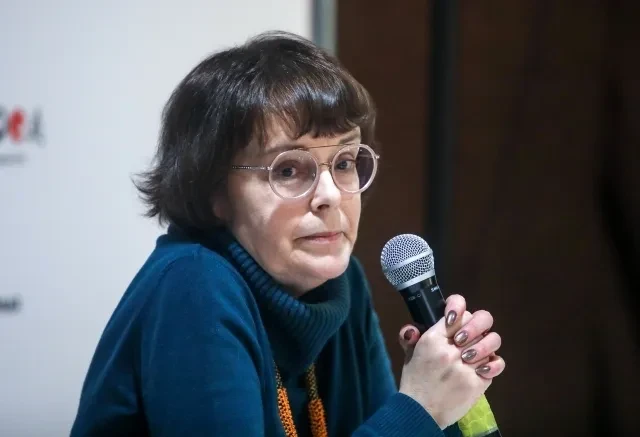
We are brewing a new “blockade”. Conditionally, the first such “business” can be called the case of the Rain TV channel. Five years ago, due to the discussion on the air, whether it was worth “holding” the city at the cost of so many lives (today it is known that more than a million people died in the blockade), the channel was on the verge of closing.
Since then, the map of “disrespect for the blocked feat of the people” played an infinite number of times-in propaganda current shows, political debate, simply in order to infringe on the objectionable ones (recall the scandal with the film by Alexei Krasovsky, which is dedicated to the inside of the blockade life). But we are talking about a case against a particular private person who allowed himself to neglect the heroic rhetoric and say about the responsibility of the Soviet leadership for what happened then, it seems, comes in for the first time. And this, in any case, is an important precedent.
“Political scientist, political strategist, public figure” (as she certifies herself on social networks) Natalya Eliseeva wrote a letter to the Investigative Committee to check Elena Chizhova, a famous writer, laureate of the Buker Prize. According to Eliseeva, Chizhov should be attracted no less than the “rehabilitation of Nazism” (Article 354.1 of the Criminal Code of the Russian Federation). The communist functionary Zyuganov and the patriotic fiction writer of the elderly also performed with passionate denunciations of Chizhova.
REFERENCE
Elena Chizhova - St. Petersburg prose writer, author of the novels “Lavra”, “Time of Women”, “Half -Book”, “Planet of Mushrooms”, “Kitaist”, “City written from memory”. Laureate of literary prizes "Northern Palmieri" (2001) and Russian booker (2009).
The reason for all this is an article that Elena Chizhova wrote for the Swiss newspaper Neue Zurcher Zeitung ("New" publishes an essay in Russian with the consent of Elena Chizhova). This is a tense and sad text about the neglect of the blockage theme, about the strange spot of muddiness in which she is.
Chizhova reflects on why, in any case, in the first year of the blockade, the city was left to the mercy of fate. Why, she writes, despite the fact that in the blockage of the city from a large land, the compositions with metal for the Leningrad military plants still reached the city’s supply of products at least in quantities compatible with life?
In this, the writer sees intent. “In the eyes of Stalin, Leningrad is an object of crystal, without any extraneous impurities of hatred. I think that its reason is a sense of self -esteem of Leningraders, the ability to independently think, which, to strengthen their God -like power, should be pulled out with the root. Destroy once and for all. "
And then, it turns out, the “author” of the blockade catastrophe is not only Hitler, who decided to take the city with great, but also Stalin,
Which consciously and even deliberately allowed this tragedy to turn around.
These considerations can be controversial, but it is still worth noting that Chizhova offers them not as a third -party observer, for whom the tragedy of the past is simply material for self -expression, but as a person, this tragedy is affected. She - from the family of blockade and from childhood remembers the squeezed rare talk about what had happened, which she rather overheard than she heard. “Now I understand that the blocked memory of my relatives was locked with double constipation: outside and inside. From the inside, because the blockade is pain that is difficult and scary to talk about; Outside, because they were tormented by the fear of saying “something superfluous”: even during the war, the topic of the blockade became the censitive. ”
In relation to the blockade, the modern Russian state inherits the Soviet one, only the form of censorship has undergone modernization. The goal is not to rejoice the number of the dead (the numbers were open to restructuring) and conceal the most terrible facts (only recently several important and strict studies of the blockade have been released), and to create and impose a certain picture of the blockade, its only legend - and stop any attempt to go beyond its framework, and any attempt to think.
“With which version of the blockade to coexist, does the poet and anthropologist Polina Barskova asks - with the version of an impeccable feat? Humanitarian catastrophe? With a multiple narrative, where human valor and human weakness constantly coexist? ” But instead of these natural and productive doubts and searches, we are imposed on us, a simplified image that should be held.
The blockade must think that this is a feat, and the feat is collective and in many ways state.
And for anyone who will at least clearly think in a different way, there will be his “political scientist, political strategist, public figure”, ready to customize the application in the UK,
And there they have and the appropriate article is prepared.
Chizhova writes that, as a congratulation on the New Year, the Blockade Society, financed by the city authorities, gave her mother three packs of crackers. Remembering “blockade bread” in this sees some kind of monstrous hint, mockery. But this, I am sure, are just indifference and exactly that unconsciousness. The memory reduced to the manual turns into a fossil, which is put on public display on the right day of the calendar.
Under a layer of varnish, memory does not survive.
REACTION
Application of the Pen-club of St. Petersburg
“ It is not a topic of memory, more precisely, the competition of two memories - the official, state, on the one hand, and the lower, folk, on the other, excited the prosecutors of Elena Chizhova. They were removed from equilibrium by several phrases in which the author of the article has personal responsibility for the blockade tragedy not only on Hitler, but also to another “monster dictator”-Stalin. Elena Chizhova believes that Stalin hated Leningrad and Leningraders and saw in the blockade the opportunity to deal with the city. Different points of view are possible here, but one thing is undoubted: Stalin lies monstrous responsibility for military failures, the result of which was the blockade. Stalin and the Stalinist regime as a whole did not give a damn about life, on the possibility of survival not only of Leningraders, but also of all his subjects. However, the post -war destruction of the Museum of the History of the Blockade and its collection shows that if not to Leningrad itself, then to his feat, to an attempt to perpetuate this feat, Stalin was at least hostilely. <...>
Most importantly, the center of gravity of the article is not a block past, but a modern “memory policy”. <...> Elena Chizhova honestly formulated her position as a Petersburger, as an artist, as a person whose family experienced a blockade. Honesty does not need justification, but deserves understanding and respect "
Full text
Under the appeal are signatures of 37 writers, literary critics and publishers of St. Petersburg. Moscow colleagues joined the authors of the letter.