
Translated material
Advanced detachments of "temple building"
Why is the Russian Orthodox Church so important to affirm the cult structures precisely in the centers of cities: the religious scholar explains
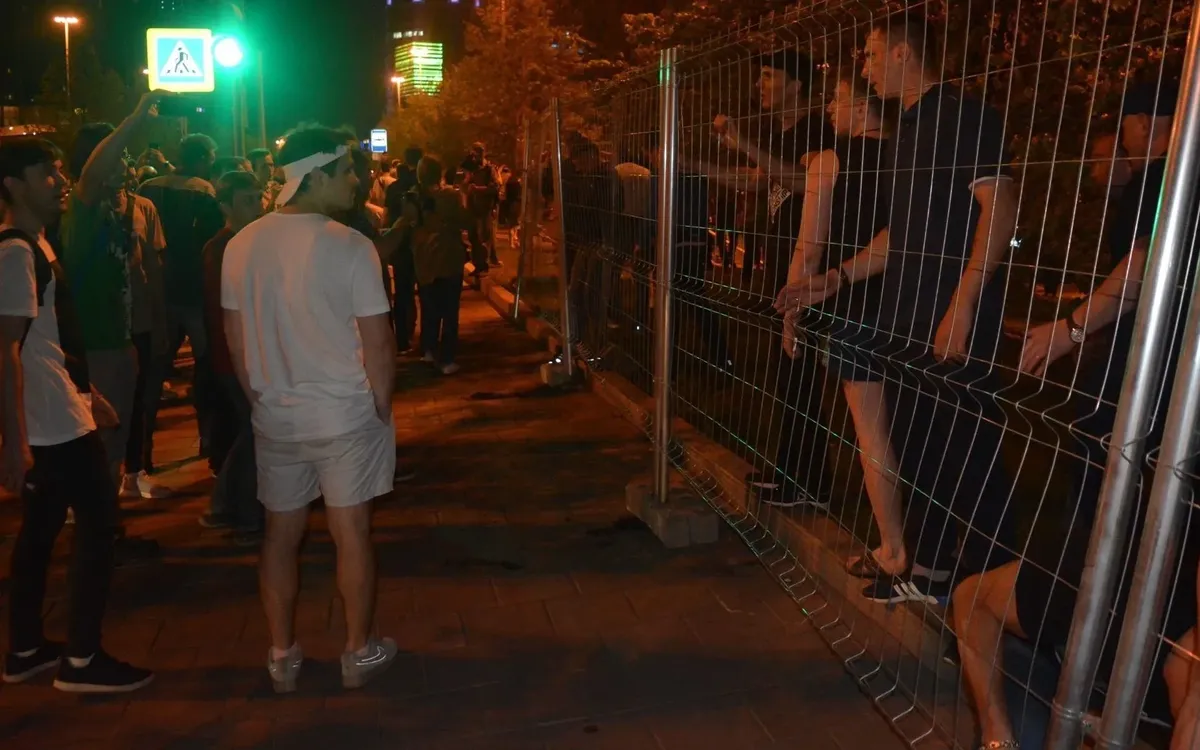
On the night of May 14, young people of sports physique (in a neighboring country, they are called “titles”) squeezed civilians from the city near the Drama Theater in the center of Yekaterinburg. For several years, residents have been opposed to the plans of the authorities and local metallurgical companies to build a square, as it were, church objects. Among the "athletes" who were fighting for the "triumph of the Orthodox faith", was Magomet Ramazanovich Kurbanov - the world champion among young people according to WBO. He was helped by associates from the Academy of Martial Arts of the Russian Copper Company and employees of some private security companies. Of course, there were no peaceful protesters of worthy arguments to answer the “athletes”, and the police and the Russian Guard did not intervene in what was happening.
The Russian Orthodox Church recently suffered two symbolic defeats from civilian activists, whom she calls the “templers”, in two capitals-Moscow and St. Petersburg.
Despite the intimidation and criminal cases, the residents of the Losinoostrovsky district of Moscow were able to block the construction of the temple in the Koropyanka park, where paramilitarian groups such as “forty forty” (SS), “Veterans of Donbass” and various “Cossacks” also performed on the side of the Russian Orthodox Church. The authorities ultimately allocated the Russian Orthodox Church an alternative site, although the rearguard battles on the Torfyanka are still ongoing.
In St. Petersburg, the local Metropolitan Barsonofius failed to get the Isaacievsky Cathedral, which the local governor has already ordered the ownership of the Russian Orthodox Church. But the protest acquired a “federal scale”, and from the Kremlin was an instruction to take it back. As a result, Metropolitan Barsonofius lost the position of manager of the Patriarchate of Affairs - the second to the table of ranks in the administrative vertical of the Russian Orthodox Church.
Against this background, the battle in the Ural capital acquires a fundamental character, the church side expects to “take revenge” here. Similar moods are facilitated by the extremely warlike position of the local Metropolitan Cyril (tip), who consciously goes to exacerbation. For example, on the evening of May 14, knowing about the plans of the protesters, he appointed a prayer service in the focus of the confrontation. And in the week of the triumph of Orthodoxy, in March of this year, to the rally for the temple, Kirill gathered in Yekaterinburg the stars of pop and cinema-Mikhail Galustyan, Sergey Bezrukov, Mikhail Porechenkov and Alexei Chadov.
Why is it so important for the metropolitan to build this temple in the central square of the city? Such standards for the behavior of diocesan bishops were set by Patriarch Kirill (Gundyaev). Having proclaimed his “program 600” in 2009 to build the maximum number of free sections of Moscow with temples and other objects of the Russian Orthodox Church, he began to demand the same actions - on a more modest scale, of course, from diocesan bishops. The main criterion for their success in the eyes of the Patriarch, and therefore career prospects, is the construction of new temples, especially majestic cathedrals. Metropolitan Cyril came to the Urals from Central Russia, and he has great ambitions.
And the Patriarch himself pays special attention to Yekaterinburg - last year he even held a meeting of the Synod in the Ural capital. This city is important in the symbolic structure of the Russian Orthodox Church as a place of the mystical victim of Tsar Nicholas II, revered by the conservative part of the clergy and laity as the “main holy Rus'”. It is the Yekaterinburg diocese that is the center of “tsarboy” - the mystical current within the Russian Orthodox Church, whose followers revere Nicholas II as the “Redeemer of the sins of the Russian people”. Such monarchical sentiments (unlike liberal and reformal, of course) find understanding and sympathy among ideologists of the current Russian regime, are seen as one of the “spiritual bastards”.
But the Yekaterinburg confrontation also has a purely financial background. Thanks to the efforts of Patriarch Kirill, his namesake-Metropolitan and the Sverdlovsk governor by the sponsors of the construction of the church of St. Catherine - of course, “the largest in the Urals” - agreed to become the main industrial giants of the region. Especially for the construction of the authorities and the diocese, they established several commercial companies accumulating “donations” to the temple.
On the scale of the Yekaterinburg diocese, this is a real “project of the century”, on the implementation of which the earthly well -being of hundreds of people depends. Moreover, part of the funds has already been received and mastered, so "nowhere to retreat."
The naked eye shows how the attendance of temples fell sharply in Russia in recent years.
In the Easter of this year in 140 millionth Russia, half as many people came to the temples than in 40 millionth Ukraine.
After a series of destructive for the reputation of the Moscow Patriarchate of scandals, this structure in the minds of a significant part of Russians began to be associated with corrupt officials. Obviously, the protests against the “Temply” are opposition, and they often (as it was in Moscow and St. Petersburg) sound political slogans. However, the church is nominally separated in Russia from the state, so the authorities still do not equate protests against the activities of the Russian Orthodox Church. The struggle for nature against pathos construction is one of the few still permitted to some extent protest zones. Therefore, various protest moods are focused on this site, far from always directly related to the Russian Orthodox Church. And the authorities willingly “surrender” the Russian Orthodox Church as a protesting (as it was in the same Petersburg), if in exchange you can get a portion of loyalty.
In the meantime, the “temple builders” saw budgets, and the opposition is undermining the spiritual basis of the regime through the discrediting of the Russian Orthodox Church, thousands of temples continue to collapse in the giant expanses of Russia. Basically, rural, abandoned - nobody needs them, on church sidelines they are called "unprofitable." And this is the most accurate diagnosis to all these patriarchal “600 programs”.