
Translated material
Putin needs Trump: against Iran or China?
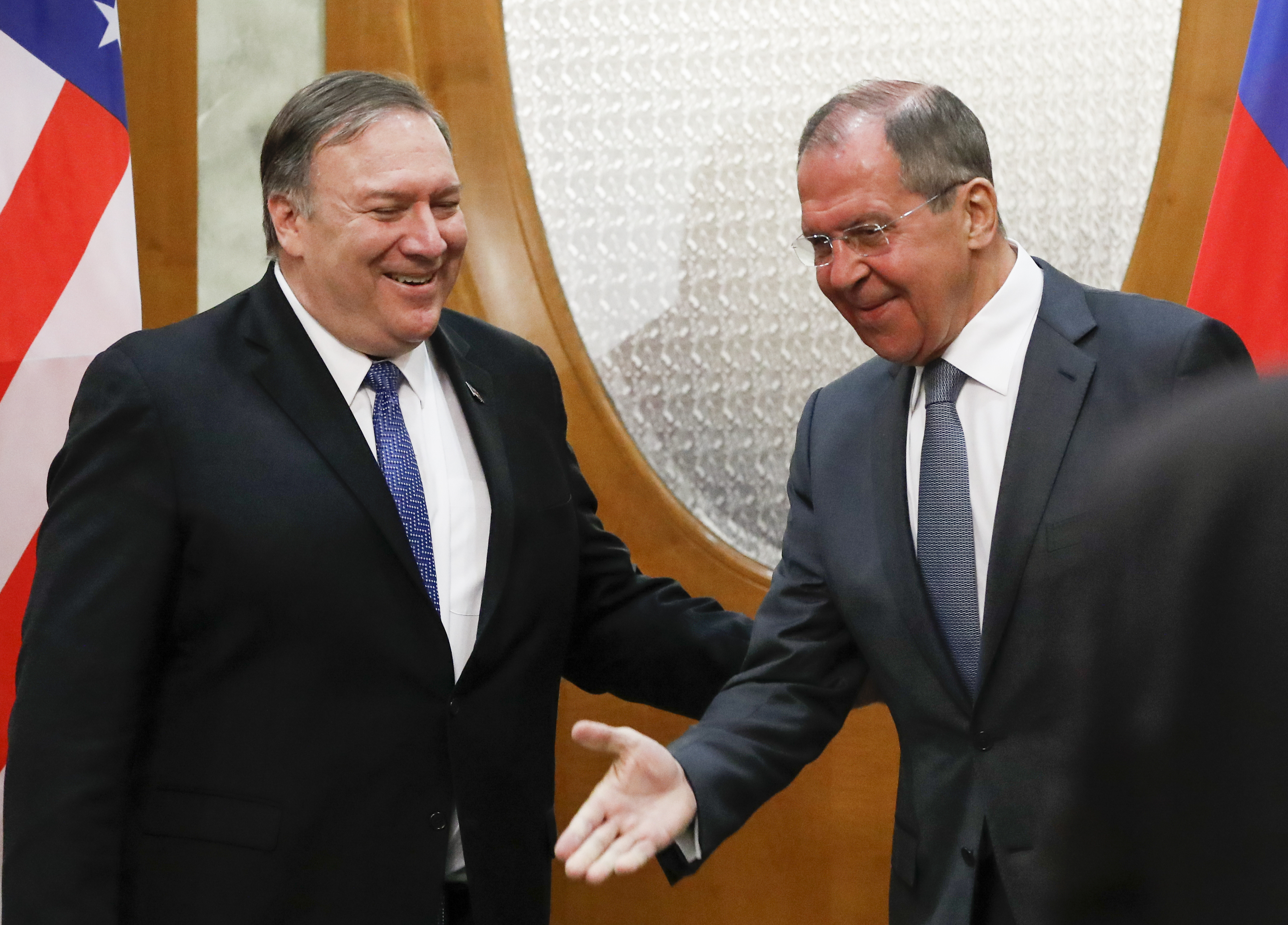
Meeting of the Foreign Minister of the Russian Federation and US Secretary of State in Sochi. Relations of Russia, the United States and China are discussing George Kunadze, Pavel Litvinov, Alexei Portan
US Secretary of State Mike Pompeo flew to Sochi for negotiations with the Russian Foreign Minister Sergei Lavrov and Russian President Vladimir Putin. We are talking about the prospect of a meeting of Russian and American presidents Vladimir Putin and Donald Trump at the G20 summit in Japanese Osaka.
The background for negotiations is: the trade war of China and the USA, the US pressure on Iran, the confrontation of the Russian Federation and the USA in Venezuela, the problems of disarmament.
What is happening in the relationship of Russia, the United States and the PRC, the diplomat and historian Georgy Kunadze , our guest from the USA, human rights activist Pavel Litvinov , professor at Higher School, Alexei Portan , discussed the diplomat and historian.
Mikhail Sokolov is broadcast.
Video version of the programMikhail Sokolov: On May 14, US Secretary of State Mike Pompeo flew to Sochi to meet with Russian President Vladimir Putin and Russian Foreign Minister Sergei Lavrov. At the same time, Putin flew to a meeting on the VPK in the city of Akhtubinsk, Astrakhan region. Moreover, his plane was accompanied by Su-57 fighters. How negotiations began with the Russian Foreign Minister Sergei Lavrov, Reuters reports.

Meeting of the Foreign Minister of the Russian Federation and US Secretary of State in Sochi. Relations of Russia, the United States and China are discussing George Kunadze, Pavel Litvinov, Alexei Portan
The text of the copyWidth PX Height PX
The url has been copied to your clipboard
No Media Source Currently Available
0:00 0:01:38Mikhail Sokolov: What is happening in the relationship of Russia, the USA and China, where in this crisis, our guests will be discussed. Before the meeting of Lavrov and Pompeo, I noticed that the negotiations of the heads of the Ministry of Foreign Affairs of Russia and China Sergey Lavrov and Van I. That is, it turns out that this date in Sochi was preceded by Russian-Chinese negotiations and consultations. Is this an accident, as the sources of the Foreign Ministry said, or so everything was actually conceived to build such a triangle?
George Kuzannes: I do not know how much this can be considered an accident. In my opinion, this is an expected accident, to some extent even a pattern. Ultimately, if you look from the outside, Russia has always strove to talk to it both Americans and the Chinese. And this has come true. The question is different: what Russia had to say to China and what she said in Sochi to the Americans now. In my opinion, there was nothing special to say.
Mikhail Sokolov: Now all this is happening, all these meetings, contacts with Moscow against the backdrop of the US trade war and China, exacerbation of relations, and raising customs duties. Is there such an anti -Chinese atmosphere in the United States? What is Donald Trump achieve here?
Pavel Litvinov: I do not know, the anti -Chinese atmosphere in the United States is not felt. Trump, of course, has a desire, most Americans, including me, support him specifically in this matter that it is necessary to improve relations with China in one specific issue - in the question of that China improves the conditions for American firms trading in China. A lot of things that China really does not like to do, promises verbally what it will do, and does not. Therefore, many times American presidents talked about these issues. Progress was, but insufficient. Trump is trying to do.
I just do not believe that Trump is suitable for this, but I wish him success. If he believes that he is right, he wants to achieve something, he loves to crush, without thinking about the position of his opponents, not understanding the consequences. He is not a diplomat, he is generally a limited person. Trump thinks that if America is stronger than China, then she has all the trump cards. And not all the trump cards. China produces half of all goods around the world, we must reckon with it. They are the Communists, they have their own authoritarian, totalitarian government, they want the people to respect that they are strong, strong. Therefore, when Trump pressed too much, they imposed their sanctions, the market fell, a lot of troubles occur. How Trump will come out of this is incomprehensible. Because this is a difficult question. All these questions are tied to the fact that doing the right things, but to do them wisely.
Mikhail Sokolov: In Sochi, they are in a hurry because such an interest in supporting Moscow in this crisis of relations between the USA and China, who will outplay whom? Is Russia's position important here or not?
Georgy Kuzannes: I do not think that in this case, the position of Russia has some kind of meaning, simply because it is a dispute between two great economic powers.
Mikhail Sokolov: And Russia is not great?
George Kuzannes: Russia, of course, is not a great power, at least in matters of the economy. Russia has nothing to offer the Chinese or the Americans. You said that if Trump believes that he is right, he is pressing. And in this regard, I have a question: there is at least one moment, one of some problem with which Trump believes that he is wrong?
Pavel Litvinov: Of course, he always believes that he is right. In this particular case, I wanted to focus the fact that he was talking with China, which is almost equal to America economically. Since America is the greatest power, he believes that everything will turn out in itself. He talked about it many times.
Mikhail Sokolov: With Korea did not work. Although it seems like America is great, and here is a small but nuclear power. And now, please, met, and nothing happened.
George Kuzannes: everything was expected.
Mikhail Sokolov: What is Trump achieved, what is China achieved? Is it not a dead end, this whole background on which we see Sochi negotiations? Some raised duties, others raised duties, and what's next?
Alexey Portan: First of all, I would like to remind you that this is happening between the United States and China not the first time during the presidential mandate Donald Trump. Each time there was a feeling that they were about to agree. Take at least their famous meeting in 2017 in Florida, when Trump invited Xi Jinping, then there were very loud agreements, everyone believed that they had agreed now, and everything would be fine. Literally a few months passed, and all these agreements scattered to fluff. Then all this was repeated several times. Public opinion was inclined to believe that two economic giants reached consent. In my opinion, maybe he is a subjective look, he will not be able to resolve disagreements to the end. Because if you look deeply, their positions are implacable. China absolutely seriously and firmly wants to become an economic and technological power number one. The goal is at least for the centenary of the People's Republic of China, that is, 2049, and possibly earlier. China has the famous China 2025 program, there are already indicated by 2025 a number of positions on which they should bypass the United States. This is just the first to not suit Trump, the Trump administration.
Trump is determined at all costs to prevent China’s breakthrough in the first place. For him, "America is the first" is a religion, this is what he believes and what he will pass away, God forbid him for many years. Trump uses any ways to combat China. Trade wars are a battle that occurs on the surface, but in the depths of the contradiction, which I just said, who will be the first power of economic and technological, it will not be possible to overcome these contradictions through negotiations. Therefore, I do not believe that they will fundamentally agree either now, in a month, or in three months.
Mikhail Sokolov: How does all this affect Russia? I saw that experts say that the fall in the ruble began. What else can happen as a result of this trade war of two giants with Russia?
Alexey Portan: Russia, of course, does not directly affect these processes, because Russia is a small economy in comparison with the United States and China. But the consequences are negative, like the whole world, Russia will feel. Maybe the consequences for Russia will be more negative, because we have a very narrow list of export products. The trade wars between giants are primarily reflected in world markets and in raw materials markets, including, even in the first place. Demand slows down, economic growth slows down, which means that the states will buy less oil, gas and other raw materials. And this is just the main article of our export. Therefore, if trading wars are delayed, China and the United States will mutually introduce serious duties, then, of course, this will affect the Russian economy, too, will negatively affect.
Mikhail Sokolov: Are the US and Trump looking for allies in Russia in this matter and in other matters? Still, the United States initiated this round of negotiations in Sochi.
George Kuzannes: Let's go from the contrary, I do not mean someone personally, but simply excluding incredible scenarios. Venezuela - Russia will not yield. Syria - Russia will not give in. Ukraine - Russia will not give in. The Northern Stream - 2 gas pipeline - Russia will not yield. In fact, Russia and the United States now do not have points of contact at which Russia could give something.
Mikhail Sokolov: And a nuclear disarmament, this agreement on missiles?
George Kuzanza: Of course, no. In other words, Russia can offer nothing but a chance for a beautiful photograph and for the most general reasoning, the United States cannot. What can the Americans offer? The sanctions will not yield. Venezuela, Syria, Ukraine, Crimea - the Americans are not ready for any of these stimuli, they can not do anything by and large.
Mikhail Sokolov: Do you mean that Trump, even if you wanted to, is it connected by Congress?
George Kuzunadze: Of course. At the same time, it is clear that Trump is now inspired by how he says that he was fully justified, his name is now beyond suspicion. This is not entirely like that, but nevertheless, he believes in it or pretends to believe. In this sense, Trump probably feels a little more free in terms of relations with Russia. But again, relations with Russia are a minefield for US domestic policy. A step to the right, a step to the left of Russia can have extremely unpleasant consequences for Trump. In this regard, I have the only question, except that the current trip of Pompeo in Europe and Russia to some extent is unexpected and incomprehensible what he wants. Why would he go to Moscow if everything is in Sochi.
Mikhail Sokolov: Did he fly to Brussels?
George Kuzannes: he flew into Brussels, where it seems to have not been waiting for him. If you compare this with the fact that the American aircraft carrier shock group is located in the Persian Gulf, if we recall that Iran is the problem in which Trump takes the most stringent position, in this connection I will not be surprised if there are assumptions that Pompeo’s trip to Europe and Russia is a prelude to some actions of the United States regarding Iran. Russia here seems to be a second row player simply because it cannot interfere, cannot stop and cannot agree. There are also no fields for compromises. Arrived - warned.
Mikhail Sokolov: Why still go to a minefield?
Pavel Litvinov: The situation in the United States is not at all as good as you might think. Trump knows that he is overlapping, that now the Democratic Congress continues to attack him. He completely unprecedented the attack on the separation of powers in the United States, practically does not give out documents, does not allow his subordinates to come to the House of Representatives, and answer questions. That is, this has never happened.
George Kuzannes: and most importantly, Müller does not show the full text.
Pavel Litvinov: Although from the text that was read, it is clear that Trump is actually guilty of the obstruction of the rule of law. This is proven, just Müller did not have the right to announce the instructions of the Prosecutor General, the Ministry of Justice that he was bringing accusatory conclusions to the president who is at the post. In the text, it is quite obvious that there are 10–20 points by which guilt has been proven. It is no coincidence that dozens of his assistants were imprisoned. Müller proved everything very carefully. Therefore, the fact that now the Congress dominated by the Democrats represents a very unpleasant situation. In addition, the elected campaign begins soon, Trump is afraid that if he does not win it, he will not only not become the president, after that you can put it in jail as a simple person. The only way is to create some crisis or the appearance of a crisis that will distract the attention of the people. Some small war, the American people can unite around the president. Or some success. Pressure on China - it was an attempt at this success.
Mikhail Sokolov: Now Iran, maybe the same?
Pavel Litvinov: Maybe. Everyone agreed, maybe besides Netanyahu that the agreement that Obama signed with Iran was reasonable, did not harm anyone, but created the potential to improve the situation in the Middle East, he canceled it. Iran put Iran and all Iranian bandits in a situation where they should also answer something or pretend that they are answering. That is, again, his absolute misunderstanding of problems, the desire to use problems only for his rating in order to get political success.
Mikhail Sokolov: Peter Zalmaev, a Ukrainian political scientist, writes very well that Trump replaces concepts. Because there really was no fact of a direct conspiracy between the campaign of Trump and Russia, but the document has many facts of Russia's interference in American elections. Although Trump claims that there was no intervention at all. It looks like a rather vulnerable position. A trip to Russia turns out such a line with untied hands: Müller's report has come out, you can now start a new round of this game. Alexey, please tell me, is there any economic field that Russia and the United States could reach or are there no common interests left here at all?
Alexey Portan: It is quite difficult to discern it, this is an economic field. Especially if we recall that no further than last spring I was invited to the State Duma twice when we developed response to the sanctions of the United States. There were the voices of some deputies to stop supplying the titanium to the United States. This, as they say, will spite my grandmother's ears to my own or a shot - this is the only way to qualify. It is clear that we will cause more economic damage from any such measure to ourselves than the United States.
The areas of cooperation with us, however, remain. This, of course, is space, this is the field of science, nuclear physics. But here a little the field has narrowed. Familiar scientists-nuclear scientists say that recently it has become much more difficult to go to the conference in the United States, and to speak there, and so on. From this we carry out certain damage. I wanted to make a small addition, as far as I remember, I asked what the United States from Russia would like in this situation. The United States has an idea, and a long -term order, to tear Russia from China. They are talking about this and now, John Bolton came here with these sentences some time ago, he explained in great detail why it is more profitable for us to get closer to the United States, and not with China. This is not possible, colleagues have already talked about it. I emphasize that this idea is long -term. Back in the 1970s, the great, I am not afraid of this epithet, Kissinger said that for the United States it is important that the distance of Washington-Moscow and Washington-Beijing is shorter than the distance Moscow-Beijing. What the United States is now striving for is, in principle, this absolutely fits into the idea that Henry Kissinger expressed almost 50 years ago.
Mikhail Sokolov: It turns out that sanctions, trade war are pushing Beijing into the arms of Moscow or, conversely, Moscow into the arms of Beijing?
Alexey Portan: Not Beijing in the arms of Moscow. Speaking in a seriously, we are the younger partner of Beijing, Beijing is absolutely aware of this. We do not always realize this or do not want to be aware. Therefore, rather, we are pushed into the arms of Beijing. But Beijing perfectly sees the situation that we have nowhere to go, we have no alternative, so we do not have to wait for particularly sincere and favorable victims from Beijing.
Mikhail Sokolov: The hugs will be Moscow - Beijing, friendship, as in 1957?
George Kuzannes: I do not expect such a scenario, and absolutely. Largely because constant allied relations are suggested by some permanent mutual obligations. That is, relatively speaking, if one ally was attacked, the other appears to his defense.
Mikhail Sokolov: And the "confrontation of hegemonism", as the Chinese say? By the way, yesterday the Chinese guest van and this said that hegemonism would be defeated.
George Kuzannes: if by this the United States is meant - this, of course, is not serious. I am not a big economist, but still I would suggest that the Trump administration will not win the current trade war with China. Look, the only leverage that they use is in essence is an increase in duties. Increasing duties on Chinese imports means raising prices for Chinese imported goods in the United States. That is, in other words, American consumers will pay for the sanctions that the US administration will pay.
Mikhail Sokolov: Will they like it?
Pavel Litvinov: No, they will not like it.
George Kuzannes: I think that sooner or later they will understand it. They will also understand because, according to very many commodity positions of an alternative, the Americans do not really have imports from China.
Pavel Litvinov: China is a real participant in world trade, the main participant practically. The United States in combination is a stronger state, both economic and military, but China is largely on equal terms, so it should be considered as close to it. It is necessary to force him to comply with the rules of the game that he does not fulfill, but it is impossible to quarrel with him. America cannot seriously quarrel. The fact that the market has fallen, the Americans react to this every second. My pension reacts to this. The falling market scares both businessmen and pensioners. The general decline of the economy will, of course, also damage Russia, but first of all it will damage the Americans, production in China will decrease. This can last long and inertia. Therefore, this is much more important than anyone will be the first in 2040 - this is not a question at all, no one thinks about it. They think about the free trade of mutually beneficial, primarily beneficial for their country. Therefore, Russia can participate in this if it is great economically, and it can threaten somewhere in Venezuela, in the Middle East or Syria, create crises, troubles, intervene in some way, with success or without success, in the election in Europe or in America. In fact, at a personal level, Trump clearly sympathizes with Putin, because he loves the authoritarian type of dictators or, at least, prone to authoritarian dictatorship. Yesterday he praised and accepted a man whom no one accepts in Europe - Orban Hungarian, who, in fact, from all of Eastern Europe, the most authoritarian dictator.
Mikhail Sokolov: Cool parties are like that.
Pavel Litvinov: with Putin a wonderful relationship. Trump never said a single bad word about Putin. There was not a single American president who did not say a lot of problems about the Soviet Union in some ways about the Soviet Union or about Russia. He never said. We can say that Putin has some kind of lever of Trump, I do not know this, although many suspect. But the main thing is that he really believes that he with Putin can support some balance, a conversation, at a personal level, Putin will support him and understand him. Another thing is that he cannot cancel sanctions without a congress, the congress will not cancel sanctions until the Russian invasion of Ukraine ceases. These are all dead ends.
Something can happen in Venezuela, regardless of the desire of America and Russia, simply because the people are close to the uprising, it is not clear how Maduro can restrain him because the country is starving, in a terrible position. And so, of course, it is nice to have support in Russia in a conflict with China, you can always find some kind of benefit.
Mikhail Sokolov: In Russia, very interesting things are happening, public consciousness, the impression that it has changed very sharply. I remember in the 1990s there were anti-Chinese sentiments. If you look at the survey now, you will see the opposite.
Poll on the streets of MoscowMikhail Sokolov: By the way, on the Internet we had a little more complicated, out of four options, it turned out that the European Union, along with the United States, was gaining a little more than the position from Alexander III “Army and Fleet”, that is, an independent position. And in its pure form, the ally of China would like to be only 6%. The street and the audience are very different.
Georgy Kuzannes: I think that the Internet audience is more free, less connected by some conventions. Some time ago I ended an article on the prospects of Russian-Chinese cooperation. I drew attention to the fact that Russia now in fact finally has become a raw materials appendage of China. When maintaining a tense relationship with the United States and European countries, Russia risks the same finally and irrevocably turn into the younger political partner of China - this is the first conclusion. The second is that Russian-Chinese trade this year is already a hundred billion dollars-this is a large amount, it has been balanced, but at the same time more than 80% of Russian exports to China are fuel, forest, hemp, and even there is. Somewhere a percent of two secret articles-apparently, the transfer of weapons, which makes no sense. In the export of China to Russia up to 90% industrial products. The structure of Russia's turnover with the European Union is almost completely repeated. In other words, the throw east, apparently, led to the fact that some part of Russian needs began to be satisfied at the expense of China. I wanted to say just about the American-Chinese relations. Somewhere in the 1970s, trade relations between the United States and Japan developed approximately the same way. In the same way, the Americans were unhappy with Japanese products, which was cheaper, better and more. Even in this war, despite the fact that Japan is one hundred percent junior ally of the United States, even in this trade war with their younger partner and ally, the Americans have not achieved success. The Japanese went to some one-time concessions. I think now China, developing its tactics and strategy in this so -called trade war, is very seriously studying the experience of Japan, which can now be in demand.
Mikhail Sokolov: I will return to the meeting in Sochi. Let us first look at the briefing of Lavrov: “The conversation with Pompeo was frank and useful. Russia is interested in normalizing dialogue with the United States. The potential of cooperation is not realized largely due to the fault of the predecessors of the current administration. The tension negatively affects the situation in the world, and we decided to move on to the practical steps to resolve the situation. We agreed to restore the communication channel of Moscow and Washington. After Müller’s report, the possibility of improving the relations of Russia and the USA - to establish a bilateral council of Russia. ” Pompeo was handed over a memorial note. We will continue consultations. There are many discrepancy between disarmament, but there is hope for an agreement. Russia advocates the continuation of the US dialogue - the DPRK. And she is interested in restoring a professional specific dialogue with the United States on strategic stability. Now, Georgy Friedrichovich, you, as a diplomat, must decipher all this from a bird's language to a human.
George Kuzanza: There is nothing to decipher here, continuous empty words. There is nothing really, by and large. When they say that we intend not to normalize the relationship, and to normalize the dialogue - this means that this is even lower than the relationship. There is really no dialogue. Russian foreign policy and American, a little to a lesser extent, but also - this is the foreign policy of slogans and high expectations.
Mikhail Sokolov: If there is an official proposal, Lavrov said, then the meeting in Sosoka between Trump and Putin, of course, will take place.
George Kuzannesze: I think they can’t be encountered somehow somewhere on the sidelines.
Pavel Litvinov: They just spoke on the phone for an hour and a half.
Mikhail Sokolov: They will also talk. Now Pompeo’s position: “The time has come to leave. The sanctions will be lifted with the DPRK after completing the agreements. We hope that the support of Maduro will stop from Russia. We hope that Russia will extend the hand of the new leadership of Ukraine and release Ukrainian sailors. They discussed with Lavrov’s control over weapons with the involvement of other countries to this issue. The United States will continue to put pressure on Iran so that it will return to the family of civilized Peoples wish.
George Kuzannesze: This moment about China’s participation in nuclear negotiations is a fairly new moment. This is important primarily because China all these decades very skillfully kept away from disputes about who has a more nuclear baton stronger. The Chinese have a large number of medium and low -range missiles, much fewer transcontinental missiles. In this sense, the Chinese succeeded that, in my opinion, no one succeeds. When the Americans suddenly put forward this thesis about China’s connection to nuclear negotiations, this is a new element that represents considerable, in my opinion, difficulties for Russia, China, and for the United States itself. Even if China simply agrees to consider or discuss this issue, it will be a very serious development, a new development. I doubt that the Chinese will go for it. They, having the second largest military budget in the world, can afford it undoubtedly. At the same time, the Chinese skillfully position themselves as a state of immeasurably weaker than the United States and Russia.
Mikhail Sokolov: The theme of Ukrainian sailors, and before arrival, Pompeo said that in Russia and China there are repressive practices. A return to these humanitarian issues, which was uncharacteristic for the Trump administration recently, to idealism in politics, can you please you as a human rights activist?
Pavel Litvinov: I am pleased with any mention of the problem of human rights. I must say that in Soviet times, starting from the time of the detachment, the arrival of Kissinger and Nixon, then even more by the time of Carter and Reagan, the issue of human rights and violation of all international obligations from Russia was one of the central issues. I repeat myself: who can believe the state who does not believe his own citizens, who cannot conduct dialogue with his own citizens?
I will give a small example that is extremely worried about me - the arrest and persecution of the historian Dmitriev, a completely innocent person, with cruel absurd accusations of pedophilia, which, of course, are terrifying all at once, no one wants to protect. Nothing proven. A man on the verge of holiness tried to restore the names of people who died as a result of the Stalinist repressions, so that everyone knew, a well -known slogan - "no one is forgotten, nothing is forgotten." We must remember our dead, without this we cannot. Преследованием Дмитриева, старого больного человека, с абсурдным обвинением, все больше и больше людей интересуется. Я приехал вместе с американским историком, священником Эриксоном, он поражался, что происходит с местами захоронений, с такими вопросами.
Трампа это не интересует нисколько. Но кроме Трампа есть люди в Конгрессе, есть американская общественность, которая в данном случае сыграет большую роль. Я надеюсь, что Трамп уйдет, и этот вопрос опять станет центральным. Киссинджер это понимал, несмотря на то что он тоже думал больше о геополитике. Я рад, что Помпео упомянул это. Приходят выборы, критика Трампа в области прав человека в любом месте может помешать в его выборах.
Россия, как и Советский Союз, позиционирует себя как великую державу, которая морально права. Китай даже об этом не говорит, ему надо стать великой державой экономически, это коммунистическая страна, секретная страна, они нарушают права человека, на Китай меньше влияет критика в вопросе прав человека, потому что их не считают, правильно или неправильно, одним из участников европейских ценностей. Путин себя считает европейцем, он из Петербурга.
Георгий Кунадзе: Необязательно быть из Петербурга европейцем.
Михаил Соколов: Я вернусь еще к одной важной теме, которая у нас поднималась, – это ситуация с Ираном. Судя по всему, Георгий Фридрихович, вы были правы. Помпео говорит: "США не хотят войны с Ираном. Давление на Иран будет продолжаться". О переброске сил США к границам Ирана: "Мы ответим в случае угрозы американским интересам". Здесь же появилось сообщение Трампа о том, что он опровергает новость "Нью-Йорк таймс" про 120 тысяч военнослужащих: "Фейковые новости. Стал бы я делать это сейчас? Абсолютно нет". Сейчас бы не стал делать, а завтра. Это же речь шла о каком-то плане. При этом параллельно Помпео говорит: "США ответят в случае угрозы американским интересам". Судя по всему, тема иранская серьезно встала. Лавров действительно начал отвечать и говорить о том, что "он за совместный поиск с Китаем и странами Запада решения иранской проблемы". Почувствовал настрой США на поиск политического решения ситуации с Ираном. Получается, что, скорее всего, этот визит на иранскую тему?
Георгий Кунадзе: Уже упоминали Киссинджера, классика дипломатии на самом деле, один из постулатов, который Киссинджер в свое время выдвинул и отстаивал, что когда государство какое-то говорит о том, что оно чего-то не будет делать, оно угрожает это сделать. Иными словами, если, допустим, Россия говорит, что она не будет вмешиваться во внутренние дела какого-то государства, она хочет сказать, что она имеет такую возможность и при случае этой возможностью воспользуется. Если США говорят о том, что они не будут начинать войну против Ирана, – это означает, что в принципе они для себя к этому уже готовы.
Михаил Соколов: "Мы фундаментально не хотим войны с Ираном", – сказал Помпео.
Георгий Кунадзе: Это все фразы, которые я бы воспринимал с достаточной тревогой.
Михаил Соколов: Госсекретарь отметил, что "США оказывают давление на правительство Ирана, чтобы оно перестало поддерживать "Хизбаллу" и тех, кто совершает обстрелы Сирии, где находятся и россияне, и американцы". Здесь они пытаются найти общие интересы.
Георгий Кунадзе: Это известный разговор. То, что Иран поддерживает "Хизбаллу", – это общеизвестный факт, как-то с этим в принципе жили. Трудно на самом деле что-либо здесь прогнозировать, но ощущения лично у меня не очень хорошие.
Павел Литвинов: У меня тоже. Я хотел бы добавить по поводу "Хизбаллы" одну очень важную деталь. У Трампа есть один личный друг, по сути дела который руководит его политикой на Ближнем Востоке, его зовут Биньямин Нетаньяху. Биньямин Нетаньяху в этом смысле выражает чаяния многих израильтян, считает Иран самым главным и самым опасным врагом. В свое время это был Ирак. По совокупности обстоятельств после 11 сентября и многих угроз было идиотское решение начать войну против Ирака. Избавились от Саддама Хусейна – это, конечно, хорошо. В свое время Иран и Ирак противостояли друг другу, создавали некий баланс. Два отвратительных диктаторских режима, но все же был какой-то баланс. Сейчас Ирак уже не участник, по крайней мере, на много лет вперед этого. Иран пытается увеличить свое влияние на Ближнем Востоке. Трамп хватается за всех возможных союзников, которые могут помочь ему увеличить рейтинг, выиграть выборы, не сесть в тюрьмы. Американские евреи, по крайней мере та часть американских евреев, которые полностью себя ассоциируют с политикой Нетаньяху, – это для него лучшие союзники.
Михаил Соколов: До этого Голанские высоты, признание столицей Иерусалим. Значит, он ведет такую трезвую политику с расчетом на внутренний политический рынок.
Павел Литвинов: И только.
Георгий Кунадзе: Я бы сказал, что в принципе ожидание какого-то прорыва или хотя бы небольшого улучшения отношений между Россией и США, на мой взгляд, беспочвенно, гораздо менее ярко выражено, если вообще существует, чем это было хотя бы в 1970-х годах, не говоря уже о 1980–90-х. Главное отличие той ситуации от нынешней в том, что в России реально существуют чудовищные, агрессивные антиамериканские настроения, эти настроения подогреваются ежедневно, ежечасно по всем федеральным каналам телевидения. Для подавляющего большинства населения России именно эти каналы являются истиной в последней инстанции.
Михаил Соколов: Соловьев с Киселевым.
Георгий Кунадзе: Если бы только они. Таких Соловьевых перечислять можно очень долго. И в общем люди действительно в это верят.
Михаил Соколов: Они верят, что Россия ведет войну не с Украиной, не в Украине, а с Соединенными Штатами на территории Украины.
Георгий Кунадзе: Россия, как и СССР, всегда мыслили себя как находящиеся в состоянии скрытой латентной войны с Соединенными Штатами, ни с кем больше.
Михаил Соколов: Это вопрос самоуважения.
Георгий Кунадзе: Конечно. Действительно, я помню и 1970-е годы, и 1980-е годы, когда даже трудно было подумать о таком накале антиамериканских настроений в нашей стране.
Михаил Соколов: В сталинское время, наверное, было?
Георгий Кунадзе: Думаю, что нет.
Павел Литвинов: В то время серьезно не воспринимали, потому что люди не чувствовали, что от них что-то зависит. Сталин и вообще коммунистические лидеры не хотели, чтобы настроение народа слишком сильно влияло на них. Поэтому они подогревали народное мнение, когда было нужно. Сейчас гораздо больше свободы, может быть вполне подверженность пропаганде, пропаганда работает.
Михаил Соколов: Они сами заказывают пропаганду и сами становятся ее жертвами – это правда. Я бы обратил внимание, украинский вопрос, по крайней мере на этой встрече Лаврова с Помпео, практически не выплыл, только просьба освободить украинских моряков в честь нового президента Украины.
Георгий Кунадзе: Слабая просьба.
Михаил Соколов: Поэтому ожидать здесь какого-то улучшения тоже не приходится.